In five minutes
Sangkuriang is a Sundanese legend from West Java about a young man who falls in love with his own mother without knowing who she is. It also explains a landscape: the volcano Tangkuban Perahu, whose name means “upturned boat”, rising just north of the city of Bandung.
The Sundanese are the people of West Java and the second-largest ethnic group in Indonesia. In Indonesian the tale is called the legenda Sangkuriang, and it is one of the most retold folk tales in the country.
Its heroine is Dayang Sumbi, a weaver with a sharp mind. Its hero is her son Sangkuriang, a hunter who is strong, proud and badly informed.
This page tells the main version first, then the variants, the written source and what readers have found in the story.
The story
The shuttle and the dog
Dayang Sumbi is a woman of noble birth who spends her days at the loom in the highlands of West Java. One day her weaving shuttle slips from her hands and falls to the ground, out of reach.
She says aloud, half in frustration, that she will marry whoever brings it back. Only her dog Tumang is nearby, and he carries the shuttle to her.
Dayang Sumbi is dismayed, but she has spoken a vow and she does not want to break it. In many tellings Tumang is not an ordinary dog but a god living under a curse, which softens the strangeness of the match.
In time she gives birth to a boy and names him Sangkuriang.
The hunt and the ladle
Sangkuriang grows into a fine hunter and never learns that Tumang is his father. The dog goes with him on every hunt.
One day Dayang Sumbi asks for the heart of a deer, and Sangkuriang cannot find one. Out of ideas, he kills Tumang and brings the dog’s heart home instead.
When Dayang Sumbi learns what was cooked for her, she is overcome with grief and anger. She strikes her son on the head with a ladle and drives him out of the house.
The blow leaves a scar, and the boy wanders far away. His mother believes she has lost him for good.
The stranger who is not a stranger
Years pass. Sangkuriang, now a grown man, reaches a village and meets a lovely woman who seems about his own age.
She is Dayang Sumbi. In the story she has stayed young through long years of ascetic discipline and the favour of the gods.
Neither recognises the other. They fall in love, and he asks her to marry him.
One day, as she parts his hair, she sees the old scar. She understands that the man she is about to marry is her son.
She tells him, but he will not believe her. He is set on the wedding, and she must find a way to stop it without a quarrel she cannot win.
One night, two impossible tasks
Dayang Sumbi sets two conditions. Before dawn he must dam the river Citarum to make a lake, and he must build a great boat for the two of them to sail on.
She expects him to fail. Instead Sangkuriang accepts, calls on spirits called guriang to help, and sets to work.
He fells a huge tree for the hull and the river begins to back up behind its dam. As the night wears on, it becomes clear that he may finish in time.
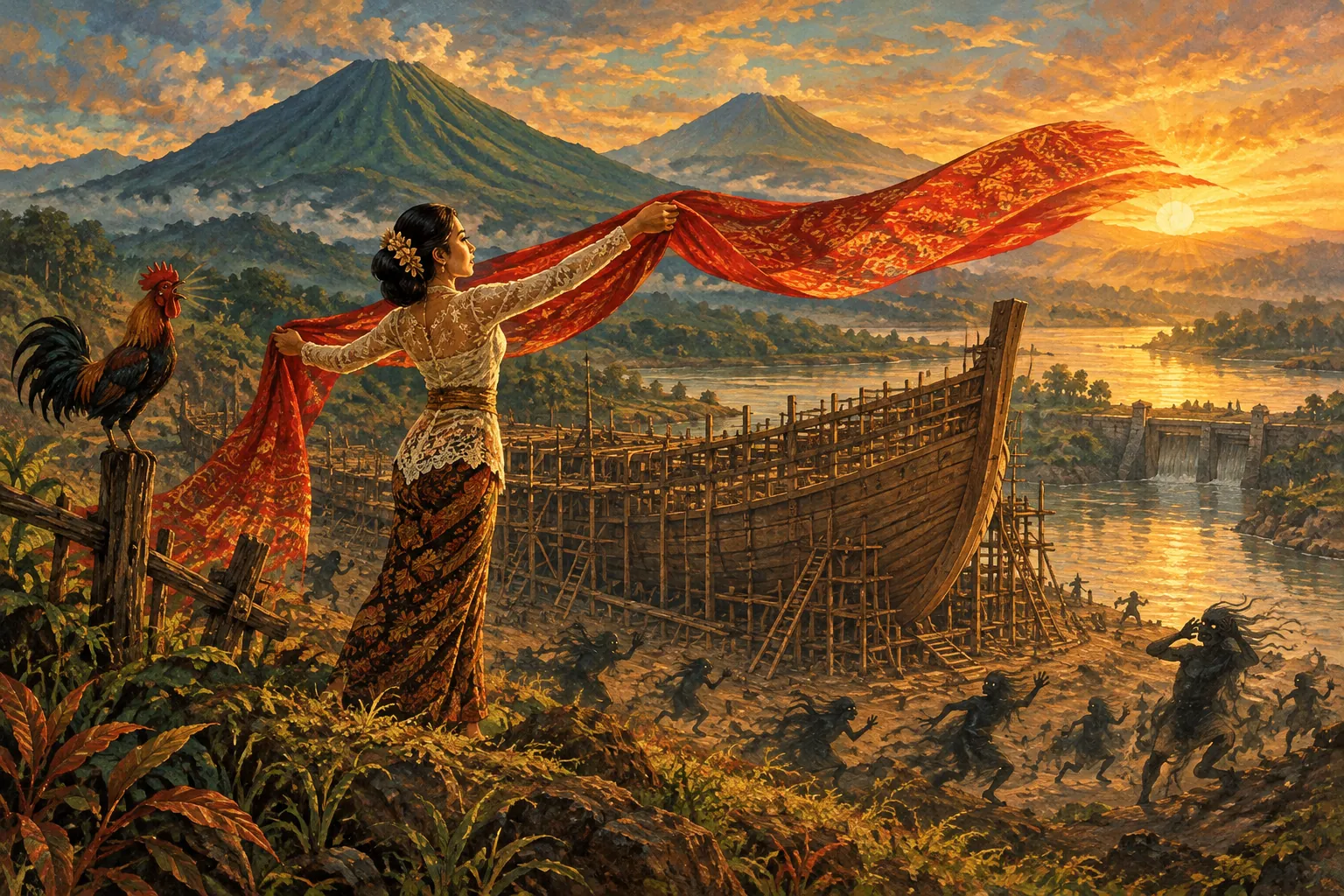
Dayang Sumbi goes out and spreads her long woven cloth to the east. Its red glow makes the sky look as if the sun is rising.
The roosters, fooled, begin to crow. The spirits believe morning has come and vanish, and the boat is left unfinished.
The boat that landed upside down
Sangkuriang understands that he has been tricked and loses his temper. He kicks the unfinished boat so hard that it lands upside down.
The overturned hull is Tangkuban Perahu, the mountain you can still see north of Bandung. The remains of the felled tree are said to be the neighbouring peak, Mount Burangrang.
The dam is also destroyed, and the lake that had begun to form drains away, leaving the Bandung basin. What happens to the mother and son afterwards depends on who is telling the tale.
Where the story comes from
The anchor text for this page is the Sundanese tradition of the legend: the oral tale told across West Java and the verse narrative known as the Wawacan Sangkuriang. A wawacan is a long Sundanese narrative poem, composed in set verse forms and traditionally read or sung aloud.
The story has no single author and no fixed text, which is why the details shift from region to region. What is stable is the chain of events: the shuttle, the dog, the scar, the two tasks, the red cloth and the kicked boat.
Here are the places where tellings differ:
- Tumang. He is an ordinary dog in some versions and a cursed god in others.
- The heart. Some tellers say Dayang Sumbi asks for a deer’s heart, others its liver.
- Her youth. Her long youth is explained by meditation, by a gift from the gods, or by a diet of raw vegetables.
- The tasks. The dam and the boat are almost always present. The dam is placed by some at the narrows where the Citarum flows into a cave, and the cloth is sometimes said to be red, sometimes simply bright.
- The ending. In some versions Sangkuriang chases Dayang Sumbi after the boat is overturned, and each of them then vanishes into the hills. In others the story simply stops at the kick.
The landscape is real. Tangkuban Perahu is a volcano of about 2,084 metres, with a long, flat-topped ridge that does look something like a capsized hull, and its craters, such as Kawah Ratu, are a popular day trip from Bandung.
The Bandung basin was also home to a lake in prehistoric times, before it drained.
Some writers have wondered whether the legend is a faint memory of that lake. That is speculation, and the tale is best read as a folk explanation of the land rather than a record of events.
What it means
Many readers see the story as a tale about a promise made in a careless moment and the chain it sets off. Dayang Sumbi’s offhand vow leads to a marriage, a death, a banishment and a near-disaster.
Its heart is the taboo against a union between mother and son, and it handles it with restraint. The hero never does what he fears, because the mother stops him.
Her clever dawn trick is often admired as a rare example of a woman winning by wit rather than strength.
Sangkuriang’s own fault is less about love than about pride and temper. He kills a loyal dog to avoid failing, refuses to hear the truth and then kicks the work of a night into a mountain.
The tale also does what many origin stories do: it makes a place memorable. Anyone who has seen the long ridge of Tangkuban Perahu from the road north of Bandung can easily picture an enormous boat upside down.
Common misconceptions
- It is not a Javanese story. It belongs to the Sundanese of West Java, who have their own language and literature separate from the Javanese of Central and East Java.
- It is not a geological explanation. The mountain is a volcano whose eruptions have been recorded in modern times, including a small one in 2019. Visitors should check the current status before travelling.
- Sangkuriang is not a villain by design. In most tellings he acts in ignorance, and the tragedy comes from what neither character knows.
- There is no single authentic text. The Wawacan Sangkuriang and the many oral versions all count as the legend.
Read next
Two other Indonesian origin tales are on FiveMinRead, and each ties a story to a landmark.
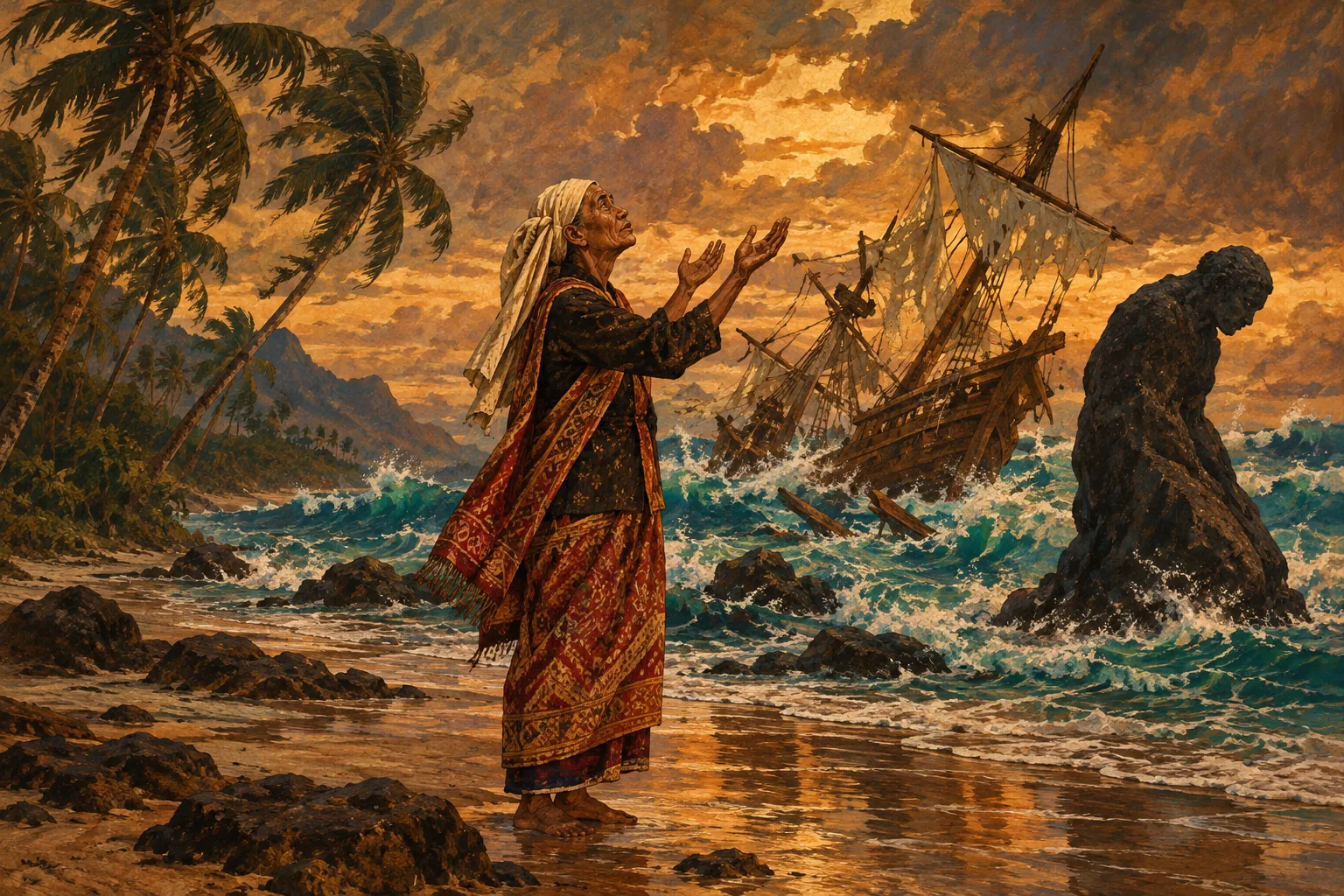
- Malin Kundang: a son who denies his mother and is turned to stone on the West Sumatran coast.
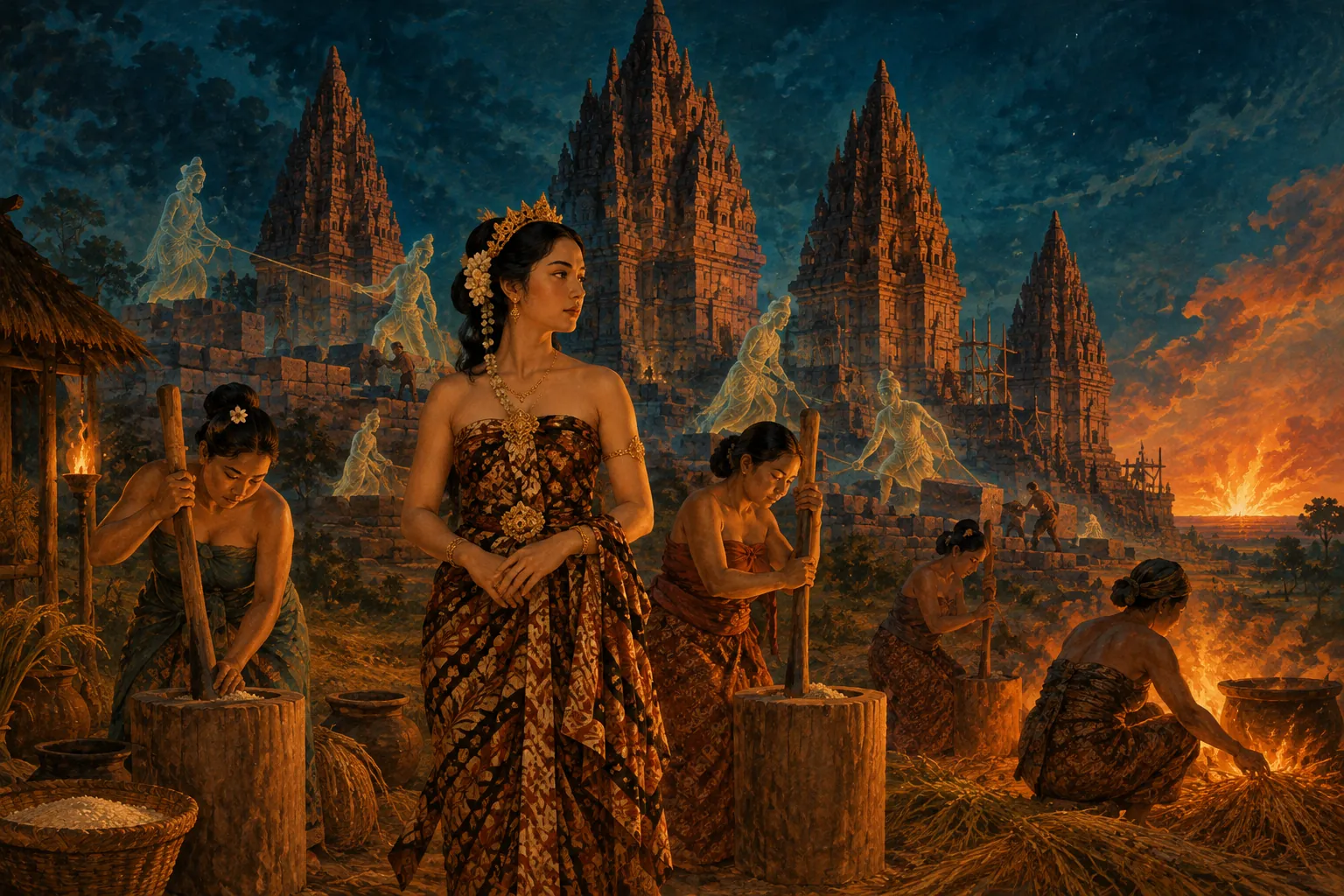
- Roro Jonggrang and Prambanan: another princess who sets impossible tasks to avoid an unwanted marriage, with a night, a temple and a rooster.