In five minutes
The One Thousand and One Nights, known in English as the Arabian Nights, is a collection of tales from Arabic, Persian and Indian storytelling traditions, gathered over many centuries. Its Arabic title is Alf layla wa-layla.
One frame story holds it together. A clever woman, Shahrazad, tells a king a new story every night so that she is not put to death at dawn.
The most famous tales in the English-speaking world, Aladdin and Ali Baba and the Forty Thieves, are not in the oldest Arabic manuscripts of the book. They entered it through Antoine Galland's French version, Les mille et une nuits, published from 1704 to 1717.
Aladdin came to Galland from a storyteller named Hanna Diyab, a young man from Aleppo whom he met in Paris in 1709.
This page covers the frame story, the tales inside it, the Aladdin story as Galland told it, and how the book reached Europe.
The story
The frame: Shahrazad and the king
King Shahriyar discovers that his wife has betrayed him. In his anger he decides to marry a new bride each evening and have her executed the next morning.
When the city begins to run short of young women, the vizier's daughter Shahrazad (also spelled Scheherazade) asks her father to give her to the king.
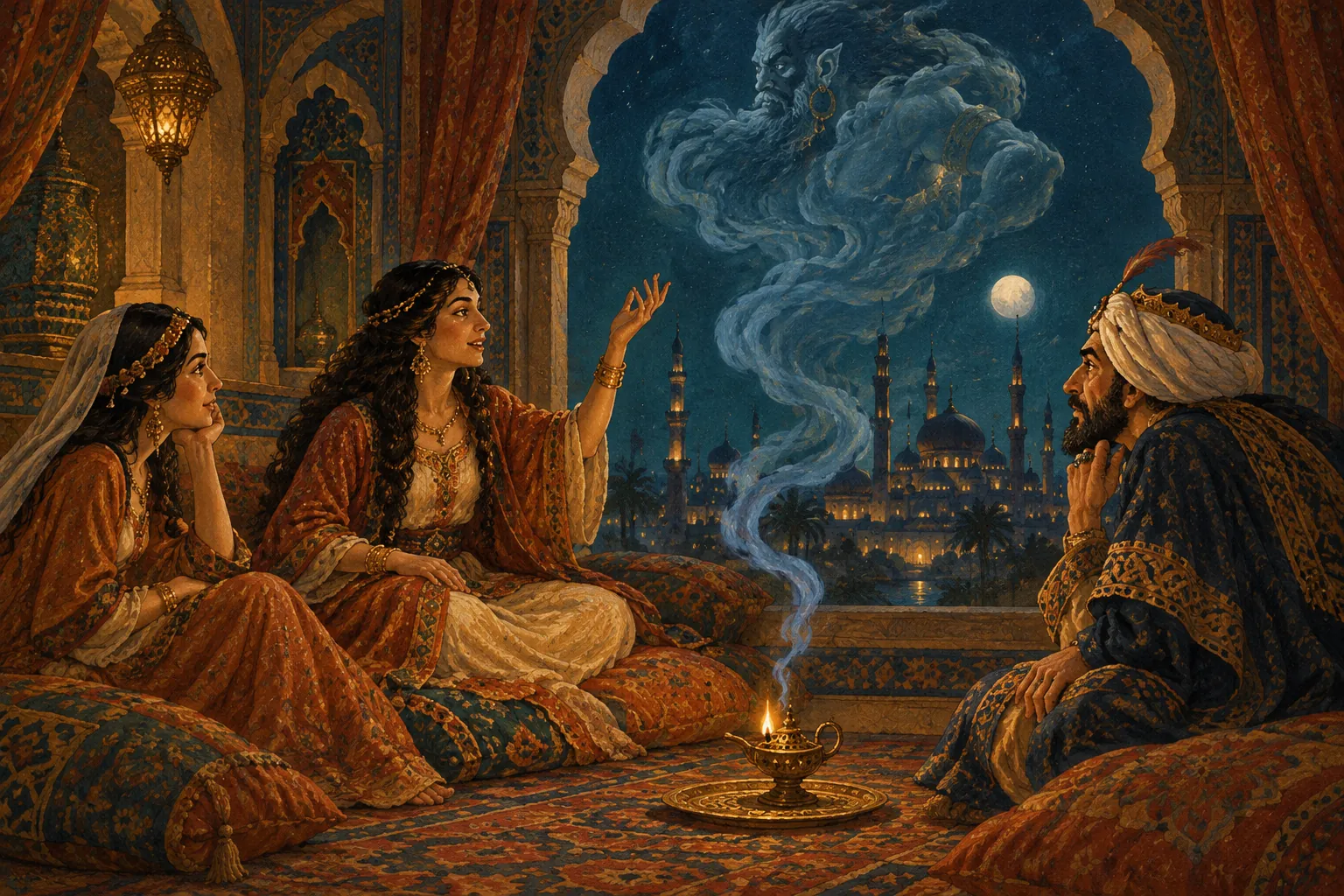
Her plan is simple. Her sister Dunyazad waits in the room, and once the night is under way she asks Shahrazad for a story.
Shahrazad begins a tale and stops at dawn, at the most exciting point. The king wants to hear the ending, so he lets her live one more day.
Night after night, one story opens inside another, until the king gives up his cruel vow and keeps her as his queen. The number one thousand and one is partly a figure of speech for 'very many'.
The tales inside
The tales include the voyages of Sindbad the Sailor, the fisherman who frees a jinni from a sealed bottle, and the porter who meets three ladies in Baghdad. Others follow the caliph Harun al-Rashid as he walks his city in disguise.
Many are comic or romantic, some are frightening, and several are written for adults. The book was never meant only for children.
In Galland's French version, the two best-known additions are Aladdin and Ali Baba. Both reached English readers through him.
Aladdin, as Galland told it
Aladdin is an idle boy in a poor family, in a city in China. His father, a tailor, has died, and his mother spins cotton to feed them.
A stranger arrives and claims to be Aladdin's long-lost uncle. He is really a magician from North Africa, who has learned that only Aladdin can lift a certain lamp from a hidden underground treasure.
The magician leads the boy into the hills and opens the earth with spells. He sends Aladdin down, tells him to bring back only the old lamp, and lends him a ring for protection.
Below, Aladdin finds a garden whose fruit are jewels. He takes the lamp and fills his pockets, but when he will not hand it over before he is out, the furious magician seals the cave and leaves him there.
Aladdin wrings his hands in despair and rubs the ring. A jinni appears and carries him home.
Later his mother polishes the old lamp to sell it, and a far more powerful jinni, the slave of the lamp, appears. He obeys whoever holds it.
The family now has food on silver dishes. Aladdin glimpses the sultan's daughter, Badroulboudour (Badr al-Budur in Arabic, 'full moon of full moons'), and falls in love.
The jinni supplies jewels as a gift for the sultan and builds a palace in one night. The sultan agrees to the marriage, and Aladdin becomes a generous, well-liked man in the city.
Years later the magician learns that Aladdin is alive. He returns to the city calling out 'new lamps for old'.
The princess, who does not know the lamp's secret, trades the old one away. The magician orders the jinni to carry the palace and the princess to Africa.
Aladdin uses the ring's jinni to follow, and with the princess's help he poisons the magician's wine. He recovers the lamp and the palace.
One danger remains. The magician's brother arrives disguised as a holy woman named Fatima, and the princess welcomes her.
He persuades the princess to ask for a roc's egg to hang in the palace dome. The jinni is angered at the request, Aladdin understands the trick, and he kills the false visitor.
When the old sultan dies, Aladdin takes the throne and rules with the princess for many years.
Where the story comes from
The anchor text for this page is the One Thousand and One Nights (Arabic Alf layla wa-layla). Its first European version is Antoine Galland's Les mille et une nuits, a twelve-volume French translation published between 1704 and 1717.
The book was never a single fixed text. Medieval manuscripts from Syria and Egypt hold different numbers of tales, and stories were added over the centuries.
Tenth-century writers describe a Persian book called Hazar Afsan ('A Thousand Tales') with a king and a vizier's daughter. A small Arabic paper fragment from about the ninth century already carries the Arabic title.
Galland, a French scholar of Oriental languages, translated from a Syrian manuscript of the Nights. Once that supply of tales ran out, he turned to stories he had heard from others.
His diary records that in 1709 he met Hanna Diyab, a Maronite Christian from Aleppo who was visiting Paris. It notes the tales Diyab told him, including those that became Aladdin and Ali Baba.
Diyab later wrote an account of his own travels, which has since been published in modern editions. The man who gave the Nights two of their most famous tales was long left out of their history.
Galland's volumes with Aladdin appeared around 1712. The Arabic texts of Aladdin that survive were written after Galland's French version.
English readers first met Galland through an anonymous English translation made from his French, beginning in 1706. It gave the book its familiar English title, Arabian Nights' Entertainments.
Later translators worked from Arabic. Edward Lane published his version around 1840, John Payne followed in 1882–84, and Richard Burton in 1885–88.
The Arabic text printed at Bulaq, Cairo, in 1835 was one of their sources.
Variants
Aladdin changes with the teller. Galland names no city and places the story in China, and later retellings have turned Aladdin into a street boy or moved the setting elsewhere.
The roles of the two jinn, the magician's brother and the ending also differ from one retelling to the next. This page follows Galland's French.
What it means
At its heart the frame story is about storytelling as survival. Shahrazad does not fight the king.
She changes him with patience, curiosity and a well-timed pause.
Many tales ask who deserves good fortune. Aladdin gains his wealth through luck and a jinni, not through work, yet the story pays close attention to whether he uses it with generosity.
The tale also warns about false kinship: the 'uncle' who is a stranger with a purpose. And its objects have power only for the person who knows how to command them.
There is a second reading about history. The Nights became a Western symbol of the 'Orient', full of palaces and magic, and Galland's China-set Aladdin shows how loosely that picture was drawn.
Behind it stands a mixed tradition: Persian, Indian, Arab and Egyptian stories, and later a Syrian storyteller in Paris.
Common misconceptions
'Aladdin is one of the oldest Arabian Nights tales.'
No Arabic text of it older than Galland's French version is known. Aladdin was added to the Nights in the early 1700s.
'Aladdin is set in Arabia.'
In Galland's version the story takes place in a city in China. The magician comes from North Africa.
'Open Sesame' belongs to Aladdin.
It belongs to Ali Baba and the Forty Thieves, Galland's other well-known addition.
'Aladdin has a flying carpet.'
Galland's Aladdin has no magic carpet. A carpet that carries its owner through the air appears in a different tale, about Prince Ahmed.
'It is a children's book.'
The Nights holds tales of love, cruelty and trickery that were written for adult listeners. Many modern editions for children are heavily shortened.
Read next
Hansel and Gretel is another famous tale that reached readers through a collector, the Brothers Grimm. Compare how a folk story changes when it is written down.
Greek mythology explained shows a different tradition of gods and heroes, and how ancient poets shaped the stories we still tell.