In five minutes
Hansel and Gretel is a German folk tale about a brother and sister who are left in a forest by their parents during a famine. They find a house made of bread and sweets, and they escape the witch who lives in it.
It is tale number 15 in the Brothers Grimm's Kinder- und Hausmärchen (Children's and Household Tales). The first volume appeared in 1812, and the collection was revised until its seventh edition in 1857.
Jacob and Wilhelm Grimm did not invent the story. They wrote down a tale already told in German-speaking lands and polished it over several editions.
The plot has four moves: abandonment, the house, the witch and the return home. Hunger drives the children out, and cleverness brings them back.
Below you will find the story retold, where it comes from, how the 1812 and 1857 texts differ, and how readers have understood it.
The story
This retelling follows the final 1857 text of the Grimms. A poor woodcutter lives at the edge of a great forest with his wife and his two children, Hansel and Gretel.
When famine strikes the land, there is hardly any bread left in the house.
One night the wife tells her husband that they cannot feed four mouths. She wants to lead the children deep into the forest and leave them there.
The man refuses at first, but she keeps at him until he gives way. The hungry children are awake in bed and hear every word.
Gretel weeps, but Hansel stays calm. He slips outside in the moonlight and fills his pockets with white pebbles.
The next morning the family walks into the woods, and Hansel drops a pebble every few steps. When the parents slip away, the children wait for the moon to rise and follow the shining pebbles home.
The father is glad to see them, but the shortage returns. This time the door is locked, so Hansel cannot gather pebbles and crumbles his bread along the path instead.
The birds eat every crumb. The children are lost and wander for days.
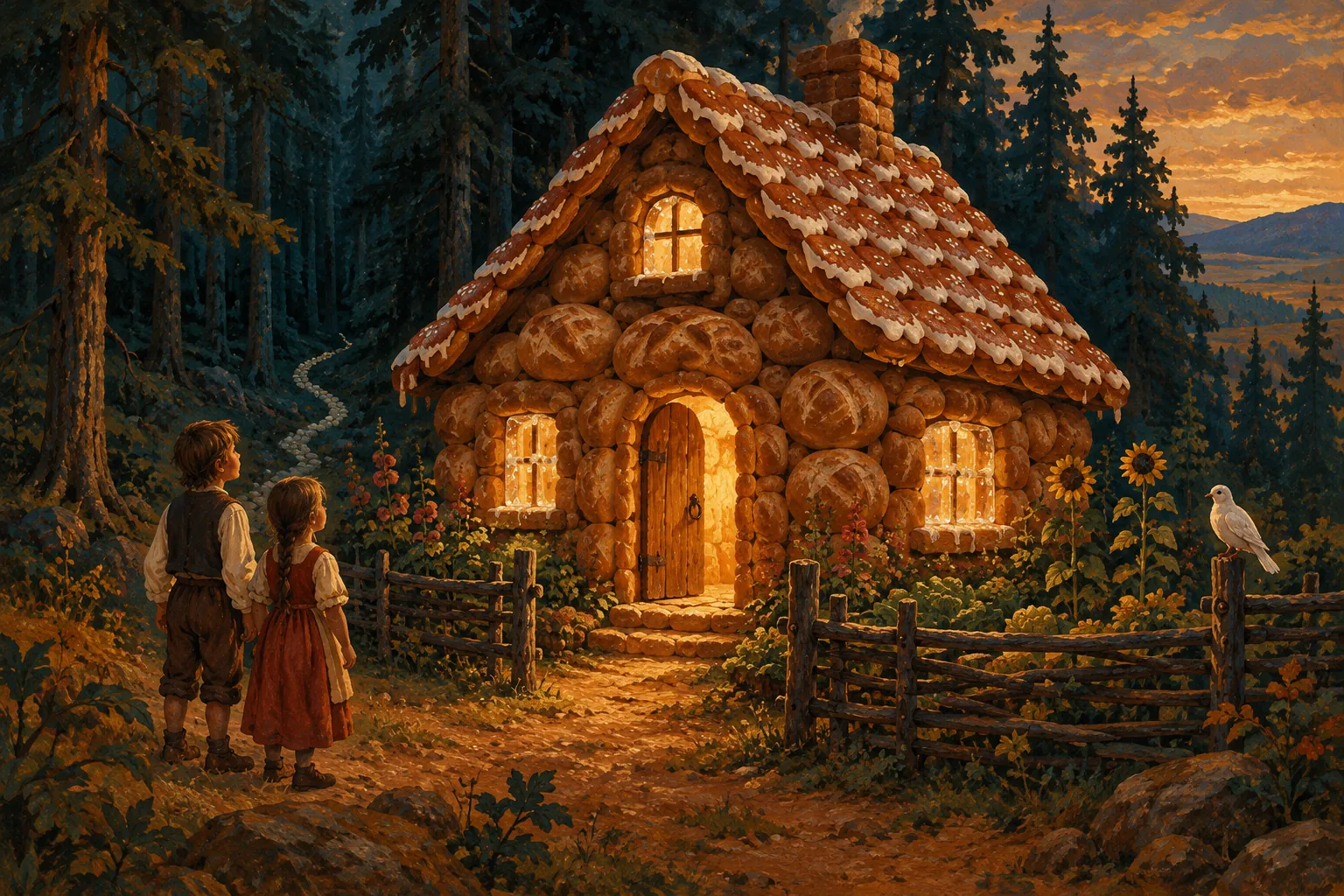
At last a white bird leads them to a little house built of bread, with a roof of cake and windows of clear sugar. Starving, they begin to eat it.
A voice calls from inside with a rhyme that we can render as: "Nibble, nibble, gnaw, who is nibbling at my little house?" The children answer, "The wind, the wind, the heavenly child," and keep eating.
The owner is an old woman who walks on a crutch and has weak red eyes. She is a witch who built the house to trap children.
She locks Hansel in a small cage and makes Gretel work as her servant. She feeds Hansel well to fatten him up, and every morning she asks him to stick out a finger so she can feel how plump he is.
Hansel holds out a thin bone instead. The witch, who cannot see well, cannot understand why he stays so thin.
After some weeks she loses patience and decides to cook him anyway. She has the oven heated and tells Gretel to crawl in and check the fire.
Gretel pretends she does not know how. When the witch leans in to show her, Gretel pushes her inside and shuts the door.
Gretel opens Hansel's cage, and the two fill their pockets with pearls and jewels from the witch's house. A wide stretch of water blocks the way home until a white duck carries them across, one at a time.
At home they find that the wife has died, and the father welcomes them. He has not had a happy hour since the day he left them.
The jewels end the family's poverty. The Grimms close the tale with a storyteller's formula about a mouse running by, and whoever catches it may make a big fur cap from it.
Where the story comes from
The source is the Brothers Grimm's Kinder- und Hausmärchen, where the tale is number 15 under the title Hänsel und Gretel. The first volume carries the date 1812, and the final lifetime edition of 1857 is the text most retellings use.
Wilhelm Grimm did most of the editing. The brothers gathered tales from friends and acquaintances in Hesse, many of them educated townspeople rather than village peasants.
Folklorists file this story under tale type ATU 327A, a group of tales about children who meet a witch or ogre and trick their way to freedom. The same pattern of children abandoned in a forest and an ogre's house appears in Charles Perrault's Le Petit Poucet (1697), a French tale that is related but not the same.
Because the story was told orally for generations before it was printed, there is no single "original" version. The Grimm text is simply the best-known fixed form.
1812 and 1857: mother and stepmother
In the 1812 text it is the children's own mother who wants them gone. In the later editions she is a stepmother, and the 1857 text is the final form of that change.
The same change happened in other Grimm tales, including Snow White. It is commonly explained as the editors' wish to protect the image of the loving mother in a book meant for families.
The main plot stays the same. The children are still abandoned, and the witch still meets her end in the oven.
If you read a retelling today, check which parent it uses. That one detail tells you which edition it follows, or whether the writer took it from a later adaptation such as Engelbert Humperdinck's opera, first staged in 1893.
What it means
The tale begins with hunger, and hunger drives every decision. The parents' choice is shocking because it is made by people who love their children and still cannot feed them.
The children answer with practical intelligence, not strength. Hansel's pebbles, his bone and Gretel's false ignorance are all small tricks that turn the witch's confidence against her.
The house of bread and sugar is the tale's central image. It offers exactly what a starving child wants, which is why it works as a trap.
The roles are balanced. Hansel plans the first escape, but Gretel ends the witch, and the two cross the water and reach home together.
Readers have found many meanings in the story. Psychological readings, such as the one in Bruno Bettelheim's The Uses of Enchantment (1976), see a tale about leaving the family home and growing up; historians stress poverty and food insecurity in early modern Europe.
These readings are interpretations, not facts about the text. The tale itself simply tells what happens and lets the listener draw the lesson.
Common misconceptions
"The house was made of gingerbread." In the Grimm text it is bread, with a roof of cake and sugar windows.
Gingerbread comes from later retellings.
"Hansel saves them both." Hansel is clever, but it is Gretel who defeats the witch and frees him.
"The Grimms recorded a pure peasant tale." The brothers edited heavily from edition to edition, and many of their informants came from the educated middle class.
"It is a record of a real event." No historical event is behind the story.
Some writers connect it with the great famine of 1315 to 1317, but that link is a guess and the tale itself names no time or place.
"The stepmother is the original villain." She is the later one.
The earliest printed text, from 1812, has the children's own mother.
Read next
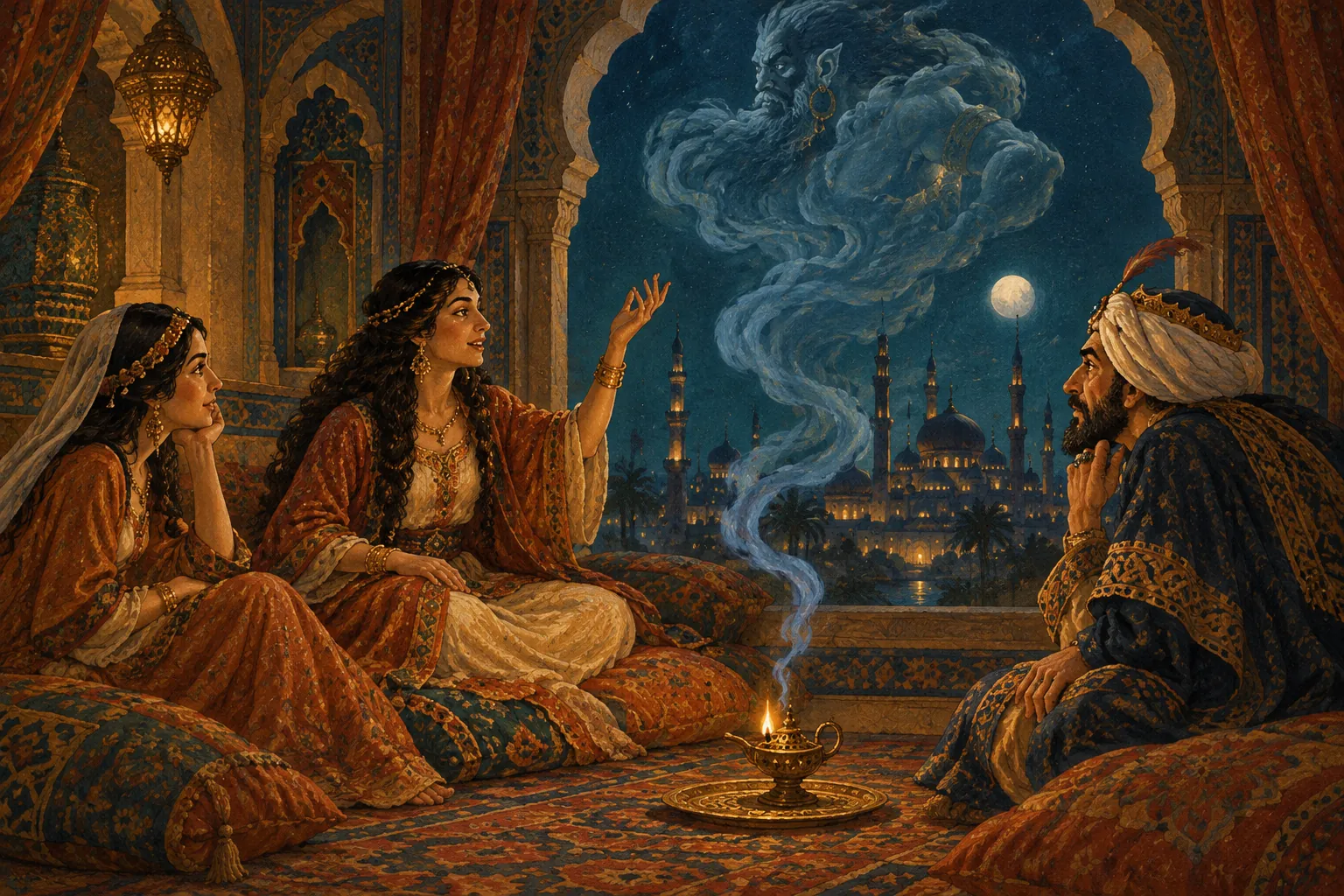
Aladdin and the Arabian Nights looks at another famous tale and the collection it became attached to, a good comparison for how stories change when they are written down.
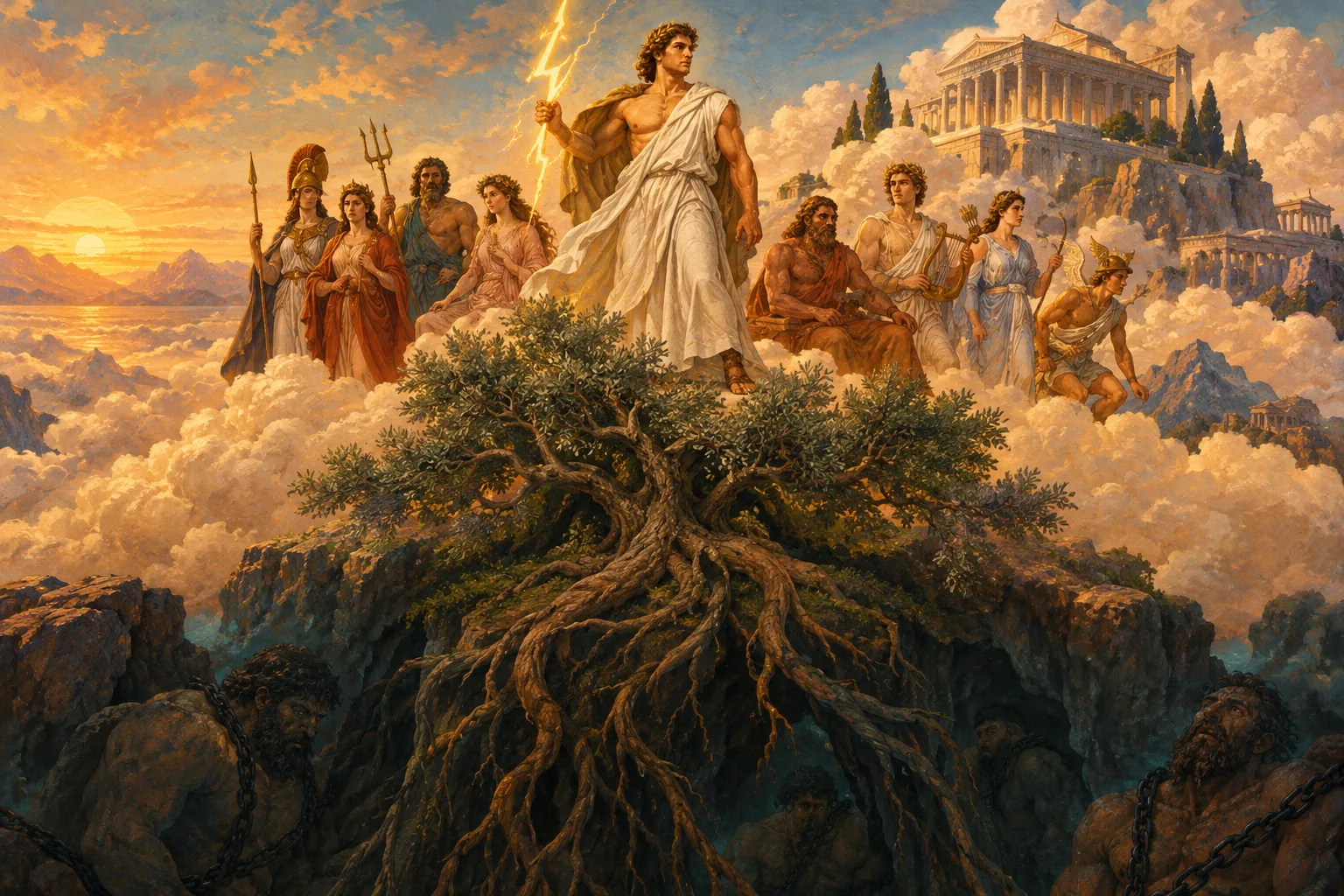
Greek mythology explained gives the wider background of myth and tradition, useful if you want to compare a German folk tale with the older stories of gods and heroes.