0% • 7 min left

Intrinsic Elements of Short Stories and Novels

November 16, 2026
Intrinsic elements are the parts built inside a story: theme, characters, plot, setting, point of view, style and moral message. To analyse them, ask seven questions about the text itself. This guide explains each element, separates it from extrinsic elements, and gives a sample analysis with three-level model answers.
Intrinsic Elements of Short Stories and Novels

Key facts

Topic
Unsur intrinsik cerpen dan novel
Market
Indonesia, Bahasa Indonesia Fase E-F
Seven elements
Theme, characters, plot, setting, point of view, style, moral message
Outside the text
Unsur ekstrinsik: author, society, reader values
Short story structure
Abstrak, orientasi, komplikasi, evaluasi, resolusi, koda
Sample story
Kunci Warung Nenek, original text written for practice

Intrinsic elements in five minutes

Intrinsic elements (unsur intrinsik) are the building blocks inside a story: theme, characters and characterisation, plot, setting, point of view, style and moral message.

If you can answer seven questions about what is on the page, you can analyse any short story (cerpen) or novel.

This guide explains each element in plain words and tests the method on a short sample story that we wrote ourselves.

It follows the Bahasa Indonesia aims for Fase E-F of Kurikulum Merdeka, but the method works for any language class.

What are intrinsic elements?

The word intrinsic means from the inside. These are the parts you can point to in the text without leaving it.

Extrinsic elements (unsur ekstrinsik) come from outside the text, such as the author's life and the society around the book.

A full analysis uses both, but exams usually begin with the intrinsic ones.

The seven intrinsic elements

1. Theme (tema)

The theme is the central idea the story keeps returning to, such as friendship, poverty, courage or responsibility.

Write it as a short phrase, then test it: does every major event connect to it?

Do not confuse the theme with the plot. The plot is what happens, and the theme is what it is about.

2. Characters and characterisation (tokoh dan penokohan)

Tokoh are the people in the story, and penokohan is how the writer shows what they are like.

The analytic method tells us directly, while the dramatic method shows traits through speech, actions, thoughts and looks.

Also name the role: protagonist, antagonist or supporting character, and flat or round.

3. Plot (alur)

The plot is the chain of events linked by cause and effect.

It can move forward, backward or mixed. Name the type and show the stages: introduction, conflict, rising tension, climax and resolution.

4. Setting (latar)

Setting has three parts: place, time and social atmosphere.

Always ask what the setting does. A hot, empty afternoon can make a character restless, and a crowded market can raise pressure.

5. Point of view (sudut pandang)

This is who tells the story. First person uses I (aku), and third person uses he or she.

Third person can be limited to one character's mind or all-knowing. The choice decides what the reader is allowed to know.

6. Style (gaya bahasa)

Style covers word choice, sentence rhythm and figures of speech such as simile and personification.

Quote a short phrase and say what effect it creates. Naming a figure of speech without its effect earns few marks.

7. Moral message (amanat)

The amanat is the lesson or value a reader can take from the story.

Write it as a full sentence, for example: we should keep our promises even when something fun tempts us.

Topic, theme and moral message: keep them apart

Three words are often mixed up. The topic is the subject in one word, such as a shop; the theme is the idea about that subject, such as responsibility; and the amanat is the lesson a reader takes away.

For Kunci Warung Nenek the topic is a shop, the theme is responsibility and the amanat is that a kept trust matters more than a short pleasure.

If you can write all three without repeating yourself, you understand the story.

Extrinsic elements (unsur ekstrinsik)

The main extrinsic elements are the author's background, the society and period in which the work was written, and the values of the readers.

For a novel, they explain why a story about school poverty or migration feels urgent to its first audience.

Keep them in a separate paragraph so the marker sees that you can tell the two groups apart.

Short story text structure (struktur teks cerpen)

School lessons often describe a short story in six parts: abstrak (an optional summary), orientasi, komplikasi, evaluasi, resolusi and koda (an optional closing comment).

Orientasi introduces people, place and time, and komplikasi starts the problem.

Evaluasi is where the tension peaks and the characters react, and resolusi settles the problem.

Not every story has an abstrak or koda, so only name the parts you can really find.

Novel or short story: what changes?

A short story usually has one main conflict, a few characters and a setting that changes little, so each element can be named in a sentence or two.

A novel stretches the same seven elements over many chapters. It may have several plot lines, a crowd of minor characters, settings in different places and a theme that develops slowly.

For a novel, pick the most important example of each element instead of listing everything. Say which chapter or scene you are using, so the marker can see you know the book.

Point of view can also shift in a novel, for example when different chapters follow different characters. Mention the shift if it happens, because it changes what the reader knows at each stage.

Sample story and quick analysis

Our sample story, Kunci Warung Nenek (The Key to Grandma's Shop), is original and written for practice.

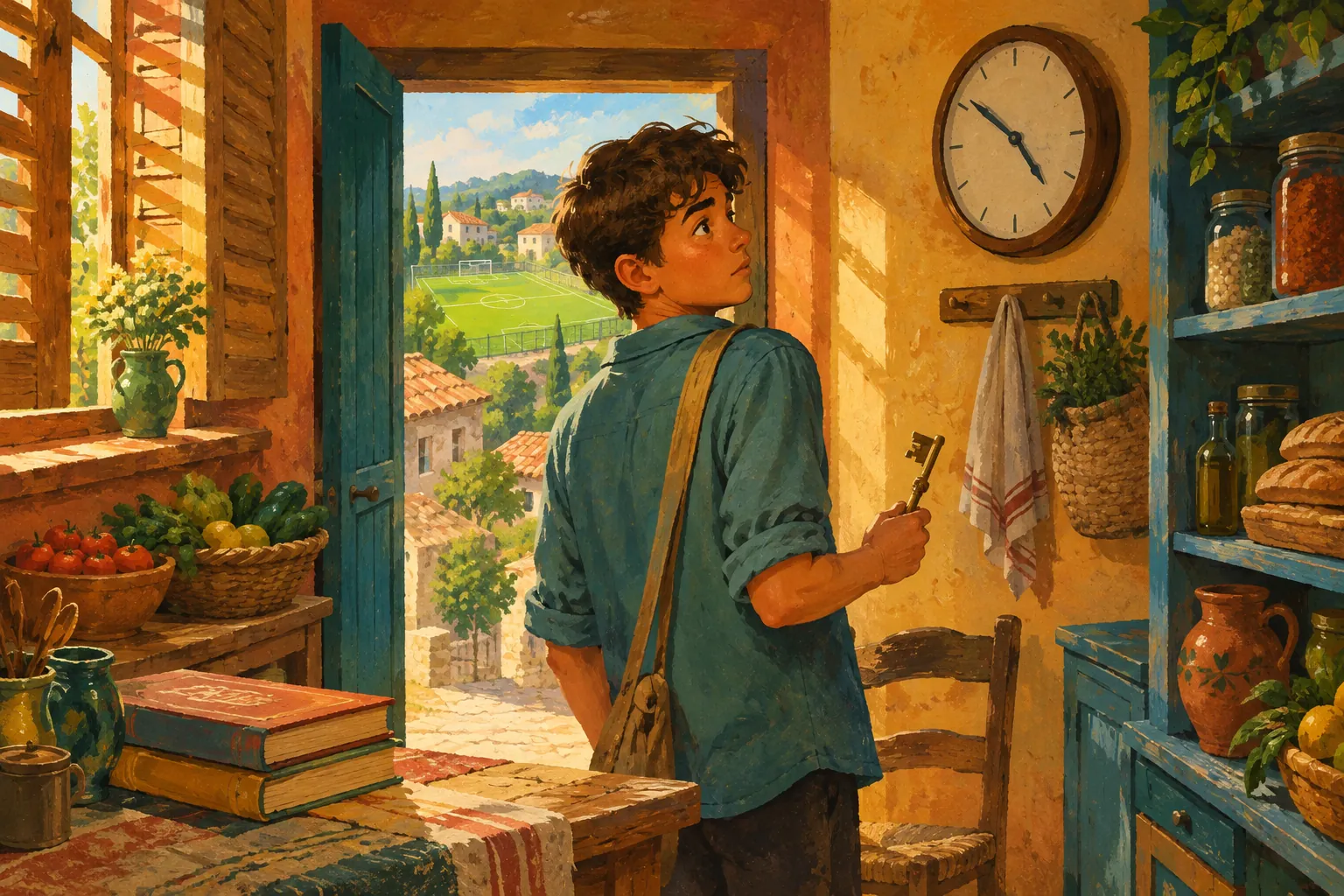
Fifteen-year-old Dimas is trusted with his grandmother's shop for one Saturday while she visits the village clinic.

He badly wants to watch the village football match at three o'clock.

Old Pak Harun arrives and needs slow, patient help to count his money, and a queue forms behind him.

Dimas stays, misses the match, and his grandmother returns to find the shop open and the ledger tidy.

Quick analysis: the theme is responsibility, and Dimas is the protagonist, a round character who becomes more patient.

The plot moves forward, the setting is a wooden shop on a village road from noon to late afternoon, and the point of view is third person limited.

The moral message is that keeping a trust matters more than a short pleasure.

How to analyse step by step

Read once for the story, then again with a pencil.

Mark one piece of evidence for each element, and write one sentence that says what it does for the story.

Link at least two elements together, for example how the setting raises the conflict.

Finish with the moral message in your own words.

Tracing one element through the story

Take setting in Kunci Warung Nenek. At noon the road is empty and the shop is quiet, so Dimas's wish to leave feels easy to follow.

By late afternoon the shop is busy, and the queue makes leaving costly. The same place therefore pushes the plot from temptation to pressure.

Notice the pattern: name the element, give a detail, say what it does. Repeat it for each of the seven, and your analysis already has evidence and commentary.

Do the same for style. A phrase such as the clock ticking louder than the radio uses personification to make time feel like a person pressing him.

Writing one analytic paragraph

Most exam answers are built from paragraphs with three moves: claim, evidence and commentary.

The claim says what the element is, the evidence is a short detail or phrase from the text, and the commentary explains what it does for the story or the theme.

Example: Dimas is a round character because he changes (claim). He first checks the clock again and again, but later reads every price aloud to Pak Harun (evidence).

This shows that his impatience is replaced by care, which supports the theme of responsibility (commentary).

Keep each paragraph on one element, or on two linked elements. Start a new paragraph when you change the point.

Exam tips for Fase E-F

Read the question words first. Analisislah asks for explanation, sebutkan asks only for naming, and bandingkan asks for similarities and differences.

Use the technical terms exactly, such as forward plot, round character and third-person limited. The right term shows that you know the material.

Spend a few minutes planning. A list of seven short evidence notes saves you from forgetting an element halfway through.

Leave a minute at the end to check that every claim has evidence and that the moral message is a full sentence.

Common mistakes

Listing elements without evidence is the most common mistake.

Another is copying a long passage instead of quoting a short phrase, and a third is mixing the theme and the moral message.

Students also forget the type of plot or the point of view, which are easy marks.

Practise

Use the three-level model answers below to compare your own work.

They are learning examples, so write your own answer first and then check what the next level adds.


Exam practice: sample answers

Model answers are examples to learn from; write your own in your words.

intrinsic element analysis (analisis unsur intrinsik)

1. Analyse the intrinsic elements of the sample story Kunci Warung Nenek (theme, characters, plot, setting, point of view and moral message).

Outline

  1. State the theme in a short phrase
  2. Name the main characters and their roles
  3. Name the plot type and show the stages
  4. Describe place, time and atmosphere
  5. Name the point of view
  6. Write the moral message as a full sentence
Basic Model answer

The story is about Dimas, a teenager who looks after his grandmother's small shop for one day.

The theme is responsibility. Dimas is the main character, and he is kind and a little stubborn.

His grandmother and old Pak Harun are minor characters.

The plot moves forward. At first Dimas wants to watch the football match.

Then Pak Harun needs help, and Dimas stays at the shop. In the end he keeps the shop open.

The setting is a wooden shop in a village on a Saturday afternoon. The story is told in the third person.

The moral is that we should keep our promises, even when we would rather do something fun.

Why this level: All elements are named correctly and the answer is easy to follow. It stays general: there is no evidence from the text, no plot stages and no explanation of what each element does. To reach good, add one specific detail per element and say why it matters.
Good Model answer

In our sample story, the intrinsic elements work together to say one thing: real responsibility costs something, and it is worth the cost.

Theme and plot. The theme is responsibility.

The plot moves forward in a clear line: Dimas is trusted with the shop (orientation), he longs to see the village football match (complication), old Pak Harun arrives and needs patient help counting his money (climax), and Dimas stays and serves the queue (resolution).

Characters. Dimas is the protagonist and a round character, because he changes from impatient to dependable.

We learn this through his actions, not through the narrator's labels: he glances at the clock again and again, yet still reads out each price slowly for Pak Harun. His grandmother is a minor, flat character who stands for trust.

Setting and point of view. The setting is a wooden shop beside a village road, from hot noon to late afternoon.

The heat and the empty road make the waiting feel long, and the later crowd raises the pressure. The third-person limited point of view stays with Dimas, so the reader feels his temptation directly.

Moral. The amanat is that keeping a promise is worth more than a short, easy pleasure.

The story shows this instead of preaching it: Dimas misses the match, yet the closing image of the neatly kept ledger shows what he gained.

Why this level: A clear thesis, labelled paragraphs, plot stages and specific evidence for each element. The analysis is mostly about each element on its own. To reach excellent, show how the elements press on each other and use the title's symbol.
Excellent Model answer

The elements of Kunci Warung Nenek are not a checklist; they press on each other. The theme of responsibility is carried by plot, character and a single symbol, the key of the title.

The title matters first. A key opens and locks, so it stands for trust that can be given or withdrawn.

When the grandmother hands Dimas the key, the story's question is already set: will he deserve it?

The plot answers by narrowing his choices. The football match is an external deadline, and Pak Harun's slow counting is the obstacle.

Because both meet at the same hour, the conflict is internal as well as external: Dimas fights his own impatience more than any person.

Characterisation reveals this by the dramatic method. Dimas never says he is torn; the narrator shows him checking the clock, then reading each price aloud.

The contrast between a restless body and a patient voice is the whole character in one gesture. Pak Harun works as a foil: his dependence makes Dimas's dependability visible.

Setting supports the mood. A hot, empty afternoon makes leaving tempting; the later queue makes staying costly.

Point of view matters too: third-person limited keeps the reader inside Dimas's temptation and avoids a narrator who could lecture.

Style adds a further layer. Short, plain sentences and everyday words, such as the shop, the ledger and the clock, keep the tone modest, which suits a story about small duties rather than heroic acts.

Structure follows the same logic. The orientation is brief, the complication arrives early and the evaluation, the moment when Pak Harun counts his coins, is the longest scene, so the reader spends the most time where the decision is made.

That choice shapes the amanat. Because the story never states its lesson, the reader supplies it: responsibility is a small decision repeated, not a grand gesture.

A possible objection is that the ending is too neat. Yet the neatness is limited: nothing is won except trust, and that restraint keeps the moral from sounding like a lecture.

The ending confirms the point by giving no victory, only a tidy ledger and a returned key.

Seen together, the intrinsic elements argue that a good story does not just contain a moral; its structure produces one. Weaker analysis lists each element, while a stronger one shows how each element makes the next one work.

Why this level: Excellent: a controlled argument, a symbol read across the whole story, and links between plot, character, setting, point of view and moral. Each claim is tied to a concrete detail. It ends by judging how the story is built, not only what it contains.

Marking rubric

  • Names all seven elements correctly
  • Gives evidence from the text for each element
  • Explains what each element does for the story
  • Links elements to one another
  • Writes the moral as a full sentence

Now write your own

Choose a short story you have read in class and write your own analysis of its intrinsic elements. Then compare it with the three levels above.

character analysis (analisis tokoh dan penokohan)

2. Analyse the characterisation (penokohan) of Dimas in Kunci Warung Nenek. Name the methods the writer uses and give evidence.

Outline

  1. Name the role of the character
  2. State two or three traits
  3. Give evidence for each trait
  4. Name the method of characterisation
  5. Say whether the character changes
Basic Model answer

Dimas is the main character. He is fifteen, helpful and a bit impatient.

We know he is impatient because he keeps looking at the clock. We know he is kind because he helps Pak Harun count his money.

The writer shows him by what he does and says. This is called the dramatic method.

The writer also sometimes tells us directly, which is the analytic method.

In the end Dimas is more patient. He changes because he chooses to keep the shop open.

So he is a round character, and his grandmother, who stays the same, is a flat one.

Why this level: Correct traits, evidence and method names. The evidence is brief and the answer does not explain why the method suits the story. For good, add more evidence and a comment on the effect.
Good Model answer

Dimas is the protagonist of Kunci Warung Nenek, and the writer builds him as a round character who changes during one afternoon.

Traits and evidence. At first he is impatient and eager for fun.

The story shows this when he glances at the clock again and again as the football match gets closer. Later he is patient and caring.

He slows down to read each price aloud for Pak Harun, who struggles with his money.

Methods. The writer mostly uses the dramatic method, showing traits through actions, speech and small habits such as the clock-watching.

There is also a little analytic method, when the narrator says he feels torn. The mix lets the reader judge him instead of being told what to think.

Foil and symbol. Pak Harun is a useful contrast, because he is slow and dependent while Dimas is young and free to leave.

The key in the title also hints at trust, so Dimas's choice is not only about a shop but about proving that he can be trusted.

Change. Dimas begins by wanting to leave and ends by staying, so his decision is the proof of his growth.

His grandmother stays the same and acts as a flat character who represents trust.

Effect. Showing instead of telling makes the reader do some of the work.

We decide for ourselves that Dimas is kind, so the judgement feels earned.

In conclusion, Dimas is believable because he is not perfect: he is tempted, but he still chooses well.

Why this level: Strong structure and evidence from the story with both methods named, plus a foil and a symbol. The comment on effect is still short. Excellent adds a judgement on why the writer chose this method and a second possible reading.
Excellent Model answer

Dimas is convincing because the writer lets his goodness cost him something. He is a round protagonist whose character is revealed mainly by the dramatic method and tested against a foil.

His first trait is impatience. The narrator does not call him selfish; instead he looks at the clock, rehearses the match in his head and counts the minutes.

These small actions carry the temptation.

His second trait is patience. When old Pak Harun arrives with a pocketful of coins, Dimas reads out each price slowly.

The same boy who could not sit still now measures time in coins. The contrast between the two scenes is the character in miniature.

Pak Harun works as a foil. His dependence and slowness make Dimas's reliability visible; without him, the boy's decision would be only a private thought.

The choice of a limited point of view supports the method. Because we only see what Dimas notices, his glances at the clock are all we need to know about his state of mind, and the narrator never has to explain it.

There is also a quiet irony. The boy who watches time most closely is the one who finally gives it away, since every minute spent with Pak Harun is a minute taken from the match.

Consider a counter-reading: perhaps Dimas stays only because he fears his grandmother's disappointment. The text allows this, and it makes him more human, but the unforced patience in his voice suggests care as well as duty.

This ambiguity is a strength. A character with one motive would be a type; a character with mixed motives and one clear choice is a person.

The writer uses the analytic method sparingly, only to confirm that Dimas feels torn. This restraint matters, because the reader reaches the judgement through evidence and the moral does not feel imposed.

Finally, the key in the title gives his growth a symbol. He starts as someone holding a key and ends as someone who has earned it.

Dimas does not become a hero; he becomes dependable, which is a smaller and truer kind of change.

A stronger analysis of character therefore does more than list traits. It explains how the writer's method, the contrast with another character and a symbol make the change believable.

Why this level: Excellent: precise evidence, a foil, a symbol, a counter-reading and a judgement about the writer's method. It ties characterisation to the moral message and ends with an argument about change.

Marking rubric

  • Names role and type of character
  • Gives at least two traits with evidence
  • Names the method of characterisation
  • Explains change or lack of change

Now write your own

Pick a character from a novel you know. Write two traits, one piece of evidence for each, and name the method of characterisation.

argumentative essay (esai argumentasi)

3. Argumentative essay: is it enough to understand only the intrinsic elements of a novel? Use Laskar Pelangi by Andrea Hirata (2005) or another novel you know.

Outline

  1. Take a position in the opening
  2. Argument 1: what intrinsic elements reveal
  3. Argument 2: what extrinsic elements add
  4. Answer a counter-argument
  5. Conclude with a final judgement
Basic Model answer

I think the intrinsic elements are not enough, so a reader should also know the extrinsic ones.

In Laskar Pelangi, the intrinsic elements tell us about Ikal, Lintang and their small school. The setting is Belitung, and the theme is the struggle to learn.

The extrinsic elements tell us more. The author, Andrea Hirata, grew up in Belitung, so the setting feels real.

The book also shows how poor children need education.

So the intrinsic elements explain the story, and the extrinsic elements explain why the story matters. A good reader needs both.

Why this level: The position is clear and the examples are accurate. The reasons are general and no counter-argument is considered. For good, add a developed argument for each side and answer an objection.
Good Model answer

Understanding only the intrinsic elements of a novel gives a reader the story, but not the full meaning. For this reason, I argue that readers also need the extrinsic elements.

What intrinsic elements reveal. In Laskar Pelangi, the first-person narrator Ikal lets us see his classmates closely.

Lintang, a brilliant boy from a poor family, shows the theme of determination. The setting of a small school in Belitung shapes the plot, because the school is always short of money and students.

What extrinsic elements add. The novel is shaped by the author's own childhood in Belitung and by the social situation around the island, including the gap between those who had good schools and those who did not.

Without this, a reader may think the story is only a sad tale about one boy.

A counter-argument. Some say that knowing the author's life spoils the text, because a story should stand alone.

That is partly true, since the intrinsic reading must come first. Yet the context is not a replacement; it deepens what we have already found.

In conclusion, intrinsic elements show how the novel works and extrinsic elements show why it matters. A careful reader uses them in that order.

Why this level: A clear thesis, two developed arguments, accurate examples and an answered counter-argument. The link between the two groups is described but not shown through one detailed example. Excellent adds precise evidence and a stronger judgement.
Excellent Model answer

A reader who understands only the intrinsic elements of a novel knows how the story is built, but not why it was built that way. I argue that intrinsic analysis is the necessary first step, and extrinsic analysis is what turns understanding into judgement.

Begin with the text. In Laskar Pelangi, Ikal narrates in the first person, so every scene is filtered through admiration for his friends.

This choice produces the portrait of Lintang as a gifted boy whose talent seems to defy his circumstances. Setting is also not a backdrop: the small school in Belitung drives the plot, because every victory happens against scarcity.

Yet these observations raise a question the text alone cannot answer: why does scarcity feel so central? The extrinsic elements answer it.

Andrea Hirata drew on his own childhood in Belitung, and the novel appeared in 2005, when education and inequality were pressing public topics in Indonesia. Read this way, Lintang is not only a character but an argument about wasted potential.

Consider also the reader's position. A student reading Laskar Pelangi today meets it with knowledge of later debates about school funding and equal access, and that present context shapes the response too.

This shows that extrinsic elements are not only about the author's time. They include the reader's own world, which is why two readers can reach different judgements from the same text and still both be supported by evidence.

A final example shows the link. Ikal's admiration for his teacher is an intrinsic feature of the narration, but it gains weight when we know that many teachers in remote areas worked with very few resources.

A fair counter-argument is that biography can distract. A reader might explain every scene by the author's life and stop looking at the words.

That risk is real, which is why the order matters: evidence from the text first, context second, and the context must always be tied back to a specific passage.

The two kinds of reading therefore check each other. Intrinsic analysis prevents context from becoming speculation, and extrinsic analysis prevents close reading from becoming a list.

In conclusion, understanding the intrinsic elements alone is sufficient to answer what happens, but not why it matters. An excellent reader moves from one to the other deliberately.

Why this level: Excellent: a precise position, a sequence that treats the two kinds of reading as dependent, a fair counter-argument and a controlled conclusion. It links narrator choice, setting, historical context and the reader's own world to one claim.

Marking rubric

  • Takes a clear position
  • Uses accurate evidence from a novel
  • Separates intrinsic from extrinsic
  • Answers a counter-argument
  • Writes a controlled conclusion

Now write your own

Write your own argumentative essay on the same question using a novel from your class, then check which level your essay is closest to.

Frequently Asked Questions

What are the intrinsic elements of a short story?

They are the parts built inside the text: theme, characters and characterisation, plot, setting, point of view, style and moral message. You find them by reading the story itself.

What is the difference between intrinsic and extrinsic elements?

Intrinsic elements are inside the work. Extrinsic elements come from outside it, such as the author's background, the society of the time and the values of the reader.

Do novels and short stories have the same intrinsic elements?

Yes, the same seven elements apply. A novel develops them over a longer text, with more characters, several plot lines and changing settings.

How is theme different from moral message?

The theme is the central idea, written as a short phrase. The moral message is the lesson a reader takes away, written as a full sentence.

What are the parts of short story text structure?

Lessons usually name abstrak, orientasi, komplikasi, evaluasi, resolusi and koda. Abstrak and koda are optional, so only name what the story really has.

Check Your Understanding

Pick an answer for each question to see if you were right.

  1. Which is an intrinsic element?

  2. Showing a character through speech and actions is called which method?

  3. A plot that goes from the past to the present in order is called what?

  4. Which part of setting is about the social atmosphere?

  5. Which is an extrinsic element?

Share:

About the Writer

Alex Ng
Alex Ng

Software Engineer & Writer

Software engineer with a passion for distilling complex ideas into actionable insights. Writes about finance, investment, entrepreneurship, and technology.

Read more →

Keep reading

Explore the topic: Sastra SMA (Indonesia)

Articles

Summaries