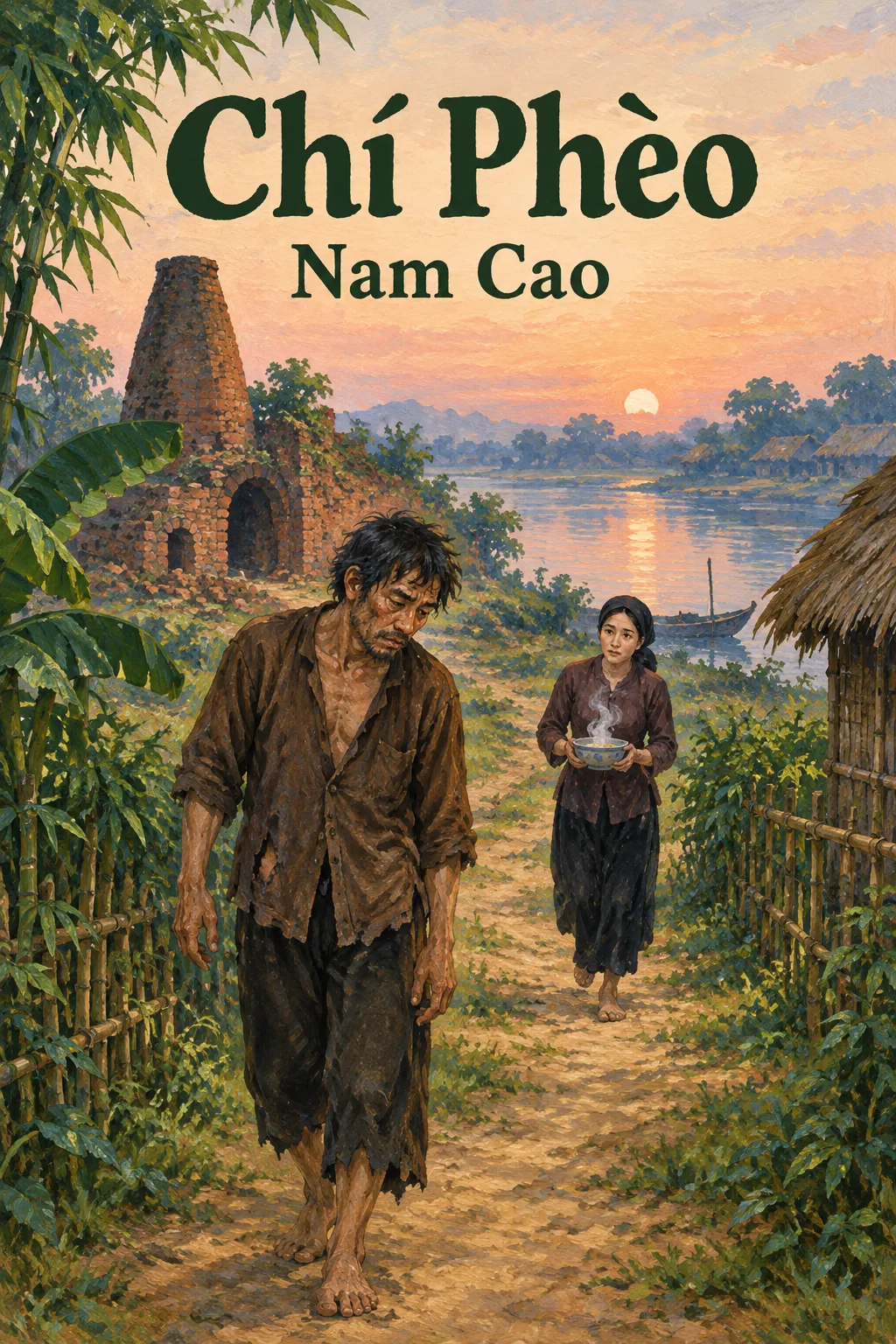
Chí Phèo
by Nam Cao
Chí Phèo is a short story by the Vietnamese realist Nam Cao, first published in 1941 and set in the village of Vũ Đại before the 1945 revolution. An orphaned farmhand is jailed because of the village boss's jealousy, comes out scarred and drunk, and lives as a thug who slashes his own face to extort money. Then a lonely woman gives him a bowl of onion porridge, and he remembers that he once wanted an ordinary life.
The Big Idea
"Nam Cao shows a village that turns a poor orphan into a monster, then offers him one moment of kindness before every door closes again."
Key Insights
A society can manufacture its own monsters
Nam Cao does not present Chí as evil by nature. A foundling with no family or land, he is thrown into prison by a jealous boss and comes out damaged. The story argues that cruelty and poverty can destroy a person long before he does any harm himself. Chí's violence is real, but it has a history.
The reader meets the cursing drunk first and learns about the brick kiln and the prison afterwards, so the question becomes who made him.
The right to be human
Chí's tragedy peaks when he wants to be good and nobody allows it. He does not ask for wealth, only for an ordinary life, a wife and some company. Being refused that turns the story from a tale of crime into one about dignity. The village's prejudice is shown as a form of violence.
After the porridge, he dreams of a small family, but the aunt's refusal makes him feel his life can never change.
Power uses the poor against the poor
Bá Kiến is not a brute. He wins by flattery and calculation, calling Chí by a friendly name and giving him wine and money. In that way a ruined man becomes the boss's enforcer against other villagers. Nam Cao shows how an unjust system can survive by turning its victims into tools.
Chí slashes his own face to extort money, while the man who set him on that road stays untouched and respected.
Kindness can wake a person, but not alone
Thị Nở's porridge is small, yet it does what years of punishment could not: it makes Chí feel human. But one person's kindness is not enough against a whole community's contempt. The story is tender about love and honest about how fragile it is when the world pushes back.
The bowl of onion porridge brings back Chí's old dream, and the aunt's refusal ends it within a day or two.
Chapter Breakdown
Chapter-by-chapter summary
Spoiler warning: this section covers the whole plot, including the ending.
Chí Phèo is a short story with no numbered chapters, so this guide splits it into six natural parts.
Part 1: The curse at dawn
The story opens with Chí Phèo stumbling through the village of Vũ Đại, drunk, shouting curses at the world and at whoever brought him into it. Nobody answers, because everyone knows better than to provoke him.
Nam Cao shows the monster first and the man later, so the reader feels what the villagers feel before learning how he got here.
That order is the story's quiet argument: fear is easy, understanding takes work.
Part 2: A foundling in the brick kiln
Chí is found as a baby, abandoned in an old brick kiln, and passed from hand to hand until he grows up as a hired farmhand. As a young man he is honest, hard-working and shy, with modest hopes.
Then the village boss Bá Kiến grows jealous over his wife and finds a pretext to have Chí sent to prison.
This part matters because it proves Chí did not begin as a villain: someone made him.
Part 3: The return from prison
After years inside, Chí comes back changed, with a shaved head, a dark and savage face and a hunger for drink. He storms into Bá Kiến's house ready for trouble, and the old man disarms him with smooth words, a few coins and wine.
Soon Chí is slashing his own face to extort money and frightening whoever Bá Kiến wants frightened.
The bitter irony is that the man who ruined him now uses him as a weapon, mostly against other poor villagers.
Part 4: Thị Nở and the bowl of porridge
One moonlit night Chí lies drunk in the open and is found by Thị Nở, an unmarried woman whom the village thinks ugly and slow. She takes care of him, and the next day she brings him a bowl of onion porridge to cure his hangover.
Waking sober for the first time in years, Chí notices the ordinary sounds of village life and feels how alone he is. He begins to dream of a small family, an honest job and a quiet old age.
It matters because one simple act of kindness is enough to bring the human being in him back to the surface.
Part 5: The door closes
Chí hopes to marry Thị Nở, and for a short while the two of them are happy. Then her aunt, who despises him, forbids the match, and Thị Nở gives way.
Chí tries to drown the pain in drink, but he has lost the numbness that protected him. He sees that his dream has no place in a village that still sees him as a drunken thug.
This is the turning point of the plot, where hope meets the wall of public opinion.
Part 6: Blood and the brick kiln
Drunk and desperate, Chí goes to Bá Kiến's house, shouts that he wants to be a decent man and asks who will let him. He kills Bá Kiến with a knife and then takes his own life.
The last image belongs to Thị Nở, who looks at Chí's empty hut and thinks of the old brick kiln, hinting that the cycle that made him could start again with another child.
The ending matters because it solves nothing: killing one boss does not change the village.
Characters
- Chí Phèo: the abandoned orphan turned village thug, who is feared by everyone but still longs to be an ordinary, decent man.
- Bá Kiến: the cunning village boss who ruins Chí, then buys his loyalty with wine and flattery, and who stands for the ruling class.
- Thị Nở: a lonely, plain woman who treats Chí as a person and brings him porridge, so she becomes the one who wakes him.
- Thị Nở's aunt: the voice of village prejudice, who refuses the match and closes the last door.
- Lý Cường: Bá Kiến's son, who points to the next generation of power that will carry on after his father.
Background: the world of the story
Chí Phèo belongs to Vietnamese critical realism, the literature of the 1930s and early 1940s that described rural poverty, debt and abuse of power without softening them.
Vũ Đại is a fictional village, but readers have always recognised it as typical of the northern Vietnamese countryside under French colonial rule.
Village notables such as Bá Kiến held real power over land, taxes and the local courts, which is why a landless farmhand had almost no protection.
Knowing this background helps you see that Chí's fate is meant as a social case, not a private accident.
Style and technique
Nam Cao writes in a spoken, sometimes coarse voice that borrows the village's own words, so the narration feels close to the people it describes.
He dwells on small details, such as the scarred face, the cursing and the bowl of porridge, and lets them carry the emotion.
The ring structure starts and ends with the brick kiln and the sense of repetition, which turns one man's death into a warning about the whole system.
The narrator also moves between harsh distance and quiet sympathy, and that shifting tone is why readers feel both fear and pity.
Key terms
- Critical realism: a literary movement that shows social problems as they are, with sharp criticism of injustice.
- Typical character: a figure who stands for a wider group, as Chí stands for dispossessed peasants.
- Ring structure: a story that ends where it began, here with the brick kiln.
- Humanism: Nam Cao's belief that even the most damaged person keeps a human core.
Why the story still matters
The story is still taught because its questions have not gone away: who is responsible when a person is broken, and who decides whether he can change?
Modern readers often connect it to stigma against people who leave prison or who live on the margins of their communities.
It also shows why a single act of kindness, like the porridge, matters but cannot replace a community willing to accept someone.
That is why examiners return to it so often: it supports character analysis, social criticism and discussion of narrative technique in one short text.
Writing about this book
Most exam questions ask about Chí's tragedy, so build your essay around a clear claim: he is a good man made monstrous by society and then refused the right to be human.
Use three steps as your evidence: the honest young farmhand, the thug made by prison and Bá Kiến, and the man who briefly wakes after the porridge.
Do not treat Chí as a pure victim or a pure villain, because Nam Cao asks us to feel both pity and fear.
Quote briefly, for example the cry about wanting to be a decent person, and always explain what the words show.
Link the ring structure, which begins and ends with the brick kiln, to the idea that the conditions repeat even when one man dies.
Plan your time: spend a few minutes outlining before you write, and keep one short quotation per stage so your evidence stays precise.
Remember the model essays on this page are examples for learning. Compare them with your own draft rather than copying them.
For the Vietnamese exam format, the Vietnamese version of this page has outlines and model essays at three levels.
Take Action
Practical steps you can implement today:
-
Read for cause, not only for plot: ask who and what shaped each character before judging them.
-
Build a character essay on stages of change, with one short quote for each stage.
-
Link the ring structure and the ending to the theme of repeating conditions.
-
Keep pity and criticism together: Chí is responsible for harm, yet he is also wronged.
Notable Quotes
"“Hắn vừa đi vừa chửi.” (Part 1; He walked and cursed as he went.)"
— Nam Cao
"“Tao muốn làm người lương thiện!” (Part 6; I want to be a decent person!)"
— Nam Cao
"“Ai cho tao lương thiện?” (Part 6; Who will let me be decent?)"
— Nam Cao
Who Should Read This
Students in upper secondary school who study Nam Cao for exams, and anyone who wants a short, powerful story about poverty, dignity and prejudice in rural Vietnam before 1945. It is suitable from about age fifteen, but it contains violence and suicide.
Characters
Chí Phèo
protagonist
An abandoned orphan who works as a farmhand, is jailed by a jealous boss and comes out a drunken thug. Under the violence he still longs for a wife, a home and a decent life.
Bá Kiến
antagonist
The cunning village boss who ruins Chí's life and later uses him as muscle. He rules by flattery and calculation as much as by force, and he represents the corrupt village elite.
Thị Nở
foil
A plain, lonely woman whom the village mocks. She treats Chí kindly and brings him porridge, which makes her the person who wakes his humanity, though she cannot defend him from prejudice.
Thị Nở's aunt
obstacle
The voice of village prejudice. She refuses to let her niece marry Chí, and her refusal ends his last hope of an ordinary life.
Lý Cường
minor character
Bá Kiến's son, who stands for the next generation of local power. His presence suggests that the system will continue after the old boss is gone.
Vũ Đại village
setting and symbol
The village is a closed community of gossip, fear and hierarchy. It is not only a background but a force that shapes and judges Chí.
Exam practice: sample answers
Model answers are examples to learn from; write your own in your words.
character analysis
1. Analyse the character of Chí Phèo. How does Nam Cao show the tragedy of a man who is turned from a decent villager into a thug?
Outline
- Thesis: Chí is a tragedy of refused humanity, not simple evil
- Origin: orphan, farmhand and honest worker
- Prison and Bá Kiến: the making of the thug
- Thị Nở: the awakening
- Rejection and death: the cost of prejudice
- Conclusion: pity and fear together
Basic Model answer
Chí Phèo is a poor man who becomes a village thug. He was an orphan, found as a baby in a brick kiln, and he grew up working for other people.
When he was young he was honest, but the boss Bá Kiến sent him to prison for no good reason. After he came out he was a different person.
He drank all the time, cut his own face to get money and scared the villagers. Everyone in Vũ Đại learns to fear him.
Nam Cao shows he is not born bad. He meets Thị Nở, who gives him porridge, and he wants to live a good life again.
But people reject him and he dies. The story shows how society can destroy a poor person, so readers feel pity as well as fear.
Good Model answer
Chí Phèo is the central figure of Nam Cao's story, and his life is the tragedy of a decent man destroyed by his society. Nam Cao shows this through three stages: the honest young farmhand, the scarred thug and the man who briefly wakes up.
First, Chí's origin makes him powerless. He is an orphan found in a brick kiln, with no family or land to protect him.
Bá Kiến, jealous and cunning, uses that weakness to send him to prison.
Second, prison changes his body and mind. He returns with a shaved head and a dark, fierce face, and he spends his days drunk, cursing and slashing his own face to demand money.
The villagers fear him, and Bá Kiến uses him as a weapon against rivals. Chí has become a tool of the man who ruined him.
Third, the porridge from Thị Nở lets him remember ordinary desires: a home, a wife, a quiet life. When her aunt refuses the match, he understands that the village will never let him be good.
His cry “Tao muốn làm người lương thiện!” shows that a real self still exists under the thug.
In conclusion, Chí Phèo's tragedy is not that he is evil but that he is denied the right to be human. The brick kiln where he began returns at the end, so his fate feels like part of a pattern, and Nam Cao makes us fear him and pity him in the same breath.
Excellent Model answer
Chí Phèo is not simply a villain who earns our pity; he is Nam Cao's argument that a society can manufacture the monsters it fears. The story traces three transformations (a decent farmhand, a feared thug, a man who wakes and is refused), and each is caused by other people's choices.
The first blow is structural. An orphan found in a brick kiln has no land, name or protector, so when Bá Kiến's jealousy needs a target, Chí is the cheapest one.
Nam Cao withholds this history until after the opening curse, so that we meet the monster first and must then account for him.
The second transformation shows how power recycles its victims. Back from prison with a shaved head and a savage face, Chí storms into Bá Kiến's house, yet the old fox calls him “anh Chí” and pours him wine.
The man who wrecked Chí's life turns him into a tool, and the weapon is aimed mostly at other poor villagers.
Nam Cao's most delicate touch is the third stage. A bowl of onion porridge from Thị Nở lets Chí notice the world sober, and what he wants is strikingly modest: a small home and company in old age.
The modesty is the point, because it shows how little the “thug” ever asked of life.
The rejection that follows is the real murder. When Thị Nở's aunt closes the door, Chí discovers that his humanity is real but unrecognised.
His cry “Tao muốn làm người lương thiện!” turns his violence into a protest, even if a hopeless one: he kills Bá Kiến, then himself.
The ring structure deepens the tragedy. By ending on the image of the empty kiln where Chí began, Nam Cao suggests that the conditions, not the individual, are what repeat.
A counter-reading holds that Chí is also responsible for the harm he inflicts. That is true, and the story never excuses it; yet his violence has a history, and Nam Cao asks us to read it as such.
Therefore Chí Phèo is best read as a tragedy of refused personhood: a man made inhuman by others and destroyed just as he tries to be human again.
Marking rubric
- Clear thesis about Chí's tragedy
- Specific evidence from at least three stages of his life
- Short, accurate quotation with comment
- Analysis of technique, not only plot
- Controlled conclusion
Now write your own
Write your own 300-word answer using the outline, then compare it with the three samples. Which level does your draft match, and what would move it up?
scene analysis
2. Analyse how Nam Cao presents Chí Phèo waking after Thị Nở's visit, and explain what the scene adds to the story's central theme.
Outline
- Context: the first sober morning
- Sounds of ordinary life
- Fear of old age and loneliness
- The dream of a small family
- Link to theme and ending
Basic Model answer
In this scene Chí Phèo wakes up sober for the first time in many years. He hears ordinary noises from the village, like people going to the market and a boat on the river, and he feels lonely.
He thinks about growing old with no one to look after him. He also imagines a small family with a wife and a quiet life.
Nam Cao uses this scene to show that Chí is still a human being under the drunk and the thug. Before this, he only curses and fights.
The scene is important because it shows the theme that everyone wants to be a normal person. It also makes the ending sadder, because we know he could have been happy.
The porridge helps him change, and Nam Cao makes us feel sorry for him.
Good Model answer
The scene in which Chí wakes sober after Thị Nở's visit is the emotional centre of the story. It shows that the man the village calls a monster still has the ordinary wishes of any human being.
First, Nam Cao uses sound. Chí hears birds, a fisherman's boat and market-goers talking, sounds that were always there but that he could not notice while drunk.
Because the world is described through his awakening senses, we feel the shock of its normality.
Second, the scene turns inward. Chí fears old age, hunger, illness and most of all loneliness, which he sees as worse than the others.
This is the first time he reflects on his own life rather than cursing at others.
Third, he imagines a small household, with a husband who works for hire and a wife who weaves. The dream is modest and domestic, so the reader sees how little he wants.
These details support the theme of the right to be human. Before the scene Chí is a symbol of fear; after it he is a person with a past and a future.
This contrast also makes the ending more painful, since the reader now knows what the village takes from him when it refuses his hope.
Excellent Model answer
Nam Cao's scene of Chí's sober waking is the story's hinge: it turns a figure of terror into a person, and it does so with the quietest materials, sounds, fears and a small dream.
The scene begins with sound. The birds, the boat's oars and the market voices were always part of Vũ Đại, but Chí can only hear them once the haze of drink lifts.
Nam Cao lets us experience the world as he does, so its ordinariness becomes a revelation.
The contrast with the opening is deliberate. The story began with a voice cursing into silence, and now Chí listens instead of shouting.
Next the narration moves from outside to inside. Chí thinks of old age, hunger and illness, then decides that loneliness is the most frightening of them.
That ranking is psychologically precise: it shows that the man who made himself feared is most afraid of being alone.
The narrator's tone matters too. It stays close to Chí's sensations and does not hurry him, so the reader forgets the label of monster that the village has given him.
His dream is the final step. He imagines a small family, with a husband working for hire and a wife who weaves, and nothing in it is ambitious.
By choosing such an ordinary picture, Nam Cao suggests that what the village denies Chí is not luxury but belonging.
In the context of 1930s rural Vietnam, where poor peasants were easily treated as disposable, giving Chí this one morning is a deliberate act of dignity. Nam Cao does not excuse the violence; he insists we see the person.
The scene therefore advances the central theme, the right to be human, without a single speech. It also builds tragic irony: the more convincing Chí's hope becomes, the harder the aunt's refusal will fall.
A sceptic could argue that the sober moment is brief and may not reveal his true nature. Yet its brevity is exactly what hurts, and Nam Cao frames it as a fragile chance the world then refuses.
Seen across the whole story, this morning is the only point at which Chí is neither drunk nor violent, and the narrator treats it as the truest version of him. That makes his later death not the revelation of a monster but the destruction of a person who has just been found.
Marking rubric
- Identifies what the scene shows about Chí
- Comments on technique (sound, shift to inner thought)
- Links to the theme of being human
- Connects to the opening and the ending
Now write your own
Choose one of the three sensory details in the scene and write a paragraph on what it shows. Use one short quotation and finish with a comment on the theme.
literary argument
3. Some readers say the real monster in Chí Phèo is Bá Kiến, not Chí. Write a literary argument on how far Nam Cao places responsibility on society rather than on the individual.
Outline
- Define the claim: society versus individual
- Evidence for Bá Kiến and the village
- Evidence that Chí still chooses harm
- Technique: narrative order and irony
- Weigh the two and conclude
Basic Model answer
I think Nam Cao puts most of the blame on society. Chí Phèo was an orphan and he had no one to protect him.
Bá Kiến sent him to prison because he was jealous, and this destroyed Chí's life. After prison Chí became a drunk who hurt other people.
Later Bá Kiến used him to scare the villagers. Chí wanted to change after he met Thị Nở, but her aunt did not let them marry.
However, Chí also did bad things. He cut his face to get money and scared poor people.
So Chí is partly responsible, but society is more to blame because it made him that way. The story is sad because he did not get a chance.
Good Model answer
Nam Cao's story places the greater responsibility on society, but it does not let Chí off completely. The tragedy lies in the way the two cannot be separated.
The case against society is strong. Chí is an orphan with no land or family, and Bá Kiến's jealousy sends him to prison, which changes him into a drunken thug.
Bá Kiến then calls him “anh Chí”, gives him wine and money, and uses him against rivals.
The village also fails him. When Thị Nở's porridge gives him a chance to change, her aunt forbids the marriage, and no one else offers him a place.
His cry “Tao muốn làm người lương thiện!” shows he wanted to belong.
Yet Chí does commit violence. He slashes his own face to extort money and frightens poor villagers who are not his enemies.
Nam Cao does not hide this.
The structure helps the argument. By showing the cursing Chí first and his past second, the story makes us ask why he is like this, which moves our attention from blame to cause.
In conclusion, the story holds Bá Kiến and the community mainly responsible, because they create the conditions in which Chí's violence grows, yet it keeps Chí's guilt visible so that the tragedy feels real.
Excellent Model answer
Nam Cao's Chí Phèo asks not only who is guilty but what guilt means when the harm done is itself the product of harm received. My argument is that the story assigns primary responsibility to the social order, embodied by Bá Kiến and the village, while keeping Chí's own violence in view so that the tragedy cannot be reduced to a slogan.
The structural evidence is strongest. Chí begins with nothing: a foundling in a brick kiln, with no land, name or protector.
When Bá Kiến's jealousy needs a target, a man like this is easy to jail, and the story never suggests the punishment is deserved.
The irony that follows is the heart of Nam Cao's critique. On Chí's return Bá Kiến answers his threats with the friendly “anh Chí”, wine and a little money.
He converts a dangerous man into an instrument, and the person who caused the wound becomes the one who profits from it.
The village's role is quieter but just as damning. After Thị Nở's porridge Chí reaches for an ordinary life, and the only thing standing in the way is her aunt's contempt, which represents the whole community's refusal to believe he can change.
When Chí cries “Tao muốn làm người lương thiện!” the sentence exposes the mechanism: he wants goodness, but goodness is something only others can grant him.
A fair argument must still admit his violence. He cuts his own face to frighten people and extort money, and his victims are often poor.
Nam Cao does not soften these acts, and the narrator's detail about his appearance is meant to make us afraid.
What the story does is give those acts a history. The order of narration matters here: we meet the cursing drunk first, then learn about the kiln and the prison, so that our judgement is delayed and complicated.
The ending confirms the argument. Chí kills Bá Kiến and himself, yet the closing image of the empty kiln suggests that the system that produced him is intact.
If an individual were the cause, his death would end the problem.
It does not, so the story's logic points to society. The most accurate reading is that responsibility is shared but not equal: Chí commits harm, while Bá Kiến and the community build the world in which that harm becomes his only language.
Marking rubric
- Takes a clear, arguable position
- Uses evidence for both sides
- Analyses technique and structure
- Handles the opposing view fairly
- Concludes with a precise judgement
Now write your own
Write your own argument on whether Chí or society bears more blame. Use at least two specific moments from the story and one short quotation.
Frequently Asked Questions
What is Chí Phèo about?
It is about a poor orphan in the village of Vũ Đại who is sent to prison by a jealous boss and comes back as a drunken thug. A kind woman briefly makes him want a normal life, but the village rejects him and he dies in despair.
Who wrote Chí Phèo and when?
Nam Cao wrote it, and it was first published in 1941. It belongs to Vietnamese critical realism, the literature of the 1930s and early 1940s that looked honestly at rural poverty and injustice.
Is Chí Phèo a villain or a victim?
He is both, and that is the point. He harms the villagers, but the story shows how an abandoned orphan and a jealous boss shaped him. Strong essays say he is wronged first and dangerous second.
Why does Chí Phèo slash his own face?
It is how he extorts money and frightens people. The act shows a man who has stopped caring about his body or dignity and who survives by making others afraid.
What does the ending mean?
Chí's death does not fix the village. The final image of the brick kiln suggests that the conditions that created him could produce another outcast, which is why the story reads as a social tragedy.
Check Your Understanding
Pick an answer for each question to see if you were right.
-
Where was Chí Phèo found as a baby?
In an abandoned brick kiln — He was abandoned in an old brick kiln, an image that returns at the end of the story.
-
Who sends Chí to prison?
Bá Kiến — The jealous village boss Bá Kiến has him jailed, which starts Chí's downfall.
-
What does Thị Nở bring Chí to help him recover?
A bowl of onion porridge — The bowl of onion porridge is the kindness that wakes Chí's human side.
-
Who stops Chí from marrying Thị Nở?
Her aunt — Thị Nở's aunt forbids the match, which closes Chí's last chance.
-
What is the name of the village in the story?
Vũ Đại — The story is set in the fictional village of Vũ Đại.
About Nam Cao
Nam Cao (1915–1951) was a Vietnamese realist writer whose real name was Trần Hữu Tri. His stories about poor peasants and struggling intellectuals, including Chí Phèo and Lão Hạc, are among the most studied in Vietnamese schools. He died in 1951 while serving the resistance, and his work is now in the public domain.
Summary Written By

Software Engineer & Writer
Software engineer with a passion for distilling complex ideas into actionable insights. Writes about finance, investment, entrepreneurship, and technology.
View all summaries →Reviews
No reviews yet. Be the first to share your thoughts!
Write a Review
Keep reading
Explore the topic: Study GuidesSummaries

The Outsiders by S.E. Hinton
S.E. Hinton
Ponyboy Curtis and his gang of Greasers clash with the wealthy Socs in a cycle of violence. After a tragic…

To Kill a Mockingbird by Harper Lee
Harper Lee
A young girl named Scout Finch grows up in the racially divided town of Maycomb, Alabama. Through her father Atticus's…
Rashomon
Ryunosuke Akutagawa
Rashomon is a short story by Ryunosuke Akutagawa, published in 1915 and set in Kyoto during a time of famine…

The Moon over the Mountain
Atsushi Nakajima
The Moon over the Mountain (Sangetsuki) is a short story by Japanese writer Atsushi Nakajima, set in Tang-dynasty China. Li…
Articles

Yggdrasil and the nine worlds
Yggdrasil is the giant ash tree of Norse myth that holds the nine worlds of gods, giants, humans and the…

Tachyons
A tachyon is a hypothetical particle that always moves faster than light. Gerald Feinberg named it in 1967, but no…

Hansel and Gretel: The Grimm Tale, Its Sources and Meaning
Hansel and Gretel is a German folk tale about two children abandoned in a forest during a famine, who outwit…