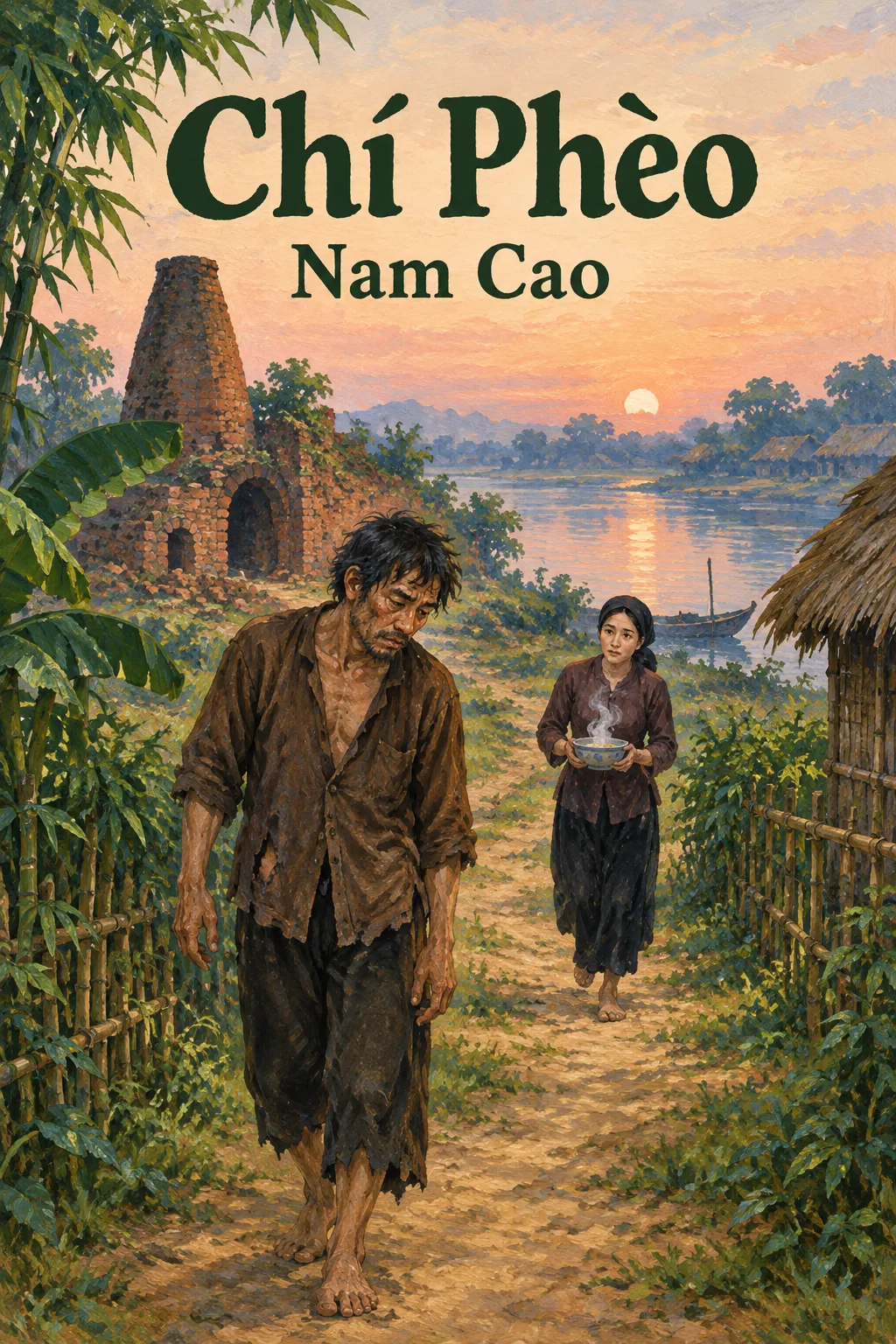
Chí Phèo
Nam Cao 著
Chí Phèo is a short story by the Vietnamese realist Nam Cao, first published in 1941 and set in the village of Vũ Đại before the 1945 revolution. An orphaned farmhand is jailed because of the village boss's jealousy, comes out scarred and drunk, and lives as a thug who slashes his own face to extort money. Then a lonely woman gives him a bowl of onion porridge, and he remembers that he once wanted an ordinary life.
核心的なアイデア
"Nam Cao shows a village that turns a poor orphan into a monster, then offers him one moment of kindness before every door closes again."
重要な洞察
A society can manufacture its own monsters
Nam Cao does not present Chí as evil by nature. A foundling with no family or land, he is thrown into prison by a jealous boss and comes out damaged. The story argues that cruelty and poverty can destroy a person long before he does any harm himself. Chí's violence is real, but it has a history.
The reader meets the cursing drunk first and learns about the brick kiln and the prison afterwards, so the question becomes who made him.
The right to be human
Chí's tragedy peaks when he wants to be good and nobody allows it. He does not ask for wealth, only for an ordinary life, a wife and some company. Being refused that turns the story from a tale of crime into one about dignity. The village's prejudice is shown as a form of violence.
After the porridge, he dreams of a small family, but the aunt's refusal makes him feel his life can never change.
Power uses the poor against the poor
Bá Kiến is not a brute. He wins by flattery and calculation, calling Chí by a friendly name and giving him wine and money. In that way a ruined man becomes the boss's enforcer against other villagers. Nam Cao shows how an unjust system can survive by turning its victims into tools.
Chí slashes his own face to extort money, while the man who set him on that road stays untouched and respected.
Kindness can wake a person, but not alone
Thị Nở's porridge is small, yet it does what years of punishment could not: it makes Chí feel human. But one person's kindness is not enough against a whole community's contempt. The story is tender about love and honest about how fragile it is when the world pushes back.
The bowl of onion porridge brings back Chí's old dream, and the aunt's refusal ends it within a day or two.
章ごとの解説
Chapter-by-chapter summary
Spoiler warning: this section covers the whole plot, including the ending.
Chí Phèo is a short story with no numbered chapters, so this guide splits it into six natural parts.
Part 1: The curse at dawn
The story opens with Chí Phèo stumbling through the village of Vũ Đại, drunk, shouting curses at the world and at whoever brought him into it. Nobody answers, because everyone knows better than to provoke him.
Nam Cao shows the monster first and the man later, so the reader feels what the villagers feel before learning how he got here.
That order is the story's quiet argument: fear is easy, understanding takes work.
Part 2: A foundling in the brick kiln
Chí is found as a baby, abandoned in an old brick kiln, and passed from hand to hand until he grows up as a hired farmhand. As a young man he is honest, hard-working and shy, with modest hopes.
Then the village boss Bá Kiến grows jealous over his wife and finds a pretext to have Chí sent to prison.
This part matters because it proves Chí did not begin as a villain: someone made him.
Part 3: The return from prison
After years inside, Chí comes back changed, with a shaved head, a dark and savage face and a hunger for drink. He storms into Bá Kiến's house ready for trouble, and the old man disarms him with smooth words, a few coins and wine.
Soon Chí is slashing his own face to extort money and frightening whoever Bá Kiến wants frightened.
The bitter irony is that the man who ruined him now uses him as a weapon, mostly against other poor villagers.
Part 4: Thị Nở and the bowl of porridge
One moonlit night Chí lies drunk in the open and is found by Thị Nở, an unmarried woman whom the village thinks ugly and slow. She takes care of him, and the next day she brings him a bowl of onion porridge to cure his hangover.
Waking sober for the first time in years, Chí notices the ordinary sounds of village life and feels how alone he is. He begins to dream of a small family, an honest job and a quiet old age.
It matters because one simple act of kindness is enough to bring the human being in him back to the surface.
Part 5: The door closes
Chí hopes to marry Thị Nở, and for a short while the two of them are happy. Then her aunt, who despises him, forbids the match, and Thị Nở gives way.
Chí tries to drown the pain in drink, but he has lost the numbness that protected him. He sees that his dream has no place in a village that still sees him as a drunken thug.
This is the turning point of the plot, where hope meets the wall of public opinion.
Part 6: Blood and the brick kiln
Drunk and desperate, Chí goes to Bá Kiến's house, shouts that he wants to be a decent man and asks who will let him. He kills Bá Kiến with a knife and then takes his own life.
The last image belongs to Thị Nở, who looks at Chí's empty hut and thinks of the old brick kiln, hinting that the cycle that made him could start again with another child.
The ending matters because it solves nothing: killing one boss does not change the village.
Characters
- Chí Phèo: the abandoned orphan turned village thug, who is feared by everyone but still longs to be an ordinary, decent man.
- Bá Kiến: the cunning village boss who ruins Chí, then buys his loyalty with wine and flattery, and who stands for the ruling class.
- Thị Nở: a lonely, plain woman who treats Chí as a person and brings him porridge, so she becomes the one who wakes him.
- Thị Nở's aunt: the voice of village prejudice, who refuses the match and closes the last door.
- Lý Cường: Bá Kiến's son, who points to the next generation of power that will carry on after his father.
Background: the world of the story
Chí Phèo belongs to Vietnamese critical realism, the literature of the 1930s and early 1940s that described rural poverty, debt and abuse of power without softening them.
Vũ Đại is a fictional village, but readers have always recognised it as typical of the northern Vietnamese countryside under French colonial rule.
Village notables such as Bá Kiến held real power over land, taxes and the local courts, which is why a landless farmhand had almost no protection.
Knowing this background helps you see that Chí's fate is meant as a social case, not a private accident.
Style and technique
Nam Cao writes in a spoken, sometimes coarse voice that borrows the village's own words, so the narration feels close to the people it describes.
He dwells on small details, such as the scarred face, the cursing and the bowl of porridge, and lets them carry the emotion.
The ring structure starts and ends with the brick kiln and the sense of repetition, which turns one man's death into a warning about the whole system.
The narrator also moves between harsh distance and quiet sympathy, and that shifting tone is why readers feel both fear and pity.
Key terms
- Critical realism: a literary movement that shows social problems as they are, with sharp criticism of injustice.
- Typical character: a figure who stands for a wider group, as Chí stands for dispossessed peasants.
- Ring structure: a story that ends where it began, here with the brick kiln.
- Humanism: Nam Cao's belief that even the most damaged person keeps a human core.
Why the story still matters
The story is still taught because its questions have not gone away: who is responsible when a person is broken, and who decides whether he can change?
Modern readers often connect it to stigma against people who leave prison or who live on the margins of their communities.
It also shows why a single act of kindness, like the porridge, matters but cannot replace a community willing to accept someone.
That is why examiners return to it so often: it supports character analysis, social criticism and discussion of narrative technique in one short text.
Writing about this book
Most exam questions ask about Chí's tragedy, so build your essay around a clear claim: he is a good man made monstrous by society and then refused the right to be human.
Use three steps as your evidence: the honest young farmhand, the thug made by prison and Bá Kiến, and the man who briefly wakes after the porridge.
Do not treat Chí as a pure victim or a pure villain, because Nam Cao asks us to feel both pity and fear.
Quote briefly, for example the cry about wanting to be a decent person, and always explain what the words show.
Link the ring structure, which begins and ends with the brick kiln, to the idea that the conditions repeat even when one man dies.
Plan your time: spend a few minutes outlining before you write, and keep one short quotation per stage so your evidence stays precise.
Remember the model essays on this page are examples for learning. Compare them with your own draft rather than copying them.
For the Vietnamese exam format, the Vietnamese version of this page has outlines and model essays at three levels.
アクション
今日から実践できるステップ:
-
Read for cause, not only for plot: ask who and what shaped each character before judging them.
-
Build a character essay on stages of change, with one short quote for each stage.
-
Link the ring structure and the ending to the theme of repeating conditions.
-
Keep pity and criticism together: Chí is responsible for harm, yet he is also wronged.
注目すべき引用
"“Hắn vừa đi vừa chửi.” (Part 1; He walked and cursed as he went.)"
— Nam Cao
"“Tao muốn làm người lương thiện!” (Part 6; I want to be a decent person!)"
— Nam Cao
"“Ai cho tao lương thiện?” (Part 6; Who will let me be decent?)"
— Nam Cao
おすすめの読者
Students in upper secondary school who study Nam Cao for exams, and anyone who wants a short, powerful story about poverty, dignity and prejudice in rural Vietnam before 1945. It is suitable from about age fifteen, but it contains violence and suicide.
Nam Cao について
Nam Cao (1915–1951) was a Vietnamese realist writer whose real name was Trần Hữu Tri. His stories about poor peasants and struggling intellectuals, including Chí Phèo and Lão Hạc, are among the most studied in Vietnamese schools. He died in 1951 while serving the resistance, and his work is now in the public domain.
要約作成者

Software Engineer & Writer
Software engineer with a passion for distilling complex ideas into actionable insights. Writes about finance, investment, entrepreneurship, and technology.
すべての要約を見る →レビュー
レビューはまだありません。最初のレビューを書きましょう!
レビューを書く
続けて読む
このテーマを探る: 学習ガイド要約

アウトサイダーズ(S.E.ヒントン著)
S.E. Hinton
1960年代のオクラホマを舞台に、貧困層の「グリース」と富裕層の「ソッシュ」という対立する二つのグループの少年たちの葛藤を描いた物語。主人…

アラバマ物語(ハーパー・リー)
Harper Lee
1930年代のアラバマ州を舞台に、幼いスカウトとその兄ジェム、そして父アティカスが、人種偏見に満ちた社会に立ち向かう姿を描いた物語です。ア…
羅生門(Rashomon)
Ryunosuke Akutagawa
『羅生門』は、芥川龍之介が1915年に発表した短編小説です。舞台は、地震や飢饉で荒れ果てた平安時代の京都。主人にひまを出された若い下人が、…

山月記(The Moon over the Mountain)
Atsushi Nakajima
『山月記』は、中国・唐の時代を舞台に、詩人として名を残したいと願った官吏・李徴(りちょう)の転落を描く、中島敦の短編小説です。李徴は優れた…