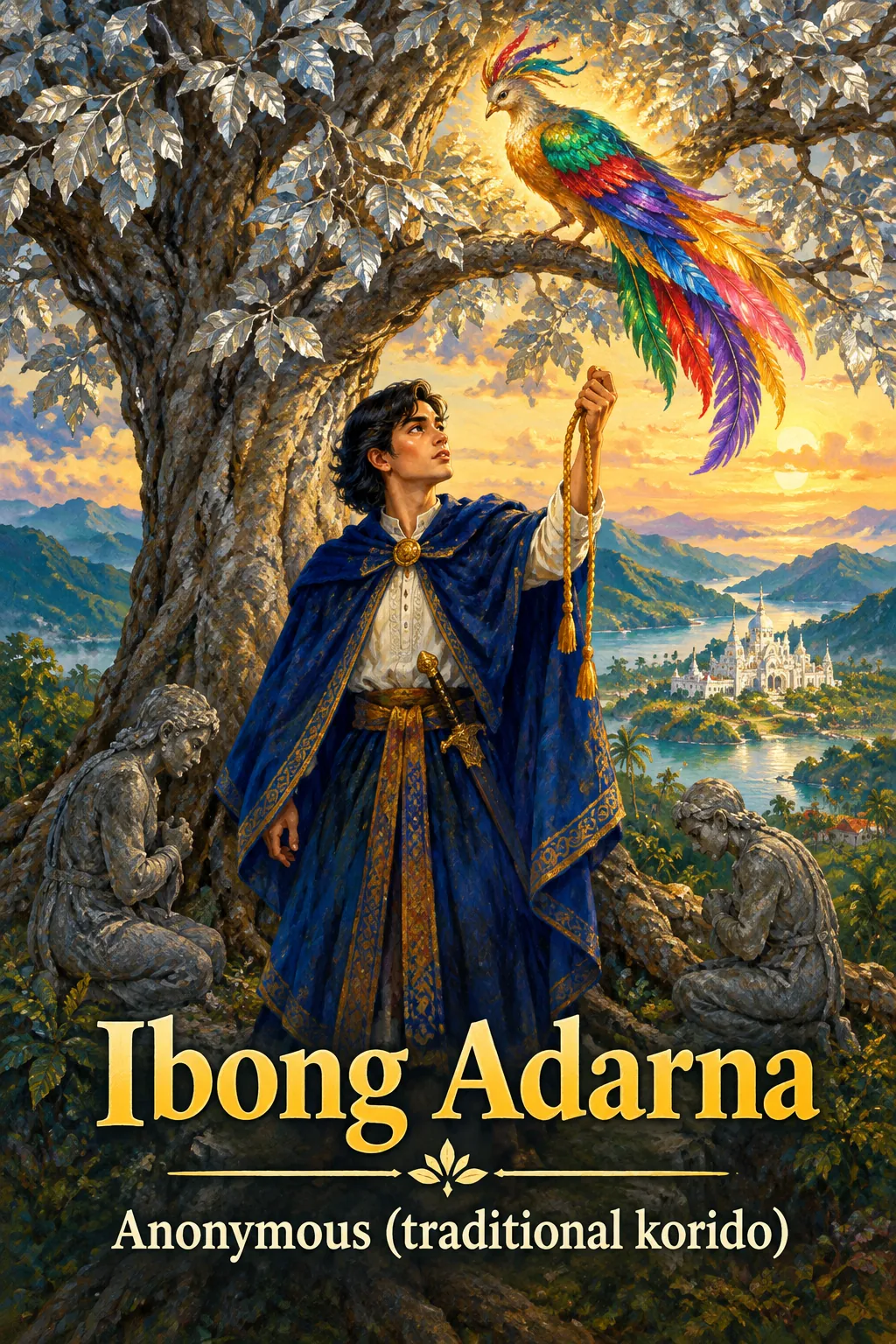
Ibong Adarna
par Anonymous (traditional korido)
Ibong Adarna is a Filipino verse romance about three princes of the kingdom of Berbanya. Their father, King Fernando, falls gravely ill, and only the song of the magical Adarna bird can heal him. The two eldest sons fail the quest, but the youngest, Don Juan, succeeds with the help of a kind hermit. His brothers' jealousy then turns a rescue into a story of betrayal, love and loyalty that carries him far beyond his father's kingdom.
L'idée principale
"Ibong Adarna is a Filipino korido about the youngest of three princes, who wins through humility, discipline and forgiveness, while his envious brothers show how jealousy can break a family."
Aperçus clés
Gratitude and humility open the way (Pasasalamat at Kababaang-loob)
Don Juan succeeds where his brothers fail because he treats a stranger kindly and listens to advice. The hermit's gifts are practical, and each one is used at the right moment. The poem suggests that people who admit they need help go further than people who trust only their rank or strength. In this story, gratitude is not just a feeling but a habit of sharing and learning.
Don Juan shares his bread with the hermit on Mount Tabor, while the older princes fail the quest and are turned to stone.
Envy destroys the family (Inggit at Pamilya)
The poem's deepest conflict is not between humans and monsters but between brothers. Don Pedro and Don Diego cannot celebrate Don Juan's success because they fear losing their father's favour. Their envy leads to violence, lies and repeated betrayals, which hurts them as well as him. The aral is that jealousy turns relatives into rivals, while generosity keeps people close.
After Don Juan frees them from stone, the brothers beat him on the road home and claim the bird as their own.
Perseverance and self-discipline (Tiyaga at Disiplina)
Don Juan is never the strongest figure in the poem, but he keeps going when the task seems impossible. He plans for the bird's songs, endures pain, and later completes Haring Salermo's seven trials. The story treats perseverance as a moral habit supported by good advice and by the help of others. For students, the lesson is to prepare, keep trying and accept help instead of giving up or taking shortcuts.
He cuts his own hand and squeezes lemon juice on it to stay awake while the Adarna sings.
Love, memory and loyalty (Pag-ibig at Katapatan)
The last part of the poem asks whether love can survive a curse. Don Juan forgets Maria Blanca when he enters Berbanya, and the poem does not blame him for the curse. Maria shows loyalty by travelling to the kingdom in disguise and restoring his memory. The aral is that faithful love needs truthfulness and effort from both partners, and that it cannot rely on luck alone.
Maria Blanca arrives dressed as a pilgrim just as Don Juan is about to marry Leonora.
Détail des chapitres
Plot Summary (Buod)
Spoiler warning: this section covers the whole plot, including the ending.
The Ibong Adarna is one continuous poem of four-line stanzas (saknong), not a book of numbered chapters (kabanata).
Editions mark the episodes differently, so this guide groups the story into eight parts. Small details, such as the exact marriages at the end, differ between editions.
Part 1: The King's Dream in Berbanya (Ang Panaginip ng Hari)
King Fernando and Queen Valeriana rule Berbanya with their three sons: Don Pedro, Don Diego and Don Juan. The king loves Don Juan most, and the older brothers notice it.
The king then dreams that Don Juan is murdered by two men, and he falls gravely ill. A physician tells the court that only the song of the Ibong Adarna, a bird that lives in a tree on Mount Tabor, can cure him.
Why it matters: the dream hints that the danger to Don Juan comes from inside the family, and it starts the whole quest.
Part 2: Don Pedro and Don Diego Fail
Don Pedro rides out first and finds the Adarna in the Piedras Platas tree. The bird sings seven songs, changing its feathers each time, and Don Pedro falls asleep, after which the bird's droppings turn him to stone.
Don Diego follows with the same result. The court waits in worry as the king grows weaker.
Why it matters: the two older princes are stronger and higher in rank, yet they fail. The poem shows that strength alone does not win this quest.
Part 3: Don Juan and the Hermit (Ang Ermitanyo)
Don Juan sets out and meets an old hermit who asks for bread. Don Juan shares what he has, and the hermit gives him a knife, dayap (small lemons), a golden cord and water.
On Mount Tabor, Don Juan cuts his hand and squeezes lemon juice into the wound so that the pain keeps him awake through the seven songs. He then catches the bird with the golden cord and uses the water to bring Don Pedro, Don Diego and the other stone figures back to life.
Why it matters: Don Juan wins by kindness, listening and self-discipline, the opposite of his brothers' approach.
Part 4: Betrayal on the Road Home
On the journey back, Don Pedro and Don Diego, burning with envy, beat Don Juan and leave him almost dead. They carry the bird to Berbanya and take the credit.
Don Juan recovers and returns, and he forgives his brothers. In the version most often taught in schools, the Adarna sings again once he is back, and the king is healed.
Why it matters: the story sets rescue and betrayal side by side and tests Don Juan's character, not only his courage.
Part 5: The Escaped Bird and the Well in Armenya
The brothers are told to watch the bird, but the bird escapes while Don Juan is on guard. Don Juan sets out to bring it back, and Don Pedro and Don Diego follow him.
At Mount Armenya, Don Juan goes down a well on a rope and reaches two enchanted palaces. He rescues Princess Juana from a giant and Princess Leonora from a seven-headed serpent, but his brothers cut the rope and he falls to the bottom.
Why it matters: the same pattern repeats: Don Juan does the brave work, and his brothers try to take the reward.
Part 6: Reino de los Cristales and Maria Blanca
Don Juan is healed, helped by a wolf, and guided to Reino de los Cristales by an eagle. There he sees three princesses bathing in a crystal lake and falls in love with Maria Blanca, daughter of Haring Salermo.
The king does not welcome the match and decides to test the stranger.
Why it matters: the story moves from a family quest to a love story, and Maria Blanca becomes the poem's other great hero.
Part 7: Haring Salermo's Trials and the Curse
Haring Salermo gives Don Juan seven tasks, such as moving a mountain and finding a ring lost in the sea. Don Juan passes them with Maria Blanca's magic and loyalty.
When the angry king turns on him, the couple flee. Salermo curses them so that Don Juan will forget Maria once they enter Berbanya.
Why it matters: the poem shows that love needs both effort and loyalty, and that the hero succeeds with help from other people.
Part 8: Forgotten Love and Restored Memory
In Berbanya, Don Juan forgets Maria Blanca and prepares to marry Leonora. Maria arrives dressed as a pilgrim and uses her magic to restore his memory.
Don Juan chooses Maria again. In the version most often taught, the two end the story ruling Reino de los Cristales, while Berbanya remains with the family.
Why it matters: memory and faithfulness are the final test, and the ending rewards patience and truthfulness over rank.
Characters (Mga Tauhan)
Don Juan is the youngest prince and the hero. He is humble, brave and patient, and he forgives his brothers even after they harm him.
Don Pedro is the eldest prince. He is proud and confident at the start, and his envy of Don Juan makes him a betrayer.
Don Diego is the second prince. He follows Don Pedro in failing the quest, then joins him in beating and betraying Don Juan.
Haring Fernando is the king of Berbanya. His illness starts the quest, and his dream warns that the family is in danger.
Ang Ermitanyo is the hermit on Mount Tabor. He rewards Don Juan's kindness with practical gifts and advice.
Ibong Adarna is the magical bird whose seven songs can heal. It stands for a prize that can only be won by self-control.
Donya Leonora is a princess rescued by Don Juan in Armenya. She is a gentle and loyal figure whose presence tests Don Juan's faithfulness later.
Donya Maria Blanca is the princess of Reino de los Cristales and Don Juan's true love. She uses magic, courage and persistence to protect him.
Haring Salermo is Maria Blanca's father and a powerful ruler. His tests and his curse make Don Juan's love story the hardest trial of all.
Donya Juana is the princess Don Juan rescues from a giant. Her rescue shows his willingness to help others for no reward.
Writing about this book (Pagsusulat tungkol sa Ibong Adarna)
Most school tasks on the Ibong Adarna ask for a character analysis, a theme and aral essay, a reaction paper or a compare and contrast. Start with one clear idea, such as humility, envy or perseverance, and follow it through the episodes.
Use two or three events as evidence, and name them exactly: the hermit's bread, the lemon and knife, the beating on the road, the well in Armenya, Salermo's trials, the curse. Briefly explain what each event shows about the character or the aral.
Keep quotations very short, or paraphrase in your own words, and give the saknong or episode if your teacher asks for it. Do not copy a published summary or translation, because your teacher can usually tell.
For a reaction paper, write in the first person and give your honest opinion, then support it with the story. For a compare and contrast, use a clear pattern, such as Don Juan against Don Pedro and Don Diego, and finish with what the comparison teaches.
The essay set below shows three levels of the same task, so you can see what makes an answer better. Use them to compare with your own writing, not to copy.
Passer à l'action
Étapes pratiques à mettre en œuvre dès aujourd'hui :
-
Share what you have and listen to advice, as Don Juan does with the hermit; help often comes back in unexpected ways.
-
Be happy for the success of your brothers, sisters and classmates, because envy harms you as much as it harms them.
-
Prepare for hard tasks with a plan, as Don Juan does with the knife and lemon, instead of trusting only your talent.
-
Forgive when you can, but stay wise: the brothers in the story repeat their wrongs.
Citations notables
"Paraphrase of the hermit's counsel on Mount Tabor: share what you have, listen to advice, and use pain to stay awake. (Part 3)"
— Anonymous (traditional korido)
"Paraphrase of the bird's seven songs: each song lulls the listener into sleep until someone finds a way to resist. (Part 2)"
— Anonymous (traditional korido)
"Paraphrase of Salermo's curse: once Don Juan sets foot in Berbanya, he will forget the princess who helped him. (Part 7)"
— Anonymous (traditional korido)
À qui s'adresse ce texte
This guide is for Filipino high school students (about Grades 7 to 10) who study the Ibong Adarna in Filipino or English class, and for teachers who need a clear buod, tauhan list, aral and sample essays. It also suits anyone who wants a quick introduction to this classic Philippine korido before reading an edition.
À propos de Anonymous (traditional korido)
The Ibong Adarna is an anonymous Filipino korido, a verse romance in four-line stanzas of eight-syllable lines, that circulated in Tagalog during the Spanish colonial period. It is often credited to José de la Cruz, but that attribution is unproven. It remains a core school text in the Philippines because it joins adventure, family conflict and clear moral lessons.
Résumé écrit par

Software Engineer & Writer
Software engineer with a passion for distilling complex ideas into actionable insights. Writes about finance, investment, entrepreneurship, and technology.
Voir tous les résumés →Avis
Pas encore d'avis. Soyez le premier à partager vos impressions !
Écrire un avis
Continuer la lecture
Explorer le thème: Guides d’étudeRésumés
outsiders (S.E. Hinton)
S.E. Hinton
L'histoire suit Ponyboy Curtis et son gang, les Greasers, dans leur conflit violent avec les Socs, les jeunes riches de…
Ne tuez pas le geai moqueur par Harper Lee
Harper Lee
À travers les yeux de la jeune Scout Finch, le roman suit la lutte de son père, Atticus, un avocat…
Rashômon
Ryunosuke Akutagawa
Rashômon est une nouvelle de Ryūnosuke Akutagawa, publiée en 1915 et située à Kyoto en pleine époque de famine et…
Sangetsuki (La Lune sur la montagne) d'Atsushi Nakajima
Atsushi Nakajima
Sangetsuki (La Lune sur la montagne) est une nouvelle de l'écrivain japonais Atsushi Nakajima, située dans la Chine des Tang.…
Articles
Tengu : les génies des montagnes du Japon
Les tengu sont les esprits des montagnes du folklore japonais, représentés avec un visage rouge et un nez immense, ou…

Mary Shelley : l'autrice qui a inventé la science-fiction
Mary Shelley (1797-1851) était une romancière anglaise qui a commencé Frankenstein à 18 ans et l'a publié anonymement en 1818.…
Le kappa : le lutin des rivières
Le kappa est une créature fluviale du folklore japonais : de la taille d'un enfant, verte ou rougeâtre, avec une…