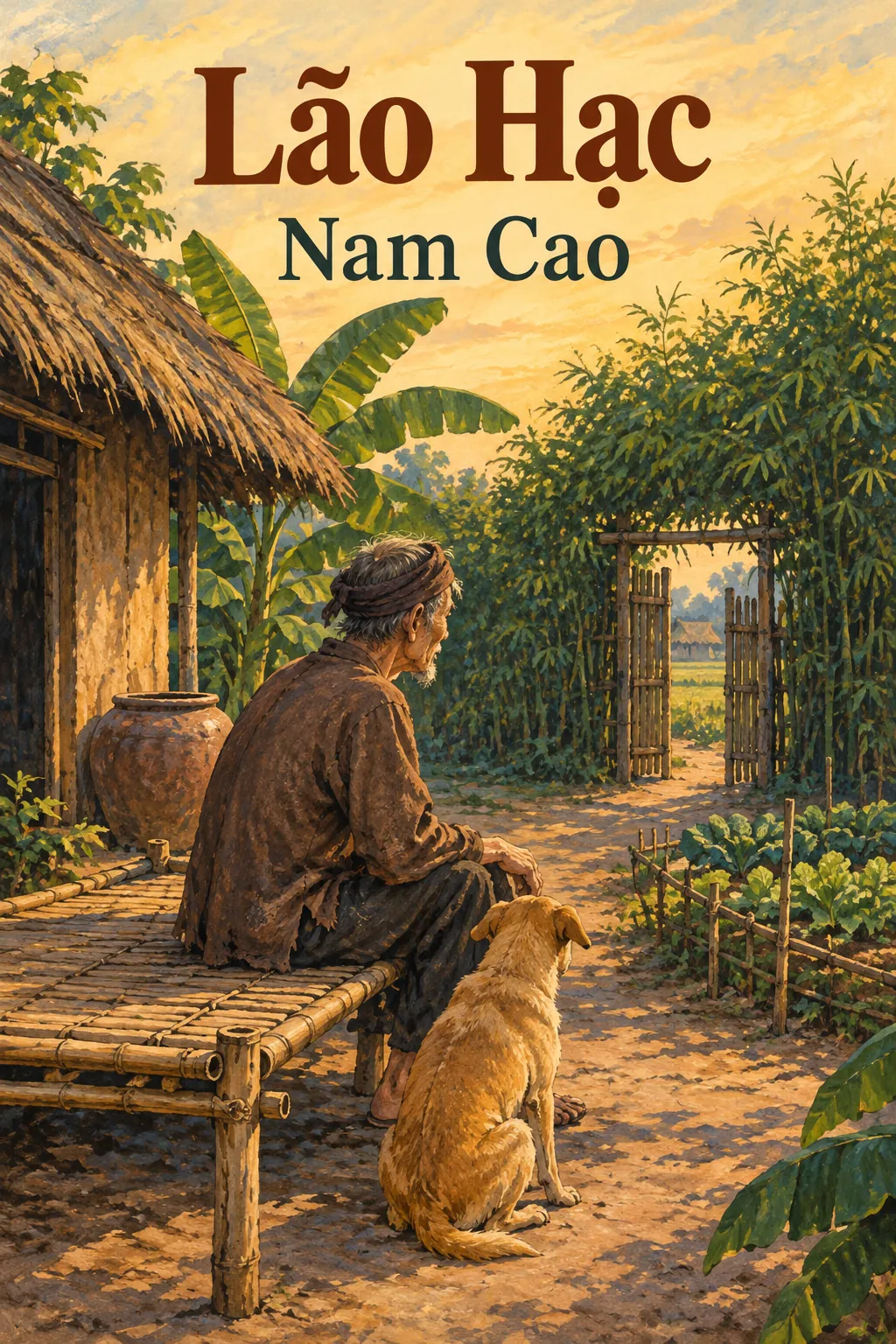
Lão Hạc
by Nam Cao
Lão Hạc is a 1943 short story by Nam Cao about a poor old farmer in a Vietnamese village under colonial rule. His wife is dead, and his only son has left to work on a rubber plantation because the family cannot afford a wedding. Lão Hạc lives alone with the dog his son left behind. Told by a village teacher, the story follows how hunger and old age push him toward a terrible decision.
The Big Idea
"A poor old farmer holds on to love for his son, tenderness for his dog and his own pride to the end. Nam Cao asks readers to understand poor people before they judge them."
Key Insights
Dignity can survive poverty
Lão Hạc is hungry enough to eat wild roots, yet he turns down help. For him, being poor does not mean giving up his pride. Nam Cao shows self-respect as the last thing a person owns, and he shows how high a price it can cost. The story asks us to see that pride is not vanity here but a way of staying a person when everything else is gone.
Lão leaves funeral money with the teacher so that no neighbour has to pay for his burial.
Fatherly love speaks through actions
Lão rarely says how much he loves his son. He shows it by guarding the garden, keeping the dog and putting his son's future above his own life. The love is quiet, practical and costly. Nam Cao lets the reader work this out from small choices, which makes the feeling more believable than any speech.
He will not sell the garden, even though that would feed him, because it belongs to his son's future.
Poverty pushes honest people to the edge
The story is set under colonial rule, when many peasants lost land and work. Nam Cao does not blame Lão for his tragedy. He makes us see how social conditions can crush a good person, and how little room such conditions leave for choice.
Lão sells the dog he loves only because he can no longer feed it or himself.
Understand people before you judge them
The narrator thinks badly of Lão after hearing about the poison, then sees he was wrong. His thought that we only see people's faults if we do not try to understand them is the moral centre of the story. It reaches beyond the village, to any reader who has judged someone too quickly.
The teacher first calls life sadder every day, then admits life is not simply sad after Lão dies.
Chapter Breakdown
Chapter-by-chapter summary
Spoiler warning: this section covers the whole plot, including the ending.
The story has no numbered chapters, so we follow it in six natural parts.
Part 1: A father, a dog and an empty house
The narrator, a village teacher called ông giáo, introduces his neighbour Lão Hạc. Lão is a poor farmer whose wife died long ago and whose only son left for a rubber plantation, because Lão refused to sell the family garden to pay for a wedding.
Lão keeps the dog Vàng, his son's keepsake, and treats it like a grandchild. Why it matters: Nam Cao sets up poverty, loneliness and fatherly love at once, so we feel the dog's weight in the later scenes.
The setting is a village in northern Vietnam before 1945, when many peasants were losing land and work. Lão's small garden is therefore all the wealth he has to pass on.
Part 2: The decision to sell Vàng
Lão falls ill, work dries up, and food gets expensive. He tells the teacher he must sell the dog because he cannot feed it, and he refuses to spend the money he is saving for his son.
The teacher's wife is unsympathetic to Lão's stubbornness. Why it matters: we see that Lão is cornered by hunger, not by carelessness.
Lão also admits that he is old and weak. Every day he lives eats into the little he has set aside for his son.
Part 3: Lão cries
Soon afterwards Lão comes to say the dog is gone. His face crumples, tears run down his wrinkles and he sobs like a child as he describes how he tricked Vàng and let it be seized.
The teacher tries to comfort him. Why it matters: the scene shows a conscience so tender that betraying a dog feels like a crime to him.
The teacher notices that Lão first tries to laugh, but the laugh turns into something close to a sob. The detail shows how hard the old man is trying to hold himself together.
Part 4: Entrusting the garden and the funeral money
Lão asks the teacher to keep the garden's papers for his son and to hold money for his funeral. He then lives on wild roots, taro and whatever he can find, and he turns down food and help.
The teacher's wife thinks he is proud to the point of being foolish. Why it matters: Lão is quietly preparing for his death while protecting his son's inheritance.
He leaves the garden in the teacher's care so that his son will not return to nothing. He also sets aside burial money so that no neighbour has to carry the cost.
Part 5: Binh Tư and the poison
Binh Tư, a neighbour known for petty theft, tells the teacher that Lão asked him for dog poison, saying he wanted to catch a dog. The teacher is deeply disappointed and decides that even honest people are corrupted by poverty.
Why it matters: the narrator, like the reader, jumps to a wrong conclusion.
The teacher is a man of books and of sympathy, so his disappointment is sharp. He had believed that Lão was the one honest man poverty could not spoil.
Part 6: Lão Hạc's death
Lão dies of the poison after a terrible struggle that lasts about two hours. Only then does the teacher understand that Lão wanted to die rather than spend his son's money or become a burden.
The teacher concludes that life is not simply sad, or at least sad in a different way. Why it matters: the ending turns a story about poverty into a lesson about understanding other people.
The neighbours are horrified by the manner of his death. Only the teacher grasps that it was chosen with a clear purpose.
Characters
- Lão Hạc: a poor, widowed old farmer. He is tender, proud and honest, and he sacrifices himself for his son.
- Ông giáo: the village teacher and narrator. He is educated and kind, but he has to learn not to judge too fast.
- Cậu Vàng: the dog, Lão's last link with his son. For Lão, it is almost a family member.
- The son: a young man who leaves because he cannot afford to marry. He is absent through the whole story but drives Lão's choices.
- Binh Tư: a neighbour who steals small things. His report about the poison misleads the narrator.
- The teacher's wife: a practical woman who is hard-pressed herself. She sees Lão as obstinate.
Context, themes and style
Nam Cao wrote in the realist tradition of Vietnamese literature before 1945. His stories look closely at ordinary people whom society had pushed to the margins.
The central theme is human dignity under poverty. Lão has almost nothing, yet he guards his honour and his son's future more carefully than his own life.
A second theme is the gap between how people look and who they are. The teacher first reads Lão's request for poison as a fall from honesty, and only the death shows the truth.
The story is told in the first person by a narrator who is both a witness and a thinker. His comments turn simple events into reflections on how we should treat each other.
Nam Cao's style is plain and exact. He uses short physical details, such as a crumpled face, tears in the wrinkles and a mouth that trembles, to show feelings that the characters never explain.
The language stays close to village speech, which makes the pain feel real and unforced. Notice how the sentences are never loud, yet the scenes stay in the mind.
Writing about this book
Most school questions ask you to analyse Lão Hạc or to respond to a passage, usually in about 600 words. Plan three points for a character essay: his love for his son, his tenderness for Vàng, and his self-respect.
Use one short piece of evidence for each point, such as the crying scene, the refusal of help, or the poison. Then say what each detail shows about him and about the society that pressed him.
For a stronger essay, add the narrator. Show how the teacher's mistaken judgement of Lão in Part 5 sets up the final lesson about understanding others.
Link to the wider topic if you are asked: poverty, peasants before 1945, and human dignity. Always use your own words, and keep any quotation under about twenty words.
The model essays below are learning examples. Compare them with your own draft and write your own answer.
Take Action
Practical steps you can implement today:
-
Look at the reasons behind a person's behaviour before you judge it.
-
When you help someone in need, protect their dignity as well as their stomach.
-
Notice quiet love: a parent's sacrifice is often unspoken.
-
In an essay, support each point with one specific scene and say what it reveals.
Notable Quotes
"“Cậu Vàng đi đời rồi, ông giáo ạ!” (Part 3: Lão tells the teacher the dog has been sold)"
— Nam Cao
"“Chao ôi! Đối với những người ở quanh ta, nếu ta không cố tìm mà hiểu họ…” (Part 5: the teacher's reflection)"
— Nam Cao
"“Không! Cuộc đời chưa hẳn đã đáng buồn…” (Part 6: the teacher's final thought)"
— Nam Cao
Who Should Read This
Students in Grade 8 and above who study Vietnamese literature, and anyone who wants a short, moving story about poverty and dignity. It takes about twenty minutes to read. The guide is useful for homework, tests and exam revision.
Characters
Lão Hạc
protagonist
A poor, widowed old farmer who lives alone with a dog. He loves his son, values honour more than comfort, and sacrifices himself to protect his son's future.
Ông giáo
narrator
The village teacher who tells the story and is Lão's neighbour and confidant. He is kind and thoughtful but misjudges Lão for a while, which teaches him a lesson about understanding people.
Cậu Vàng
symbol
Lão's dog, left by his son. It stands for Lão's love, his loneliness and the family he is still trying to hold together.
The son
absent presence
Lão's only son, who leaves to work on a rubber plantation because the family cannot pay for a wedding. He never appears, but every decision Lão makes is for him.
Binh Tư
foil
A neighbour known for petty theft who tells the teacher about the poison. He seems to confirm the teacher's pessimism and highlights how different Lão's honesty is.
The teacher's wife
supporting
A practical, anxious woman struggling with poverty of her own. She finds Lão stubborn and shows how hard it is for the poor to help each other.
Exam practice: sample answers
Model answers are examples to learn from; write your own in your words.
literary analysis (nghị luận văn học: phân tích nhân vật)
1. Analyse the character of Lão Hạc in Nam Cao's short story to show the beauty of the poor peasant's soul and the tragedy of his fate before 1945. (About 600 words in the Vietnamese exam.)
Outline
- Introduction: Nam Cao, the story, and a thesis about Lão Hạc
- Point 1: a loving father who protects his son's future
- Point 2: a tender, conscientious man shown through the Vàng scene
- Point 3: dignity that refuses help and ends in death
- Conclusion: social meaning and Nam Cao's humanism
Basic Model answer
Lão Hạc is a poor old farmer in Nam Cao's short story. He is both pitiable and admirable.
First, he loves his son. The boy could not marry because the family was poor, so he left to work on a rubber plantation, and Lão Hạc kept the garden for him.
Second, he is tender towards the dog Vàng, his son's keepsake. When he sells it, he cries like a child.
Third, he has strong pride. He lives on wild roots and refuses help from the teacher.
In the end he chooses death so that he does not spend his son's money.
In short, Lão Hạc shows a poor peasant who is rich in love and dignity. Nam Cao shows deep sympathy for him.
Good Model answer
Nam Cao is a leading realist writer, and Lão Hạc is among his most moving stories. Through this character, he shows that a poor peasant can be crushed by hunger and still keep love and dignity.
First, Lão Hạc is a father who loves his son deeply. His son could not afford to marry, so he left for a rubber plantation.
Lão refused to sell the garden, because it was all his son would have, even though he himself went hungry.
Second, he is a man of strong feeling and a tender conscience. He treated Vàng as a family member, so selling it brought him great pain.
When he tells the teacher, his face crumples, tears run down his wrinkles and he sobs like a child.
He blames himself for tricking a dog that trusted him. This detail shows that his pain is the pain of a conscience.
Third, he has high self-respect. He eats wild roots and taro rather than accept charity, leaves funeral money with the teacher so he will not burden his neighbours, and takes poison so that he will not spend his son's inheritance.
His death is terrible, but it is a choice made to protect his honour.
Lão's tragedy comes from circumstances, not from his character. Poverty under colonial rule pushed a decent man to the edge.
With a first-person narrator, vivid portrayal and plain language, Nam Cao creates a figure who is deeply pitiable and deeply respected.
Excellent Model answer
Nam Cao's Lão Hạc is a story in which the smallest things, a dog, a garden and a few coins, carry the biggest questions. Its hero is a peasant who is cornered by poverty but proves that dignity can survive when everything else is gone.
The first layer of the character is a father who loves in action. His son could not marry, so he left for a rubber plantation, and Lão would not sell the garden, which was his son's only property.
Hunger comes to him later, but the decision to protect the garden comes first. His love is not words but a choice repeated until it costs him his life.
The second layer is tenderness, concentrated in Vàng. Lão calls the dog cậu Vàng and feeds it like a grandchild, because it is the last thing his son left him.
When he sells it, Nam Cao lets the body speak: the crumpled face, the tears squeezed out by wrinkles, the sobbing like a child. Lão's own words are plain, “Cậu Vàng đi đời rồi, ông giáo ạ!”, and the plainness makes the grief heavier.
He blames himself for deceiving something that trusted him. A man this sensitive to a dog's trust is a man for whom betrayal is a moral matter.
The third layer is dignity, and it explains why the death is not simple despair. Lão refuses help, lives on roots, leaves funeral money and papers for the garden with the teacher, and then takes poison.
This is a deliberate act, and it is also the act that can be misread. Binh Tư's remark about the poison convinces the teacher that Lão has fallen, so the misjudgement within the story mirrors the one a careless reader might make.
Lão's death proves the opposite: he could not live without making his son poorer, so he took the only action that kept both his honour and his son's inheritance.
That is why the teacher's final thought, that life is not simply sad, matters. It turns a tragedy into an invitation to look at people more carefully.
The tragedy is social as well as personal. Under colonial rule, losing land and work left no space for a decent peasant to live.
Nam Cao does not accuse Lão of weakness; he accuses a world in which honesty and survival cannot coexist.
Through a first-person narrator, concrete physical detail and an unhurried tone, Nam Cao makes Lão Hạc a portrait of the peasant's soul. It earns pity, but it earns something more valuable, respect.
Marking rubric
- States a clear thesis about Lão Hạc's character
- Uses at least three accurate details from the story
- Explains what each detail shows, not only what happens
- Mentions the social context without losing the text
- Controls structure: opening, three points, conclusion
Now write your own
Write your own 600-word essay on Lão Hạc. Then compare your thesis and evidence with the three levels above, and list one thing you could add.
literary analysis (nghị luận văn học: cảm nhận về một đoạn trích)
2. Respond to the passage in which Lão Hạc tells the teacher he has sold Vàng. What does it show about his feelings and about Nam Cao's style? (About 600 words in the Vietnamese exam.)
Outline
- Place the passage in the story
- Describe the physical details of Lão's grief
- Explain what it shows about his conscience and love
- Comment on Nam Cao's style: first-person narrator, word choice
- Link to what happens next
Basic Model answer
In this passage Lão Hạc tells the teacher that he has sold the dog Vàng. It is one of the most moving scenes in the story.
Lão's face changes. It crumples, his eyes fill with tears and he cries like a child.
This shows that selling the dog hurts him very much.
He also feels guilty, because he tricked the dog that trusted him. So we see that Lão is a kind man with a tender conscience.
Nam Cao describes Lão's face and voice in detail, so the reader can feel the pain. The teacher tells the story, which makes the scene sound real.
This passage prepares us for Lão's later decision. It also shows that he is poor but has a rich heart.
Good Model answer
This passage, where Lão Hạc tells the teacher he has sold Vàng, is the emotional heart of the first half of the story. Nam Cao uses it to show a poor man's grief and a very tender conscience.
The scene begins with a short sentence: “Cậu Vàng đi đời rồi, ông giáo ạ!” The words are plain, almost casual, but they carry heavy feeling because we know Vàng was his son's keepsake and his only companion.
The description of his body is the main tool. His face crumples, his wrinkles squeeze out tears, and he sobs like a child.
Nam Cao chooses vivid words for face and sound, so that the pain is visible, not just stated.
The content of Lão's story adds guilt. He explains how he tricked the dog, which came to him trusting, and let it be seized.
He feels he has betrayed someone, which is a sign of how deeply he feels.
The first-person narrator is a good choice. The teacher watches and listens, tries to comfort Lão, and thereby makes the reader share his sympathy.
The passage also prepares for what follows. A man who suffers this much for a dog will not casually spend the money he saved for his son, so his later decision becomes understandable.
It shows Nam Cao's humanism: he finds great feeling in a poor old man.
Excellent Model answer
In the passage where Lão Hạc tells the teacher that he has sold Vàng, Nam Cao pairs a plain sentence with an unusually intense picture of grief. That pairing shows the double nature of Lão, a man who hides his feelings until they overwhelm him.
The line “Cậu Vàng đi đời rồi, ông giáo ạ!” is flat and brief. It uses a colloquial phrase, as if the news were small, but it follows a long run of days when Lão cared for the dog like a grandchild, so the understatement makes the grief heavier.
Then the body takes over. The face crumples, the wrinkles seem to press the tears out, and the toothless mouth trembles and sobs like a child's.
By choosing words of shape and sound, Nam Cao makes us see an old man's pain, and by making the man old and ugly in the usual sense, he makes the pain more moving, not less.
The content of the confession is the key. Lão does not complain about hunger; he accuses himself of deceiving a dog that came running with its tail wagging.
This shows that his moral sense extends even to an animal, and it hints that he will treat a bigger responsibility, his son's inheritance, with absolute seriousness.
The first-person narration limits what we know. The teacher sees the tears and hears the words, but cannot yet see the plan that begins to form, so we are in the same position as he is, a sympathetic witness who understands only part of the story.
This limit pays off later. When the teacher hears about the poison, he misjudges Lão, and the reader who has felt this scene knows how unfair that judgement is.
In the end the passage is small in scale but large in meaning. It shows a man whose love is shown in conscience, and it sets up the theme that runs to the last line: we must try to understand people before we decide who they are.
Marking rubric
- Locates the passage and states its function
- Analyses specific details of language and description
- Explains the character's feelings accurately
- Links the passage to the rest of the story
- Uses own words and keeps quotations short
Now write your own
Choose another scene, for example the death of Lão Hạc, and write a 600-word response in the same way. Then add a paragraph that links it to a social issue today, such as helping others with dignity.
Frequently Asked Questions
Who wrote Lão Hạc and when?
Nam Cao wrote Lão Hạc, and it was published in 1943. It is a realist short story about a poor peasant under colonial rule, told by a village teacher. It is one of the author's best-known works and is widely studied in Vietnamese schools.
Why does Lão Hạc sell the dog Vàng?
Lão is ill, has little work and cannot afford to feed the dog. He also refuses to touch the money he has saved for his son. Selling Vàng hurts him deeply, because the dog is the last thing his son left behind.
Why does Lão Hạc choose death? (contains the ending)
He believes that if he lives, he will have to spend his son's money or the garden. He chooses to die, using poison, to protect his son's future and keep his own dignity.
What is the role of ông giáo?
He is the narrator and Lão's confidant. His doubts after hearing about the poison, then his realisation after Lão's death, let Nam Cao make a point about understanding people before judging them.
What does Binh Tư do in the story?
Binh Tư, a neighbour who has a reputation for petty theft, tells the teacher that Lão asked for dog poison. His remark makes the teacher misjudge Lão, which sets up the final lesson.
How long is Lão Hạc and what should I focus on for class?
It is a short story that takes about twenty minutes to read. For class, focus on three things: Lão's love for his son, the scene where he cries over Vàng, and the teacher's change of view at the end.
Check Your Understanding
Pick an answer for each question to see if you were right.
-
What is the name of Lão Hạc's dog?
Vàng — Lão calls his dog cậu Vàng, as if it were a family member.
-
Why does Lão Hạc's son leave the village?
He cannot afford to marry — The family is too poor for a wedding, and Lão will not sell the garden, so the son goes to work on a rubber plantation.
-
Who tells the story?
Ông giáo — The village teacher narrates in the first person.
-
What does Lão ask Binh Tư for?
Dog poison — Lão says he wants it to catch a dog, which misleads the teacher about his plan.
-
What does the teacher learn at the end?
Life is not simply sad if we understand people — He realises he misjudged Lão and that understanding others changes how we see life.
About Nam Cao
Nam Cao (1915-1951), real name Trần Hữu Tri, was a Vietnamese short-story writer and novelist from Hà Nam. He is known for realist stories about poor peasants and struggling intellectuals under colonial rule, such as Chí Phèo and Lão Hạc. He died in 1951 during the war of resistance.
Summary Written By

Software Engineer & Writer
Software engineer with a passion for distilling complex ideas into actionable insights. Writes about finance, investment, entrepreneurship, and technology.
View all summaries →Reviews
No reviews yet. Be the first to share your thoughts!
Write a Review
Keep reading
Explore the topic: Study GuidesSummaries
The Outsiders by S.E. Hinton
S.E. Hinton
Ponyboy Curtis and his gang of Greasers clash with the wealthy Socs in a cycle of violence. After a tragic…
To Kill a Mockingbird by Harper Lee
Harper Lee
A young girl named Scout Finch grows up in the racially divided town of Maycomb, Alabama. Through her father Atticus's…
Rashomon
Ryunosuke Akutagawa
Rashomon is a short story by Ryunosuke Akutagawa, published in 1915 and set in Kyoto during a time of famine…

The Moon over the Mountain
Atsushi Nakajima
The Moon over the Mountain (Sangetsuki) is a short story by Japanese writer Atsushi Nakajima, set in Tang-dynasty China. Li…
Articles
Kappa: the river imp
The kappa is a river creature of Japanese folklore: child-sized, green or reddish, with a water-filled dish on its head…

Ray Bradbury
Ray Bradbury (1920–2012) was an American writer who turned science fiction into poetry about people. He is best known for…

Yggdrasil and the nine worlds
Yggdrasil is the giant ash tree of Norse myth that holds the nine worlds of gods, giants, humans and the…