In five minutes
The Trojan War is the Greek legend of a ten-year siege of the city of Troy, fought after the Trojan prince Paris carried off Helen, wife of the Spartan king Menelaus. It ends when Greek soldiers hide inside a giant wooden horse and the Trojans drag it into their own city.
Here is the part many people miss: the horse is not in Homer's Iliad. That poem stops before Troy falls.
The horse appears in short glimpses in Homer's Odyssey, and in full, dramatic detail in Book 2 of Virgil's Aeneid, a Latin epic written centuries after Homer.
This page tells the story in order, says which text carries each piece, and keeps the legend apart from what archaeologists have found at Troy. It is part of our guide to Greek mythology explained.
The story
A quarrel among goddesses
In the older tradition, the war grows out of a beauty contest. The goddesses Hera, Athena and Aphrodite each want to be named the fairest, and the Trojan prince Paris is asked to judge.
Aphrodite promises him the most beautiful woman in the world, and he chooses her. That woman is Helen, who is already married to Menelaus of Sparta.
Paris takes Helen to Troy. Whether she goes willingly or is taken by force differs from one telling to the next.
Menelaus's brother Agamemnon, king of Mycenae, gathers the Greek kings and a great fleet. Homer calls these Greeks Achaeans, Danaans or Argives, and among them are Achilles, Odysseus, Ajax and Diomedes.
Ten years at the walls
The siege lasts ten years, and the Greeks cannot break the walls of Troy. The Iliad covers only a few weeks near the end.
It opens with the anger of Achilles, who leaves the fighting after Agamemnon takes a prize of war from him. His friend Patroclus goes into battle wearing Achilles' armour and is killed by Hector, the greatest Trojan fighter.
Achilles returns and kills Hector, and then gives the body back to Hector's father, King Priam. The poem ends with Hector's funeral, with the city still standing.
The death of Achilles and the fall of Troy were told in later poems of the Epic Cycle. These survive only in summaries and fragments.
The wooden horse
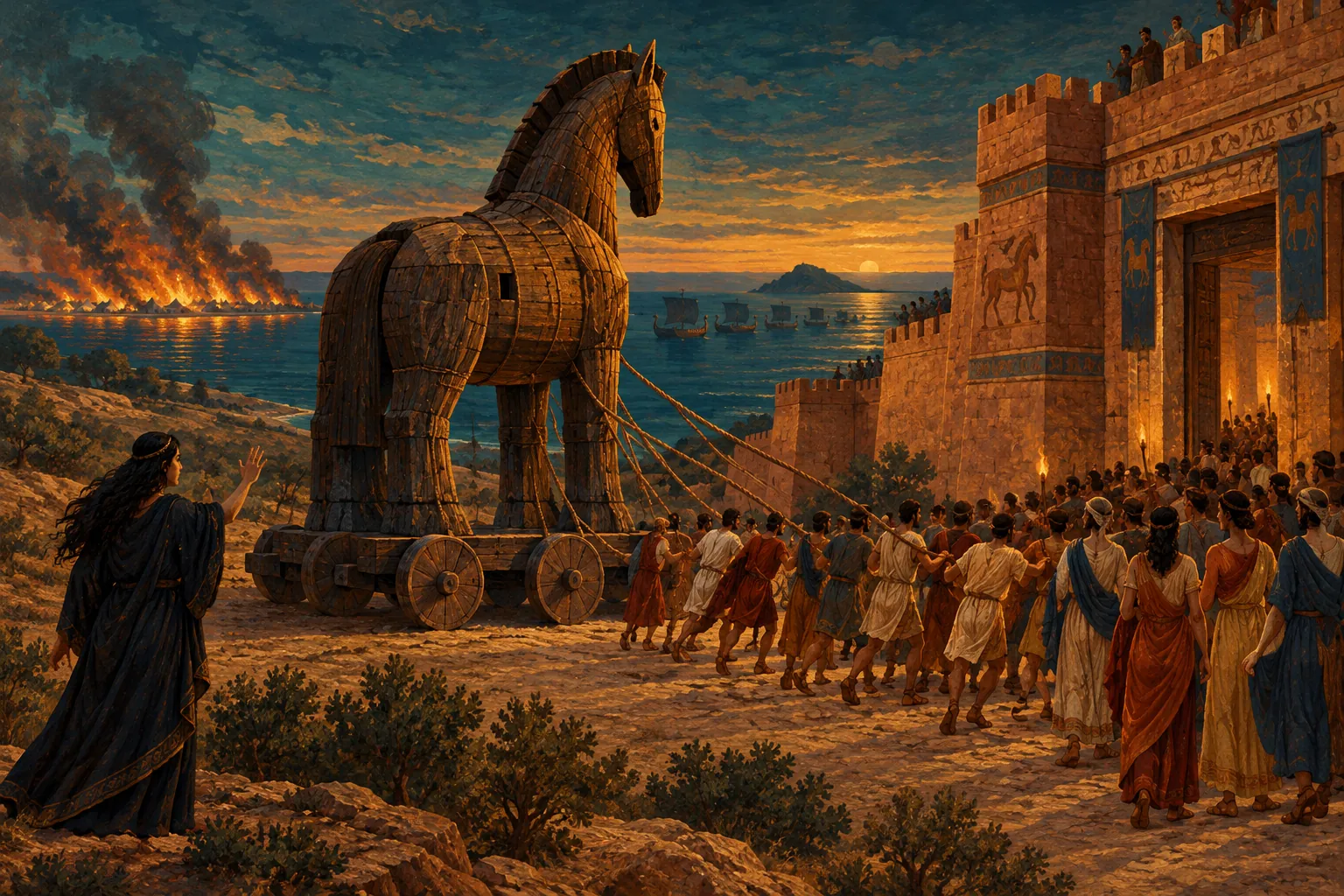
When force fails, the Greeks try a trick. A craftsman named Epeius builds a huge hollow horse of wood, and a band of Greek fighters climbs inside.
The rest of the army burns its camp and sails out of sight to the nearby island of Tenedos. At dawn the Trojans find an empty beach and a giant horse.
In Virgil's version, a Greek named Sinon is found left behind. He tells the Trojans that the Greeks have gone home and that the horse is an offering to Athena, built too large to pass through the gates.
The priest Laocoön is not fooled. He warns, “I fear the Greeks, even when they bring gifts” (Aeneid 2, our translation of the Latin).
He hurls a spear at the horse, and soon afterwards two sea serpents kill him and his sons. The Trojans read this as a sign that the horse is sacred.
The prophetess Cassandra also warns them, and as her fate decrees, nobody believes her. The Trojans open a gap in their wall, pull the horse inside and celebrate the end of the war.
The night Troy fell
When the city is asleep, Sinon lets the hidden warriors out of the horse. They open the gates, and the fleet returns from Tenedos under cover of night.
Troy is burned and plundered, and King Priam is killed. The Aeneid follows one survivor, Aeneas, who carries his old father on his back and leads his young son by the hand out of the burning city.
His escape begins a long journey that Virgil links to the founding of Rome. Helen is taken back by Menelaus, and Homer's Odyssey shows her at home in Sparta years later, while Odysseus struggles for ten more years to reach his own home.
Where the story comes from
No single book holds the whole story. Each ancient text keeps its own piece.
- Homer's Iliad: a few weeks in the tenth year, ending with Hector's funeral. No horse and no fall of Troy.
- Homer's Odyssey: short mentions. In Book 4, Menelaus remembers how Helen walked around the horse and called to the men inside in the voices of their wives, while Odysseus kept them silent. In Book 8, the singer Demodocus performs the horse's story at a feast, and Odysseus weeps.
- Virgil's Aeneid, Book 2: the fullest account, with Sinon, Laocoön, the serpents and the burning city, told by Aeneas.
- The Epic Cycle: lost poems such as the Cypria (the causes, including the contest of the goddesses), the Little Iliad and the Sack of Ilium, known today through summaries.
Virgil wrote between about 29 and 19 BCE, long after Homer, and he tells the tale from the Trojan side. That is one reason the horse feels like a cruel trap in his version.
How the versions differ
Ancient storytellers did not agree on every detail. The purpose of the horse, how many warriors hid inside and how the city was entered change from source to source.
Helen's part changes too. In the Odyssey she is a restored queen at home in Sparta, while in Euripides' play Helen only a phantom goes to Troy and the real Helen waits in Egypt.
Later poets add names, numbers and scenes. Treat those as retellings built on the older core, not as the Homeric version.
Myth and archaeology: Troy at Hisarlik
A real city lies under the mound of Hisarlik, in north-western Turkey near the Dardanelles. Frank Calvert and Heinrich Schliemann dug there in the 1860s and 1870s, and later teams found many layers of settlement, now labelled Troy I to IX.
The Late Bronze Age levels (Troy VI and VII) show a strong fortified citadel. One layer, Troy VIIa, was destroyed by fire at around 1200 to 1180 BCE, and Hittite texts of the same age mention a western place called Wilusa that many scholars link with Ilios, the Greek name for Troy.
What the ground does not show is a ten-year siege led by Agamemnon, a wooden horse or Helen. Ideas that the horse was a siege machine, or a memory of an earthquake, have been suggested, but none can be proved.
The fair summary is that Troy was a real place, and the Greek epics are poetry built on it over centuries of retelling.
What it means
The horse is a story about trust. A gift that looks like surrender turns out to be the weapon.
It also sets two kinds of strength side by side: the force of Achilles could not take Troy, but the cunning of Odysseus could.
Virgil adds a darker note, because the Trojans' own longing for peace makes them believe a lie. Today a “Trojan horse” means anything harmless-looking that hides a threat, and computer security borrowed the name for malicious software.
Common misconceptions
- “The horse is in the Iliad.” It is not. The poem ends before the city falls.
- “Homer tells how Achilles died of an arrow in the heel.” The Iliad only foretells his death, and the heel story comes from later writers.
- “The face that launched a thousand ships is Homer.” That line comes from Christopher Marlowe's play Doctor Faustus, written in the late 1500s.
- “The Greeks offered the horse as a gift.” In Virgil, “an offering to Athena” is the lie told by Sinon. The horse is a trap.
- “Archaeology proved the legend.” It showed that a city called Troy plausibly existed, not that the story happened.
Read next
Greek mythology explained maps the gods and heroes behind this war.
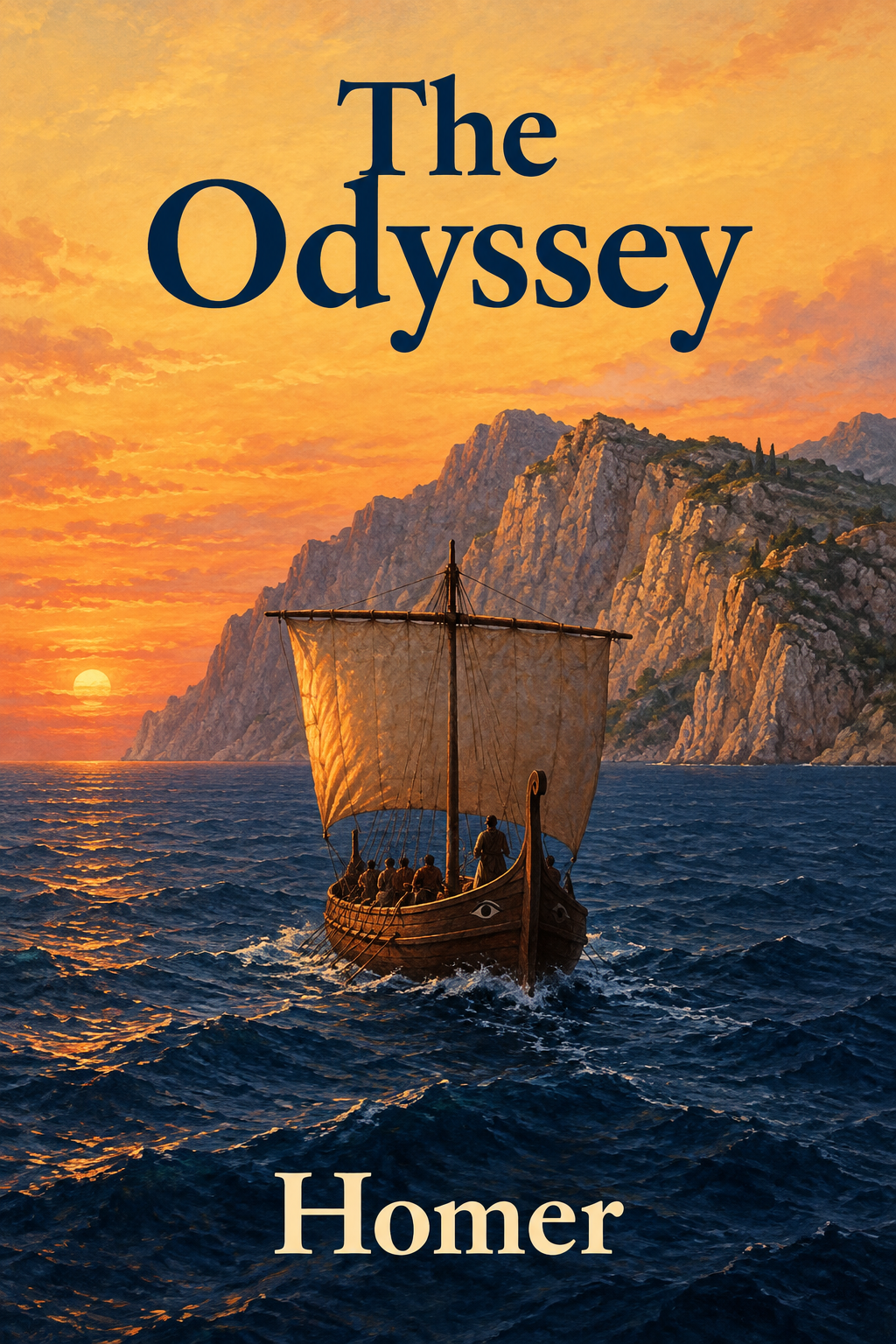
The Odyssey follows Odysseus on his long way home after Troy, and includes the singer who tells the story of the horse.