In five minutes
Persephone is the daughter of Demeter, goddess of grain, and of Zeus. Hades, lord of the dead and Zeus's brother, carries her down to the underworld to be his queen.
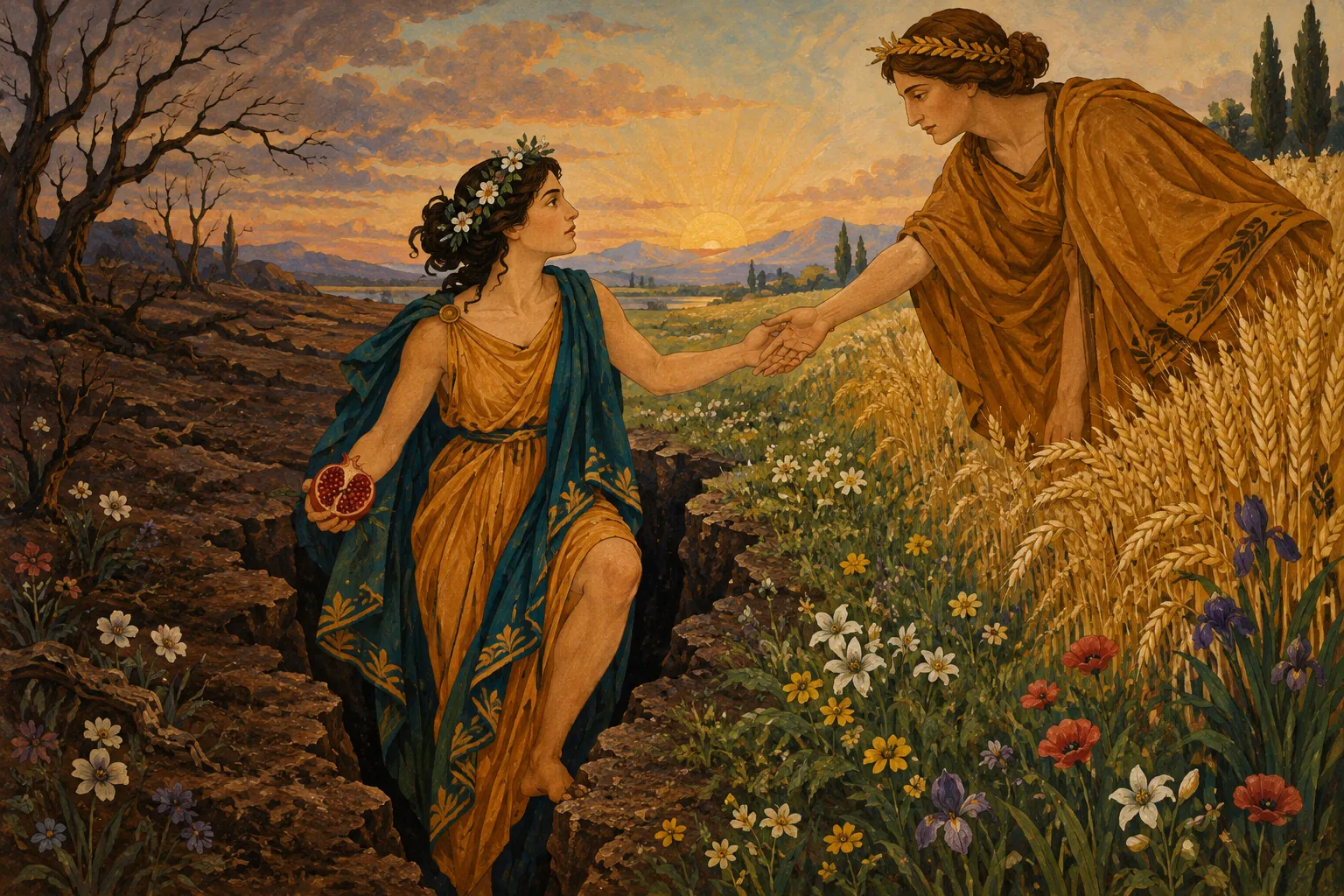
Demeter's grief makes the earth barren, and Zeus is forced to order Persephone's return. Because she has tasted food of the dead, she cannot stay above for good, so her year is divided between two worlds.
The oldest complete telling is the Homeric Hymn to Demeter, a Greek poem from about the seventh or sixth century BCE. The best-known Latin version is in Book 5 of Ovid's Metamorphoses, where the goddesses are called Proserpina and Ceres.
For the wider world this tale belongs to, start with Greek mythology explained.
The story
What follows is the version of the Hymn, with Ovid's changes set apart in the next section. Persephone is also called Kore, which simply means "the maiden".
The meadow opens
Persephone is picking flowers in a meadow with the daughters of Oceanus. She reaches for a narcissus of astonishing beauty, a flower grown as a lure.
The earth splits open, and Hades rises in a golden chariot drawn by immortal horses. He seizes her and drives her down, while she cries out to her father.
Zeus does not answer, because he has already agreed to the abduction. Only Hecate, in her cave, and Helios, the sun, hear her voice.
Demeter searches
Demeter hears her daughter's cry and tears her veil from her head. For nine days she wanders the earth with burning torches, and she neither eats nor bathes.
On the tenth day Hecate tells her that she heard the cry but did not see the abductor. The two go to Helios, who sees everything, and he tells Demeter that Zeus gave Persephone to Hades.
Helios adds that Hades is no unworthy husband for a goddess. Demeter is not comforted, and in her anger at Zeus she leaves Olympus to live among mortals.
The old woman at Eleusis
Disguised as an old woman, Demeter sits down beside a well near Eleusis. The daughters of King Celeus find her and take her home, where the queen, Metaneira, hires her as nurse to the baby Demophon.
In secret, Demeter feeds the child ambrosia and hides him in the fire at night to burn away his mortality. Metaneira sees it and screams, and the goddess stops the rite and throws off her disguise.
She stands revealed, tall and radiant, and orders the people of Eleusis to build her a temple and an altar. She promises to teach them her own rites.
The year without harvest
Demeter shuts herself inside the new temple and mourns. She makes the year the cruelest humans have known, and no seed sprouts in the ploughed fields.
If the famine goes on, people will die and the gods will lose their offerings. Zeus sends messenger after messenger, but Demeter refuses to let the earth grow until she sees her daughter.
At last Zeus sends Hermes down to Hades with an order to bring Persephone back. Hades agrees, but he secretly gives her a pomegranate seed to eat as she leaves.
The return
Mother and daughter meet again, and Demeter asks whether Persephone ate anything below. If she did not, she can live above forever, but if she did, she must go back for part of each year.
Persephone admits the seed and tells her mother the whole story. Zeus, through Rhea, then settles the matter: she will spend a third of the year in the underworld and the rest with the gods.
Demeter lets the fields bloom again, and the whole earth is covered with leaves and flowers. Before she returns to Olympus she teaches her sacred rites to the leaders of Eleusis.
Where the story comes from
The Homeric Hymn to Demeter is a poem of roughly 490 lines. Despite its name it was not written by Homer, and it is usually dated to the seventh or sixth century BCE.
Hesiod's Theogony, a little earlier, mentions Persephone only briefly. It says Hades took her with Zeus's consent and that she is now the wife of the lord of the dead.
The Roman poet Ovid retells the story in Book 5 of the Metamorphoses, written around 8 CE. He turns it into a long, lively episode set in Sicily, and the goddesses appear under their Latin names Proserpina and Ceres.
Ovid's Hades is called Dis, or Pluto, and he is struck by one of Cupid's arrows. That romantic detail is Ovid's own and does not appear in the Greek hymn.
How the versions differ
In the Hymn the meadow is the Nysian plain, a place the poet does not locate on any map. In Ovid it is the meadow of Enna in Sicily, beside a lake and a spring.
The pomegranate also changes. In the Hymn it is a single seed that Persephone is made to swallow, and in Ovid it is seven seeds she eats of her own accord, seen by a spirit called Ascalaphus, whom Ceres turns into an owl.
The length of her stay below differs too. The Hymn says a third of the year, while Ovid has Jupiter split the year into two equal halves.
Ovid also adds the nymph Cyane, who tries to block Dis's path and is turned into a pool, and Arethusa, who tells Ceres what she saw underground. These characters have no place in the Hymn.
What it means
The most familiar reading links Persephone's return to spring and her absence to the barren part of the year. The Hymn does tie her return to the earth flowering with spring blooms, though its main interest is grain and what the gods owe the people who grow it.
The poem is also the founding story of the Eleusinian Mysteries, a secret ritual held at Eleusis for about two thousand years. What happened inside is poorly known, since initiates kept it secret, but the Hymn explains why the rites began.
It is also a story about a mother's grief and about power. Zeus and Hades settle Persephone's fate between them, and the poem lets Demeter's anger undo their plan.
Finally, it is a story about crossing a boundary. Persephone becomes the one goddess who belongs to both the living and the dead, which is why the later Greeks pray to her for the dead and for the grain alike.
The same underworld appears in Orpheus and Eurydice, where a mortal tries to talk his way past its rulers.
Common misconceptions
- "Hades kidnapped her alone." In the Hymn, Zeus agrees to the marriage beforehand, which is why Demeter's quarrel is as much with him as with Hades.
- "Hades is the devil." He is the god of the dead and the ruler of a place, not a force of evil, and Helios even calls him a fitting husband.
- "She ate six seeds, so she spends six months below." That number is a later tidy retelling, because the Hymn has one seed and a third of the year, while Ovid has seven seeds and half a year.
- "Persephone and Kore are different goddesses." Kore, the maiden, is the same figure as Persephone, the queen of the dead.
- "It is only a weather story." The seasons are one meaning among several, and the poem is equally about grief, divine politics and the rites of Eleusis.
Read next
- Greek mythology explained places Demeter, Hades and Zeus in the family of the Olympian gods.
- Orpheus and Eurydice follows another journey into the underworld, this time by a living man.