In five minutes
George Orwell was the pen name of Eric Arthur Blair (1903–1950), an English novelist, essayist and journalist. He is best known for two short books, Animal Farm (1945) and Nineteen Eighty-Four (1949), which turned the abuse of political power into stories almost anyone can follow.
Orwell was not a science fiction specialist, and he never set out to join the genre. Even so, Nineteen Eighty-Four is one of the founding works of dystopian fiction, and writers still borrow its ideas about surveillance, controlled language and rewritten history.
This page belongs to our History of Science Fiction series. It covers his life, his main books, his essays and the words he left behind.
Spoiler note: the page describes the setup of his two famous novels but never reveals how either one ends.
Who was George Orwell?
Eric Blair was born on 25 June 1903 in Motihari, British India, where his father worked in the colonial opium department. He came to England as a small child and later won a scholarship to Eton College.
He skipped university and joined the Indian Imperial Police in Burma in 1922. After five years he resigned, with a lasting distrust of empire.
Back in Europe he lived cheaply in Paris and London and wrote about it in Down and Out in Paris and London (1933). It was the first book printed under the name George Orwell, a name taken from the River Orwell in Suffolk.
In 1936 he went to Spain, joined a militia during the Civil War and was shot through the throat in 1937. His account, Homage to Catalonia (1938), shows how political lies spread even among people fighting on the same side.
He married Eileen O'Shaughnessy in 1936, and the couple adopted a son, Richard, in 1944. Eileen died in March 1945, during an operation.
In the Second World War he worked for the BBC's Eastern Service and then as literary editor of the left-wing weekly Tribune. He wrote much of Nineteen Eighty-Four on the Scottish island of Jura while ill with tuberculosis.
The novel appeared in June 1949, and Orwell died in London on 21 January 1950, aged 46.
His main books
Burmese Days (1934)
A novel about a timber merchant in a small colonial town in Burma. It draws on his years as a police officer there.
The Road to Wigan Pier (1937)
Reporting on the lives of coal miners and the unemployed in northern England. The second half argues about socialism and why it struggles to win people over.
Homage to Catalonia (1938)
His first-hand account of the Spanish Civil War. It is often named as the moment his political writing found its voice.
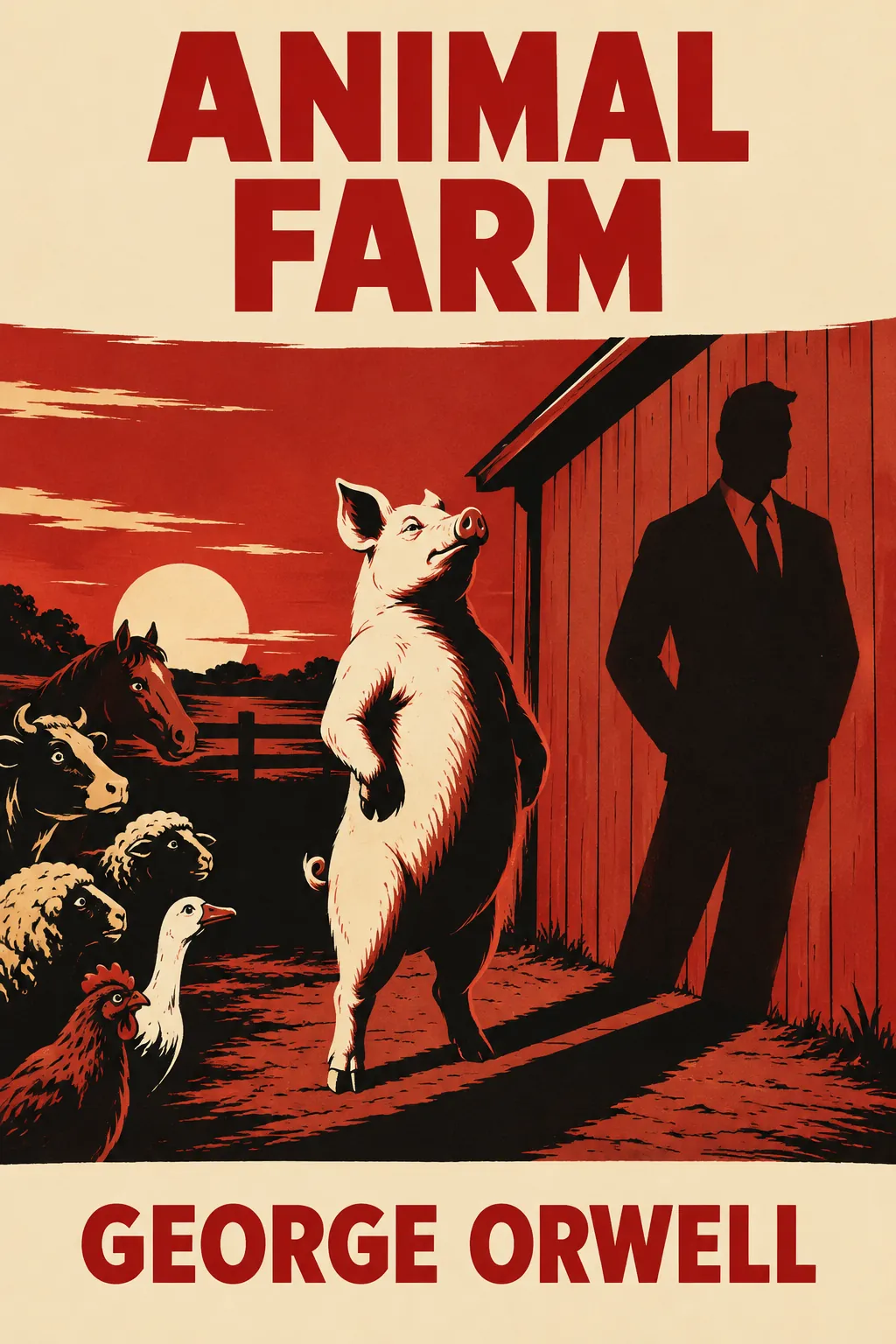
Animal Farm (1945)
The animals of Manor Farm drive out their human owner and run the farm themselves. Soon the pigs, led by Napoleon, take more and more power for themselves.
It is read as a fable about the Russian Revolution and the rise of Stalin. Several publishers turned it down during the war because the Soviet Union was a British ally.
Its best-known line is “All animals are equal but some animals are more equal than others.” (Chapter 10)
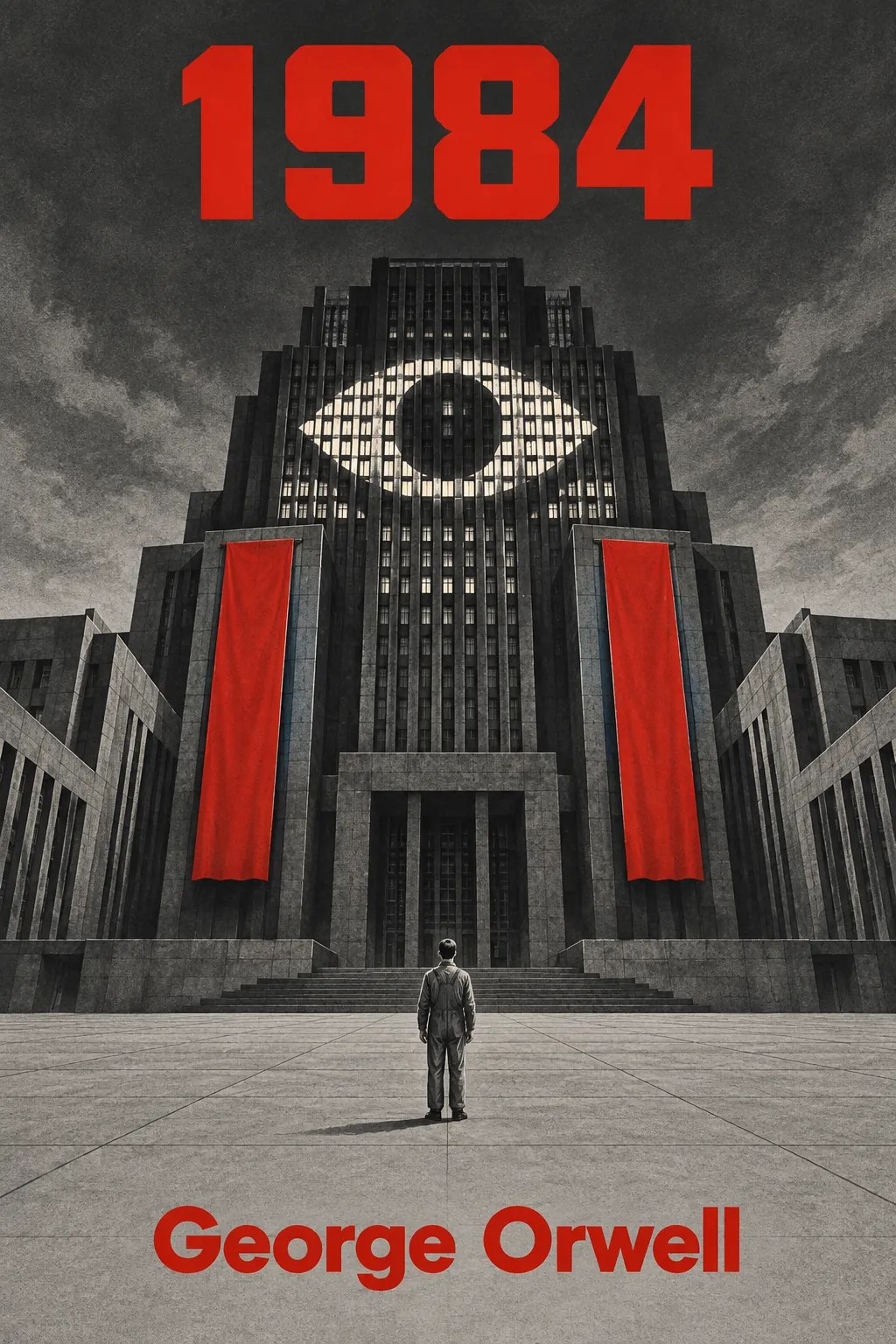
Nineteen Eighty-Four (1949)
Winston Smith lives in a London that belongs to the one-party state of Oceania. He works at the Ministry of Truth, where his job is to change old newspaper records so that they match whatever the Party says today.
Posters warn that Big Brother is watching, and a telescreen in every home watches back. Winston begins a small, secret act of rebellion by keeping a diary.
Where Orwell meets science fiction
Nineteen Eighty-Four is set in the future, so it is usually shelved with science fiction. But Orwell cared less about machines than about power.
His question was what happens when a state controls information, language and memory. The telescreen is only a prop for that idea.
In January 1946 he reviewed Yevgeny Zamyatin's novel We, an earlier story of a regulated, glass-walled society. Readers often compare it with Nineteen Eighty-Four.
Another common comparison is Aldous Huxley's Brave New World (1932). In 1949 Huxley wrote to Orwell to say that people might be controlled by pleasure and distraction more than by fear.
Many readers still hold the two books side by side when they talk about social media, advertising and state surveillance.
Animal Farm is a fable rather than science fiction. It is still the best first step into Orwell's politics.
The essays and the fight for plain language
Many critics rate Orwell's essays as highly as his novels. In Shooting an Elephant (1936), a young police officer in Burma kills an elephant because a crowd expects it, and sees that empire traps the rulers as well.
In Politics and the English Language (1946) he argues that vague, padded writing helps people hide what they think. His advice is to choose the short, concrete word over the long, fancy one.
In Why I Write (1946) he said that since 1936 his serious work had been against totalitarianism and for democratic socialism.
In an October 1945 essay on the atom bomb he used the phrase “cold war”, one of its earliest appearances, for a world split between nuclear-armed powers.
Words Orwell gave us
Nineteen Eighty-Four added several terms to everyday English.
- Big Brother: the Party's leader, whose face watches from every poster. Today it means any watching authority.
- Doublethink: believing two contradictory things at once and accepting both.
- Newspeak: a shrunken language built so that unwelcome ideas become hard to even think.
- Thoughtcrime: the crime of holding a forbidden opinion, even in silence.
- Memory hole: a chute where inconvenient records are destroyed.
- Orwellian: describing state control of truth, language and private life.
You can read more about the first of these in our guide to Big Brother and the word Orwellian.
Common misconceptions
“Nineteen Eighty-Four was a prediction.” In 1949 Orwell said that the book was meant as a warning about where certain trends could lead, not as a forecast.
“Orwell was against socialism.” He called himself a democratic socialist.
His target was totalitarian rule, whether it came from the right or the left.
“Orwellian just means surveillance.” Cameras are only one part.
The deeper idea in his work is the control of language, history and what people are allowed to think.
“Animal Farm is a children's story.” It reads simply, but it is political satire about revolution turning into dictatorship.
“Orwell was always George Orwell.” His birth name was Eric Blair, and his friends and family used it for his whole life.
Where to start
If you are new to Orwell, begin with Animal Farm. It is short and can be read in an evening.
Then move to Nineteen Eighty-Four, and after that try Politics and the English Language, which takes only a few minutes.
Readers who want the real history behind both novels should finish with Homage to Catalonia.
Legacy
The Orwell Prize, founded in 1993, honours political writing in the spirit of his work. His name has also become an adjective, and people still argue about what does and does not count as Orwellian.
Read next
- History of Science Fiction: the wider story of the genre, and where dystopias fit.
- Big Brother (Orwellian): where the phrase comes from and how it is used today.
- 1984 by George Orwell: our full study guide to his best-known novel.
- Animal Farm by George Orwell: a study guide to the farmyard fable.