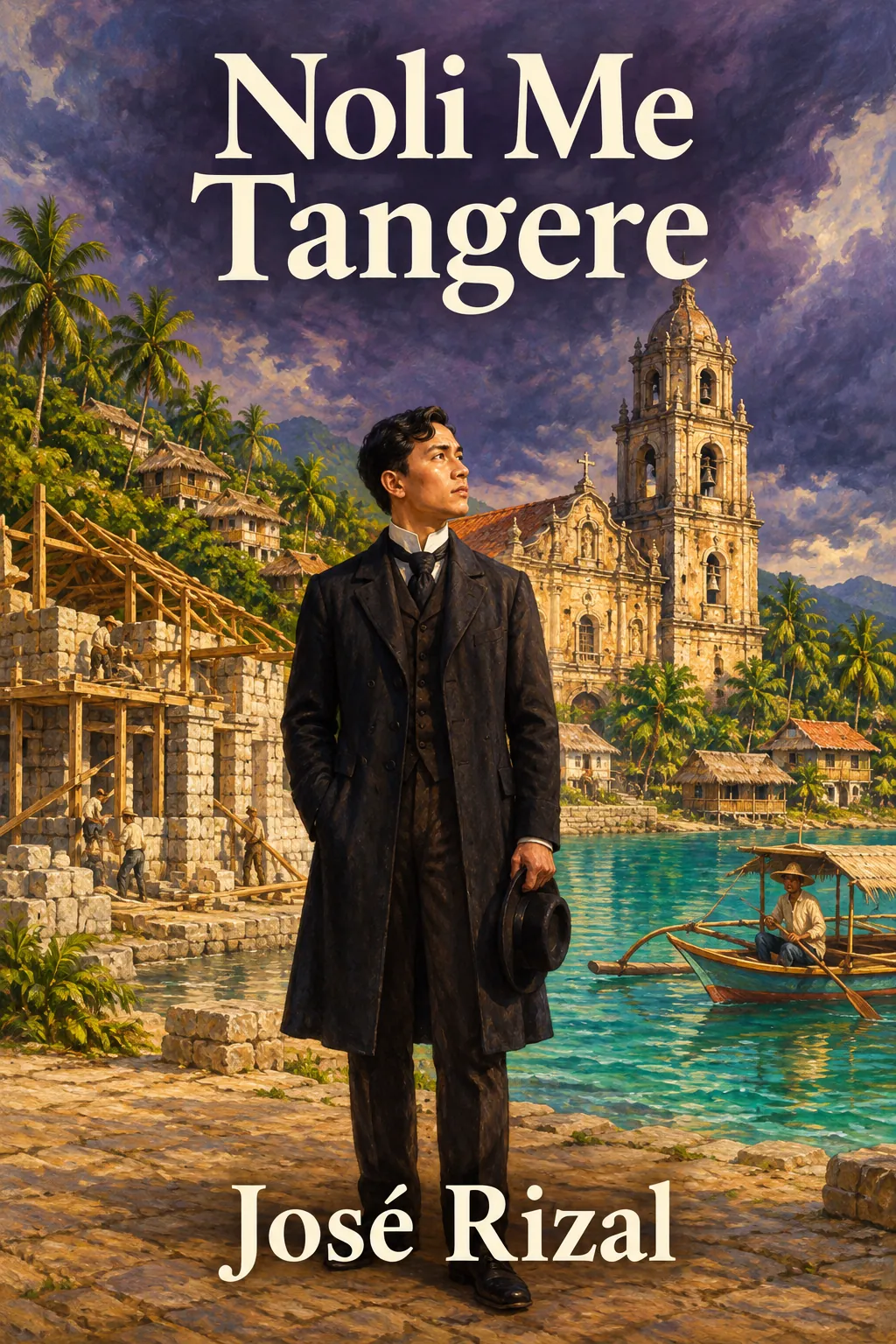
Noli Me Tangere
oleh José Rizal
Noli Me Tangere (1887) is José Rizal's novel about Crisóstomo Ibarra, a young Filipino who returns home after seven years in Europe, full of plans to build a school. In the town of San Diego he meets the power of the friars and of the officials who protect them. Through his love for María Clara and his friendship with the hunted boatman Elías, the book shows how abuse, fear and silence damage a whole society. It is the first of Rizal's two novels and a Grade 9 set text in the Philippines.
Ide Utama
"Noli Me Tangere shows a Philippines held back by abusive friars, corrupt officials and fearful neighbours. Rizal argues that real change needs education, courage and honest reform, not good intentions alone."
Wawasan Utama
Power without accountability
Rizal shows a town where religious, police and social power belong to the same small circle. Because nobody can check them, small cruelties grow into serious injustice. The novel's target is the system that lets abuse go unchecked, not every person in authority.
Father Dámaso insults Ibarra and has his father's body removed from its grave, and nothing happens to him. Later, Father Salví uses the false uprising to destroy Ibarra, and the authorities accept it.
Education as hope and as a threat
Ibarra believes a school can change San Diego, but the book also shows why education worries the powerful. The old schoolmaster describes classes built on fear and memorising, which keep pupils obedient. Rizal suggests that real learning builds independent minds.
The schoolmaster's account of beatings and rote lessons contrasts with Ibarra's plan for a modern school, which draws immediate attempts at control from the friars' supporters.
Reform or resistance
Ibarra and Elías answer injustice in opposite ways: one through lawful reform, the other from the experience of being hunted. Rizal does not simply choose a side. Both men are honest, and both are defeated by a system built on fear.
Elías saves Ibarra twice and finally gives his life so that Ibarra can escape. Their friendship shows that the two approaches need each other, even while they disagree.
Fear, silence and imitation
The book shows how ordinary people help abuse survive. Some stay silent, some turn on a neighbour who is accused, and some copy the rulers in the hope of rising. Rizal asks readers to see their own part in these habits.
After Ibarra's arrest, neighbours who praised him now join the accusers. Capitán Tiago protects his wealth by pleasing the powerful, and Doña Victorina pretends to be Spanish.
Rincian Bab
Chapter-by-chapter summary (Buod ng mga Kabanata)
Spoiler warning: this section covers the whole plot, including the ending.
The novel has 63 numbered chapters and an epilogue (some editions count the epilogue as chapter 64), so the chapters (kabanata) are grouped into nine parts here.
Part 1: The Homecoming (Chapters 1–8)
Capitán Tiago holds a dinner in Manila to welcome Crisóstomo Ibarra, who has just returned after seven years of study in Europe. Most guests praise him, but Father Dámaso, a friar who knew his family, insults him in front of everyone.
Ibarra stays polite, and Lieutenant Guevara quietly tells him that his father, Don Rafael, died in prison after the priest turned the town against him. Ibarra then meets María Clara, Tiago's daughter and his childhood sweetheart, and the two renew their promise to each other.
Why it matters: the dinner introduces the three forces that drive the plot, which are Ibarra's idealism, the friars' arrogance and a love that the powerful will try to control.
Part 2: San Diego (Chapters 9–14)
Ibarra travels to his home town, where the priest and the Guardia Civil matter more than the elected officials. At the cemetery, a gravedigger tells him that his father's body was dug up and thrown into the lake.
Ibarra is shaken but does not seek revenge. He decides to honour his father by building a modern school instead.
Why it matters: his answer to cruelty is reform, and the rest of the book tests whether that answer can work.
Part 3: Sisa and Her Sons (Chapters 15–19)
Sisa is a poor mother whose sons, Basilio and Crispín, work as church sacristans. Crispín is accused of stealing money and is beaten, then he disappears, while Basilio is wounded and escapes.
Sisa slowly loses her mind as she searches for them. An old schoolmaster also explains how beatings and rote memorising ruin the classroom.
Why it matters: the chapters show that the poor pay the price for the abuse of power, and they explain why Ibarra's school matters.
Part 4: The School and the Lake (Chapters 20–27)
Ibarra's school plan reaches the town council, where the friars' supporters try to control it. On a picnic at the lake, a crocodile attacks, and Elías, a quiet boatman, saves Ibarra's life.
The old thinker Pilosopo Tasyo then advises Ibarra to seek the backing of the priest and the authorities.
Why it matters: Elías enters as a counterpoint to Ibarra, a man who knows that reform alone may not be enough.
Part 5: Fiesta and Banquet (Chapters 28–34)
The town celebrates its fiesta with a sermon, a procession and the laying of the school's foundation stone. Elías again saves Ibarra when a rigged derrick collapses and kills another man instead.
At the banquet, Dámaso insults the memory of Ibarra's father. Ibarra loses control and raises a knife at the priest until María Clara stops him.
Why it matters: the one moment when Ibarra loses his temper gives his enemies the excuse they need.
Part 6: Excommunication and Intrigue (Chapters 35–44)
Dámaso's allies have Ibarra excommunicated, but the friendly Governor-General lifts the punishment. Meanwhile Doña Consolación, the wife of the alferez, mistreats Sisa, and Father Salví quietly works against Ibarra.
Why it matters: these chapters show how the church, the army and the social elite protect each other.
Part 7: Elías and Ibarra (Chapters 45–51)
Elías reveals that he is hunted by the authorities and tells Ibarra about the injustice that destroyed his family. He asks Ibarra to use his influence for the poor.
Ibarra believes in lawful reform and the goodwill of the government.
Why it matters: this is the philosophical heart of the book, the debate between patient reform and harder resistance.
Part 8: The False Uprising (Chapters 52–58)
A staged attack on the barracks breaks out, and Salví and his hired men make sure the blame falls on Ibarra. Ibarra is arrested, and the neighbours who once praised him now turn on him.
Why it matters: the town's fear makes it easy to trick, and the system accepts a forged accusation.
Part 9: Escape, Loss and Epilogue (Chapters 59–63 and Epilogue)
María Clara is pressed to marry a Spaniard, Alfonso Linares, and begs Dámaso to let her enter a convent. Ibarra escapes by boat with Elías, who draws the pursuers away and is shot.
On Christmas Eve, the dying Elías bids farewell to the dawn he will not see and asks those who live to remember the people who fell in the night. Sisa finds Basilio but dies soon after.
The epilogue closes the story with María Clara behind convent walls and no justice for the town.
Why it matters: the ending offers no easy victory, so the reader is left to carry the question forward.
Characters (Mga Tauhan)
- Crisóstomo Ibarra: the idealistic hero who returns from Europe to build a school. He trusts the law and the government to bring change.
- María Clara: Ibarra's sweetheart, raised by Capitán Tiago. She is gentle and obedient but chooses the convent over a forced marriage.
- Elías: a boatman hunted by the authorities. He saves Ibarra and sees the poor's suffering clearly.
- Padre Dámaso: an arrogant friar who insults Ibarra and abuses his power.
- Padre Salví: a quiet, scheming friar who plots Ibarra's downfall.
- Capitán Tiago: a rich man who protects his wealth by pleasing the powerful.
- Sisa: a poor mother whose grief at losing her sons drives her mad.
- Pilosopo Tasyo: an old thinker, laughed at by the town, who warns Ibarra about the road ahead.
Writing about this book (Aral at Tema)
Grade 9 teachers often ask about theme (tema), character (tauhan) and the aral, so plan your answer around one clear idea.
Start with a thesis, for example: Rizal shows that abuse of power survives when ordinary people stay afraid.
Support it with two or three events, such as Crispín's punishment, the insult to Don Rafael's memory and the false uprising. Explain what each event proves instead of stopping at the plot (buod).
For a character analysis (pagsusuri ng tauhan), pick one trait and follow it across the book. Ibarra's idealism, for example, is strongest in the school plan and is tested at the banquet and during the false uprising.
For a reflection or reaction paper, say what the book made you think and connect it to your own community.
Keep quotes short, give the chapter, and use your own words for everything else.
The sample answers at the end of this page are for learning, so compare them with your own work instead of copying them.
Ambil Tindakan
Langkah praktis yang bisa Anda terapkan hari ini:
-
Treat the aral as the point of your essay: say what a character's choice teaches, then support it with one clear event.
-
Compare characters by their methods, not only their traits. Ibarra and Elías make the best pair.
-
Notice who benefits from silence in a story, and ask who might speak up in your own community.
-
Keep quotes short and give the chapter, then explain them in your own words.
Kutipan Menarik
"“To my Fatherland.” (Dedication, our translation)"
— José Rizal
"“I will do what the ancients did with their sick: place them on the temple steps, so each visitor may suggest a cure.” (Dedication, our translation)"
— José Rizal
"“I die without seeing dawn shine on my country. You who will see it, welcome it, and remember those who fell in the night.” (Chapter 63, our translation)"
— José Rizal
Siapa yang Harus Membaca Ini
Best for Grade 9 and 10 students in the Philippines who are studying Noli Me Tangere for class, and for anyone who wants a clear overview before reading the full novel. It also helps readers who are new to Philippine history and want to understand why the book still matters.
Tentang José Rizal
José Rizal (1861–1896) was a Filipino physician, writer and reformer born in Calamba, Laguna. He studied medicine in Madrid and wrote Noli Me Tangere in Europe, publishing it in Berlin in 1887, followed by El Filibusterismo in 1891. He was executed in Manila in December 1896 and is the Philippines' national hero.
Ringkasan Ditulis Oleh

Software Engineer & Writer
Software engineer with a passion for distilling complex ideas into actionable insights. Writes about finance, investment, entrepreneurship, and technology.
Lihat semua ringkasan →Ulasan
Belum ada ulasan. Jadilah yang pertama berbagi pemikiran Anda!
Tulis Ulasan
Lanjut membaca
Jelajahi topik: Panduan BelajarRingkasan

Educated: Sebuah Memoar tentang Keluarga dan Pengetahuan oleh Tara Westover
Tara Westover
Memoar tentang seorang wanita yang lahir di keluarga survivalist ekstrem tanpa akses sekolah atau medis, namun berhasil menempuh pendidikan hingga…

Ringkasan Atomic Habits: Membangun Kebiasaan Baik dengan Langkah Kecil
James Clear
Atomic Habits menjelaskan empat hukum untuk merancang kebiasaan: jelas, menarik, mudah, dan memuaskan. Clear menghubungkannya dengan sistem serta identitas; contoh…

The Psychology of Money
Morgan Housel
Kupas tuntas pemikiran Morgan Housel tentang bagaimana aspek psikologis memengaruhi keputusan keuangan dan perjalanan kita dalam membangun kekayaan.

Think and Grow Rich
Napoleon Hill
Bagaimana jika rahasia kekayaan dan kesuksesan bukan terletak pada strategi finansial yang rumit, melainkan pada kekuatan pikiran Anda sendiri? Buku…
Artikel

Lubang Hitam dalam Fiksi Ilmiah
Lubang hitam adalah wilayah ruang angkasa dengan gravitasi yang begitu kuat sehingga tak ada apa pun, bahkan cahaya, yang bisa…
Mitologi Yunani dijelaskan
Mitologi Yunani adalah kumpulan kisah yang diceritakan bangsa Yunani kuno tentang dewa, Titan, dan pahlawan. Sumber tertulis tertuanya adalah Teogoni…

Nebula Award: Pengertian dan Pemenang Terkenalnya
Nebula Award adalah penghargaan fiksi ilmiah dan fantasi Amerika yang dipilih oleh para penulis profesional. Science Fiction and Fantasy Writers…