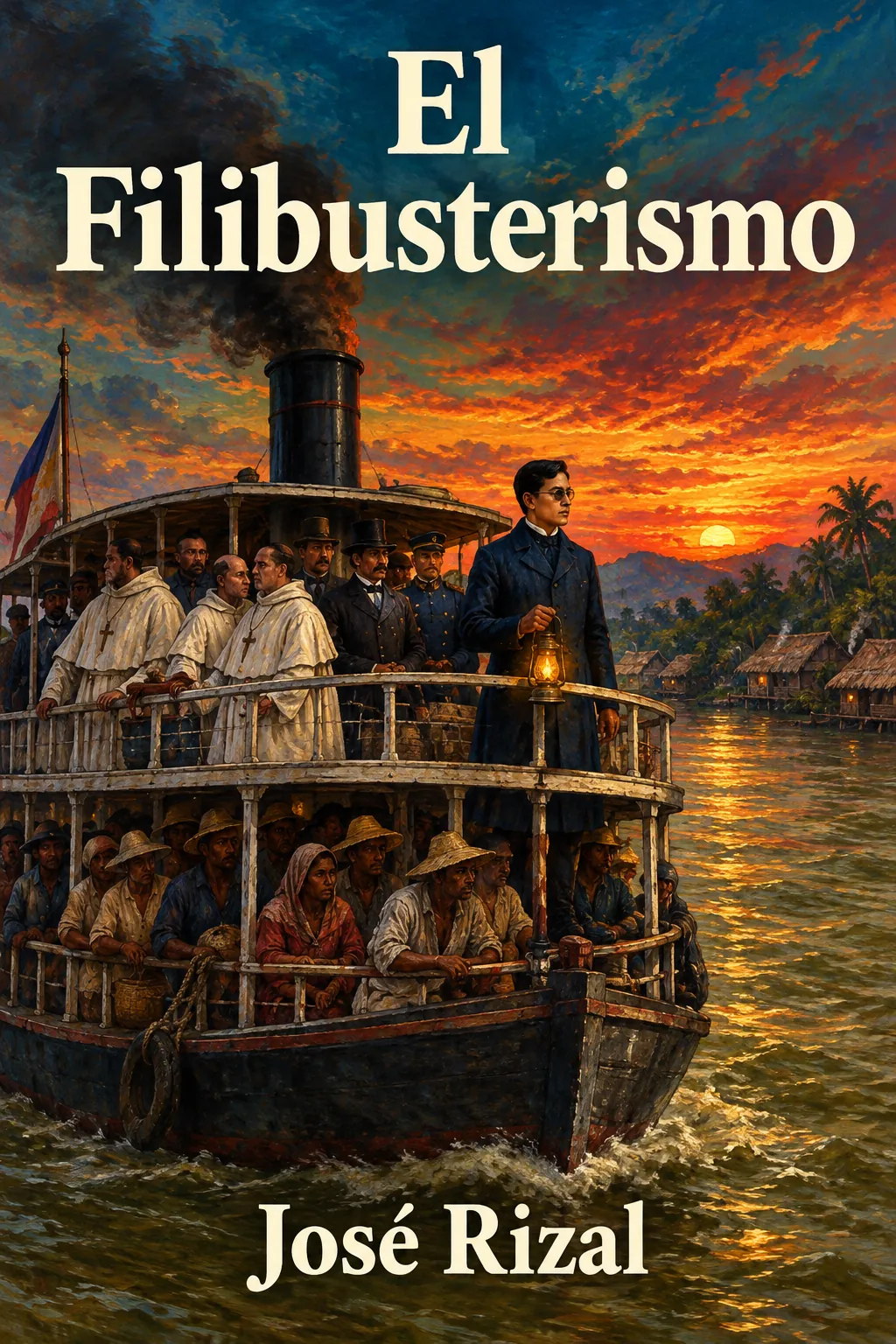
El Filibusterismo
oleh José Rizal
El Filibusterismo (1891) is José Rizal's sequel to Noli Me Tangere. A wealthy jeweler called Simoun returns to the Philippines and becomes an adviser to the Captain-General, but he hides a secret identity and a plan for revenge. Around him, farmers, students and officials show how land grabs, rote schooling and corrupt rule wear people down. As the date of a grand wedding feast approaches, the novel asks what price a nation should pay for change, and who has the right to decide.
Ide Utama
"Thirteen years after Noli Me Tangere, a rich jeweler named Simoun plots revenge on a corrupt colony, while the novel asks whether violence can deliver justice or whether freedom must be earned through character."
Wawasan Utama
Injustice is built into the system
Rizal shows that abuse does not come only from bad individuals. It is carried by rents, courts, schools and customs that favour the powerful, so the farmer, the student and the servant all lose. Each institution looks respectable on its own, yet together they close every honest exit, which is why decent people drift toward anger or despair.
Kabesang Tales develops his farm by his own labour, but the friars' estate raises the rent and then claims the land, and the courts and officials side with the owners. His daughter Juli then has to sell her freedom as a servant to pay for his release.
Violence cannot be the answer to violence
Simoun wants the colony to become worse so that people will rise. The book shows that this plan makes more victims and makes the avenger resemble the oppressor, and Rizal treats this as a moral failure. Even readers who understand Simoun's pain are asked to see that a just goal does not excuse any method.
Simoun's explosive lamp at the wedding feast would kill innocent guests along with the powerful, and it is stopped when Isagani, warned by Basilio, throws it into the river in an act of conscience.
Education must teach thinking
Rizal argues that schools which reward memory and obedience produce discouraged students, not free citizens. A nation needs learners who can question and judge, and a school that punishes questions teaches people to accept what they are told, including injustice.
Plácido Penitente leaves school because his class is a routine of recitation. The students' petition for a Spanish academy is delayed and then, by Don Custodio's ruling, handed to a religious order, so the students lose control of their own idea.
Freedom must be deserved
Padre Florentino says a people who are not ready for freedom may simply replace one tyranny with another. Real change needs character, sacrifice and just means as well as courage, and it cannot be handed over by a lucky stroke or a sudden uprising.
In the last chapter, Florentino tells the dying Simoun that justice cannot be won by hatred. He then lets the sea take Simoun's jewels so that they cannot be used for harm, leaving the future to people who earn it.
Rincian Bab
Chapter-by-chapter summary (Buod ng bawat kabanata)
Spoiler warning: this section covers the whole plot, including the ending.
The novel has 38 kabanata. They are grouped here into nine parts so that the story is easier to follow.
Part 1: Kabanata 1–3, The Steamer Tabo
The crowded steamer Tabo crawls along the Pasig River and Laguna de Bay toward Laguna. On the upper deck, friars, officials and wealthy passengers argue about how to speed up the river trip, while ordinary travelers sit below.
The jeweler Simoun, always in dark glasses, stands on the upper deck near the powerful, and the thoughtful retired priest Padre Florentino is among the travelers. The talk goes nowhere, which shows from the first pages how much talk and how little action the people at the top produce.
Part 2: Kabanata 4–6, Kabesang Tales and Basilio
Kabesang Tales turns wild land into a good farm, but the friars' estate claims it and keeps raising the rent. He fights in court and loses, and Simoun visits him, takes Maria Clara's locket and leaves a revolver in exchange.
Basilio, now a medical student, goes home to San Diego for the holidays to see Juli, Tales's daughter, whom he hopes to marry. This part matters because it ties the injustice of land to the lives of the young characters we will follow.
Part 3: Kabanata 7–10, Simoun Revealed
In a forest near his mother's grave, Basilio meets Simoun in Kabanata 7 and learns that he is Crisostomo Ibarra, who is still alive. Simoun explains his plan for a revolt and invites Basilio to join, but Basilio prefers to finish his studies.
In the village, Kabesang Tales takes to the hills as an outlaw, and Juli must serve a wealthy pious woman to repay the ransom. The village gossip shows how the "respectable" often look away from suffering.
Part 4: Kabanata 11–14, Los Baños and the Students
The Captain-General holidays at Los Baños (Kabanata 11), where Plácido Penitente is a clever but unhappy student. In the physics class (Kabanata 13), the teacher rewards memorising and obedience instead of understanding, and Plácido walks away from his studies.
In the house of the students (Kabanata 14), Isagani, Makaraig and their friends plan a petition for an academy that teaches Spanish. The novel uses the classroom to show that colonial schooling does not build thinking citizens.
Part 5: Kabanata 15–21, The Petition and Don Custodio
The petition travels through offices and drawing rooms, starting with the lawyer Señor Pasta (Kabanata 15), where friars and officials care more about their own standing than about the cause. Gossip among merchants, journalists and clergy turns the matter into a game of pride.
In Kabanata 20, Don Custodio, the official who must decide, approves the academy but places it under a religious order, probably the Dominicans of Santo Tomás. The students learn this a little later and feel it is a hollow result, because the friars now control their own idea, and this is where Simoun's arguments start to sound convincing to them.
Part 6: Kabanata 22–26, The Theatre and the Posters
An evening at the theatre (Kabanata 22) shows Manila's elite laughing and flirting, while Isagani watches Paulita Gómez, whom he loves. Their relationship, like the country, is quietly failing.
Then threatening posters appear overnight in public places (Kabanata 26). They raise fear and give the authorities an excuse to arrest the students.
Part 7: Kabanata 27–32, Panic and Arrests
In Kabanata 27, Padre Fernandez and Isagani debate whether the Filipino can ever be heard under the present order. Manila panics about the posters (Kabanata 28), and officials look for someone to blame.
Basilio is arrested although he had nothing to do with the posters. Juli, desperate to help him, goes to Padre Camorra and jumps from a window rather than be harmed (Kabanata 30), and her death shows the system's cruelty at its sharpest.
Part 8: Kabanata 33–35, The Plan and the Feast
Simoun gets Basilio released and invites him again to join the uprising, and this time Basilio is bitter enough to consider it. Simoun prepares a lamp filled with explosive, to be placed at the wedding feast of Paulita and Juanito Pelaez, where the colony's rulers will gather.
At the feast (Kabanata 35), Basilio warns Isagani of the danger. Isagani bursts in, seizes the lamp, throws it out of the window into the river and escapes unrecognised.
The wedding is also the end of Isagani's hopes, so the political plot and the love story meet in a single room.
Part 9: Kabanata 36–38, The Aftermath and the Ending
In Kabanata 36 and 37 the guests, officials and the journalist Ben-Zayb are left puzzled by what happened, and rumours of gunpowder and conspiracy spread through Manila. Isagani's act has saved many lives and ended the plot.
Simoun escapes, wounded and defeated, and reaches Padre Florentino's seaside home (Kabanata 38).
Simoun takes poison, confesses his past, and talks with the priest about why his plan failed. Florentino says freedom must come through justice and sacrifice, then throws Simoun's jewels into the sea, leaving the future to those who deserve it.
Characters (Mga Tauhan)
- Simoun: A rich jeweler who is really Ibarra from Noli Me Tangere. He plans a bloody revolt.
- Basilio: A diligent medical student whose family was destroyed in the first book. He wants a quiet life but is dragged into the plot.
- Isagani: A poet and student leader with a strong conscience. His love for Paulita and his honour pull him in different directions.
- Padre Florentino: A kind and thoughtful retired priest. He gives the book's last moral judgement.
- Kabesang Tales: A farmer who loses his land to the friars' estate and becomes an outlaw.
- Juli: Tales's daughter and Basilio's sweetheart, who sacrifices herself for her family.
- Plácido Penitente: A talented student who leaves school after unfair treatment.
- Don Custodio and Ben-Zayb: A self-important official and a vain journalist who show the shallow side of power.
Writing about this book (Pagsulat ng Reaksyon o Repleksyon)
DepEd tasks on El Filibusterismo usually ask for a character analysis, a theme and aral essay, a reaction or reflection paper, or a compare-and-contrast. Start with a clear claim, such as "Simoun's failure shows that revenge cannot create justice."
Then support the claim with one specific scene for each point, such as Kabesang Tales losing his land or Isagani throwing the lamp into the river. Keep quotations short, and add your own comment after each piece of evidence to explain why it matters.
For a reflection, connect the book to your own life: where do you see fairness or unfairness at school or in the community? Say what you would do differently, and give a lesson (aral) that you believe in.
Compare characters by using the same points for each of them, such as goals, methods and results. The model essays below show three levels, and you should use them to compare with your own work, not copy.
Ambil Tindakan
Langkah praktis yang bisa Anda terapkan hari ini:
-
Look for the system behind an injustice, not only the person who does the harm.
-
Judge a cause by its methods as well as its goals.
-
Use education, honest speech and community action when you want change.
-
Treat love, friendship and conscience as real forces in your decisions.
Kutipan Menarik
"Why independence, if the slaves of today will be the tyrants of tomorrow? (Padre Florentino, Derbyshire translation, "Conclusion"; Kabanata 38 in the usual numbering)"
— José Rizal
"You have believed that what crime and iniquity have defiled and deformed, another crime and another iniquity can purify and redeem. (Padre Florentino, Derbyshire translation, "Conclusion"; Kabanata 38 in the usual numbering)"
— José Rizal
Siapa yang Harus Membaca Ini
This guide suits Grade 9 and 10 students in the Philippines who are studying El Filibusterismo for DepEd English or Filipino class, as well as senior high school and college readers. It also helps anyone who wants a clear summary, character guide and essay models before reading the full novel.
Tentang José Rizal
José Rizal (1861–1896) was a Filipino doctor, writer and reformer born in Calamba, Laguna. He wrote Noli Me Tangere (1887) and El Filibusterismo (1891) to expose abuses under Spanish rule and argue for reform through education. He was executed in Manila on 30 December 1896, and he is the Philippines' national hero.
Ringkasan Ditulis Oleh

Software Engineer & Writer
Software engineer with a passion for distilling complex ideas into actionable insights. Writes about finance, investment, entrepreneurship, and technology.
Lihat semua ringkasan →Ulasan
Belum ada ulasan. Jadilah yang pertama berbagi pemikiran Anda!
Tulis Ulasan
Lanjut membaca
Jelajahi topik: Panduan BelajarRingkasan
The Outsiders oleh S.E. Hinton
S.E. Hinton
Novel ini mengikuti kehidupan Ponyboy Curtis dan kelompok 'Greasers' yang terjebak dalam perang saudara dengan kelompok 'Socs' yang kaya. Melalui…

To Kill a Mockingbird oleh Harper Lee
Harper Lee
Berlatar di Maycomb, Alabama, novel ini mengikuti Scout dan Jem Finch saat ayah mereka, Atticus, membela seorang pria kulit hitam…
Noli Me Tangere
José Rizal
Noli Me Tangere (1887) is José Rizal's novel about Crisóstomo Ibarra, a young Filipino who returns home after seven years…

The Crucible
Arthur Miller
The Crucible is Arthur Miller's 1953 play about the Salem witch trials of 1692. When a group of girls is…
Artikel

Antimateri
Antimateri tersusun dari antipartikel: kembaran partikel biasa dengan massa sama dan muatan berlawanan. Teori Paul Dirac menunjuk ke arahnya antara…
Dewa-Dewi Mesir Kuno: Ra, Osiris, Isis, dan Lainnya
Dewa-dewi Mesir adalah para dewa Mesir Kuno, dari dewa matahari Ra hingga Osiris, Isis, Horus, Set, Anubis, Thoth, dan Hathor.…

Telepati
Telepati adalah anggapan bahwa pikiran atau perasaan bisa berpindah antarpikiran tanpa ucapan atau indra yang dikenal. Istilahnya dicetuskan pada 1882,…