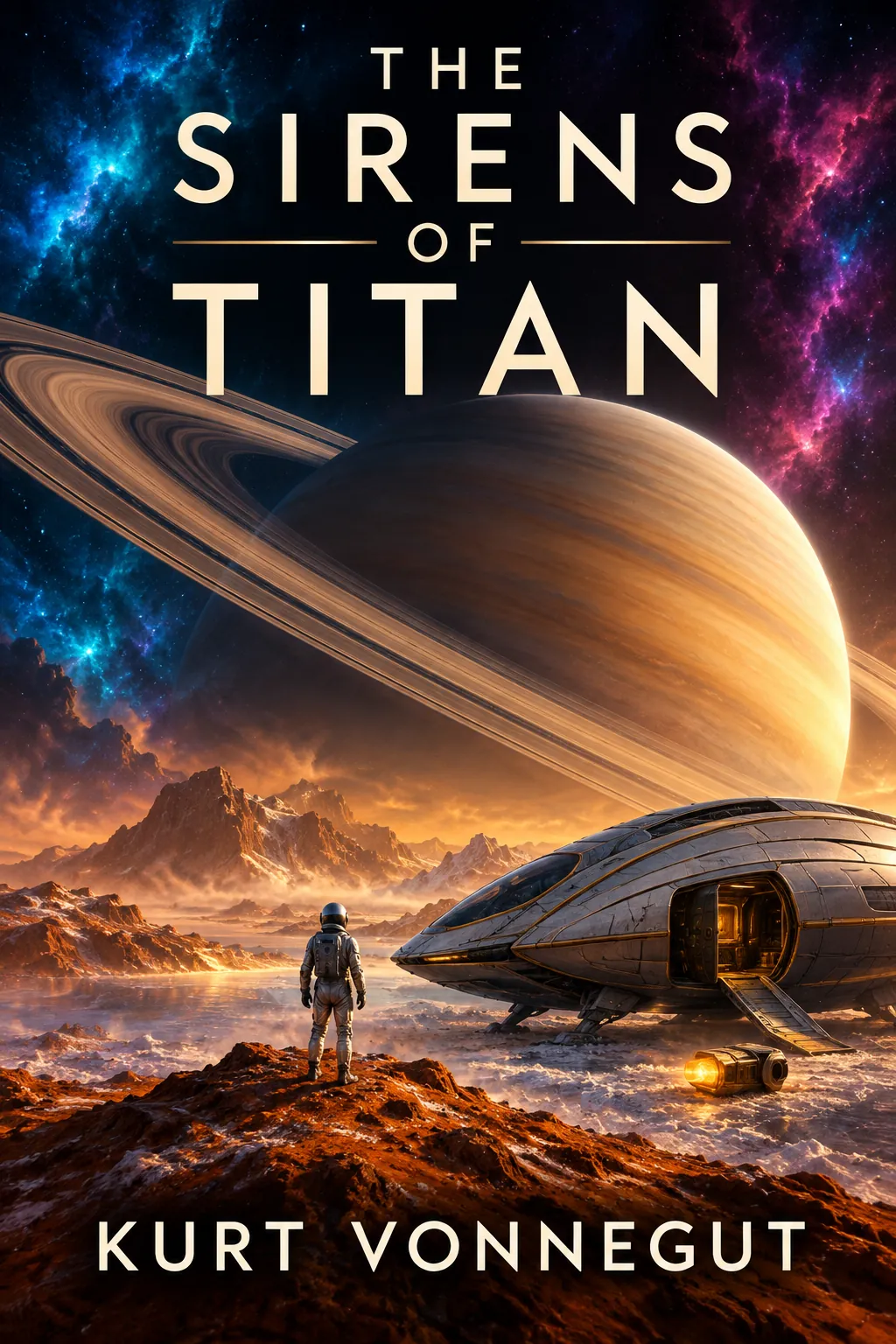
The Sirens of Titan
by Kurt Vonnegut
The Sirens of Titan is Kurt Vonnegut's 1959 comic science-fiction novel about Malachi Constant, the richest and luckiest man in America. A time-travelling millionaire, Winston Niles Rumfoord, pulls him across the solar system, and along the way Malachi loses his fortune, his name and his memory. The story asks a big question with a light touch: if human history has a hidden purpose, does that give our own lives any meaning?
The Big Idea
"The Sirens of Titan asks whether life still has meaning if someone else wrote the plan. Vonnegut answers with dark comedy first, and then with something surprisingly gentle."
Key Insights
Free will is the central question
Almost every character believes they are choosing their own path, and almost all of them are wrong. Vonnegut does not simply say that fate rules. He asks how a person should live once they suspect it might, and that is a more interesting question than whether fate exists. The novel lets the reader laugh at the characters while quietly applying the question to their own life.
Malachi fights Rumfoord's prophecy at every step, yet each escape lands him exactly where Rumfoord said he would be.
Armies and wars can be staged
The Army of Mars is built so that its soldiers will be sacrificed. Rumfoord plans the invasion of Earth to fail, because the horror will unite the planet. Vonnegut points out that a leader can shape a crowd's feelings, and even invent an enemy, to get a result he wants. The idea is uncomfortable because it is not limited to science fiction.
Recruits lose their memories and names, and officers control them through implanted antennas, so they believe they are free soldiers.
A useful lie can still change behaviour
Rumfoord's new religion says God does not care what humans do. That sounds cynical, but it pushes people to be kind to each other, even though the church was born from a staged war. The novel does not fully endorse or reject this. It lets the reader feel both the comfort of the idea and its emptiness.
The Church of God the Utterly Indifferent unites a world that has just seen a huge slaughter.
Wealth and luck are not the measure of a person
Malachi begins the story with money and luck and ends it with neither. Vonnegut suggests that those things were never what made him a person. What remains after the losses is how he treats the people close to him, and he learns that late, and at a high price.
Malachi dies in Indianapolis with nothing, yet he has learned to love Beatrice, and the illusion he sees at the end is a happy one.
Meaning is local, not cosmic
The big reveal shows human history as a delivery job for an alien. The book then refuses to let that turn into despair. If no grand purpose is available, the nearest purpose is still real: care for the people who are around you. Vonnegut puts the answer at the end of an enormous setup, so the smallness of the answer is the point.
The small metal strip and the one-dot message make the cosmic plan look tiny, while the human relationships stay vivid.
Chapter Breakdown
Chapter-by-chapter summary
Spoiler warning: this section covers the whole plot, including the ending. The novel has twelve numbered chapters and an epilogue; they are grouped below by where the story takes place.
Chapters 1–3: A prophecy at Newport
Malachi Constant is the richest man in America. His fortune grew from his father's lucky investments, and he spends it on parties and bad behaviour. He is invited to Newport to see Winston Niles Rumfoord, who flew his private spaceship into a strange region called the chrono-synclastic infundibulum. Rumfoord now exists as a wave stretched across the solar system and appears on Earth only at fixed intervals. He tells Malachi that he will visit Mars, Mercury, Earth and Titan, and will father a child with Rumfoord's wife, Beatrice. Malachi laughs, then watches his luck turn. Why it matters: a man with every freedom is about to learn how little of it is his.
Chapters 4–7: Mars and the Army of Unk
Malachi is pulled into the Martian army that Rumfoord has built from recruits taken from Earth. The recruits lose their memories, get new names and carry small antennas in their heads, through which officers can punish them. Malachi becomes Unk. Rumfoord's plan brings him together with Beatrice, and their son Chrono is born on Mars. The army then attacks Earth and is wiped out. Rumfoord staged the invasion on purpose, planning for it to fail so that Earth would unite in horror. Why it matters: the soldiers think they are free, but they were built to be spent.
Chapters 8–9: Mercury and the harmoniums
Rumfoord sends Unk and a fellow soldier, Boaz, from Mars to Mercury on an autopiloted ship. They are stuck there for a long stretch, living in caves among the harmoniums, small creatures that feed on vibrations and cling to the walls. Boaz stays with the harmoniums, while Unk escapes and goes back to Earth alone. Why it matters: Mercury asks whether being comfortable is the same as being free. Boaz settles for comfort, and Unk keeps moving toward a destiny he cannot yet see.
Chapters 10–11: Earth and the new religion
Unk returns to an Earth that has changed. The failed Martian invasion has left the planet shocked and united under the Church of God the Utterly Indifferent, founded by Rumfoord. Its idea is that God does not care what people do, so people must care for each other. The church makes Malachi Constant its scapegoat: he is pilloried as a symbol of the arrogance and luck that people now blame for their troubles. Rumfoord then sends him, Beatrice and Chrono to Titan. Why it matters: the religion rests on a staged war, yet it really does make people kinder.
Chapter 12: The Gentleman from Tralfamadore
On Titan, where Rumfoord and his dog Kazak stay permanently, Malachi meets Salo, a machine messenger from Tralfamadore. Salo's ship broke down, and he has been stranded in the solar system for over 200,000 years. Tralfamadorians steered human history to produce the spare part he needed, and monuments such as Stonehenge told him how the work was going. The part is the small metal strip that Chrono carries as a lucky charm. Why it matters: the man who seemed to control everything was a tool of a plan with a tiny purpose.
Chapter 12 and Epilogue: The message and the end
Salo's long-awaited message is a single dot that means “Greetings.” After an argument with Rumfoord about it, Salo takes himself apart. Chrono stays on Titan among the birds, and Beatrice dies. Years later Malachi puts Salo back together and asks to be left in Indianapolis. There he dies of exposure while waiting for a late bus, comforted by a pleasant illusion Salo planted. Why it matters: history turns out to have been an errand, and what remains is the love Malachi finally learned.
Characters
- Malachi Constant. The richest man in America, famous for luck and bad behaviour. He loses his money, his memory and his pride, and learns to love. He dies in Indianapolis, waiting for a bus.
- Winston Niles Rumfoord. A wealthy Newport aristocrat who survives a flight into the chrono-synclastic infundibulum and sees past and future. He stages the Martian invasion and founds the church, yet he is a tool of Tralfamadore himself.
- Beatrice Rumfoord. Rumfoord's proud, bitter wife, who dreads the prophecy about Malachi. Events on Mars and Titan slowly wear her stubbornness away. She dies on Titan.
- Chrono. The son of Malachi and Beatrice, born on Mars. His lucky charm is the metal strip that Salo needs, and he chooses to stay on Titan among the birds.
- Boaz. Malachi's fellow soldier, a gruff man who offers real loyalty in a world of manipulation. He goes with Unk to Mercury and stays there with the harmoniums.
- Salo. A machine messenger from Tralfamadore, stranded on Titan for over 200,000 years. He is the book's reminder that humanity may be a footnote in somebody else's story.
- Kazak. Rumfoord's dog, who shares his strange existence in space and time.
- The Tralfamadorians. Machine-like beings who appear mainly through Salo and their effect on human history. They are indifferent, patient and almost comically bureaucratic.
Writing about this book
For an essay or a book-club talk, begin with the question the novel keeps asking: can your life matter if someone else is steering it? You can compare how Malachi behaves at the start with how he behaves at the end, and ask which version is closer to being free. Another angle is the Church of God the Utterly Indifferent. It is a made-up religion built on a staged war, yet it makes people treat each other better; does the truth of a belief matter if the result is good? You could also look at Vonnegut's humour. Where does a joke hide pain, and where does it show care? Use your own examples from the scenes, and say clearly what you think and why. These questions are starting points, not ready-made answers.
Take Action
Practical steps you can implement today:
-
When you feel stuck in a plan someone else made, ask what you can still choose today, even if it is small.
-
Notice when a leader or a group tells you how to feel, and ask who gains from that feeling.
-
Do not measure your worth by money or luck; both can disappear faster than you expect.
-
Put your attention on the people near you, since they are the part of life you can really affect.
Notable Quotes
"“Everyone now knows how to find the meaning of life within himself.” (Chapter 1, opening line)"
— Kurt Vonnegut
"“Take care of the people, and God Almighty will take care of Himself.” (Chapter 7, the motto of the Church of God the Utterly Indifferent)"
— Kurt Vonnegut
"“A purpose of human life, no matter who is controlling it, is to love whoever is around to be loved.” (Epilogue)"
— Kurt Vonnegut
Who Should Read This
Readers aged about 15 and up who enjoy short, funny and strange science fiction. It suits upper-secondary students looking for a first Vonnegut novel, and adults who like questions about fate, free will and the meaning of life, including those who later want to read Slaughterhouse-Five.
Frequently Asked Questions
What is The Sirens of Titan about?
It is a comic science-fiction novel about Malachi Constant, who is carried around the solar system by the time-travelling Winston Niles Rumfoord. Its main subject is whether human life has meaning when history seems to be controlled by someone else.
When was The Sirens of Titan published?
Kurt Vonnegut published it in 1959. It was his second novel, after Player Piano, and it was written before the books that made him most famous, such as Cat's Cradle and Slaughterhouse-Five.
Who are the main characters?
The main characters are Malachi Constant, the richest man in America; Winston Niles Rumfoord, who sees time differently; Beatrice Rumfoord; their son, Chrono; the soldier Boaz; and Salo, a machine messenger from Tralfamadore.
What is the chrono-synclastic infundibulum?
It is an invented region of space in the novel. A person who flies into it becomes spread out across space and time, which lets Rumfoord appear at set moments and see the future.
What is the main theme?
The central theme is the search for meaning when free will is in doubt. Vonnegut also writes about war, manipulation, religion, wealth and luck, and ends by pointing to love for the people around you.
Is The Sirens of Titan hard to read?
It is short and fast, with simple sentences and plenty of jokes. The ideas are strange and the plot moves between planets, but the story is easy to follow if you keep track of Malachi's journey.
Check Your Understanding
Pick an answer for each question to see if you were right.
-
Who is the richest man in America at the start of the novel?
Malachi Constant — Malachi Constant begins the novel as the richest and luckiest man in America.
-
What happens to Rumfoord when he flies into the chrono-synclastic infundibulum?
He is spread across space and time — He becomes a wave stretched through the solar system and appears on Earth only at set times.
-
What is the name of the religion Rumfoord starts?
The Church of God the Utterly Indifferent — The Church of God the Utterly Indifferent teaches that God does not care what we do, so people must care for each other.
-
What is Salo waiting for on Titan?
A spare part for his ship — Salo, a machine messenger from Tralfamadore, is stranded and needs a spare part to continue his journey.
-
What does Salo's message across the galaxy say?
Greetings — The message he carries is a single dot that means Greetings.
About Kurt Vonnegut
Kurt Vonnegut (1922–2007) was an American novelist who served in the Second World War and survived the bombing of Dresden as a prisoner of war. He mixed science fiction, dark comedy and plain moral questions. The Sirens of Titan was his second novel, and Slaughterhouse-Five later made him famous.
Summary Written By

Software Engineer & Writer
Software engineer with a passion for distilling complex ideas into actionable insights. Writes about finance, investment, entrepreneurship, and technology.
View all summaries →Reviews
No reviews yet. Be the first to share your thoughts!
Write a Review
Keep reading
Explore the topic: Science FictionSummaries

Out of My Mind
Sharon M. Draper
“Out of My Mind” by Sharon M. Draper is a poignant narrative that explores the life of Melody Brooks, a…

Ender’s Game
Orson Scott Card
“Ender’s Game” by Orson Scott Card is a riveting science fiction novel that transports readers into a future where humanity…

Pachinko
Min Jin Lee
“Pachinko”, a spellbinding multigenerational historical saga by Min Jin Lee, explores the lives of a Korean family trying to make…

The Perks of Being a Wallflower
Stephen Chbosky
The Perks of Being a Wallflower by Stephen Chbosky is a profound coming-of-age novel, told through the intimate letters of…
Articles

A Christmas Carol themes: generosity, isolation and responsibility
Dickens's novella is usually read as a story about a man who changes his mind. Its themes are sharper than…
Nebula Award: What It Is and Notable Winners
The Nebula Award is an American science fiction and fantasy prize voted on by working writers. The Science Fiction and…

Seiun Award
The Seiun Award is Japan's oldest science fiction award, first given in 1970. Fans who attend the annual Japan SF…