In five minutes: what post-apocalyptic fiction is
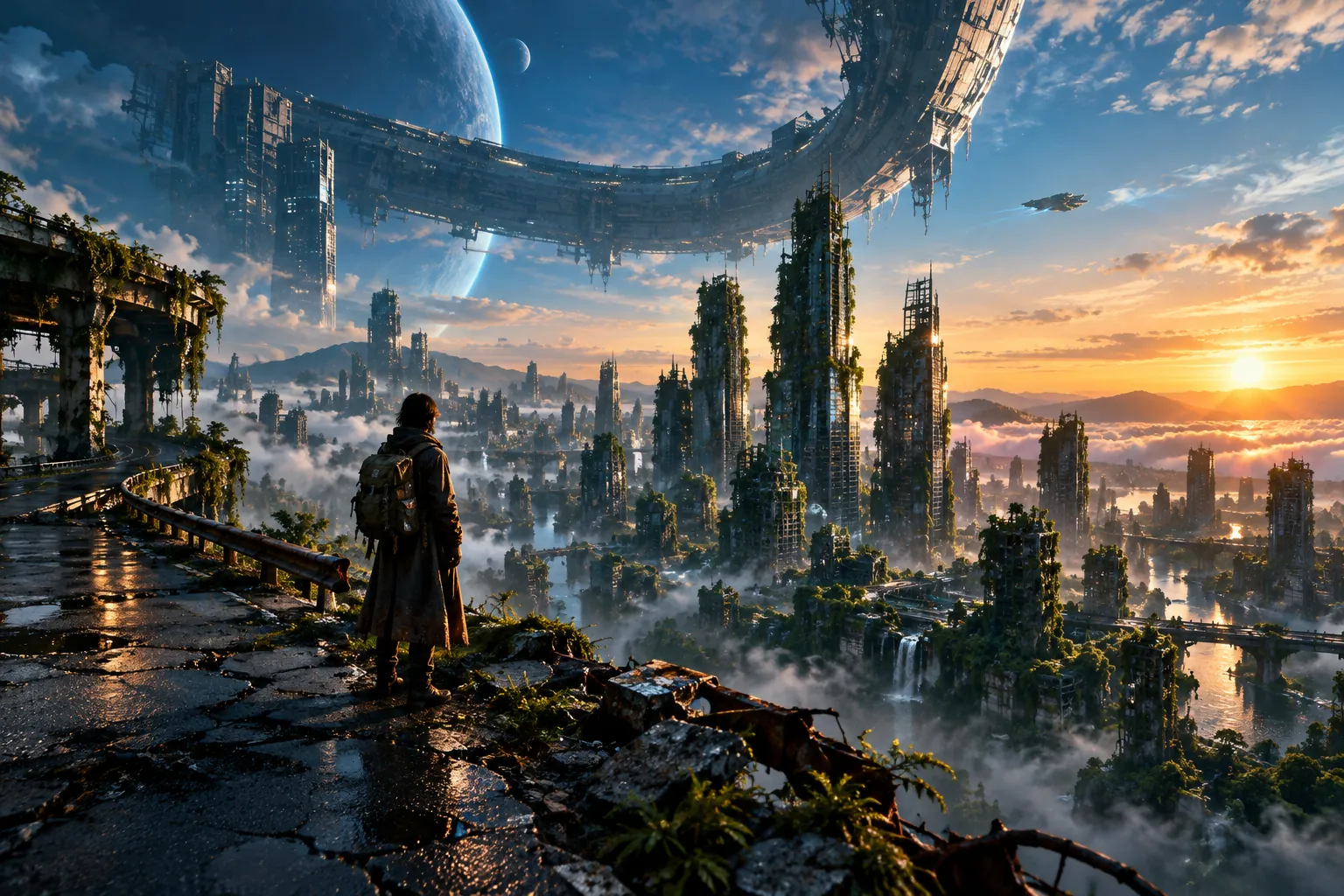
Post-apocalyptic fiction is a branch of science fiction set after a catastrophe that has broken civilisation, so the story is about the survivors and the world they inherit.
The cause can be nuclear war, a plague, climate collapse, an asteroid or something nobody ever explains.
What matters is the long aftermath, not the disaster itself.
The genre is close kin to dystopia, but the two are different.
A dystopia shows a society that works badly, usually by force. A post-apocalyptic story shows a society that has stopped working at all.
It also sits inside the wider history of science fiction, which gives its older roots.
What the word means
“Apocalypse” comes from the Greek apokalypsis, meaning an “unveiling”, and reached English through the biblical Book of Revelation.
In everyday speech it came to mean the end of the world.
Apocalyptic fiction describes the disaster itself. Post-apocalyptic fiction starts once the dust has settled.
In Japan the same idea is often called 終末もの (shūmatsu-mono, “end-times stories”), and the English term is used as a loanword.
The British novelist Brian Aldiss coined “cosy catastrophe” in the 1970s for a quiet, comfortable kind of British disaster story, with John Wyndham as his main example.
Most stories share a recognisable setting: ruined cities, scarce food and water, small wary communities and a dangerous road.
The road matters more than it seems, because with no engines or fuel, travel becomes slow and every journey carries a risk.
Small objects also gain weight, such as a tin of food, a working radio, a book or a map.
A short history
The roots go back to the nineteenth century.
Mary Shelley’s The Last Man (1826) follows the last survivor of a plague that wipes out humanity in the far future.
Richard Jefferies’ After London (1885) imagines England sliding back into wilderness and feudal life after an unexplained catastrophe.
M. P. Shiel’s The Purple Cloud (1901) leaves one man alive after a poisonous cloud sweeps the world.
The genre exploded after the atomic bombings of Hiroshima and Nagasaki in August 1945, when humans could suddenly destroy their own world.
George R. Stewart’s Earth Abides (1949) shows a disease emptying the United States and a small group of survivors starting again.
John Wyndham’s The Day of the Triffids (1951) combines a mass blinding with aggressive walking plants.
Richard Matheson’s I Am Legend (1954) follows one man who may be the last of his kind.
Nevil Shute’s On the Beach (1957) waits for fallout to reach Australia, the last inhabited place.
Walter M. Miller Jr.’s A Canticle for Leibowitz (1959) follows a monastery that preserves scraps of knowledge across centuries after a nuclear war.
Pat Frank’s Alas, Babylon (1959) shows a small Florida town coping after a nuclear exchange.
Later landmarks include Octavia E. Butler’s Parable of the Sower (1993), Cormac McCarthy’s The Road (2006) and Emily St. John Mandel’s Station Eleven (2014).
Japan built its own tradition. Hayao Miyazaki’s manga Nausicaä of the Valley of the Wind and Katsuhiro Otomo’s Akira both began in 1982, and Buronson and Tetsuo Hara’s Fist of the North Star followed in 1983.
The real science
The fiction borrows from real risks, and some of them are well established.
An asteroid struck what is now Mexico’s Yucatán coast about 66 million years ago, and the Chicxulub impact is linked to the extinction of the non-avian dinosaurs.
The Black Death of 1347 to 1351 killed a very large share of Europe’s people, with historians often estimating a third or more. Society reorganised and carried on.
That points to a lesson from history: real collapses tend to be regional and gradual, not a total stop overnight.
Nuclear winter is a scientific hypothesis, first laid out in a 1983 paper by Turco, Toon, Ackerman, Pollack and Sagan.
It proposes that smoke from burning cities could block sunlight and cool the planet enough to damage harvests.
The size of the effect depends on how many cities burn, and researchers still model it, but the central worry of widespread crop failure is taken seriously.
The Doomsday Clock, set by the Bulletin of the Atomic Scientists since 1947, is a symbol of risk, not a forecast.
What is pure invention? Instant worldwide collapse in a few days, gangs on the roads within a week, and the speed at which engineered machines and cities turn to ruin.
Where it shows up in fiction
These books are the usual starting points, and they cover very different moods.
- Earth Abides (1949): a quiet, thoughtful story of one community rebuilding after a plague.
- The Day of the Triffids (1951): the classic “cosy catastrophe”, with a sharp question about who can still see.
- On the Beach (1957): no survivors in the long run, only the way people choose to spend their last months.
- A Canticle for Leibowitz (1959): how knowledge survives, and how humanity can repeat its mistakes.
- The Road (2006): a father and son walking a burned America, with spare, unforgettable prose.
- Station Eleven (2014): a travelling theatre company keeps art alive after a pandemic.
Films and games also use the setting, but books are where the genre was shaped.
For a longer reading list, see our guide to the best science fiction books.
How to read these stories
One useful habit is to ask what the author thinks caused the collapse, because the cause shapes the message.
A nuclear story usually warns about weapons, a plague story about fragile networks of trade and care, and a climate story about neglected limits.
Then ask what the survivors choose to protect. A library, a child, a song or a patch of seed corn tells you what the writer values.
Finally, notice the pace. Some books are fast and violent, while others are slow, almost pastoral, and spend whole chapters on farming, repairing tools and learning to trust a stranger.
None of this requires special knowledge, so a first-time reader can simply pick a book and start.
Why readers keep coming back
The setting is a thought experiment: take away shops, power and governments, and see what people do.
Some stories answer with cruelty, and others with unexpected kindness.
Many also ask what we would choose to save: tools, medicine, music, the written word.
There is a quiet comfort too, since an empty world is a clean slate, and the best of these books know that this comfort is a trap as well as a promise.
Common misconceptions
- It is the same as dystopia. No. Dystopia is an oppressive society that still functions, such as the one in 1984. Post-apocalyptic stories begin after society has collapsed, though many later rebuild a dystopia.
- It always involves a nuclear war. No. Plague, climate change, blindness, fungal infection, asteroids and unexplained events all appear.
- It is always hopeless. No. Station Eleven and Earth Abides are quietly hopeful, and even The Road ends on a note of tenderness.
- It needs zombies. No. Monsters appear in some books, but the genre is mostly about ordinary people and the choices they make.
- It is a survival manual. No. These stories care about meaning and morals far more than gear.
Read next
- Dystopia: the closest neighbour, with its own rules and classics.
- Best science fiction books: where to find the novels named above.
- History of science fiction: the bigger story this genre belongs to.