In five minutes
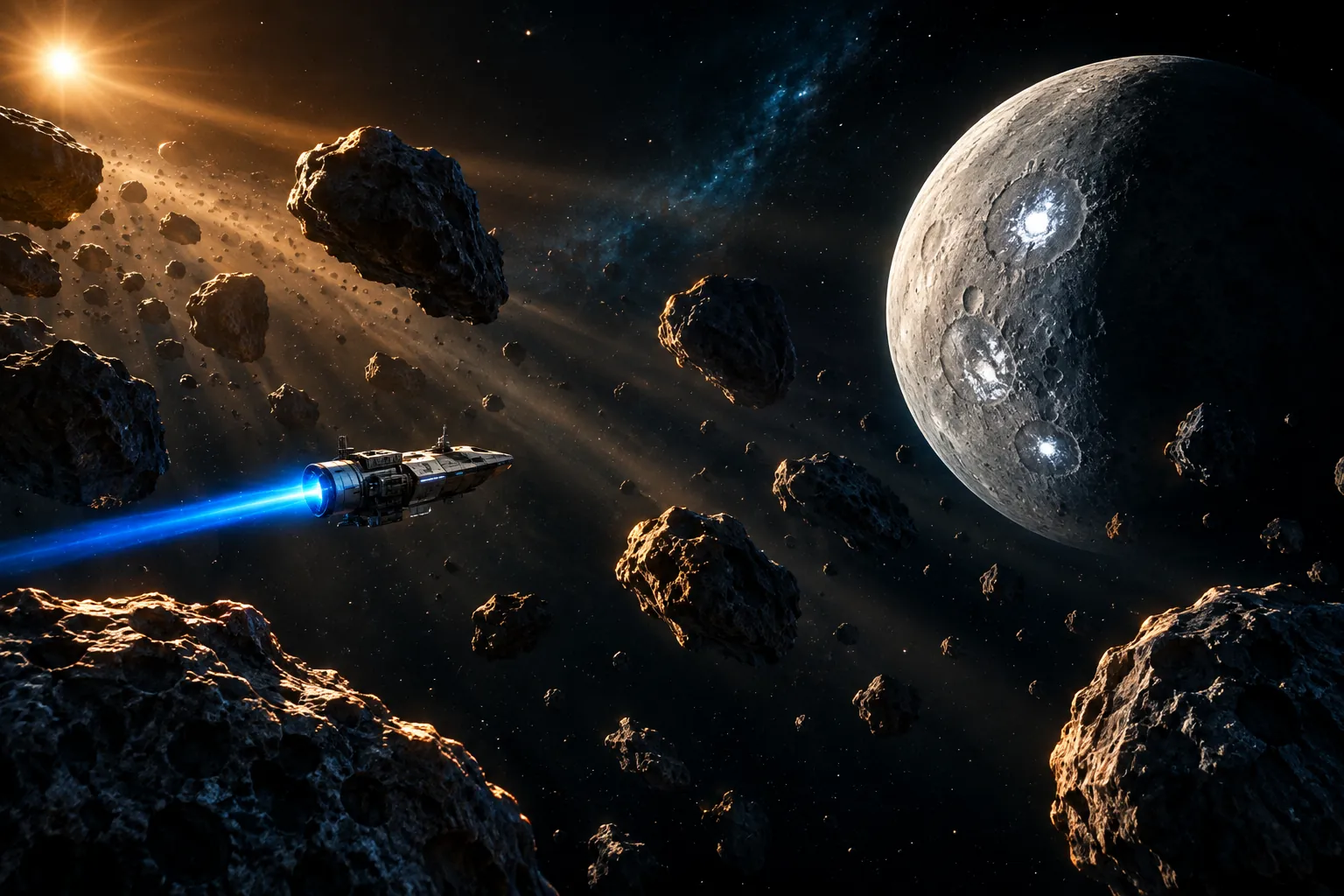
The asteroid belt is a doughnut-shaped region of rocky and metallic bodies that circle the Sun between the orbits of Mars and Jupiter. It lies roughly 2.2 to 3.2 times as far from the Sun as Earth does, a distance astronomers write as 2.2 to 3.2 astronomical units (AU).
It contains millions of asteroids, but it is mostly empty space. Add every one of them together and you get only about 3 percent of the mass of our Moon.
That gap between what people imagine and what is really there is the main thing to remember. Science fiction, from pulp stories to modern space epics, loves the belt as a setting, as our history of science fiction shows.
The belt is also a real place that spacecraft have crossed many times. Understanding it explains a lot about how the Solar System was built.
Where it is and how big it is
Earth sits at 1 AU from the Sun, Mars at about 1.5 AU and Jupiter at about 5.2 AU. The main belt fills much of the gap between Mars and Jupiter, with most asteroids orbiting between about 2.2 and 3.2 AU.
Asteroids in the belt take roughly three to six years to go around the Sun once. Their orbits are slightly tilted and oval, so the belt is a thick, fuzzy band rather than a flat ring.
Astronomers have catalogued more than a million asteroids. Surveys estimate that there are between one and two million larger than one kilometre across, plus a vast number of smaller ones.
Only a few are big. The four largest are Ceres, Vesta, Pallas and Hygiea, and Ceres alone holds more than a third of the belt's total mass.
Ceres, the belt's dwarf planet
Ceres is about 940 kilometres across, roughly a quarter of the width of the Moon. It is round, which is why the International Astronomical Union classed it as a dwarf planet in 2006.
Italian astronomer Giuseppe Piazzi found it on 1 January 1801, and at first it was celebrated as a new planet. Within a few years other bodies turned up at similar distances, and it became clear that Ceres was the largest member of a whole population.
NASA's Dawn spacecraft orbited Ceres from 2015 to 2018. It photographed bright salt-rich patches inside craters and found signs of water-bearing minerals on and below the surface.
How the belt formed
The belt is not the wreckage of a lost planet, an idea that was popular in the twentieth century. The total mass is far too small, and the asteroids are chemically varied in ways one planet would not explain.
The current view is that the belt is leftover building material. The Solar System began as a disc of gas and dust, and rocks gradually clumped together into larger bodies.
Near the belt's distance, Jupiter's powerful gravity kept stirring the region. It sped up the rocks' orbits, so collisions broke things apart more often than they merged, and no planet could finish growing.
Many asteroids are therefore close to untouched samples of the early Solar System, about 4.5 billion years old. That is one reason space agencies study them so closely.
The real science: why the belt is so empty
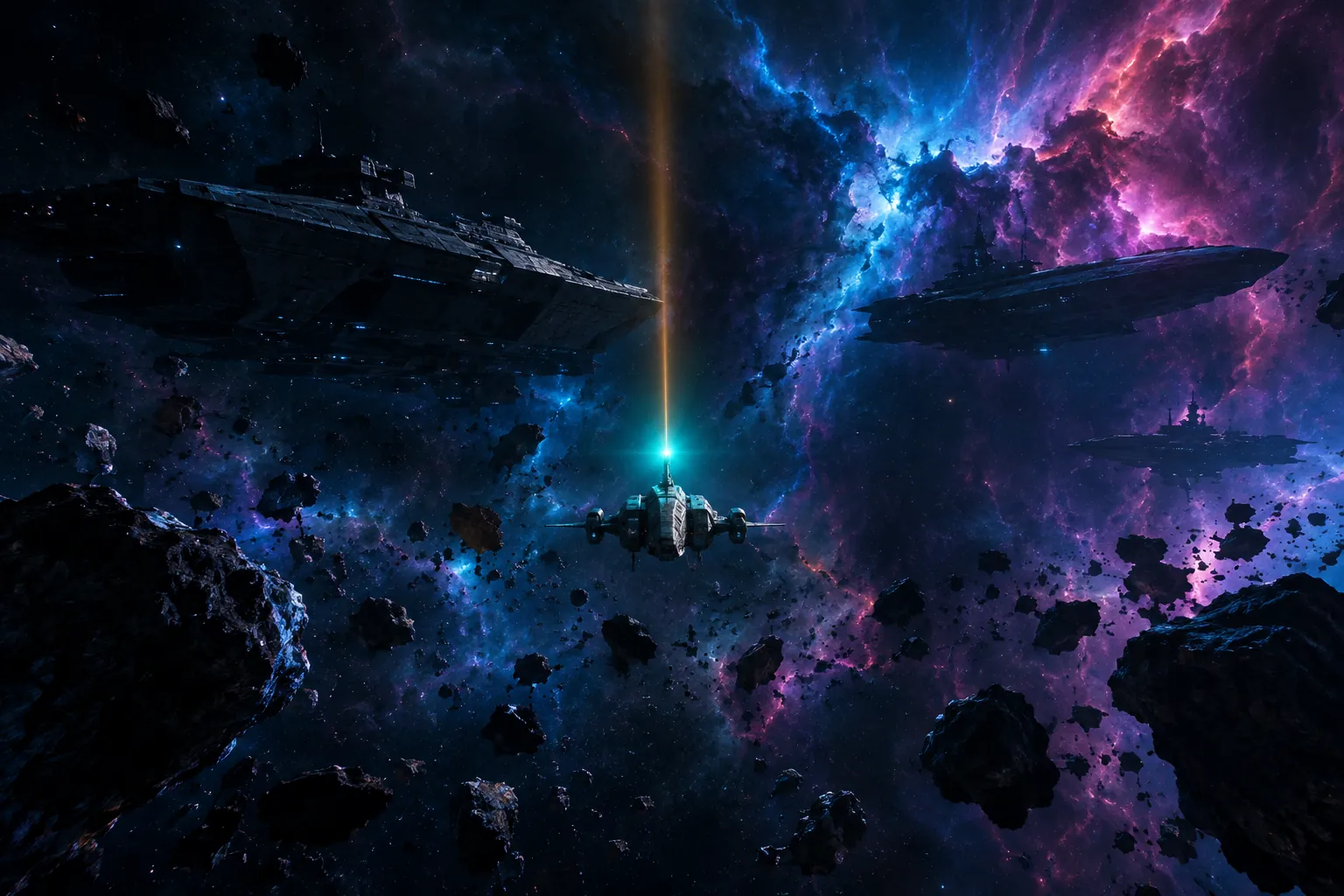
If you stood on one asteroid, you would usually not see another with the naked eye. Typical neighbours are hundreds of thousands of kilometres apart, many times the distance from Earth to the Moon.
This is why spacecraft cross the belt without special risk. Pioneer 10 was the first probe to do so, entering in 1972 and coming out the other side in 1973 without harm.
The belt also has gaps. In 1866 the American astronomer Daniel Kirkwood noticed that some orbital distances hold almost no asteroids.
These Kirkwood gaps appear where an asteroid's orbit would repeat in a simple ratio with Jupiter's, such as three asteroid orbits for each one of Jupiter's. The repeated tugs push rocks out of those orbits over time.
The belt can also send rocks toward us. Collisions and Jupiter's pull sometimes nudge fragments onto paths that cross the inner Solar System, and many meteorites found on Earth come from the belt.
Exploring the belt
The first spacecraft close-ups came from NASA's Galileo probe, which passed the asteroid Gaspra in October 1991 and Ida in 1993. It found that Ida has a tiny moon, later named Dactyl.
NASA's Dawn mission then did something new in 2011. It entered orbit around Vesta, and in 2015 it moved on to Ceres, the first spacecraft to orbit two different bodies beyond Earth.
More missions are under way. NASA's Psyche spacecraft launched in October 2023 to visit a large metal-rich asteroid, with arrival planned for 2029.
Japan's Hayabusa2 brought back samples from the asteroid Ryugu in December 2020. Ryugu is a near-Earth asteroid, not a belt member, but it is thought to have come from the belt.
Where it shows up in fiction
The belt appears in science fiction early. Isaac Asimov set the 1939 story "Marooned Off Vesta" near one of its largest asteroids, imagining stranded crew members at the edge of human reach.
Later writers used the belt for stories about work and class. Larry Niven's Belters, in his Known Space stories, are a hardy people who live by mining rock, and the idea has recurred in the genre ever since.
Kim Stanley Robinson's novel 2312 turns hollowed-out asteroids into travelling habitats with their own landscapes. The belt there is not an obstacle but a place to live.
A popular modern version is the "belter" setting: a working frontier where miners and haulers are poorer than the planets' inhabitants and depend on ice and metal. It uses real facts, such as the belt's resources, to ask who owns space and who profits from it.
Those stories also feed on a real idea. Because asteroids hold water ice, iron and nickel, and some carry valuable metals, people have long argued that mining them could one day support life in space, a theme that also ties into terraforming and megastructures in sci-fi.
Common misconceptions
"Ships have to dodge rocks constantly." They do not.
Collisions in the real belt are rare, and a ship on a straight path would normally meet nothing.
"It is the remains of a destroyed planet." The numbers do not support that.
The belt's total mass is a few percent of the Moon's, so there was never enough material for a planet.
"Asteroid mining is already easy." It is not.
No one has mined an asteroid commercially. Sample-return missions bring home grams to a few hundred grams, which is a long way from industry.
"All asteroids are in the belt." Many are not.
Near-Earth asteroids, Trojans that share Jupiter's orbit and others live elsewhere in the Solar System.
Read next
Continue with Terraforming to see how fiction and science think about changing a world to suit us. Then try Megastructures in sci-fi for the biggest things writers have ever imagined building from asteroid-scale material.
For the wider story of the genre, return to the History of Science Fiction hub.