In five minutes
Proxima Centauri is the closest star to the Sun, about 4.25 light-years away.
It is a small, dim red dwarf, so faint that nobody saw it until astronomers searched for it with a telescope in 1915.
Light from Proxima takes about four years and three months to reach us. A spacecraft travelling as fast as Voyager 1 would need roughly 75,000 years.
Since 2016 it has had a second claim to fame: a planet, Proxima b, orbits it in the zone where liquid water could exist on a rocky surface.
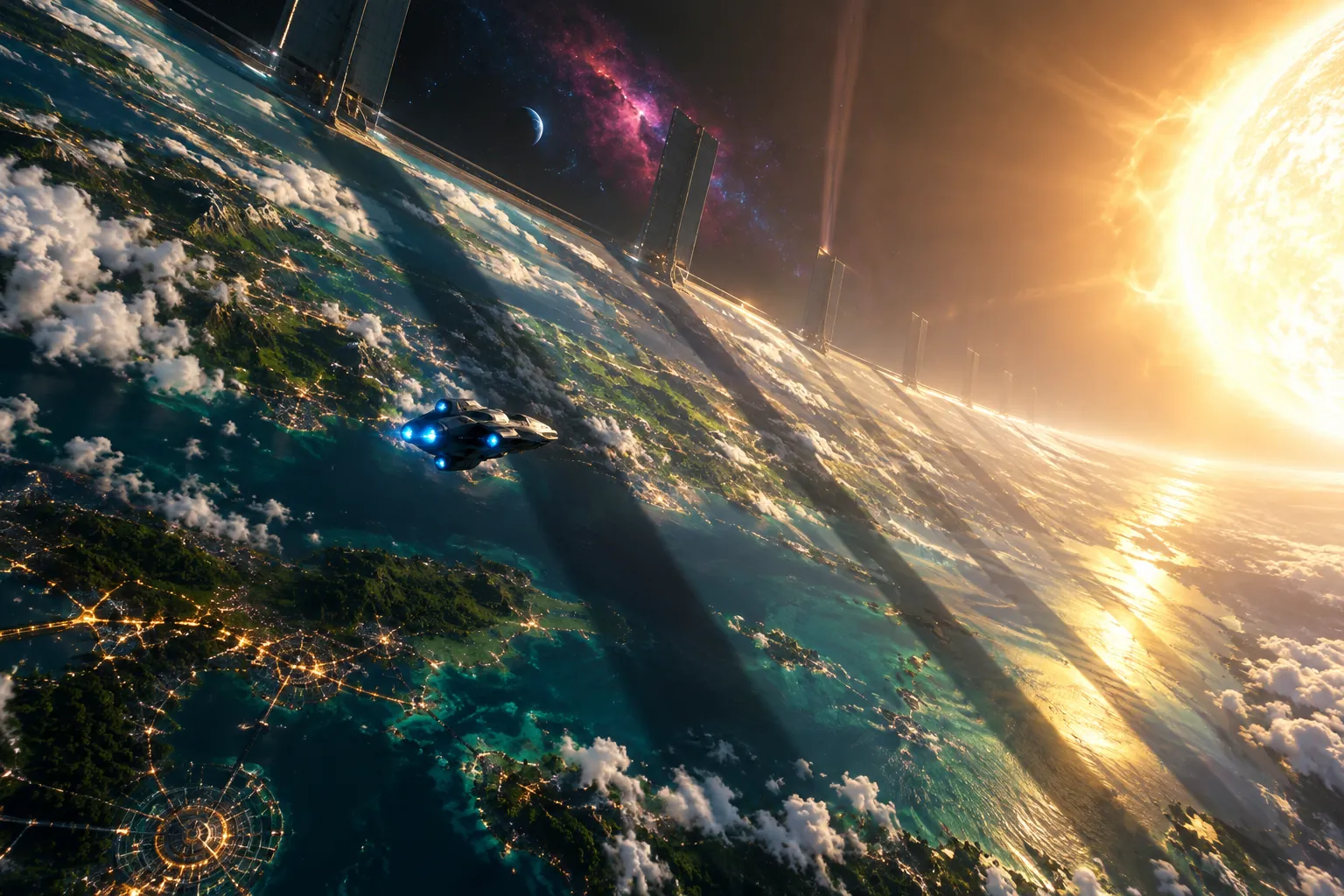
That is why writers keep sending ships there. It is the shortest trip to another sun that anyone can imagine, and it is still enormous.
The star next door
Proxima is a red dwarf, the smallest and most common kind of star in our galaxy. It has about 12 percent of the Sun's mass and about 15 percent of its width.
Its surface temperature is roughly 3,000 kelvin, against about 5,800 for the Sun. It gives off less than a fifth of one percent of the Sun's light, and much of that is infrared that our eyes cannot see.
Because it is so dim, Proxima has an apparent brightness far below the limit of the human eye. You need a telescope to find it, even though it is closer than any star you can see on a clear night.
It is part of the Alpha Centauri system. The bright pair Alpha Centauri A and B, about 4.37 light-years away, looks like one star to the eye in the southern sky, and Proxima is a third, much smaller member far out from them.
Astronomers measured the three stars' motion and confirmed in 2017 that Proxima is bound to the pair. It circles them at about 13,000 times the distance between the Earth and the Sun, and one orbit takes roughly 550,000 years.
The Scottish-born astronomer Robert Innes found the star in 1915 at the Union Observatory in Johannesburg, because it moved across the sky in the same way as Alpha Centauri. In 1917 he suggested the name Proxima, from the Latin for "nearest".
Red dwarfs burn their fuel very slowly. Proxima is roughly five billion years old, and models say it could shine for several trillion years.
The real science
Its planets
In August 2016 a team led by Guillem Anglada-Escudé announced Proxima b in the journal Nature. They found it by watching the star wobble toward and away from us, using the HARPS spectrograph in Chile, in a campaign called Pale Red Dot.
Proxima b orbits very close to its star, about 0.05 times the Earth–Sun distance, and a year there lasts about 11.2 days. Its minimum mass is a little over one Earth mass.
That orbit puts it in the habitable zone, where a planet could be warm enough for liquid water. Being in the zone does not mean it has water, an atmosphere or life, and nobody has measured any of those.
A second planet, Proxima d, was reported in 2022 from ESPRESSO data. It is much smaller, about a quarter of an Earth mass, and circles in about five days, far too hot for life as we know it.
A third signal, called Proxima c, was reported in 2020 as a possible larger planet on a five-year orbit. It is still treated as a candidate rather than an established world.
Flares and radiation
Proxima is a flare star. Its magnetic activity throws out sudden bursts of light and charged particles, which can be far stronger, compared with the star's size, than anything the Sun does.
Proxima b sits so close that it would receive much more X-ray energy than the Earth does. Whether an atmosphere could survive that, or be rebuilt, is an open question that astronomers study with models and new telescopes.
Close orbits also tend to lock a planet so that one side always faces the star. Climate models for such worlds range from a frozen night side to an air circulation that spreads heat widely, and the answer depends on facts we do not yet have.
Why the trip is so hard
The distance is about 40 trillion kilometres. Voyager 1, travelling at about 17 kilometres a second, would take about 75,000 years.
The fastest spacecraft so far, the Parker Solar Probe, reached about 192 kilometres a second near the Sun, which would still mean about 6,600 years. Chemical rockets cannot carry enough fuel to do better.
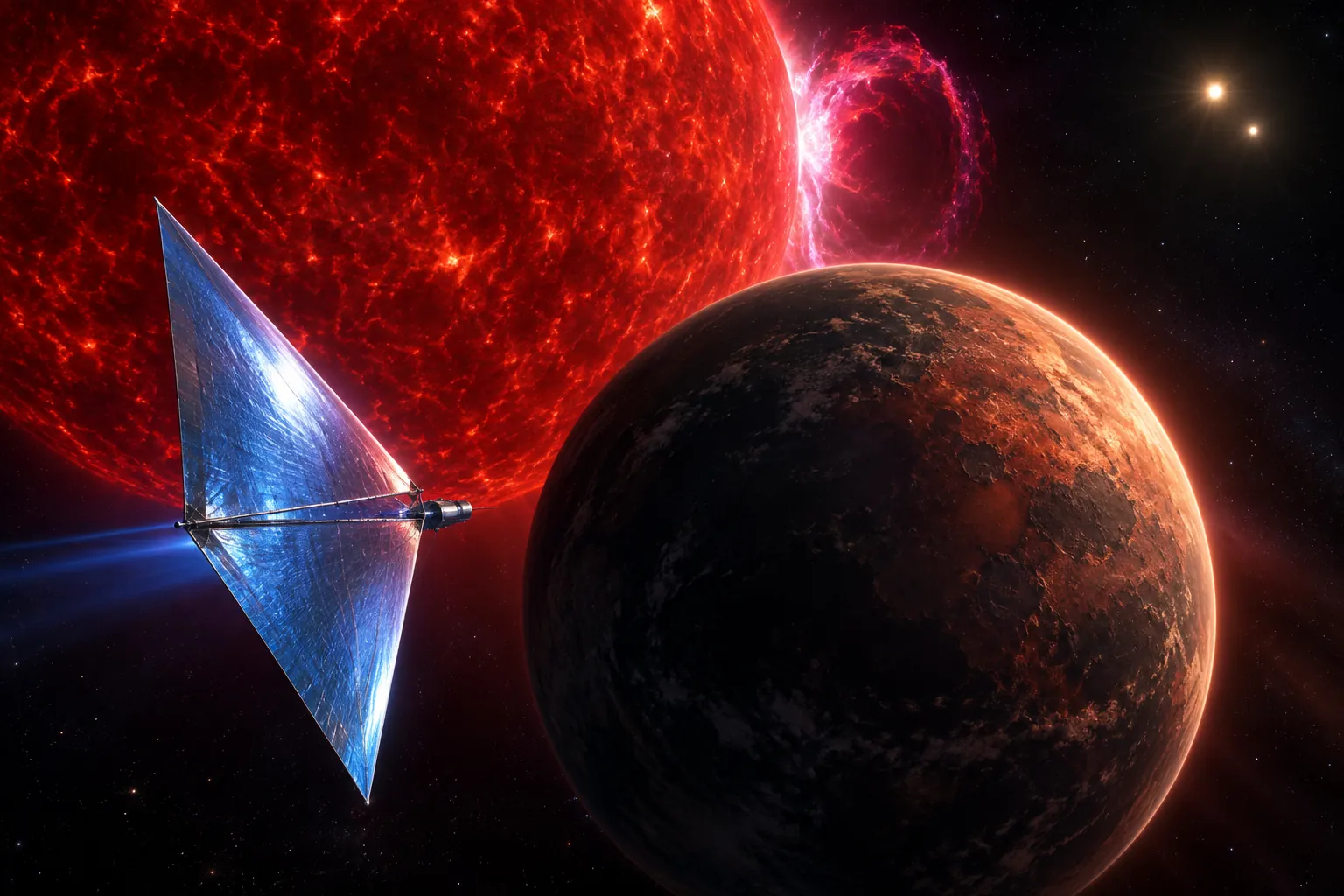
The best-known proposal is Breakthrough Starshot, announced in 2016. It imagines thousands of gram-scale probes pushed by ground-based lasers on light sails to about a fifth of the speed of light, reaching Proxima in around 20 years.
It remains a research concept, and its biggest problems are laser power, sail survival and getting any data back.
Larger ships would need much more time. That is the gap that fiction fills with the slow arks of the generation ship or with faster-than-light ideas such as the warp drive, which no known physics supports.
Where it shows up in fiction
Proxima became a stock destination in the history of science fiction because it is the least distance a story can cover and still leave the Solar System.
Robert A. Heinlein used it in his generation-ship story Orphans of the Sky, first published as two novellas in 1941. The crew of the starship Vanguard have forgotten they are on a ship at all, and the journey to Proxima has become myth.
Stephen Baxter's novel Proxima (2013) sets a human colony on a world in this system. It draws on the real idea of a tidally locked planet circling a red dwarf.
Liu Cixin's The Three-Body Problem places its alien civilisation in the Alpha Centauri system, the neighbour of the Sun, and the story uses the 4-light-year gap as the time it would take messages and ships to cross.
Writers like Proxima for the same reason scientists do. It is real, it has a planet in the right zone, and the distance is large enough to make every choice about time, fuel and the people on board matter.
Common misconceptions
"Proxima is the closest star to Earth." The closest star to Earth is the Sun.
Proxima is the closest star to the Sun, and so the nearest star outside our own system.
"Alpha Centauri is one star." The bright point in the southern sky is two stars, Alpha Centauri A and B. Proxima is a third, faint one, and the name Alpha Centauri C is also used for it.
"You can see Proxima in the sky." You cannot see it without a telescope.
It is also below the horizon for most of Europe, North America and Japan.
"Proxima b is a second Earth." It has a similar minimum mass and is in the habitable zone.
We do not know its size, its air, its water or whether it is rocky at all.
"We could be there within a lifetime." Not with any spacecraft we can build today.
Starshot-style probes might change that for tiny, uncrewed craft, but people are a far bigger problem.
Read next
Generation ship: the slow-ark idea that stories use to reach Proxima over many human lifetimes.
Warp drive: the faster-than-light idea, and what real physics says about it.
History of science fiction: the hub for how the genre grew from early voyages to the stars.