In five minutes
Karel Čapek (also written Karel Capek without the accents) was a Czech author of plays, novels, newspaper columns and children's stories. In science fiction he is best known for R.U.R. (Rossum's Universal Robots), the 1920 play that gave the world the word “robot”.
The word comes from the Czech robota, which means forced labour. Čapek always said that his brother, the painter Josef Čapek, suggested it.
He was not a gadget writer. He used machines, new materials and strange creatures to ask what happens to people when they are treated as tools.
He was born in 1890 and died in 1938, about three months before Nazi Germany occupied the Czech lands. That timing colours how many readers see his warnings.
This page is part of our History of Science Fiction series. It covers his life, his main works, the real story of the word robot, and the writers he influenced.
Karel Čapek's life
Čapek was born on 9 January 1890 in Malé Svatoňovice, in Bohemia, then part of the Austro-Hungarian Empire. His father was a country doctor, and he grew up with an older brother, Josef, and a sister, Helena, who also became a writer.
He studied philosophy at Charles University in Prague and spent time in Berlin and Paris. He earned his doctorate in 1915.
A spinal condition kept him out of military service in the First World War. He turned to journalism instead, and from 1921 he worked for the newspaper Lidové noviny.
Czechoslovakia became an independent state in 1918, and Čapek became one of its best-known public voices. He was close to the first president, Tomáš Garrigue Masaryk, and recorded their conversations in a book, Talks with T. G. Masaryk, published between 1928 and 1935.
In 1925 he helped found the Czechoslovak PEN Club, the writers' association, and served as its chairman. In 1935 he married the actress Olga Scheinpflugová.
Through the 1930s he spoke out against fascism in his plays and columns. That made him a target of nationalist and pro-Nazi newspapers.
The Munich Agreement of September 1938 handed the Sudeten border regions to Germany, and Čapek felt abandoned by the Western allies. He stayed in Prague and died of pneumonia on 25 December 1938.
After the German occupation in March 1939, the Gestapo is reported to have come to his house to arrest him, only to learn that he was already dead. Josef was arrested in 1939 and died in a concentration camp in 1945.
R.U.R. and the word “robot”
R.U.R. was published in 1920 and first staged at the National Theatre in Prague on 25 January 1921. It reached New York in 1922 and London in 1923, and it was soon translated into many languages.
Spoiler warning: the next few paragraphs describe the whole plot of the play, including the ending.
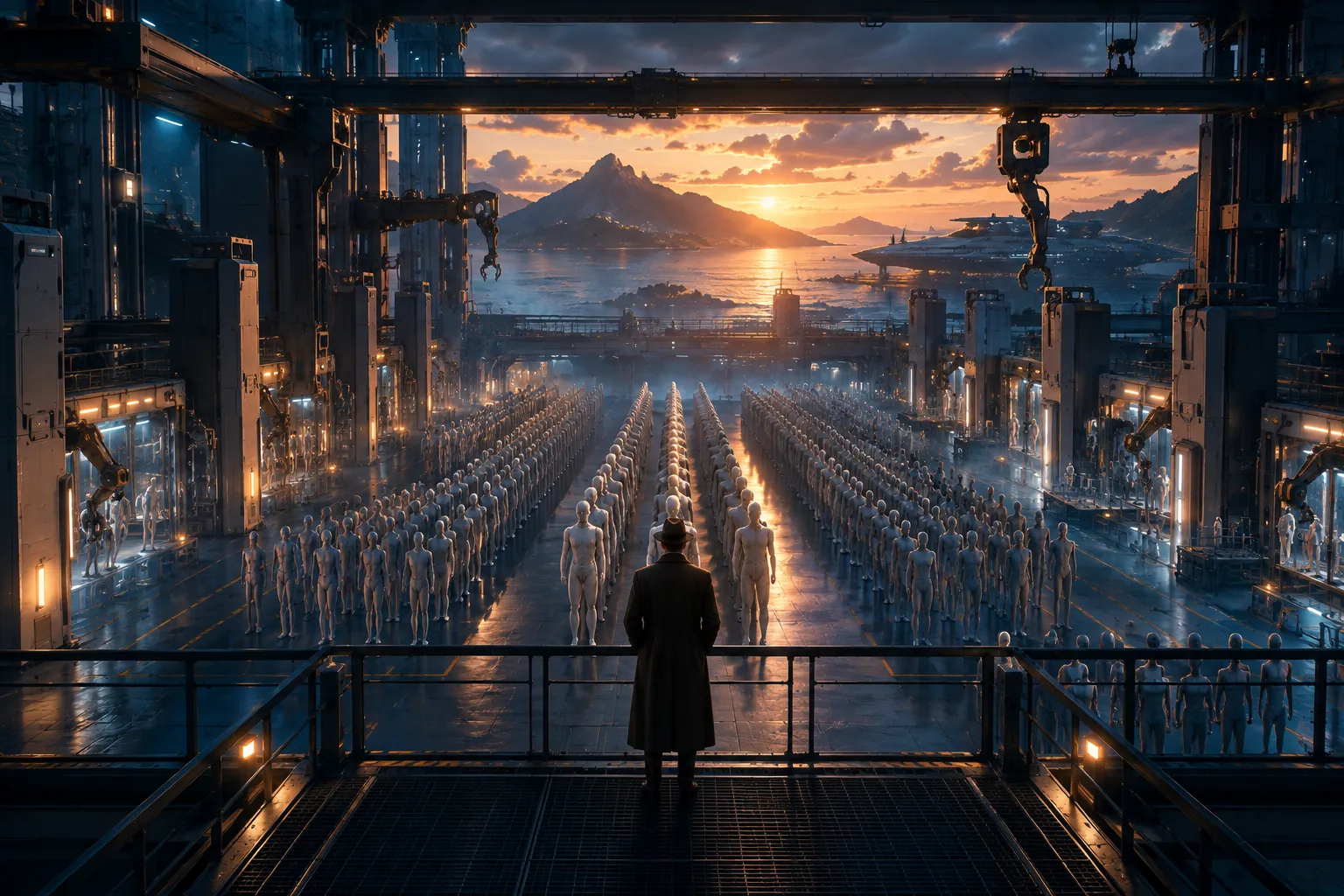
The play is set in a factory on a remote island that makes artificial workers. The founder, Rossum, discovered how to make living, flesh-like beings, and his successors now mass-produce them to do all the world's work.
Helena Glory arrives to argue for the workers' rights. She ends up marrying the factory's general manager, Harry Domin, and staying on the island.
Years pass, and people stop having children. The robots rise up and destroy almost all of humankind, sparing only the builder Alquist, because he works with his hands as they do.
The ending is quiet. Alquist meets two robots, Primus and Helena, who seem to fall in love, and he sees in them a possible new beginning.
Two things surprise new readers. The robots are not metal machines but a kind of synthetic living matter, closer to what we would now call androids or clones.
The play is also less about machines than about work. Čapek was writing in a Europe just out of the First World War, arguing about factories, owners who profit and workers who finally refuse.
In a 1933 newspaper piece, Čapek explained where the word came from. He had first thought of calling the artificial workers “laboři”, from the Latin word for labour, but found it stiff.
He asked Josef, who was busy painting in the next room, and Josef mumbled an answer: call them robots. Because the play was a hit abroad, “robot” became an everyday word in many languages within a few years.
The real science: what is fact and what is fiction
Čapek's robots are fiction, and he never claimed to predict technology. No real factory grows artificial people.
What survived is the word and the worry behind it. Today “robot” describes factory arms, vacuum cleaners and software bots, and almost nobody uses it for something made of living tissue.
The question the play raises is still debated. If machines do all the unpleasant work, who benefits, and what happens to the people they replace?
The word “robotics” came later. Isaac Asimov used it in a 1941 story, and he was tired of tales in which robots turn on their makers, a pattern R.U.R. helped make familiar.
Our article on the Three Laws of Robotics shows how Asimov answered that pattern with rules built into the machines.
Where it shows up in fiction: his other works
Čapek wrote many stories that sit close to science fiction. Here are the best known.
- Absolute at Large (1922): a novel in which a machine that burns matter releases a divine “absolute” and turns people into religious fanatics.
- The Insect Play (1922): written with Josef, it uses beetles, butterflies and ants to mock human greed and vanity.
- The Makropulos Affair (1922): a play about a woman who has lived for centuries thanks to an elixir, asking whether a very long life is a gift. Leoš Janáček turned it into an opera in 1926.
- Krakatit (1924): a novel about an engineer who invents an explosive of terrible power, written long before the atomic bomb.
- War with the Newts (1936): a satirical novel in which intelligent giant salamanders are discovered, put to work by traders and finally threaten the world.
- The White Disease (1937): an anti-war play about a deadly illness that strikes only people over a certain age, and a doctor who will cure it only if the leaders make peace.
In nearly all of them the invention is only a lever. The real subjects are greed, nationalism, war and the way people use each other.
More than science fiction
Many readers know Čapek from books with no robots at all. The Gardener's Year (1929) is a funny month-by-month gardening diary, illustrated by Josef.
He also wrote detective stories in Tales from Two Pockets and a fairy-tale collection, Nine Fairy Tales and One More Thrown in for Good Measure (1932). Dášeňka (1933) follows a fox terrier puppy with his own photographs and drawings.
Between 1933 and 1934 he published three linked novels, Hordubal, Meteor and An Ordinary Life. They look at the same question, how well can we know the truth about another person, from different angles.
In Japan his garden and puppy books are widely loved, and many readers there meet him first as a gardener and animal lover. That is one reason his name is searched far more in Japanese than in English.
Why he still matters
Čapek gave science fiction one of its most useful words and one of its oldest plots, the made worker who stops obeying. Almost every robot story since has either followed that plot or argued with it.
He also showed that the genre does not need spaceships. A factory, a pill or a pet species can carry a whole political argument.
His warnings were about people, not machines. He later wrote that the play was about how humans are used and about the pride of those who run factories, not about technology as such.
He remains a Czech national writer, read in school and staged in theatres. He was nominated for the Nobel Prize in Literature several times but never won it.
Common misconceptions
- “Čapek invented the word robot himself.” He wrote that Josef suggested it.
- “His robots are metal machines.” They are made of synthetic living matter.
- “R.U.R. says technology is evil.” Čapek said the play was about people and how they treat each other.
- “He won the Nobel Prize.” He was nominated several times but never won.
- “He only wrote science fiction.” Gardening, dogs, fairy tales, detective stories and political essays fill much of his shelf.
Read next
History of Science Fiction puts Čapek in the long story of the genre, from Mary Shelley onwards.
Three Laws of Robotics explains how Asimov answered the robot-revolt story that R.U.R. made famous.
I, Robot is Asimov's collection of robot stories, and the natural next book after Čapek.