Aldous Huxley in five minutes
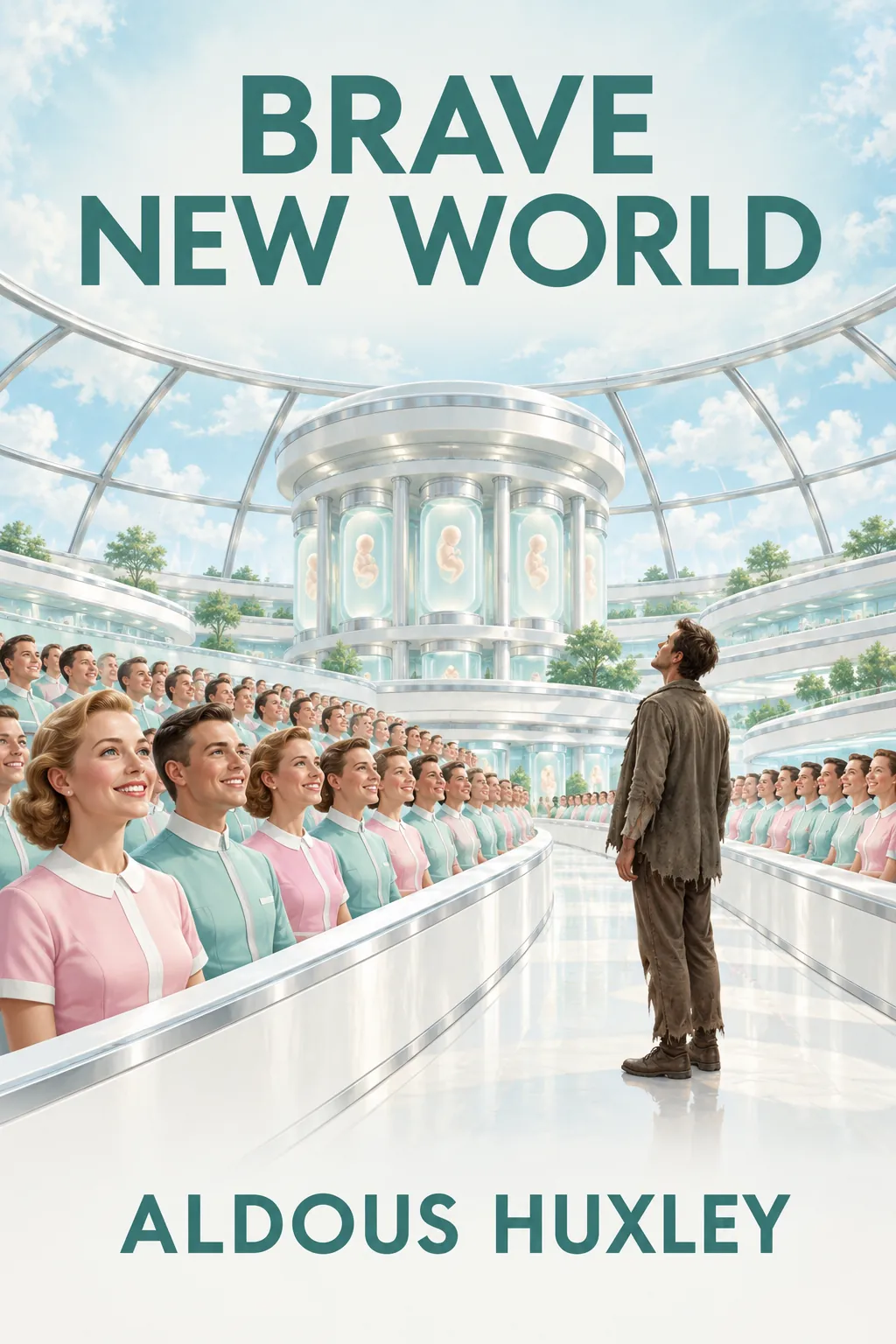
Aldous Huxley (1894–1963) was an English writer who spent most of his career on satirical novels, essays and travel books. He is remembered in science fiction for one novel, Brave New World (1932), which imagines a peaceful future built on engineered babies, conditioning and a pleasure drug.
George Orwell feared a state that crushes people. Huxley feared a society that keeps them so comfortable that they stop asking questions.
That contrast is why people search his name whenever a new technology promises to make life easier.
This page covers his life, his main books, the science behind his ideas and the mistakes readers often make about him. It sits inside our History of Science Fiction.
Who was Aldous Huxley?
Huxley was born on 26 July 1894 in Godalming, Surrey, into a famous intellectual family. His grandfather was the biologist T. H. Huxley, an early defender of Darwin's theory of evolution, and his older brother Julian became a well-known biologist too.
At about sixteen he caught an eye disease that left him almost blind for a time. He recovered enough sight to study English literature at Balliol College, Oxford, but poor vision stayed with him for life.
After the First World War he made his name with witty novels about clever, restless people, beginning with Crome Yellow in 1921. Point Counter Point (1928) was his best-known novel before Brave New World.
He also taught French for a short time at Eton, where one of his pupils was Eric Blair, who later became George Orwell.
In the 1930s Huxley turned toward pacifism and spiritual questions, and in 1937 he moved to California. He lived in the United States for the rest of his life and died in Los Angeles on 22 November 1963, the same day President Kennedy was shot.
Brave New World (1932)
Brave New World is set in the World State, about six centuries from our time. Babies are grown in hatcheries and sorted into castes, from clever Alphas to labouring Epsilons.
People are shaped from birth by conditioning, and they use a drug called soma to wipe away worry. Nobody is hungry, and nobody is allowed to be lonely or different for long.
The story follows Bernard Marx, Lenina Crowne and a man raised outside the system, known as John the Savage. Their meeting shows how strange the "perfect" world looks to someone who did not grow up in it.
The title comes from a line in Shakespeare's The Tempest. Many critics also read the book as a reply to the cheerful visions of the future by H. G. Wells.
For the full plot, characters and themes, see our Brave New World study guide.
Other books worth knowing
- Point Counter Point (1928): a satirical novel of London's intellectual circles and his bestseller before 1932.
- Ends and Means (1937): an essay collection arguing that peaceful goals need peaceful methods.
- The Perennial Philosophy (1945): an anthology of mystical writing from many religions, with Huxley's commentary.
- Ape and Essence (1948): a bitter satire set in a world after nuclear war.
- The Doors of Perception (1954): an essay on his experience with mescaline.
- Brave New World Revisited (1958): a non-fiction look at how far the real world had moved toward his novel.
- Island (1962): his last novel, a hopeful utopia on the imagined island of Pala.
The real science: what he got right and wrong
Huxley grew up among biologists, and his fiction takes real science and pushes it further. That mix of fact and exaggeration is the best way to read him.
Babies made outside the body. The first baby conceived by in vitro fertilisation, Louise Brown, was born in England in 1978.
IVF is now routine, but the novel's mass production of identical embryos remains fiction.
Learning in your sleep. In the book, children absorb lessons from recordings while asleep.
Research has not shown that people can learn complex material this way, so this part is invention.
Soma. No real drug removes all discomfort without harm.
Modern medicines treat specific conditions, but writers still use soma in debates about treating unhappiness with pills.
Huxley's own experiments. In 1953 he took mescaline under the watch of the psychiatrist Humphry Osmond and described it in The Doors of Perception.
The title comes from a line by the poet William Blake.
In Brave New World Revisited he argued that advertising, propaganda and crowded cities were already pushing the world toward his novel. That is an argument, not a measured forecast, and readers should treat it as opinion.
Where it shows up in fiction
Brave New World stands beside Nineteen Eighty-Four and Fahrenheit 451 as one of the three classic dystopias. Later stories about designer babies, mood-changing drugs and endless entertainment borrow its worries.
In 1949 Huxley wrote to Orwell after reading Nineteen Eighty-Four. He praised it, but argued that future rulers might find drugs and persuasion more efficient than force.
The critic Neil Postman used the same contrast in Amusing Ourselves to Death (1985). He argued that Orwell feared what would be done to us, while Huxley feared what we would do to ourselves.
Island works as the hopeful twin of Brave New World. It shows a small society that uses science and spiritual practice to help people live well, not to control them.
Why Huxley still matters
Huxley's value does not rest on predicting gadgets. It rests on asking what a society gives up when it chooses comfort above everything else.
In the book, the World State is stable because people are taught to want exactly what they are given. Nobody rebels, because nobody feels a reason to.
That idea is easy to apply to modern life. Readers often connect it to endless streams of entertainment, targeted advertising and apps built to hold our attention.
The novel is a satire, and satire exaggerates on purpose to make a point visible.
He was also honest about the limits of his own book. In a foreword added to a later edition, he admitted that the story offered its hero only two bad choices, and said he would give a sane third option if he wrote it again.
Island, written many years afterwards, can be read as his attempt to sketch that third option.
How to start reading Huxley
If you are new to him, begin with Brave New World. It is short, fast and full of ideas that are easy to discuss.
Next, try Island if you want to see his hopeful side, or The Doors of Perception if you are curious about his thinking on the mind.
Brave New World Revisited is a good follow-up for readers who like essays and arguments more than stories. Read it as one thoughtful writer's opinion, and compare it with your own view.
While reading, ask a simple question of each scene: who benefits from this arrangement, and what has been taken away to make it work?
Common misconceptions
- "Brave New World was a prediction." It is a satire and a thought experiment about stability versus freedom, not a timetable.
- "Huxley and Orwell wrote the same warning." Orwell's fear was force and fear. Huxley's fear was pleasure and distraction.
- "He mainly wrote science fiction." Most of his work is satire, essays and spiritual writing. Only a few books are science fiction.
- "He simply promoted drugs." In his famous novel a happiness drug is a tool of control, so reading him as a plain advocate misses the point.
Read next
Start with the Brave New World study guide to see his main idea in full.
For the bigger picture of where he fits among other writers, read the History of Science Fiction.