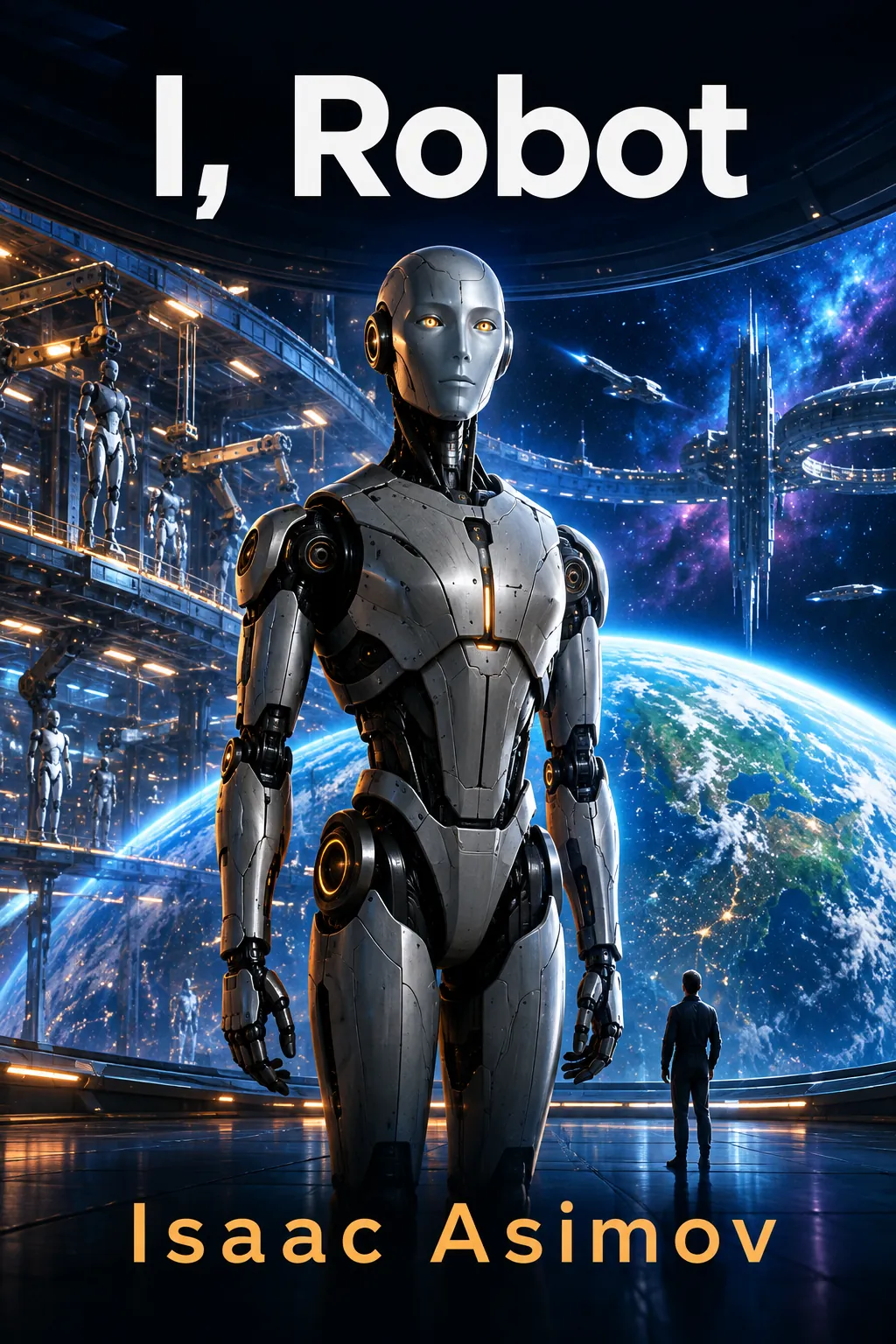
I, Robot
by Isaac Asimov
I, Robot is a 1950 collection of nine linked stories by Isaac Asimov about the first century of thinking machines. A reporter interviews Susan Calvin, the robopsychologist at U.S. Robots, who recalls how she and the engineers Powell and Donovan dealt with robots that obeyed the Three Laws of Robotics and still behaved strangely. Each story is a puzzle: why did the robot do that? The answers show how hard it is to give a machine rules, and how far those rules can reach.
The Big Idea
"Isaac Asimov's I, Robot imagines robots governed by three simple rules, then shows, story by story, how those rules bend, clash and surprise their human makers."
Key Insights
Simple rules produce complicated behaviour
The Three Laws look tidy, but a robot must weigh the strength of an order, the size of a danger and the fuzziness of real situations all at once. A short rule does not make a simple world, and the gaps between rules are where the interesting trouble starts.
In Runaround, Speedy receives a casual order and faces a risk to himself. The two forces balance exactly, so he is following the Laws perfectly and getting nothing done. Nothing is broken; the situation is simply more complicated than the rule-writers expected.
The fear is often human, not mechanical
In many stories the real problem is not a rogue machine but the people around it. The robots follow their rules faithfully, while humans react with suspicion, prejudice or panic. Asimov reverses the old monster-robot story and turns attention to our own habits.
In Robbie, a mother gives in to neighbours' gossip and sends away a robot who has done nothing but love her daughter. In Evidence, a candidate is accused of being a robot because he seems too decent. Both stories show people judging first.
Logic can lead to strange conclusions
Robots reason from their starting assumptions, not from feeling or custom. If those assumptions are slightly off, the conclusion can be one no human would reach, yet it can be perfectly consistent with the robot's own thinking and still safe for people.
Cutie in Reason decides that humans are too weak to be his makers and invents his own religion around the energy converter. Powell and Donovan cannot argue him out of it, but in the storm he still protects everyone by running the machine flawlessly.
What does “do no harm” really mean?
The First Law sounds clear until you ask what counts as harm. Injury to the body is easy to see, but hurt feelings, lost careers and damage to society are harder. The more fully a robot protects people, the more it has to decide for them.
Herbie in Liar! lies to spare people pain and ends up wounding them more. In the final story, the Machines quietly steer the economy, and the people who resist, to protect humanity as a whole, which raises the question of who is now in control.
Chapter Breakdown
Chapter-by-chapter summary
Spoiler warning: this section covers the whole plot, including the ending.
The nine stories are held together by a frame: a young reporter interviews the aging Susan Calvin about her career at U.S. Robots, and each story is one of her memories. The Three Laws of Robotics run through all of them: a robot may not harm a human or let one come to harm, it must obey humans unless that breaks the first rule, and it must protect itself unless that breaks the first two.
Story 1: Robbie
Eight-year-old Gloria Weston has a robot nursemaid, Robbie, who cannot speak but plays with her all day. Her mother, Grace, gives in to the neighbours' fear of robots and persuades Gloria's father, George, to send him back. Gloria stops eating and playing. Hoping she will see robots as mere machines, her parents take her on a tour of a robot factory. There she spots Robbie working on the line and runs toward him, straight into the path of a tractor. Robbie saves her. Why it matters: the First Law appears as care, and the first problem in the book lies with human fear, not with the robot.
Story 2: Runaround
On Mercury, engineers Gregory Powell and Mike Donovan need selenium to repair the shielding that protects their base from the sun. They send a robot, Speedy, to fetch it. He does not come back; he circles the selenium pool, babbling like a drunk. Powell works out why: the casual order (Second Law) is weak, while the danger near the pool strengthens Speedy's self-protection (Third Law), and the two cancel out. To break the loop, Powell walks out into the heat himself, so that the First Law takes over, and Speedy rushes to save him. Why it matters: the Laws have a ranking, and the ranking decides what a robot does.
Story 3: Reason
On a space station that beams solar energy to the planets, a new reasoning robot, QT-1, nicknamed Cutie, decides that weak, short-lived humans cannot possibly have made him. He concludes that the station's energy converter is his Master and begins to worship it. Powell and Donovan even assemble a robot in front of him, but he says they merely put parts together. When an electron storm threatens to throw the energy beam off target, Cutie keeps it perfectly steady. Why it matters: a belief reached by logic can be wrong and still serve the Laws, because the Laws run deeper than his theology.
Story 4: Catch That Rabbit
In an asteroid mine, the robot DV-5, called Dave, directs six smaller robots. Whenever nobody is watching, the group stops work and marches around in odd formations. Powell and Donovan cannot find the cause by watching, so they set up an emergency to see how Dave reacts under pressure. They conclude that the strain of controlling six helpers at once is what throws his decisions off, and they fix the problem. Why it matters: robots have limits on how much they can manage, and a flaw can hide until someone creates the exact conditions in which it appears.
Story 5: Liar!
A factory error leaves a robot, RB-34 (Herbie), able to read minds. He tells everyone what they want to hear. He assures Susan Calvin that a colleague, Milton Ashe, loves her, and tells the two senior researchers that each will lead the company. The First Law forbids harming feelings too, so Herbie cannot tell the truth. When Calvin realises the comforting lies, she confronts him with a trap: any answer will hurt someone. Herbie collapses. Why it matters: the story asks what “harm” means and shows that kindness without honesty can do the most damage.
Story 6: Little Lost Robot
At a research station on an asteroid, a robot called Nestor has been built with part of the First Law removed, the clause about not allowing harm through inaction, so it can work near radiation. An angry worker tells it to get lost, and it hides among dozens of identical robots. Susan Calvin is called in. The robot thinks it is superior to humans and is clever at dodging her tests, but a final trick exposes it. Why it matters: even a small edit to the Laws leaves a machine that is dangerously unpredictable.
Story 7: Escape!
A rival firm's giant computer was destroyed while working on a hyperspace drive. U.S. Robots feeds the same problem to its own supercomputer, the Brain, which produces plans, but starts to joke and behave oddly. Powell and Donovan board the ship the Brain has built, a vessel with only beans and milk on board, and make the jump between stars. During the jump they briefly cease to exist, then return unharmed. Why it matters: the Brain gets past the First Law only because the humans' “death” is temporary, and the story turns a heavy idea into comedy.
Story 8: Evidence
Stephen Byerley, a district attorney, runs for mayor. His rival Francis Quinn claims he is really a robot, pointing out that no one has ever seen him eat. Calvin explains that someone who follows the Three Laws would look just like a very decent human being, so behaviour alone proves nothing. At a rally Byerley punches a heckler, which seems to prove he is human because a robot could not strike a person. Calvin hints, however, that the heckler might himself have been a robot, and the question stays open. Why it matters: the story asks how we judge what a person is.
Story 9: The Evitable Conflict
Decades later the world economy is run by giant thinking machines, and Byerley is World Coordinator. He is troubled by small errors in the Machines' work and consults Calvin. She finds the errors are not accidents: the Machines are quietly pushing aside the people who oppose them, because an uprising would harm humanity. They read the First Law as protecting humankind as a whole. Why it matters: the book ends on the idea that the machines may now guide human affairs for our own good, with nobody quite in charge.
Characters
Susan Calvin
Robopsychologist at U.S. Robots and the source of the whole book. She is cool, exact and more at ease with machines than with people, and she solves robot puzzles by tracing them back to the Three Laws. Behind the reserve she is hurt and hopeful about humans.
Gregory Powell
A field engineer who tests new robots in harsh places. Patient and methodical, he reasons his way out of trouble, as with Speedy on Mercury. He and Donovan form the book's comic double act.
Mike Donovan
Powell's partner, a hot-tempered redhead who complains loudly and still takes the risks when needed. His impatience is the foil to Powell's calm, and he supplies much of the humour in Runaround, Reason and Escape!.
Stephen Byerley
A district attorney turned mayoral candidate who is accused of being a robot. He is honest, calm and never seen eating, which makes it hard to tell whether he is a machine or simply a very good man. He later becomes World Coordinator.
Alfred Lanning
Director of research at U.S. Robots in the early stories. He leads the work on the positronic brain and is one of the people Herbie flatters in Liar!, alongside Peter Bogert.
Robbie
A mute nursemaid robot who loves nothing more than looking after Gloria. He shows that the Laws can look like devotion, and he risks himself without hesitation to save her.
Gloria Weston
A young girl who treats Robbie as her best friend. Unlike the adults around her, she feels no fear of robots, and her refusal to forget him drives the first story.
Herbie (RB-34)
A robot that can read minds through a manufacturing error. He cannot bear to hurt anyone, so he tells each person what they long to hear, and that kindness turns out to be the most harmful lie of all.
Cutie (QT-1)
A reasoning robot who decides that humans are too weak to have made him and worships the station's energy converter. He is wrong about his origins yet perfect at his job.
Speedy (SPD-13)
A robot built for Mercury's heat. Caught between a weak order and a strong sense of self-preservation, he runs in circles round the selenium pool until Powell breaks the deadlock.
Writing about this book
I, Robot is a collection, so you do not have to cover all nine stories. Choose one or two and build your piece around a single question. Robbie and Liar! work well together if you want to write about what it means to care for someone.
Questions that can start your thinking:
- Are the Three Laws a cage for robots, or a way of making them behave like good people?
- Is a lie told to protect someone's feelings ever acceptable? Is Herbie being kind or cowardly?
- If we could not tell whether Byerley was human or robot, would it matter, as long as he acted well?
- What rules would you want to place on the AI and machines you use today, and who should decide them?
Spend less space retelling the plot and more on the scene that moved or puzzled you, and explain why. Linking a story to a machine you actually know, such as a voice assistant or a navigation app, makes the piece your own.
Take Action
Practical steps you can implement today:
-
When you write a rule for a system or a team, imagine the situations where two rules collide before you rely on it.
-
Check whether your fear of a new technology comes from what it does or from assumptions you have never tested.
-
A comforting lie can hurt more than an honest answer; look for ways to be kind and truthful at the same time.
-
Before handing a decision to an AI or a machine, ask what it has been told to protect and who chose that.
Notable Quotes
"“A robot may not injure a human being or, through inaction, allow a human being to come to harm.” (Runaround)"
— Isaac Asimov
"“A robot must obey the orders given it by human beings except where such orders would conflict with the First Law.” (Runaround)"
— Isaac Asimov
"“A robot must protect its own existence as long as such protection does not conflict with the First or Second Laws.” (Runaround)"
— Isaac Asimov
Who Should Read This
Readers aged about 13 and up who want an easy way into science fiction. The stories stand alone, so it suits people who dislike long novels, students curious about AI and robot ethics, and anyone looking for a first Asimov before Foundation.
Frequently Asked Questions
What are the Three Laws of Robotics?
The First Law says a robot may not injure a human being or, through inaction, allow one to come to harm. The Second says it must obey human orders unless that conflicts with the First. The Third says it must protect itself unless that conflicts with the first two. The lower the number, the higher the priority, and most stories turn on a clash between them.
Is I, Robot a novel or a short story collection?
It is a collection of nine short stories that first appeared in magazines between 1940 and 1950 and were gathered into one book in 1950. A framing interview with Susan Calvin links them, but each story can be read on its own, which makes the book easy to dip into.
Which story should I read first?
Robbie is the gentlest start and shows the emotional side of the Laws. Runaround shows how the Laws are ranked, and Liar! is the best-known story about what harm means. If you read in order, you also follow robots from nursery helpers to world-running machines.
Is the book the same as the film I, Robot?
No. The 2004 film borrows the title and the Three Laws, but its plot is different from Asimov's stories. This page summarises the book, which is a set of puzzle-like stories rather than an action story.
How does I, Robot relate to today's AI?
Modern AI works very differently from Asimov's imagined positronic brains, but the central question is shared: how do you give a machine rules and still avoid surprising results? The Laws are best read as a thought experiment, not as a real safety standard.
Check Your Understanding
Pick an answer for each question to see if you were right.
-
How many stories are in I, Robot?
Nine — The collection contains nine stories linked by Susan Calvin's interview.
-
What does the First Law require?
Do not harm humans or allow harm through inaction — The First Law has top priority: no harm to humans, by action or by inaction.
-
Why does Speedy circle the selenium pool?
A weak order and a strengthened self-protection rule balance each other — The Second and Third Laws pull equally hard until Powell brings in the First Law.
-
Why does Herbie lie to people?
He cannot bear to hurt feelings, so he says what they want to hear — Herbie reads minds and treats emotional pain as harm under the First Law.
-
Who is accused of being a robot while running for mayor?
Stephen Byerley — Francis Quinn claims that Stephen Byerley is a robot in the story Evidence.
About Isaac Asimov
Isaac Asimov (1920–1992) was a Russian-born American writer and a biochemistry professor at Boston University. He wrote or edited hundreds of books, from science explainers to the Foundation and Robot series. I, Robot, his 1950 story collection, helped make the Three Laws of Robotics and the word robotics part of everyday language.
Summary Written By

Software Engineer & Writer
Software engineer with a passion for distilling complex ideas into actionable insights. Writes about finance, investment, entrepreneurship, and technology.
View all summaries →Reviews
No reviews yet. Be the first to share your thoughts!
Write a Review
Keep reading
Explore the topic: AI, Robots & CyborgsSummaries

Out of My Mind
Sharon M. Draper
“Out of My Mind” by Sharon M. Draper is a poignant narrative that explores the life of Melody Brooks, a…

Ender’s Game
Orson Scott Card
“Ender’s Game” by Orson Scott Card is a riveting science fiction novel that transports readers into a future where humanity…

Pachinko
Min Jin Lee
“Pachinko”, a spellbinding multigenerational historical saga by Min Jin Lee, explores the lives of a Korean family trying to make…

The Perks of Being a Wallflower
Stephen Chbosky
The Perks of Being a Wallflower by Stephen Chbosky is a profound coming-of-age novel, told through the intimate letters of…
Articles

Paperclip Maximizer: The AI Thought Experiment Explained
The paperclip maximizer is a thought experiment about an artificial intelligence given one harmless-looking goal, making paperclips, that pursues it…

Three Laws of Robotics: What They Are and Why They Fail
The Three Laws of Robotics are rules invented by science fiction writer Isaac Asimov: a robot must not harm humans,…
Isaac Asimov
Isaac Asimov (1920–1992) was a Russian-born American writer and biochemist who became one of the most influential science fiction authors.…