In five minutes
Schrödinger's cat is a thought experiment from 1935 that puts a cat in a sealed box and asks when, exactly, the cat becomes alive or dead. It was meant as a challenge to quantum physics, not as a description of how cats behave.
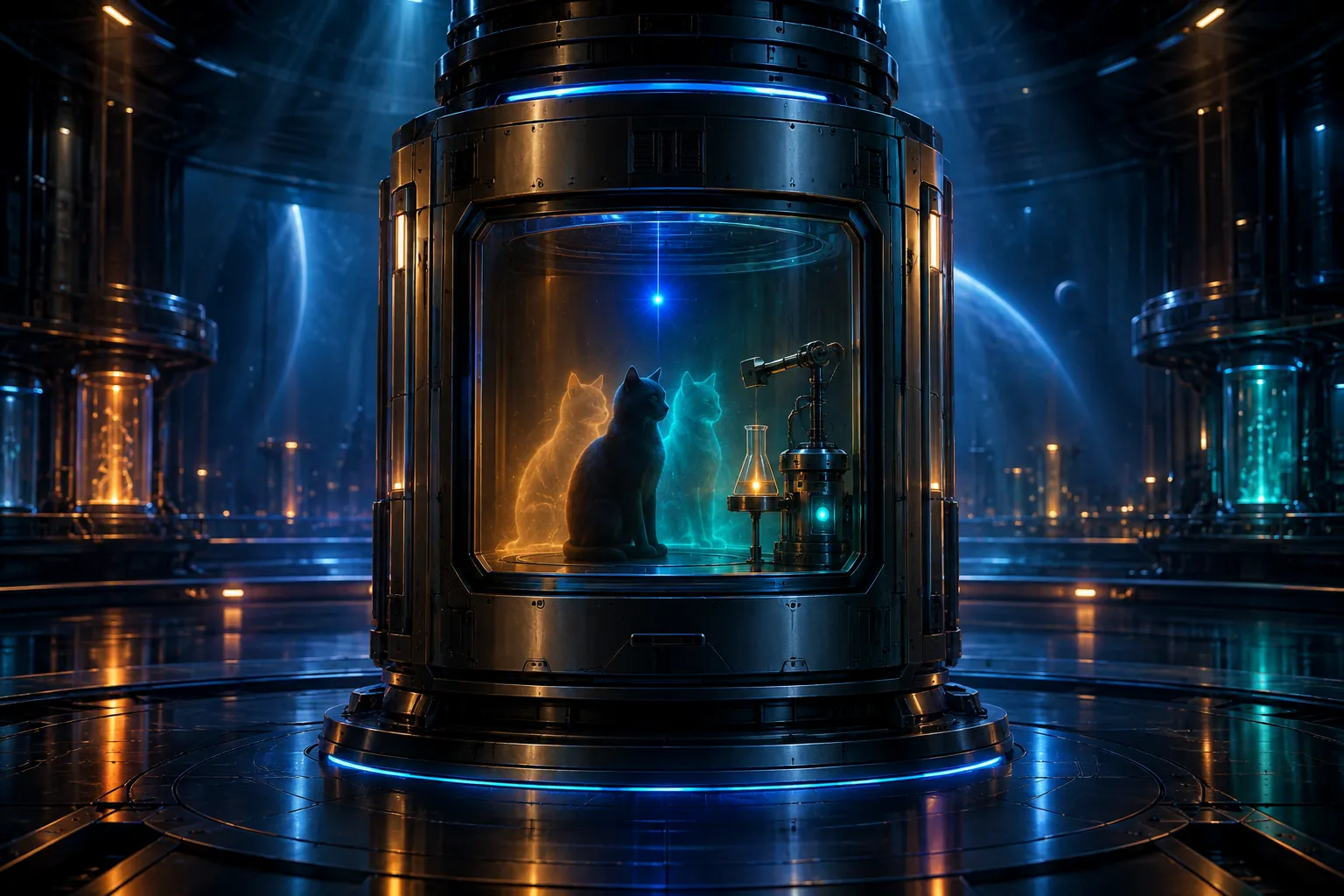
The setup is simple. A cat sits in a steel chamber with a tiny amount of radioactive material, a Geiger counter, a hammer and a flask of poison.
The amount of material is so small that one atom has an even chance of decaying within an hour. If an atom decays, the counter fires, the hammer smashes the flask and the cat dies.
If nothing decays, the cat is fine. Nobody outside the box can know which happened until they open it.
Quantum theory describes an atom's decay as a matter of probability. Until it is measured, the atom is described by a wave function that holds both outcomes at once, a state called a superposition.
Schrödinger's point was that if you follow the chain of cause and effect, that strange description seems to spread from the atom to the counter, the hammer, the flask and finally the cat. The whole box would be an even mix of "living cat" and "dead cat" until someone looks.
He thought this result was absurd. That is the heart of the puzzle: the maths works superbly for atoms, yet nobody has ever seen a cat that is both.
Where the idea comes from
Erwin Schrödinger, an Austrian physicist, described the cat in a long paper in the German journal Naturwissenschaften in November 1935. The paper surveyed the state of quantum mechanics, and the cat is one vivid example inside it.
By then he was already famous. His wave equation of 1926 is still the standard way to describe how a quantum system changes over time, and he shared the 1933 Nobel Prize in Physics with Paul Dirac.
The cat grew out of an argument. In 1935 Albert Einstein, Boris Podolsky and Nathan Rosen published a paper claiming that quantum mechanics must be incomplete.
Einstein and Schrödinger wrote to each other about it that summer. Einstein described a heap of gunpowder that, under quantum rules, would be a mix of exploded and not exploded after a while.
Schrödinger answered with a more dramatic picture, the cat. So the cat is an ally of Einstein's doubts, not a statement of belief.
It shows what happens when a rule built for atoms is stretched to something you can see and hold. Schrödinger wanted physicists to notice that the theory gave no clear answer about where the quantum world ends and the everyday world begins.
The real science
What is established
Superposition is real. Electrons, photons and atoms can be prepared in states that combine possibilities, and the interference patterns they produce confirm it.
What is not settled is the measurement problem. When we measure a quantum system we always find one definite result, yet the equations describe a blend of possibilities.
Why one outcome appears, and what counts as a measurement, are still debated. The cat is the most famous way of asking that question.
Three ways to read the puzzle
The Copenhagen interpretation, associated with Niels Bohr and Werner Heisenberg, treats the wave function as a tool for predicting results. A measurement gives one outcome, but the theory does not say exactly where measuring begins.
The many-worlds interpretation, proposed by Hugh Everett in 1957, removes the sudden choice altogether. Every outcome happens, each in its own branch of reality, and the cat is alive in one and dead in another.
This is the idea behind the multiverse of science fiction, although physicists still argue about whether it is the right reading.
Decoherence, developed from the 1970s by H. Dieter Zeh and later Wojciech Zurek and others, adds a physical explanation. A large object constantly bumps into air molecules, light and heat, and these contacts wipe out the interference that makes a superposition detectable, almost instantly.
So a cat never stays in a visible mix of states for long. Decoherence explains why large things look ordinary, though physicists still disagree on whether it fully explains why we see one outcome.
Other proposals exist too, such as objective-collapse models and Bohm's pilot-wave theory. They make different claims, and none has won general agreement.
What experiments have shown
No one has put a real cat into such a state. What labs have done is create "cat states", superpositions of two clearly different states of something bigger than a single atom.
Serge Haroche and David Wineland shared the 2012 Nobel Prize in Physics for methods of measuring and controlling individual quantum systems. In 2010 a team led by Aaron O'Connell at the University of California, Santa Barbara, put a tiny mechanical resonator, visible under a microscope, into a quantum state.
The 2022 Nobel Prize in Physics went to Alain Aspect, John Clauser and Anton Zeilinger for experiments on entangled particles. Their work shows that quantum links between objects are real and measurable.
The size of the objects keeps growing, but every one is carefully isolated from its surroundings. That isolation is exactly what a living cat in a box could never have.
Where it shows up in fiction
The cat is one of the most borrowed images in science fiction and in jokes about science. It works as shorthand for uncertainty, and it fits the larger story of how the genre has used physics, which you can follow in our history of science fiction.
Ursula K. Le Guin wrote a short story called "Schrödinger's Cat" in the 1970s, which plays with the idea in a surreal, comic way. Robert Anton Wilson used the name for a trilogy of novels that mixes physics, conspiracy and shifting realities.
Many stories about parallel timelines owe something to the many-worlds reading that the cat helped inspire. Stories about worlds that may not be what they seem also sit close to the simulation hypothesis, which asks a similar question about what is real before anyone checks.
Common misconceptions
"Schrödinger said cats can be alive and dead." He did not.
He offered the cat as an absurd consequence of applying quantum rules to a large object, and he used it to criticise the way the theory was being explained.
"A conscious person must look to decide the outcome." The standard mathematics does not need a mind.
Any interaction that records the result, such as the Geiger counter, counts as a measurement in most modern readings, and the cat itself is a very large, noisy observer.
"It is just ignorance, like not knowing which hand holds the coin." In a coin game the coin is already in one hand.
A quantum superposition produces interference effects that mere ignorance cannot, which is why physicists treat it as something different.
"Scientists have shown a real cat in two states." They have not.
Experiments use atoms, photons, tiny vibrating devices and superconducting circuits, isolated from their surroundings.
"Quantum physics means anything is possible." The theory gives precise probabilities for what will be measured, and those predictions are among the best tested in science.
Read next
- History of Science Fiction: the wider story of how science ideas became stories.
- Multiverse: the many-worlds idea that tries to answer what happens to the cat.
- Simulation hypothesis: another thought experiment about whether the world is what it appears to be.