In five minutes
Titan is Saturn's largest moon, and it is the only moon in the Solar System with a thick atmosphere. It is also the only world besides Earth where rivers, lakes and seas of liquid sit on the surface today.
The liquid is not water. At about −179 °C, the lakes of Titan are filled with methane and ethane, the same compounds that make up natural gas on Earth.
Titan is wider than the planet Mercury, and only Jupiter's Ganymede is a larger moon. Its air is mostly nitrogen, like ours, but the surface pressure is about 1.5 times what you feel at sea level.
Deep under the ice, data from the Cassini spacecraft suggest a layer of liquid water. Organic chemistry on top, water below and an energy supply from sunlight: that mix is why astronomers keep calling Titan one of the most interesting places to study.
Fiction got there first, long before probes did. Our History of Science Fiction article shows how writers imagined worlds like this one.
A moon the size of a planet
Titan orbits Saturn at an average distance of about 1.2 million kilometres and circles the planet once every 16 days. Like our Moon, it always shows the same face to its planet.
Its diameter is about 5,150 kilometres, which is larger than Mercury's 4,880 kilometres. Titan weighs far less than Mercury, though, because it is made of roughly half rock and half ice.
Gravity on the surface is about one-seventh of Earth's. A 70-kilogram person would feel like someone weighing 10 kilograms.
Saturn has well over 100 known moons, and Titan is by far the largest of them. It is the second-largest moon in the Solar System, behind only Ganymede.
The Dutch astronomer Christiaan Huygens found Titan on 25 March 1655, using a telescope he built with his brother Constantijn. It was the first moon ever discovered around Saturn.
Huygens did not name it. The name Titan was suggested in 1847 by John Herschel, who proposed naming Saturn's moons after the Titans, the giants of Greek myth who were brothers and sisters of Cronus, the Greek counterpart of Saturn.
The real science: what we know
An orange haze and a thick atmosphere
In November 1980 Voyager 1 flew past Titan at about 6,500 kilometres and found that it could not see the surface. A thick orange haze hid everything.
The atmosphere is about 95 percent nitrogen and roughly 5 percent methane, with traces of other gases. Sunlight breaks methane apart, and the pieces join into larger organic molecules that form the haze and slowly fall to the ground as dark dust.
That is why Titan is a favourite of chemists. It is a natural laboratory for carbon chemistry on a scale no lab can match.
Cassini and Huygens
The Cassini spacecraft, a joint mission of NASA, the European Space Agency and the Italian space agency, launched in 1997 and reached Saturn in 2004. It carried a European-built probe named Huygens.
Huygens separated in December 2004 and landed on Titan on 14 January 2005. It remains the first landing on any world in the outer Solar System.
The descent took about two and a half hours, and the probe kept sending data from the ground for more than an hour. Its photographs showed rounded pebbles of water ice and channels that look like dry riverbeds.
Cassini itself flew past Titan more than 120 times, using radar to see through the haze. The mission ended on 15 September 2017, when the spacecraft was deliberately sent into Saturn's atmosphere.
Lakes, seas and methane rain
Cassini's radar found dark, smooth patches near Titan's poles, and by 2007 scientists had reported them as lakes of liquid hydrocarbons. The largest sea, Kraken Mare, covers several hundred thousand square kilometres in the north.
On Titan, methane does the job that water does on Earth. It evaporates, forms clouds, falls as rain and runs through river valleys back into the seas.
Near the equator, Cassini found huge fields of dunes. The sand is not silica but dark grains of organic material, shaped by the wind.
One Titan season lasts about seven Earth years, because Saturn takes roughly 29 years to orbit the Sun. Clouds and storms move between the poles over those seasons.
An ocean under the ice
As Titan circles Saturn, the planet's gravity squeezes and stretches it a little. Cassini measured how much, and the results, published in 2012, fit best with a layer of liquid water beneath the ice shell.
Scientists use the same idea for Jupiter's moon Europa, which you can read about in Europa (moon). Details such as the depth of the ocean and how salty it is are still being worked out.
Could anything live there?
No sign of life has been found on Titan. At the surface, water is frozen as hard as rock, so life as we know it could only exist in the ocean far below, if anywhere.
Some scientists also ask whether a very different kind of life could use liquid methane instead of water. There is no evidence for that so far, and it remains speculation.
The next mission: Dragonfly
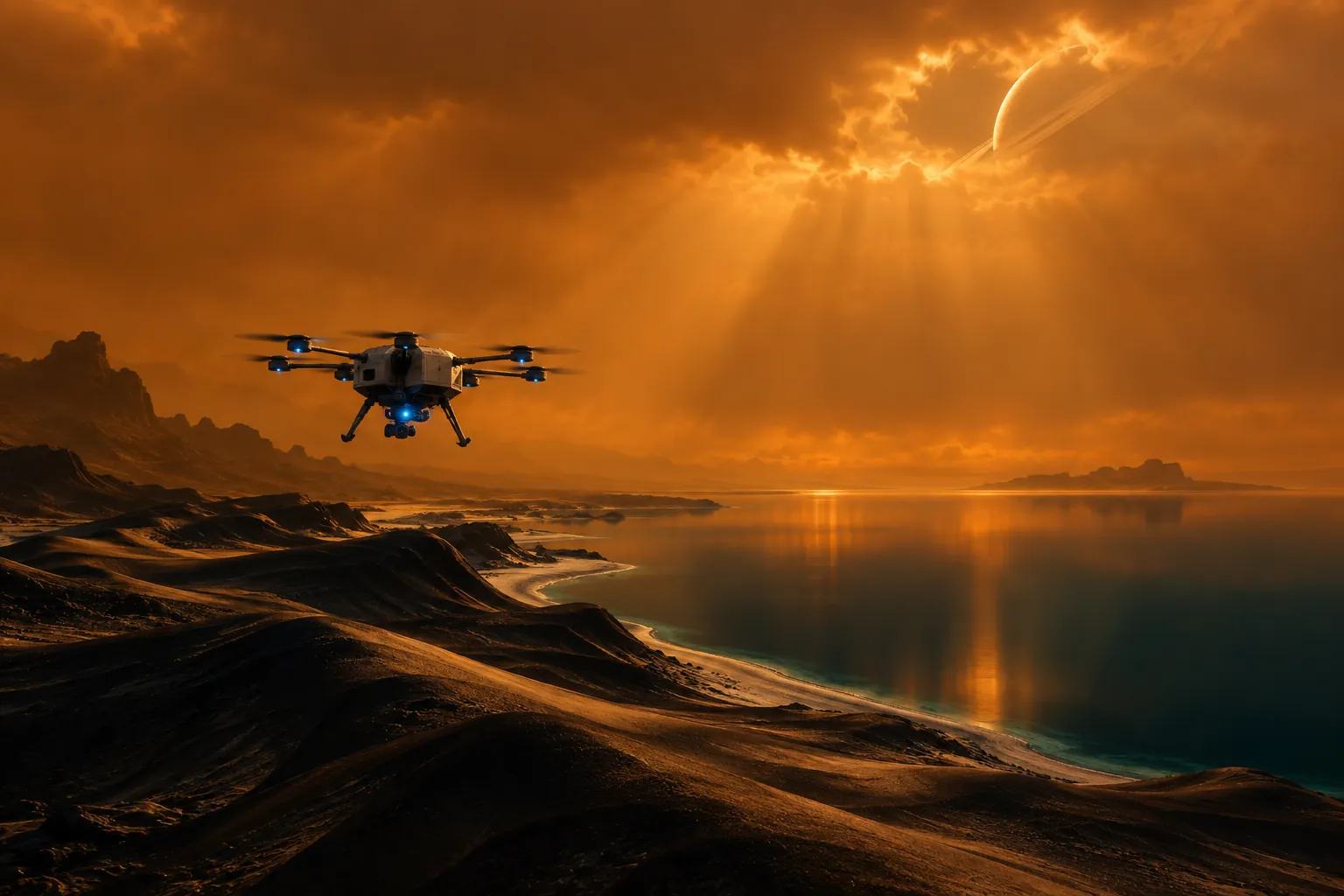
NASA's Dragonfly is a rotorcraft roughly the size of a small car, with eight rotors. It is planned to launch in 2028 and arrive at Titan in 2034.
It will land first in the dune fields near the equator and then fly from site to site, heading for Selk crater, to study the surface chemistry.
Flying is practical there because the air is dense and gravity is low. The lander will be powered by a radioisotope generator, since sunlight under the haze is very weak.
Where it shows up in fiction
Kurt Vonnegut's novel The Sirens of Titan (1959) sends its characters across the Solar System, and Titan gives the book its name. It is a comic, philosophical story, so it uses Titan as an idea more than as a physical place.
Arthur C. Clarke's Imperial Earth (1975) follows a man born in a Titan settlement who travels to Earth in the year 2276. Clarke pictured Titan as a working colony far from home.
Both books were written before Voyager 1 and Cassini. The real Titan turned out different from what either author imagined, with methane rain and dunes of organic grains.
Writers still use Titan as a symbol of the far frontier. For another moon that science fiction loves, see Io (moon).
Common misconceptions
“Titan has lakes of water.” The lakes and seas on the surface are liquid methane and ethane.
Liquid water is thought to exist only deep inside.
“Titan is a frozen copy of early Earth.” The comparison is popular, but it is loose.
Titan is far colder, has almost no free oxygen and runs its weather on methane instead of water.
“You could walk around Titan with just an oxygen mask.” The cold of −179 °C means you would also need heavy insulation.
The thick air does mean a pressure suit would not be needed, which is a real difference from the Moon or Mars.
“Titan could be terraformed easily because it has an atmosphere.” Titan gets about one percent of the sunlight Earth gets and is extremely cold, so the idea is far beyond any near-term technology.
Our article Terraforming explains what the idea involves and where it runs into limits.
“Titan is the only moon with an atmosphere.” Several moons have thin atmospheres, such as Io and Triton.
Titan is the only one with an atmosphere thicker than Earth's.
Read next
Europa (moon): another ocean world, and the best comparison for what may lie under Titan's ice.
Io (moon): the most volcanic world in the Solar System, and a very different kind of moon.
Terraforming: what it would take to remake a world, and why fiction loves the idea.
History of Science Fiction: the wider story of how writers imagined these places.