In five minutes
ʻOumuamua (1I/2017 U1) is the first object from another star system that astronomers have caught passing through ours. It was found in October 2017, crossed the inner Solar System within weeks, and is now heading back out into interstellar space for good.
It was faint, elongated and oddly fast, so it raised an unusual question: what is it? A rock, a chunk of ice, or something built?
The short answer from most researchers is that it is a natural object, probably a fragment of ice or rock thrown out of another star's planetary system long ago. The longer answer is that we only had a few months of data, and it behaved in ways that no ordinary asteroid or comet does.
This page walks through what was measured, which explanations are serious science, and why the story caught so many people's imagination. It sits beside our History of Science Fiction guide, because the idea of a visitor arriving unannounced from the stars is one of the oldest in the genre.
What astronomers saw in 2017
On 19 October 2017, Robert Weryk spotted a fast-moving dot in images from the Pan-STARRS1 telescope on Haleakalā in Hawaii. Within days, follow-up observations showed that its path was not a closed ellipse around the Sun but an open curve called a hyperbola.
That meant it was not bound to the Sun and would never return. Far from the Sun it was moving at about 26 kilometres per second relative to the Sun, much faster than anything born in our own system could be at that distance.
Its route was just as telling. It passed closest to the Sun on 9 September 2017, at roughly a quarter of the Earth–Sun distance and well inside the orbit of Mercury.
It then swept past Earth on 14 October at about 24 million kilometres, around sixty times the distance to the Moon. Nobody saw it coming, because it was found only after it had already passed.
The strangest data was its brightness. It rose and fell by a factor of about ten every seven to eight hours, which points to a body that is very elongated or flat and is rotating as it flies.
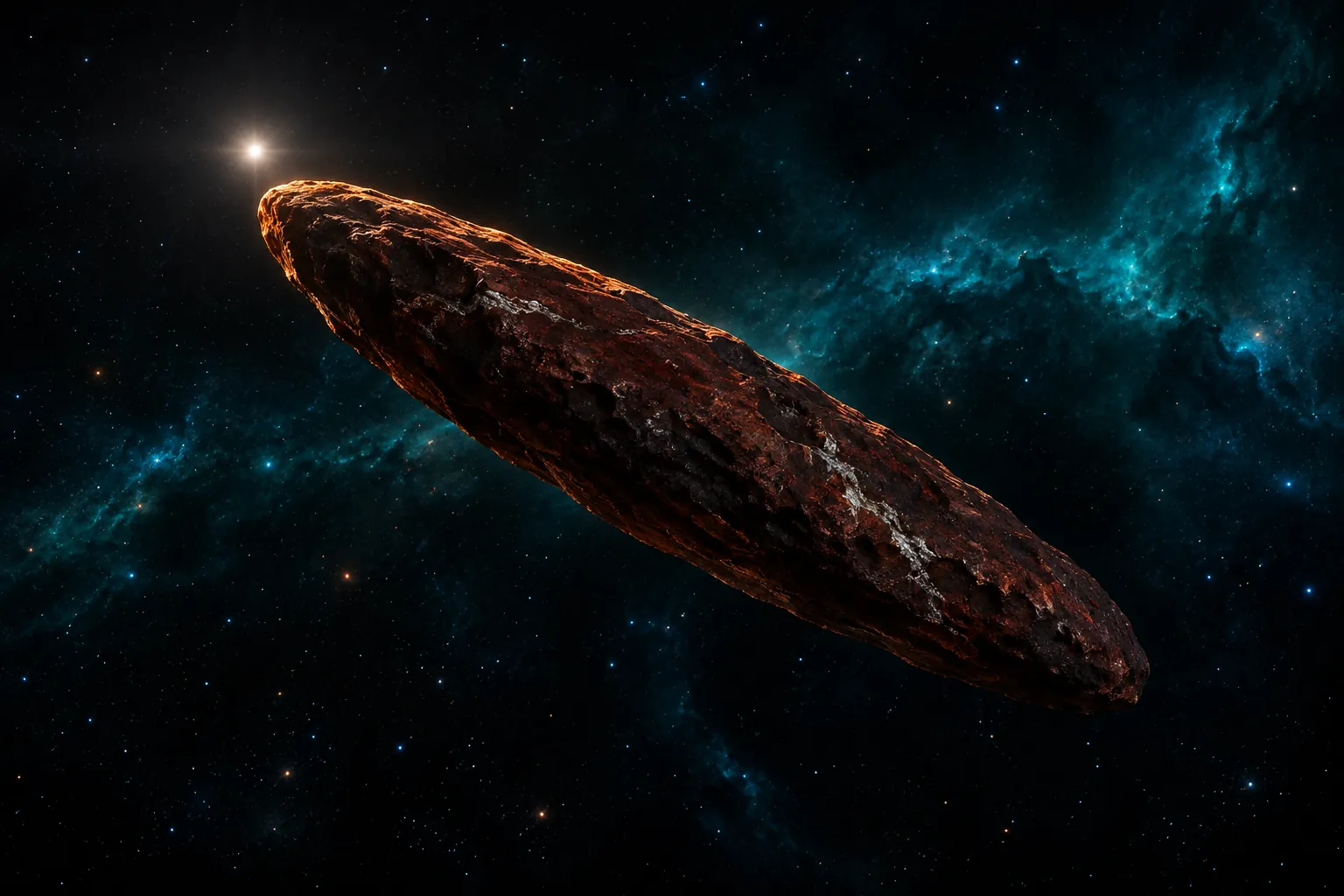
Early estimates put its length at a few hundred metres, with a length-to-width ratio of at least five to one. Later work found that it was not spinning neatly like a top but tumbling, which makes its exact shape harder to pin down.
Astronomers saw no clear coma, the cloud of gas and dust that normally surrounds an active comet, and no tail. Yet in 2018 a team led by Marco Micheli reported that it sped up slightly as it left the Sun, by more than gravity alone could explain.
By January 2018 it had faded below what even the Hubble Space Telescope could detect. Everything we know comes from those few months of observations.
What the name means
The object was first logged as a comet, then as an asteroid, and finally given a brand-new label, 1I, the first entry in the catalogue of interstellar objects. The Pan-STARRS team then worked with Hawaiian-language advisers to choose a name.
They picked ʻOumuamua, usually explained as "a messenger from afar arriving first". It is pronounced roughly oh-MOO-ah-MOO-ah, and the opening mark is the Hawaiian ʻokina, a brief pause in the voice.
The real science: what is known and what is debated
What is established
Three things are solid. It came from outside the Solar System, it was small and elongated or flat, and it left on a path that will never bring it back.
It was also not a normal comet or a normal asteroid. Its surface was reddish, a colour seen on some bodies in the outer Solar System, and it showed no sign of the dust that comets shed.
What is still argued about
The odd acceleration is the heart of the argument. In 2023, Jennifer Bergner and Darryl Seligman proposed in the journal Nature that hydrogen trapped in water ice could be released as the object warmed, giving a small push without any visible dust.
Other natural ideas include a shard of a Pluto-like world made of nitrogen ice, proposed by Steven Desch and Alan Jackson in 2021. Another is a fragment torn apart by the tides of a passing star, suggested by Yun Zhang and Douglas Lin in 2020.
Then there is the alien idea. In 2018, Avi Loeb of Harvard and Shmuel Bialy suggested that a very thin object shaped like a light sail, pushed by sunlight, could match the acceleration, and Loeb later argued for an artificial origin in his book Extraterrestrial (2021).
That is a hypothesis, not a finding. An international team gathered by the International Space Science Institute concluded in 2019 that the observations fit a natural origin, and a Breakthrough Listen search with the Green Bank Telescope in December 2017 found no artificial radio signal.
The honest position is that we have no close-up image, so several explanations still fit the data. The natural ones need fewer unusual assumptions, which is why most astronomers favour them.
Later visitors help. Comet 2I/Borisov arrived in 2019 and looked like an ordinary comet from another star, and 3I/ATLAS was found in 2025, which suggests interstellar objects are not rare, only hard to catch.
Where it shows up in fiction
The nearest ancestor is Arthur C. Clarke's novel Rendezvous with Rama (1973), in which a huge cylinder enters the Solar System and a human crew goes inside. News coverage of ʻOumuamua reached for the comparison almost at once.
The difference is the point. Clarke's visitor is enormous, steady and clearly engineered, while ʻOumuamua was small, tumbling and gone in a few months.
The wider idea belongs to first-contact stories, where the question is how people would react to a sign of other minds. Our guide to first contact in fiction and science follows that tradition.
It also touches the Fermi paradox. If the galaxy holds many planetary systems, rocks ejected from them should drift between the stars, and a probe could drift too.
ʻOumuamua showed that such wanderers can really be caught by our telescopes. It did not show that anyone built one.
Common misconceptions
"It was confirmed to be an alien ship"
No. The alien-probe idea is one hypothesis from a small group of scientists, and the wider research community did not accept it.
"It was a cigar-shaped spaceship"
The cigar picture is one artist's guess from the brightness changes. A flat, pancake-like shape fits the data as well, and nobody has a photo of its true outline.
"It was just a normal comet"
Not quite. A normal comet shows a bright cloud and tail, and ʻOumuamua did not, which is why the label changed from comet to asteroid to something new.
"Scientists ignored the odd acceleration"
They did not. The 2018 measurement was published in Nature, and several natural explanations were proposed within a few years to account for it.
"It is still on its way to us"
It is leaving. It crossed the orbit of Jupiter in 2018 and is heading outward, roughly toward the constellation Pegasus.
Read next
First contact (in fiction and science): how stories and scientists imagine the moment we learn we are not alone.
Fermi paradox: why a crowded galaxy looks so quiet, and where visitors like this one fit.
History of Science Fiction: the long story of alien visitors in books, from early tales to the present.