In five minutes
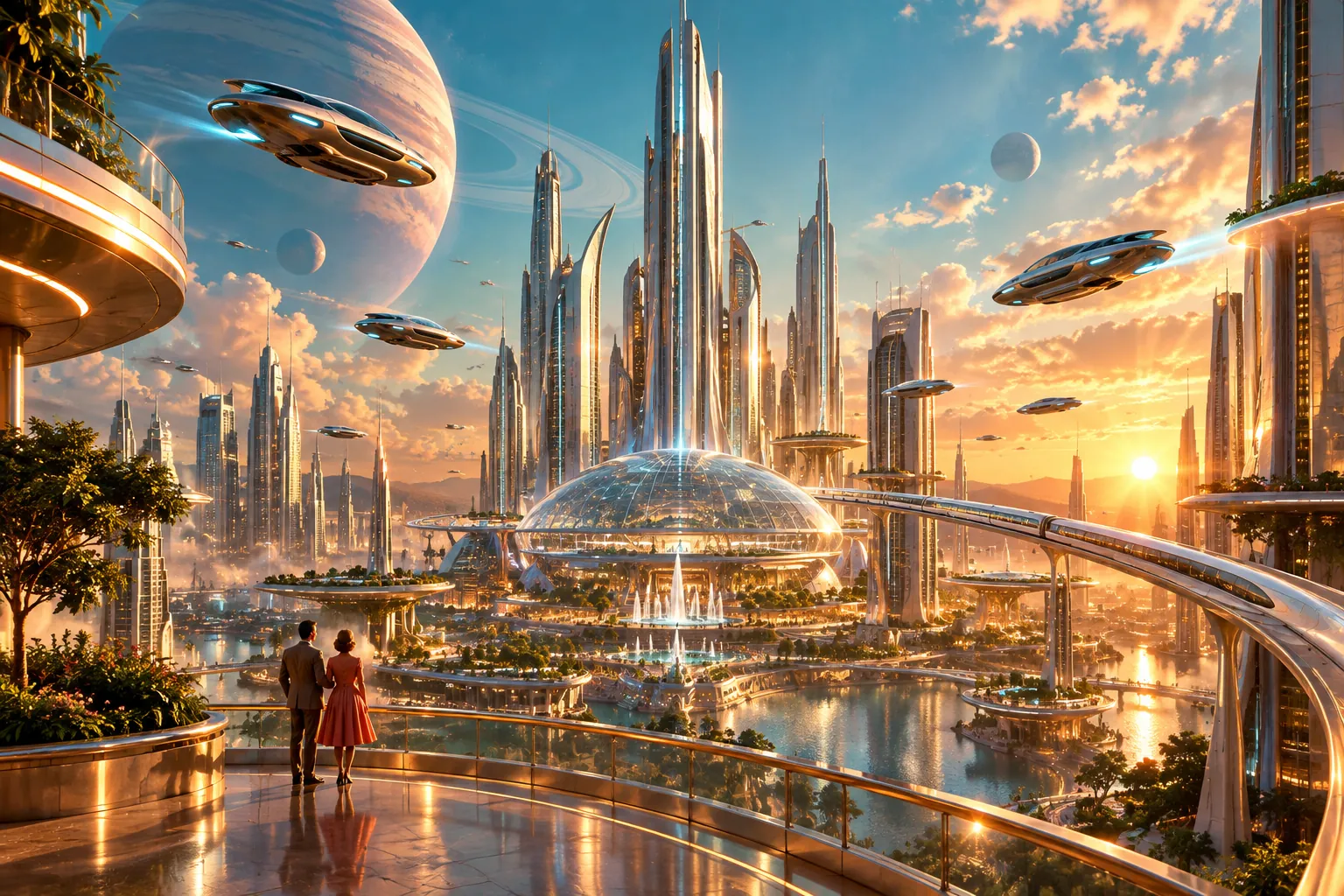
Retrofuturism is the way earlier generations pictured the future, and the modern taste for that picture. It is the 1950s kitchen with a robot maid, the gleaming city of monorails and towers, the family car that flies.
The word joins “retro” (looking back) and “future” (looking ahead). It points at the gap between the tomorrow that was promised and the one that arrived.
There are two strands. The first is original work, made when the future was still a hopeful guess, such as magazine covers, world’s fairs and cartoons.
The second is newer work that borrows the same look on purpose. Sometimes it does so with love, and sometimes with a smile.
Both strands share a feeling that is hard to name: a warm, slightly sad sense of a tomorrow that never came. That mix of optimism and nostalgia is why the style keeps coming back.
Many modern visions of the future are dark, from climate collapse to constant surveillance. Against that background, a picture of a cheerful future can feel fresh, even a little comforting.
Look for three signs: rounded, streamlined shapes, bright chrome and primary colours, and a simple faith that technology will make life better. If a scene shows a hover-car next to a 1950s hat, you are probably looking at retrofuturism.
It is better seen as a look and a mood than a strict genre, since it can be applied to almost any kind of story. It sits inside the wider history of science fiction and is a close cousin of steampunk, which looks back even further.
Where the term comes from
The idea is older than the word. In 1883 the French illustrator and writer Albert Robida published Le Vingtième Siècle, a comic, detailed vision of the 1950s with crowded skies and a home screen he called the téléphonoscope.
The word itself arrived later. In the late 1980s the American artist Lloyd Dunn used “retrofuturism” as the name of a small magazine, and critics adopted it for the whole mood.
A few years earlier, William Gibson had already caught the feeling in a short story, “The Gernsback Continuum” (1981).
Its narrator is a photographer hired to record the streamlined buildings of the 1930s. He begins to see the bright future of old pulp magazines leaking into the present.
Gibson’s story is a good guide to the tone. The old future is lovely, a little eerie and not quite innocent.
A short history of the look
These decades produced the look because change felt fast: electric homes, mass-market cars, airliners, nuclear power and rockets arrived within a single lifetime. Designers and artists had real machines to extend.
In 1926 the publisher Hugo Gernsback launched Amazing Stories, and artist Frank R. Paul’s covers filled it with rockets and towers. In 1927 the German film Metropolis showed a vast future city to audiences across the world.
The 1939 New York World’s Fair took “The World of Tomorrow” as its theme. Its most famous exhibit, General Motors’ Futurama, showed a huge model of an America of 1960 laced with highways.
Around then, streamlining spread from trains to toasters. Smooth, wind-cutting curves became a signal that something was modern.
After the war, atomic power and space became the heroes. In 1957 Ford showed a scale model of the Nucleon, an imagined car with a small reactor; no real one was ever built.
On the American West Coast, boomerang shapes, starbursts and upswept roofs made up Googie architecture. The name comes from Googie’s, a Los Angeles coffee shop that opened in 1949.
Disneyland opened its Tomorrowland in 1955, and the cartoon The Jetsons began in 1962, set about a century ahead. The space race of the 1960s pushed silver fabrics and porthole windows into everyday design.
When Apollo 11 landed on the Moon in July 1969, the dream of space travel looked vindicated. Many of the other promises, from lunar bases to flying cars, did not follow.
Japan had its own version. Illustrator Shigeru Komatsuzaki (1915–2001) drew giant rockets and undersea cities for boys’ magazines.
Osamu Tezuka’s Astro Boy began in 1952, and the robot’s fictional birthday was 7 April 2003. The 1964 Tokaido Shinkansen and Expo ’70 in Osaka, with its theme “Progress and Harmony for Mankind”, gave the dream real concrete form.
The real science: what the old futures got right and wrong
Retrofuturism is not forecasting. It is a picture of what a period hoped for and feared, so judging it only on hits and misses misses half the point.
Still, plenty came true. Humans reached the Moon in 1969, and jet airliners, high-speed trains and video calls are now ordinary.
Monorails, a favourite of the old drawings, did appear, in Seattle in 1962 and Tokyo in 1964, though only as short lines. Plenty of other things did not happen.
Bell’s Rocket Belt flew a person in 1961, but each flight lasted well under a minute, and personal jet packs never caught on. The atomic car stayed a model, and the all-pill dinner has not arrived either.
Moon bases were common in forecasts of the 1950s and 1960s. Instead, the last Apollo mission left the Moon in 1972.
More interesting is what the old pictures missed. Few of them imagined the internet or the smartphone, technologies that changed how people connect more than how machines look.
Many also kept society frozen in place, with new gadgets in the kitchen and the mother still doing the housework. In that sense an old vision of the future is a self-portrait of its own time.
Where it shows up in fiction
Start with books. Gibson’s “The Gernsback Continuum” is about retrofuturism itself, which makes it a good entry point.
Robert A. Heinlein’s The Door into Summer (1957) is set in 1970 and 2000 and is full of household machines. Read today, it shows the future as the 1950s imagined it.
Films are best named rather than described: Metropolis (1927), Brazil (1985) and Back to the Future Part II (1989), which imagined the year 2015. The date in that film, 21 October 2015, came and went, and fans compared it with the real world.
Close relatives exist. Steampunk rebuilds the steam-powered nineteenth century, while “atompunk” is a name some fans give to the atomic-age look of the 1950s.
Cyberpunk differs mainly in mood. Cyberpunk arrived in the 1980s with neon and distrust, while retrofuturism looks back at an age that still trusted the future.
A handy trick when watching: look for what has not changed. Hats, hairstyles and furniture in a “future” scene often give away the decade it was made.
Common misconceptions
“It is the same as steampunk.”
Not quite. Steampunk reworks the steam-powered nineteenth century, while retrofuturism mostly deals with the twentieth century’s visions of tomorrow.
They overlap and are often shelved together, but the starting points differ.
“It is just nostalgia for the past.”
What people miss is not the past itself but the future the past believed in. There is hope in it, and a little irony.
“People back then were naive.”
Many of these pictures were serious extensions of the technology of their day, and some came true, from Moon landings to bullet trains. Laughing at them misses how reasonable they were.
“It is only American.”
American examples are the loudest, but Robida in France, Komatsuzaki and Expo ’70 in Japan, and Soviet space-age posters show the same hope elsewhere.
Read next
- History of Science Fiction: the bigger story, from early fantasies of the future to today.
- Steampunk: the cousin that rebuilds the steam age instead of the atomic one.
- Cyberpunk: the darker, neon-lit answer that took over in the 1980s.