In five minutes
The Wow! signal is a radio burst that the Big Ear telescope in Ohio recorded on the night of 15 August 1977.
It lasted 72 seconds, it was strong, and it was squeezed into a very narrow band of frequencies close to the one hydrogen atoms radiate.
A few days later, astronomer Jerry Ehman was going through the printouts and circled the strange sequence of characters. He wrote “Wow!” in the margin, and the name stuck.
No one has found the signal again, in nearly fifty years of looking. That is why it is both the most famous candidate in the search for extraterrestrial intelligence (SETI) and a lesson in why scientists ask for a repeat before they believe anything.
It also belongs to the larger story of how science fiction and real astronomy keep borrowing from each other, which we follow in the History of Science Fiction.
What the telescope recorded
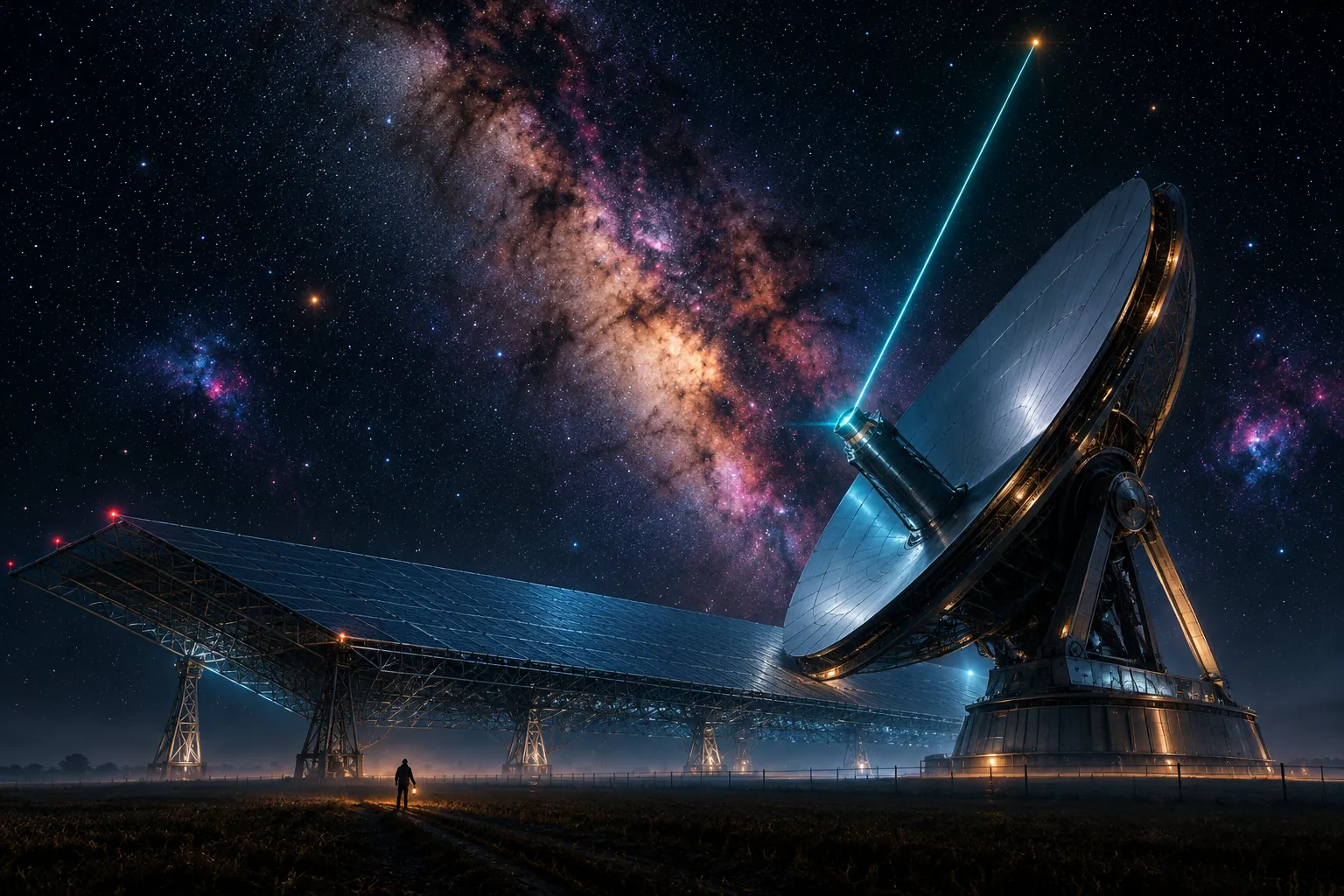
Big Ear was a radio telescope run by Ohio State University near Delaware, Ohio. Its huge flat reflector and curved mirror did not move while observing: they let Earth’s rotation sweep the sky past a fixed beam.
A radio source at a fixed position in the sky therefore crossed the beam in about 72 seconds, and the telescope was running one of the first long SETI programmes, begun in the 1970s.
The computer printed the signal strength every 12 seconds as a character. Digits meant a signal 1 to 9 times above the background noise, and letters took over for stronger readings.
On 15 August 1977 the printout for one channel read 6EQUJ5. The values climbed from 6 to a peak of U, roughly thirty times the background, and then fell away again.
That rise and fall is exactly what a steady source would produce as it passed through the telescope’s beam, which is one reason the burst looked so convincing.
The frequency was about 1420 megahertz. This is the radio frequency of neutral hydrogen, the most common element in the universe, and it lies in a band where human transmitters are meant to stay silent.
Scientists had proposed back in 1959 that a civilisation wanting to be noticed might broadcast near this frequency. The Wow! signal fits the textbook guess, which helps explain the excitement.
The direction pointed to the constellation Sagittarius, well south of the celestial equator. No obvious nearby star system was identified there.
The real science: why it is still unexplained
The key problem is simple: it never repeated. Science works on results that others can check, and a single 72-second event cannot be checked.
Big Ear’s design makes it odd. It had two receiving horns that looked at the same strip of sky a few minutes apart, and the burst showed up in only one of them.
If the source had been steady, both horns should have seen it. So whatever it was, it either switched off in between, or it was not a steady source in the first place.
Follow-up searches began within days and have continued for decades. Astronomer Robert Gray and others searched the same patch of sky, including observations with the Very Large Array in the 1990s, and found nothing similar.
Several explanations have been proposed, and none is accepted by everyone. Earth-based interference, such as a reflection from a satellite or a stray transmitter, is the most cautious one, although the protected band makes it less likely.
In 2017 a researcher suggested that hydrogen clouds around two comets that happened to be in the region might have produced the burst. Other astronomers pointed out that comet emission is weak and spread across a wider range of frequencies than the signal showed.
More recently, researchers studying archived observations have proposed that a flare from a distant neutron star could have switched on a natural hydrogen cloud for a moment. This is still a hypothesis, not a result.
The honest summary is that the Wow! signal has a few possible explanations, no proof for any of them, and no way back to the original sky to measure again.
How astronomers weigh a one-off signal
Scientists usually ask four questions of any strange detection: did it repeat, did more than one instrument see it, can known sources explain it, and can others check the data.
The Wow! signal looks exciting on the first question but fails the rest, because it appeared once, in one horn, with no second instrument pointed at the same sky.
This is why careful researchers call it a “candidate” and not a “detection of aliens”. The word candidate means worth a second look, nothing more.
A useful comparison is the pulsars found in 1967. At first their regular pulses were jokingly labelled “LGM”, for little green men, until more observations showed they were spinning neutron stars.
That story is a reminder that unexplained signals sometimes do turn out to be natural, and that the only way to learn is to keep watching.
Why the hydrogen line matters
Neutral hydrogen atoms release radio waves with a wavelength of about 21 centimetres, which is what the 1420 megahertz figure means.
Astronomers use this “21-centimetre line” every day to map the gas in our galaxy, so radio telescopes everywhere are built to listen there.
That makes the band a natural meeting point, a bit like agreeing to meet at the main station, which is why SETI searches focus on it.
It also means a strong narrow burst on that frequency is unusual, since most natural sources spread their energy across a much wider range.
Where it shows up in fiction
The signal gave writers a ready-made image: a lone line on a printout that might be somebody, somewhere, saying hello.
Carl Sagan’s novel Contact (1985) imagines a signal that does repeat, and follows what would happen to science and to politics once it is decoded.
Stanisław Lem’s His Master’s Voice (1968) asks a quieter question: even if a signal arrives, would we ever understand what it is for?
In Liu Cixin’s The Three-Body Problem, a radio message sent into space and an answer received years later drive the whole trilogy. That is a mild spoiler about the plot, but the book’s premise shows what a single reply could set in motion.
For the wider idea of meeting a stranger from the stars, see our article on first contact in fiction and science.
Common misconceptions
“It was a message.” Nothing was decoded.
The six characters are only a strength reading, with no words, pattern or meaning in them.
“It proved aliens exist.” It did not.
It is an unexplained observation, and an unexplained observation is not evidence for any one answer.
“It lasted 72 seconds because the senders stopped.” The 72 seconds is how long a fixed source takes to cross Big Ear’s beam.
The telescope could not tell us how long the source really lasted.
“Wow!” is a code. It is just what a surprised astronomer wrote on paper.
“Nobody is still looking.” Radio telescopes and SETI projects around the world still listen on the same frequencies, and the Fermi paradox, the question of why we see no one, is the larger puzzle behind them.
Read the Fermi paradox next.
A short reading guide
If you want to remember the case in one line, think: strong, narrow, hydrogen, 72 seconds, once.
When you read about it online, check whether the writer says “message” or “signal”, and whether they mention that it was never repeated.
Good sources also explain the one-horn problem, because that detail shows the writer has looked beyond the headline.
Read next
Fermi paradox: if the universe is so old and so large, why has no one called, and where does a signal like this fit into the answers?
First contact (in fiction and science): how writers and scientists have imagined the day a signal turns out to be real.
History of Science Fiction: the hub for the genre’s big ideas, from early tales to modern novels.