In five minutes: what is spaghettification?
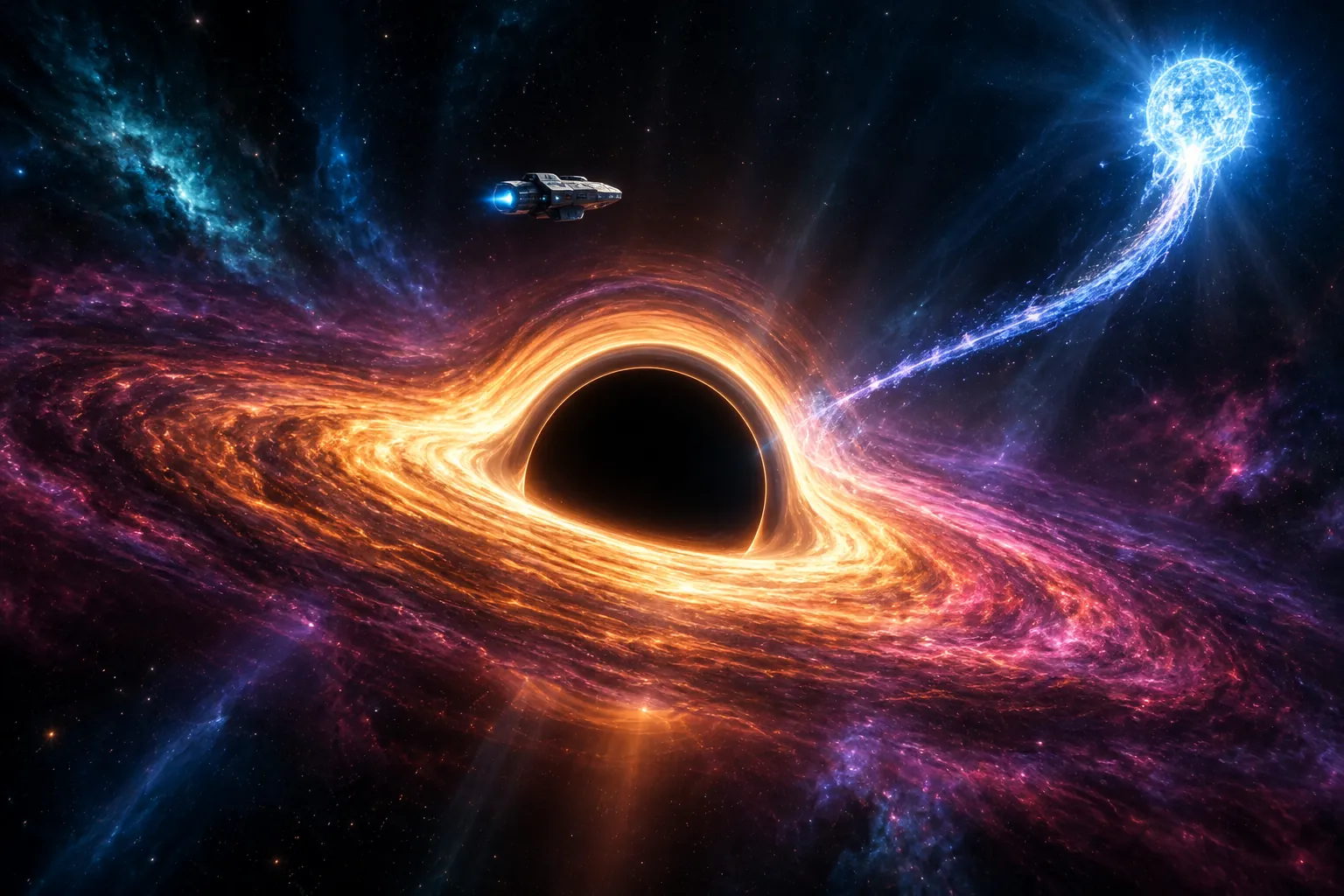
Spaghettification is what happens when an object falls toward a very strong source of gravity and is stretched along its line of fall while being squeezed from the sides. It ends up long and thin, like a strand of pasta.
The cause is not gravity alone, but the difference in gravity from one place to another. That difference is called a tidal force.
Picture an astronaut falling feet first toward a black hole. The feet are closer to the hole, so they are pulled harder than the head.
Far from the hole, that gap is tiny and nobody notices it. Close to a small black hole, it becomes enormous.
The astronaut is stretched along the line toward the hole. At the same time the body is squeezed sideways, because every part of it is being pulled toward the same centre.
The physicist Stephen Hawking made the idea famous in his 1988 book A Brief History of Time, where he describes an astronaut falling feet first into a black hole and being stretched like spaghetti. Physicists also say "tidal stretching", and the informal name "noodle effect" turns up in popular science.
This page belongs to our History of Science Fiction hub, because the idea has been a favourite of science fiction writers for decades.
The idea explained simply: it is the difference that hurts
Gravity gets weaker with distance. So two points at different distances from a massive object feel slightly different pulls.
On Earth you already see this. The Moon pulls harder on the near side of the planet than on the far side, and that difference helps raise the ocean tides.
The effect is gentle for the Earth and Moon. Your body is far too small and too strongly held together to notice.
Now shrink the distance and raise the mass. The tidal force grows very steeply as you get closer: it scales with the inverse cube of the distance.
Halve the distance and the tidal stretch becomes eight times stronger. That is why the last stretch of a fall is so violent.
Notice something odd here. A freely falling astronaut does not feel "gravity pulling" at all, just as astronauts on the space station feel weightless.
What the astronaut feels is the stretching, because different parts of the body fall at slightly different rates. Einstein's general relativity describes this as the curvature of spacetime, and tides are the part of gravity that cannot be removed by falling.
The real science: what is established and what is speculation
The established part is the physics of tides. Tidal forces are measured every day, and the Roche limit, worked out by the French astronomer Édouard Roche in the 1840s, tells us how close a moon can orbit before a planet's tides pull it apart.
Spaghettification is the same idea pushed to the extreme. Black holes and neutron stars are the only places where it can happen to a compact object.
The size of the black hole matters a great deal. For a black hole of about ten times the Sun's mass, the event horizon is only about 60 kilometres across (a radius of about 30 kilometres).
An astronaut would be stretched fatally well before reaching that horizon. The tidal force at that distance is many millions of times Earth's gravity across the height of a person.
For a supermassive black hole, the situation flips. Sagittarius A*, at the centre of our galaxy, has a mass of roughly four million Suns, and its horizon is about 24 million kilometres across (a radius of about 12 million kilometres).
Because the horizon is so large, the tidal force at the edge is mild. A traveller could cross the horizon without being torn apart.
In theory the stretching would still come later, deeper inside, as the traveller nears the central singularity. Nobody can observe that region, and what happens at the singularity itself is not something current physics can describe.
We have, however, watched spaghettification happen to stars. When a star strays too close to a supermassive black hole, the black hole's tides tear it into a stream of gas, in what astronomers call a tidal disruption event.
Martin Rees worked out the theory in 1988, and dozens of these events have since been found. One of the best studied is AT2019qiz, spotted in 2019 about 215 million light-years away, which astronomers observed with the European Southern Observatory's Very Large Telescope.
The speculative part is everything about a human body. No person or probe has ever approached a black hole, so the details of a human fall are calculations, not observations.
Where it shows up in fiction
Science fiction writers noticed tidal forces long before the word spaghettification was popular. Larry Niven's short story "Neutron Star" (1966) is a classic example, where a pilot is threatened by the tides near a collapsed star.
Niven built the tension on real physics, which helped make him a leading name in hard science fiction.
The 2014 film Interstellar is an instructive case, by name only. Its giant black hole is supermassive, which fits the physics above: a visit to its neighbourhood does not tear the travellers apart.
Many other stories use the idea as a quick, grisly way to show how dangerous a black hole is. The better ones check whether the black hole is small or huge before deciding what happens.
If you like stories about strange spacetime, wormholes are the cousin of this topic. In our article on the wormhole you can see how fiction and physics share another famous shortcut through space.
Common misconceptions
"Everything is torn apart at the event horizon." Not always.
For a supermassive black hole you cross the horizon with little tidal stress, and for a small one the stretching starts well outside it.
"You would feel a huge pull." In free fall you feel no pull at all.
You feel only the difference between head and feet.
"Black holes suck things in." Far away, a black hole's gravity is the same as that of any object with the same mass.
The Sun swapped for a black hole of equal mass would leave Earth's orbit unchanged.
"It only happens at black holes." Tidal stretching happens everywhere, but it becomes dramatic only near very dense, massive bodies such as neutron stars and black holes.
"You become a literal noodle." The name is a vivid picture.
Real tidal disruption turns a star into a stream of hot gas, and a body would be torn apart long before it looked like pasta.
Read next
Wormhole: the other famous shortcut through spacetime, and how real physics and fiction treat it.
History of Science Fiction: the hub for the ideas, authors and eras behind stories like these.