In five minutes
Cyberspace is the idea that the connected world of computers is a place you can go to, not just a tool you use.
The word comes from fiction. The writer William Gibson used it first in a 1982 short story.
It then became a nickname for the early internet, a term in law and defence policy, and the standard name for the digital world in science fiction.
This page belongs to our History of Science Fiction hub. It explains the idea, the real technology behind it and the most common mix-ups.
What cyberspace means
There are two meanings, and people often blend them.
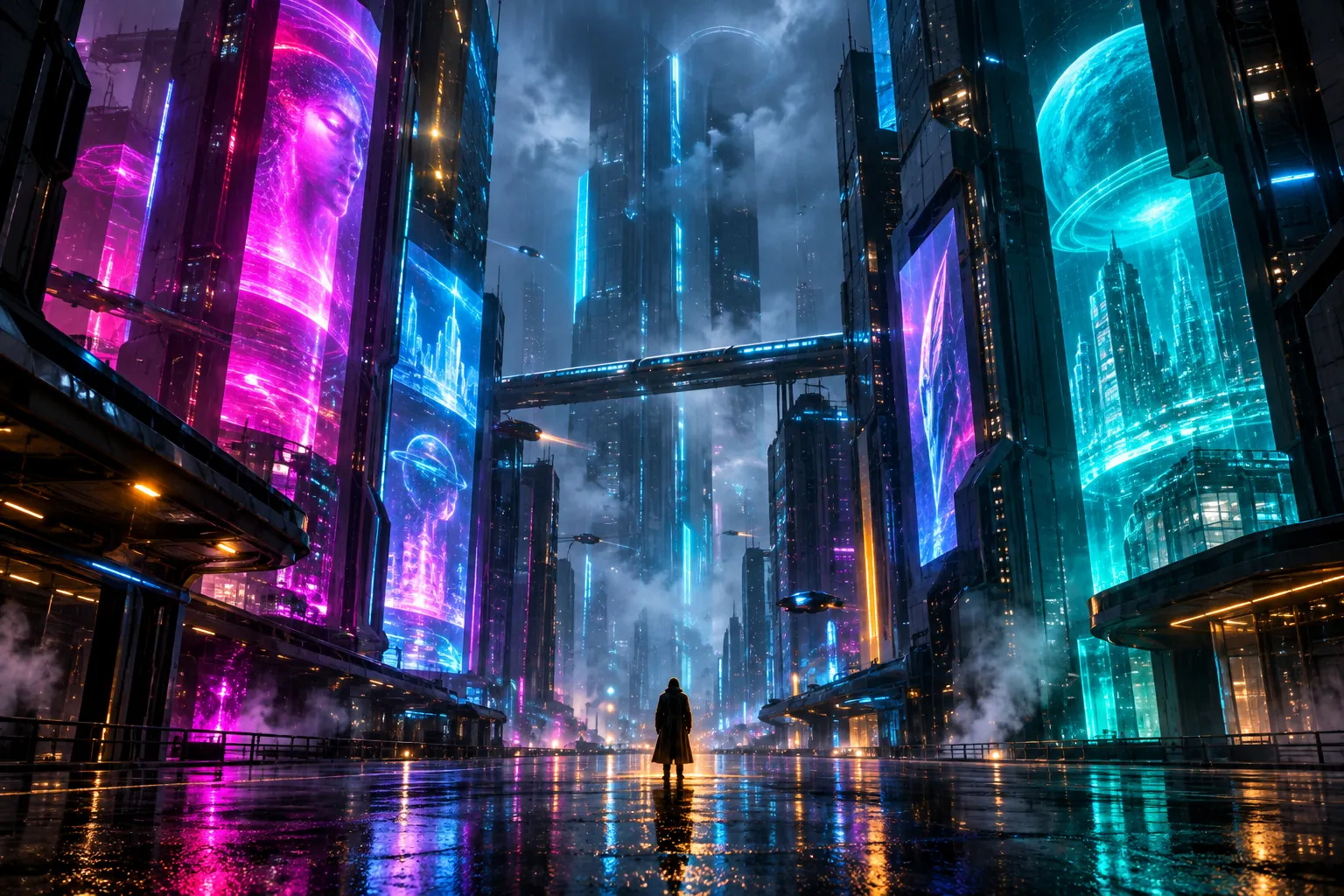
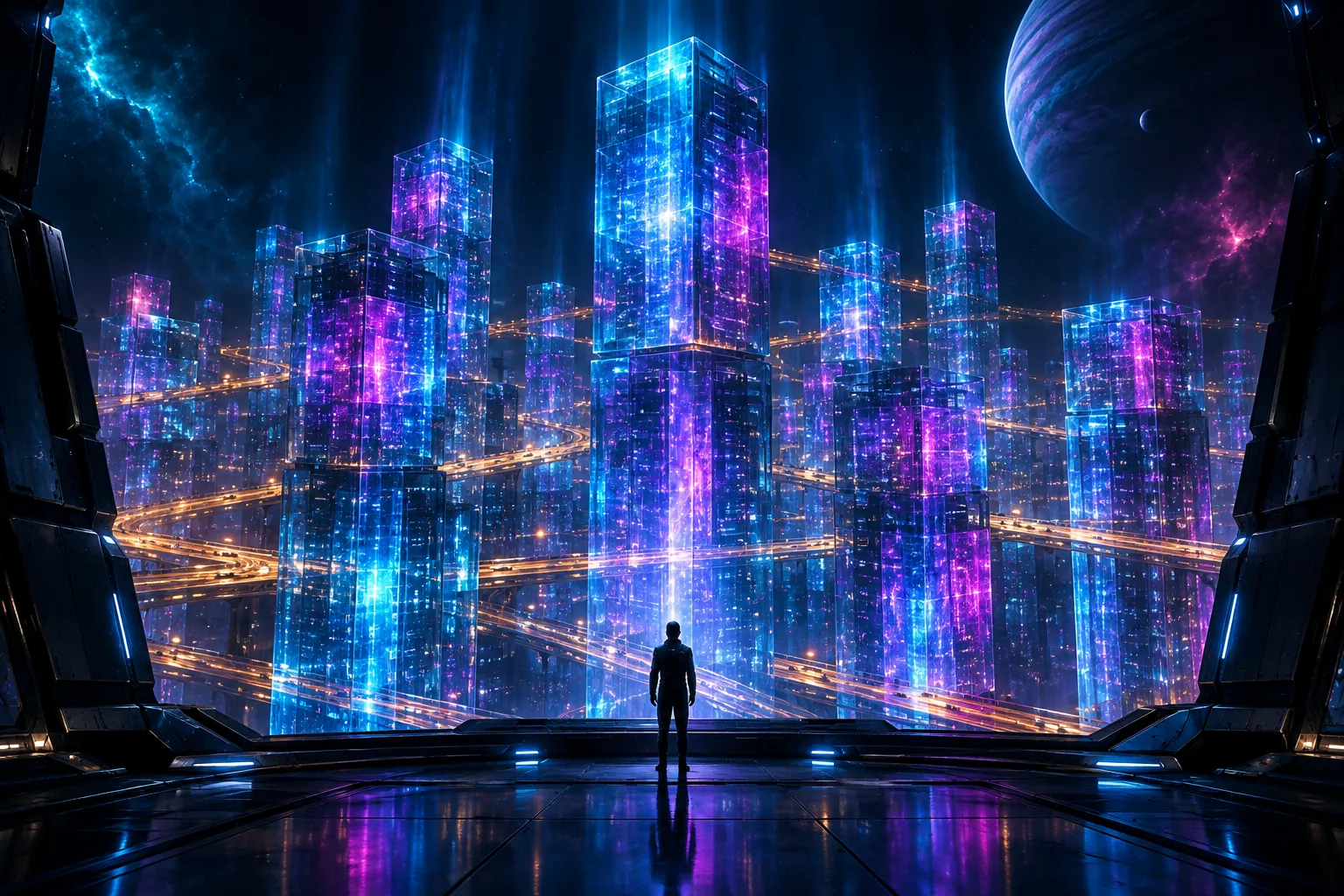
In fiction, cyberspace is a shared, three-dimensional space made of data. A character plugs in and sees companies, files and security systems as buildings, lights and shapes.
In everyday and official language, cyberspace is the whole environment created by networks, computers, software and the people who use them. Nobody walks around in it, but it still feels like a place when you say you met someone online or that a site is down.
What both meanings share is a feeling: information has a geography. You can arrive, wander, get lost, trespass and defend a border.
Where the word came from
William Gibson, born in 1948 and later based in Vancouver, wrote the short story “Burning Chrome”. It appeared in Omni magazine in July 1982.
He needed a name for the space his hackers worked in and built one from “cybernetics” and “space”.
Cybernetics is the study of control and communication in machines and living things. Mathematician Norbert Wiener named it in 1948, borrowing a Greek word for a ship’s steersman.
Gibson has said he got the picture from watching teenagers in video arcades. They leaned into their games as if they wished they could step inside the screen.
He has also said the word felt evocative but had no clear meaning, which was exactly why it suited a story.
Gibson was not alone in imagining virtual worlds. Vernor Vinge’s novella “True Names” (1981) showed hackers working in a shared digital realm, and the 1982 film Tron put a programmer inside a computer.
But Gibson supplied the name, and the name is what stuck.
Why the idea caught on
Before cyberspace, computers were mostly seen as calculators, filing cabinets or office machines. The word gave them a different image: a landscape you could travel through.
That image helped ordinary readers picture something abstract. A network of cables and software is hard to imagine, but a city of glowing towers is easy.
The word also gave people a shared vocabulary. When the public internet arrived in the 1990s, journalists, lawyers and teachers already had a ready-made term for it.
That is why you will see the word in old news stories about “surfing” and “the information superhighway”. Those phrases belong to the same habit of treating networks as places and roads.
Neuromancer and the word’s breakthrough
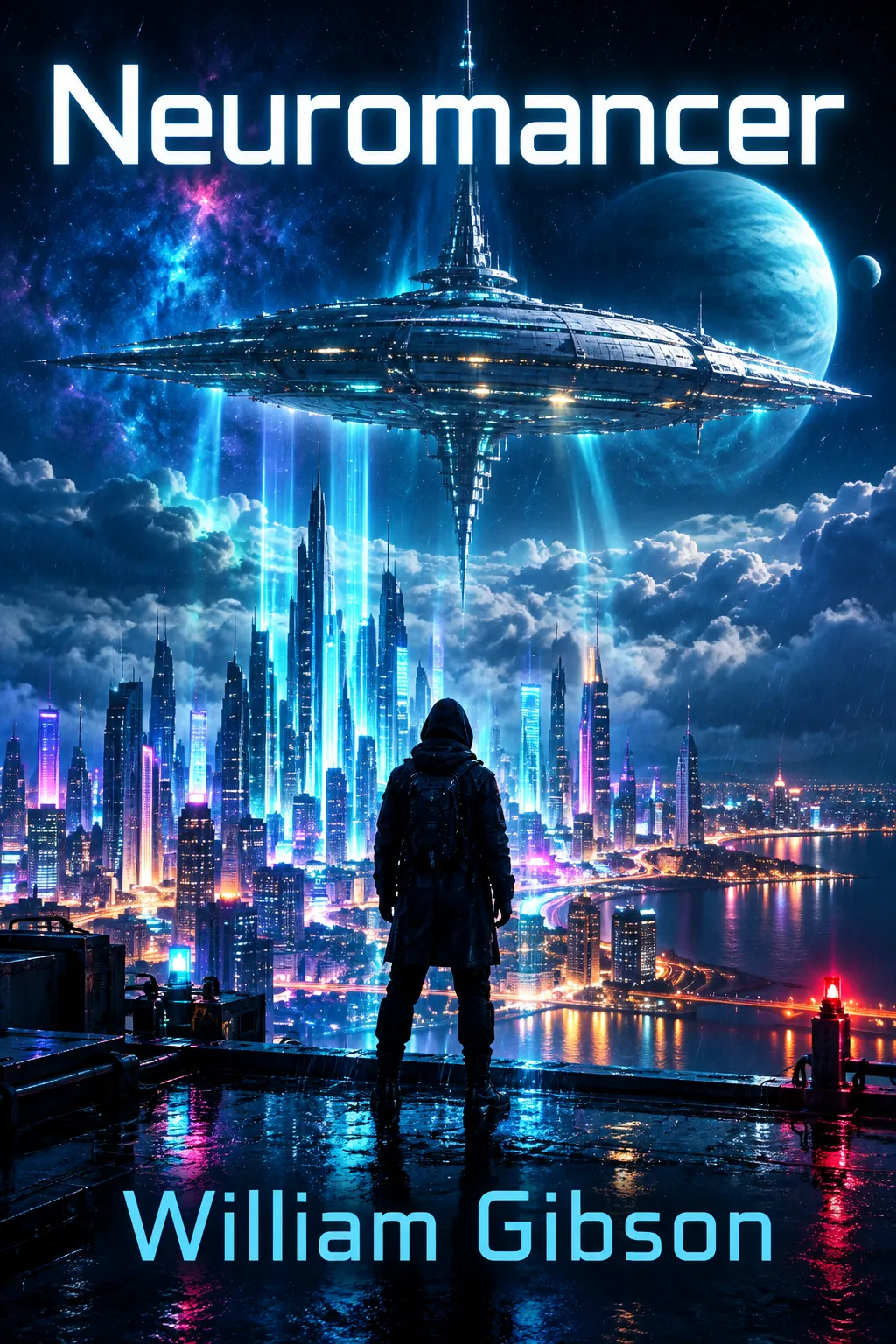
In Neuromancer (1984), cyberspace is the main setting. The hero, Case, is a hacker who “jacks in” to a global network and moves through it as a glowing landscape.
The novel describes cyberspace as “a consensual hallucination”, a world that exists because millions of people agree to see the same data the same way.
That phrase explains why the word spread. It treats the network as a shared experience, not just a pile of machines.
Neuromancer won the Hugo, Nebula and Philip K. Dick awards, and it helped launch the cyberpunk movement.
The book appeared before the World Wide Web existed. The web was proposed in 1989 and opened to the public in 1991.
The real science: what exists and what is speculation
The established part is the network. The internet grew out of ARPANET, which began in 1969, and billions of devices now exchange data on it.
People already treat it as a space in practical ways. Courts argue about where online acts happen, and companies and governments talk about defending networks.
The United States Department of Defense said in its 2011 cyberspace strategy that it treats cyberspace as an operational domain, alongside land, sea, air and space.
Virtual reality and augmented reality are real and improving. In 1992 Neal Stephenson’s novel Snow Crash described a virtual “Metaverse”, and in 2021 Facebook renamed itself Meta to build something like it.
The speculative part is Gibson’s direct neural link. Brain-computer interfaces exist in medical research, mainly to help people with paralysis control devices, but nothing lets a person “jack in” to a full sensory world.
A fully shared three-dimensional world used by everyone is also still fiction. Most people experience cyberspace as screens, text, voice and video.
Where it shows up in fiction
Neuromancer is the starting point. Its sequels, Count Zero (1986) and Mona Lisa Overdrive (1988), continue the story of the same network and give it new inhabitants.
Gibson’s early stories, collected as Burning Chrome in 1986, show smaller, grittier versions of the idea.
Snow Crash gives a more commercial and comic version, with avatars and a virtual street. Later novels and films, including The Matrix in 1999, use the same basic setup of a world inside the machine.
The shared pattern is easy to spot. A character leaves the body behind, enters a space made of information, and finds that the rules of that space are set by whoever owns it.
If you want the wider genre around these books, start with Cyberpunk.
Common misconceptions
“Cyberspace is just another word for the internet.” Not quite.
The internet is the technology. Cyberspace is the idea of the space it creates, and it also covers private networks and the people using them.
“Gibson invented the internet or predicted it exactly.” He did neither.
He wrote a vivid image and a name, and he has said he knew little about computers when he wrote Neuromancer. What he got right was the feeling of living online.
“Gibson also coined cyberpunk.” No. The term comes from a 1983 story by Bruce Bethke, and critics later applied it to Gibson’s work.
“Cyberspace means virtual reality.” Virtual reality is one way to enter a digital space.
Email, forums and online games are cyberspace too, with no headset.
“It is only a sci-fi word.” It began in fiction, but it now appears in laws, military plans and security policy.
How to write about cyberspace in class
If a teacher asks you to explain the word, give its origin first: Gibson, 1982, “Burning Chrome”, then the 1984 novel.
Next, separate the two meanings. Say that the fictional version is a shared 3D world, while the everyday version is the environment created by networks and their users.
Then add one example of real-world use, such as the 2011 United States defence strategy that treats it as an operational domain.
A strong answer ends with a point of view. For instance, you can argue that fiction often supplies the words we later use to describe real technology.
Avoid claiming that Gibson predicted the internet. A safer and more accurate claim is that he gave people a vivid way to imagine it.
Read next
Neuromancer: the novel where cyberspace became a place you could walk through, and the best place to see Gibson’s idea at full strength.
Cyberpunk: the genre built on high technology and low lives, which grew around this word.
History of Science Fiction: the larger timeline that shows where cyberspace fits among other big ideas.