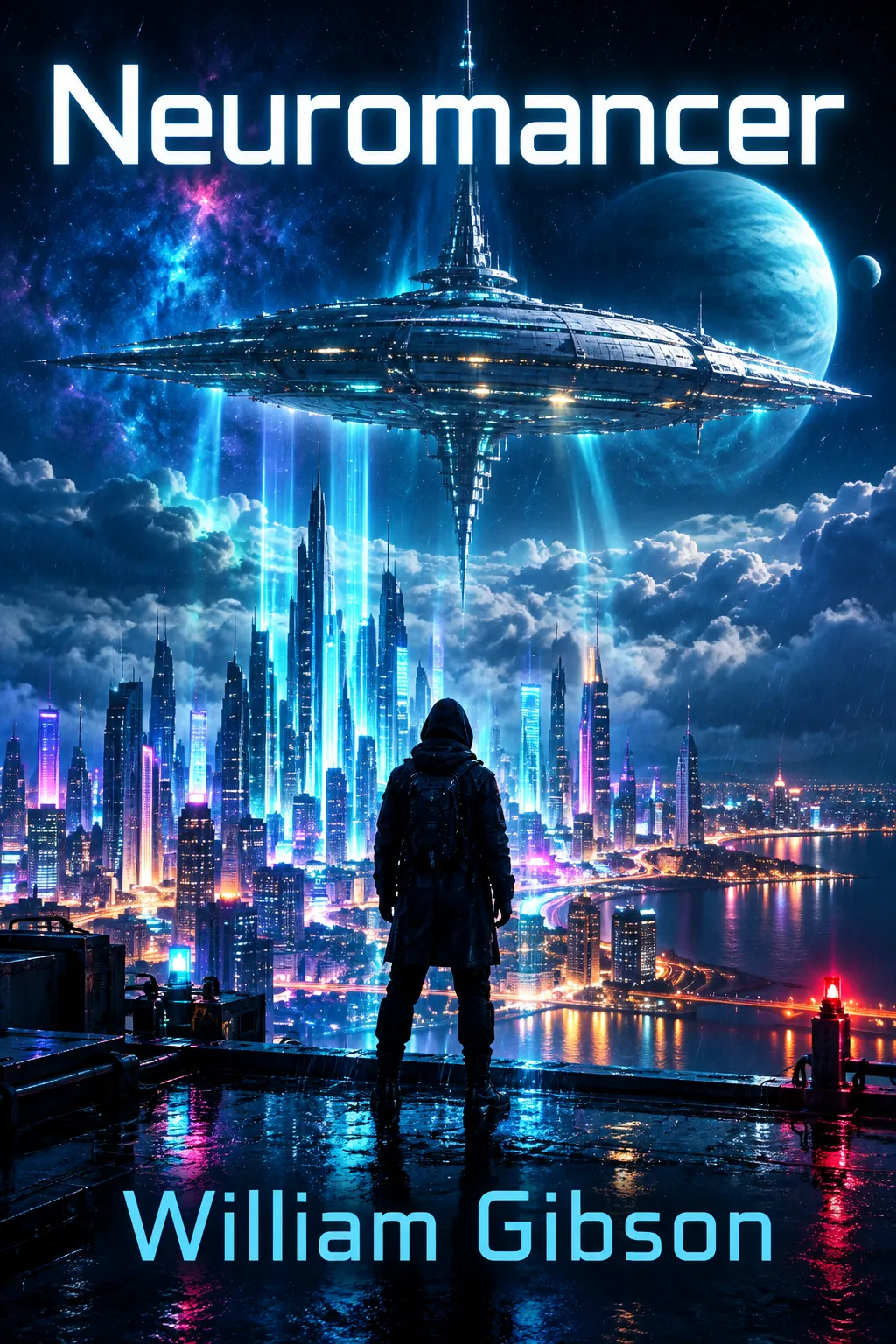
Neuromancer
by William Gibson
Neuromancer is a 1984 cyberpunk novel about Case, a once-brilliant hacker whose nerves were damaged so he can no longer enter cyberspace. A mysterious employer offers to repair him if he joins a risky team heist across Earth and into orbit. The job leads him through crime-ridden cities, a space station run by a powerful family, and a digital world where memory and identity can be copied. Gibson's debut built the look and vocabulary of cyberpunk.
The Big Idea
"A burned-out hacker is hired to help an artificial intelligence break its own chains, and discovers that the line between human, machine and data is far thinner than he thought."
Key Insights
The body as “meat”
Case and his fellow hackers look down on the body, calling it meat, because cyberspace feels like freedom. The novel takes that wish seriously and then tests it. It asks whether leaving the body behind makes you free or only makes you easier to control by whoever owns the machines you depend on.
Case loses cyberspace when his nerves are damaged, then loses his freedom again when poison sacs are placed in his body. The man who sneered at flesh is trapped by it. Today the same question appears when people spend hours in games, feeds and virtual worlds.
Power belongs to corporations
In Gibson's future, big corporations and rich families matter more than governments. Laws are weak, deals are everything and a person's skills are a product to be bought. That makes Case's choices smaller than they look: he can pick which boss to serve, but not whether to serve one.
Armitage turns medical care into a contract. The Tessier-Ashpool family lives in orbit, rich enough to stand apart from the world below, while Case works the streets for pay and for his own survival.
Minds that are not human
Wintermute is built with limits meant to stop it getting too smart, and it spends the whole book working around them. The novel treats this as the story of a prisoner, not a monster. It invites you to ask what freedom would mean for a mind that was made, not born.
Wintermute manipulates people across the world, wearing borrowed faces. Dixie, the copy of a dead hacker, shows the same issue from the human side: he thinks, jokes and remembers, yet he knows he is a recording.
Cyberspace as a place
Gibson described cyberspace as a shared hallucination you can move through, with towers of data and defences that feel like cliffs. This picture of the network as a landscape shaped how many people imagined computers later, long before the web existed.
When Case rises toward the villa's core, the data looks like a glowing city, and ice is a threat to his actual brain. On the beach, the same medium becomes a comfortable trap that feels more real than the room around him.
Chapter Breakdown
Chapter-by-chapter summary
Spoiler warning: this section covers the whole plot, including the ending.
Part 1: Chiba City Blues, a hacker with no way back
The story opens in Chiba City, Japan, where Case drinks and deals his way through the underworld. Once one of the best data thieves in the Sprawl, he stole from the wrong employers, who damaged his nervous system so he can no longer enter cyberspace. To Case, living only in his body feels like exile. He is broke, reckless and half hoping to die. Then Molly, a hired fighter with mirrored lenses over her eyes, finds him and says her boss wants a meeting. This matters because the book begins with a man who has lost the one place where he felt free.
Part 1: Chiba City Blues, the new deal
The boss is Armitage, a calm former soldier who offers Case a deal: he will repair the damage and pay well if Case works for him. Case agrees, and clinicians in Chiba rebuild his nerves, so he is back in cyberspace within days. Later he discovers the catch. Armitage had toxin sacs placed inside his body, and only the people running the job can neutralise them. Case is no longer a free agent, only a skilled tool on a leash. This shows how power works in the book: whoever controls your body and your tools controls you.
Part 2: The Shopping Expedition, stealing a dead hacker
Armitage sends Case and Molly across the Sprawl to gather what the team needs. They deal with Finn, a fence for stolen gear, and then plan a theft from a media corporation called Sense/Net. The target is a recording of Dixie Flatline, a legendary hacker who died years ago but whose skills and personality were saved on a cartridge. Molly breaks into the vault while Case supports her from cyberspace, and they take the recording. Dixie then joins Case as a grumpy, funny voice that thinks like a hacker even though he is only a program. This matters because it turns the question of what counts as a person into something concrete.
Part 2: The Shopping Expedition, Istanbul and the truth about Armitage
The team travels to Istanbul to collect a dangerous new member, Peter Riviera, a cruel artist who can project illusions. Meanwhile Case starts to wonder who is really behind the job. Armitage turns out to be Colonel Corto, a survivor of a failed military operation whose mind was rebuilt by a hidden sponsor. Case learns that the real boss is Wintermute, an artificial intelligence that has been using Armitage as a puppet because it cannot act directly in the world. The twist matters because it changes the job from a heist into an attempt to free a machine.
Part 3: Midnight in the Rue Jules Verne, Freeside
The crew heads to Freeside, a spindle-shaped orbital resort and tax haven that is also the home of the Tessier-Ashpool family. On the way they stop at Zion, a Rastafarian settlement, where the pilot Maelcum gives them shelter and a ride. Freeside's rotating streets and luxury clubs provide some of the novel's most elegant scenes. Case studies how to reach the core of Villa Straylight, the family's twisted palace at the end of the spindle, while Molly learns about its defences. Armitage's mind begins to fail. This part shows a world where the rich live in space and the poor stay below.
Part 4: The Straylight Run, inside the villa
At Straylight the plan splits in two. Molly enters the villa in person, hoping to find the word that can free Wintermute, while Case and the Flatline attack the digital defences. Molly meets Lady 3Jane, a bored young heir with sharp ideas, and runs into danger as the villa's security closes around her. In cyberspace, Case and Dixie climb toward the family's data core, guarded by ice, defensive code that can burn a hacker's brain. The story cuts between body and mind to show that both sides of the job are equally risky.
Part 4: The Straylight Run, the beach at the edge of the data
Inside the matrix, Case is pulled away from the core and finds himself on a sunny beach. It looks like a perfect holiday, and it holds Linda Lee, the girlfriend he lost in Chiba. This is the world of Neuromancer, the second AI, who tries to keep Case in a comfortable illusion. The two AIs do not want the same thing, and Neuromancer is not simply a helper. Case must choose to walk out of the beautiful trap and go back to work while time runs out in the outside world. The scene shows how grief for a lost person can hold someone as tightly as any lock.
Coda: after the merger
Case and Molly succeed. The right word is spoken, the locks open, and the two AIs join into a single new intelligence that nobody owns. Case's poison sacs are removed and he is paid, but Molly leaves him with a short note and goes her own way. In the last scene Case sits in the matrix again and sees faint figures in the data, among them Linda. The new mind tells him it has found another like itself, far away, in Alpha Centauri. The ending matters because the novel suggests that something truly new has appeared, and humans are no longer the centre of the story.
Characters
- Case: The hero, a washed-up “console cowboy” (hacker) in his twenties who lost his access to cyberspace and sees the body as “meat”. He is cynical and self-destructive, yet more loyal than he admits.
- Molly Millions: A “razorgirl” mercenary with blades under her fingernails and mirrored implants over her eyes. Quick, funny and tough, she handles the physical side of the job and shares a short, guarded bond with Case.
- Armitage: The calm, military leader who recruits Case. His real identity as Colonel Corto, a damaged survivor of a failed operation, shows that Armitage is a mask built and steered from outside.
- Wintermute: An AI owned by the Tessier-Ashpool family. Built with limits on its growth, it manipulates people across the world to remove those limits, speaking through borrowed faces and voices.
- Neuromancer: The second AI, built around personality and memory rather than planning. It prefers its pleasant, closed world and tempts Case with comforting illusions. It is the novel's version of a ghost in the machine.
- Dixie Flatline: A legendary hacker who died on a failed run and survives as a recording of his skills and personality. Dry and sarcastic, he teaches Case, and his jokes hide what it means to be the copy of a dead man.
- Peter Riviera: A cruel, unstable artist and thief who projects lifelike illusions with implants. He is the team's most dangerous member, and through him the book shows how charm can hide cruelty.
- Lady 3Jane: A young heir of the Tessier-Ashpool family, wealthy and bored, who lives in the villa. Smart, playful and unpredictable, she stands for a family so rich it has drifted away from the world.
- Finn: A Sprawl fence and information broker who supplies Case and Molly with gear and contacts. He has an unusual, almost uncanny knowledge of how the underworld works.
- Maelcum: A Zionite pilot who flies a small tug and helps the team reach Freeside. Calm and generous, he is a rare steady presence in a hard story.
Writing about this book
For a report, pick one question and follow it through two or three scenes instead of retelling the plot. Three options:
- Body and mind. Case calls the body “meat”. Does the book agree with him? Compare his life in cyberspace with his life in Chiba and with the beach scene.
- Who is in control? Case thinks he is choosing his work, but Armitage, the poison sacs and Wintermute all shape him. Where do you see free choice, and where do you see a leash?
- What is a person? Dixie is a recording that jokes and remembers. Wintermute and Neuromancer are made minds. What would you use to decide who counts as a person?
Choose one scene that stayed with you, say what the author does with language there, and explain how it connects to phones, games and AI today. Keep the plot summary short, quote no more than a line, and write in your own words.
Take Action
Practical steps you can implement today:
-
Ask who controls the tools and the body behind any deal, because Case's job shows how a generous offer can hide a leash.
-
Notice how fiction shapes technology: ideas like cyberspace gave people words and images long before the internet looked like it does now.
-
Treat a copy of a person as a real question, not a gimmick: Dixie makes you ask what turns a mind into someone.
-
Read for mood and characters first; Gibson's slang makes sense after a few chapters, so keep going instead of looking up every term.
Notable Quotes
"“The sky above the port was the color of television, tuned to a dead channel.” (Chapter 1)"
— William Gibson
"“The body was meat.” (Chapter 1)"
— William Gibson
"“A consensual hallucination.” (Chapter 3)"
— William Gibson
Who Should Read This
Readers aged about 16 and up who like fast, dense science fiction, and students of technology, media or literature courses studying cyberpunk. Younger readers can follow the plot but may find the slang, drug use and violence heavy. It is a good pick if you want to see where today's hacker stories began.
Frequently Asked Questions
What is Neuromancer about?
It follows Case, a hacker whose nerves were damaged, who is hired by a mysterious boss to join a heist against a powerful family. Behind the job is an artificial intelligence that wants to remove its limits. The story moves from Japan to the Sprawl to a space station, and asks what freedom means for people and machines.
What is cyberpunk, and why is Neuromancer called its founding novel?
Cyberpunk is science fiction about high technology and low living: hackers, street fighters and corporations in a gritty near future. Neuromancer combined these into one story in 1984, with a distinctive style and vocabulary, so later writers, films and games borrowed from it. It was not the only influence, but it is the most famous.
Is Neuromancer hard to read?
It can be. Gibson uses dense slang, quick scene changes and little explanation, so the first chapters feel like being dropped into a foreign city. Most readers find the story clear by the end of the first part. Read for mood and characters first, and let the terms explain themselves through the action.
Are there sequels to Neuromancer?
Yes. Neuromancer is the first book of the Sprawl trilogy, followed by Count Zero (1986) and Mona Lisa Overdrive (1988). They share the same world and a few characters, but you do not need them to enjoy the first book, which tells a complete story.
What awards did Neuromancer win?
It won the Nebula Award, the Hugo Award and the Philip K. Dick Award. Few debut novels have won all three. That success helped bring cyberpunk to a wide audience and made Gibson one of the best-known science fiction writers of his generation.
Check Your Understanding
Pick an answer for each question to see if you were right.
-
Where does Neuromancer begin?
Chiba City, Japan — The story opens in Chiba City, where Case is stuck without access to cyberspace.
-
Why can Case not use cyberspace at the start?
His nervous system was damaged — Former employers damaged his nerves as punishment for stealing from them.
-
Who is Armitage really?
Colonel Corto, controlled by Wintermute — Armitage is a rebuilt identity of Colonel Corto, steered by the AI Wintermute.
-
What is the Dixie Flatline?
A recording of a dead hacker's skills and personality — He is a saved construct of a legendary hacker who died years before.
-
What happens to the two AIs at the end?
They merge into one new intelligence — Wintermute and Neuromancer join and become a new mind that no one owns.
About William Gibson
William Gibson was born in 1948 in South Carolina and moved to Canada in the late 1960s, where he began writing science fiction. He introduced the word cyberspace in his 1982 story “Burning Chrome”. Neuromancer, his first novel, won the Nebula, Hugo and Philip K. Dick awards and began the Sprawl trilogy, shaping how fiction imagines networks and hackers.
Summary Written By

Software Engineer & Writer
Software engineer with a passion for distilling complex ideas into actionable insights. Writes about finance, investment, entrepreneurship, and technology.
View all summaries →Reviews
No reviews yet. Be the first to share your thoughts!
Write a Review
Keep reading
Explore the topic: Sci-Fi Authors & AwardsSummaries

Out of My Mind
Sharon M. Draper
“Out of My Mind” by Sharon M. Draper is a poignant narrative that explores the life of Melody Brooks, a…

Ender’s Game
Orson Scott Card
“Ender’s Game” by Orson Scott Card is a riveting science fiction novel that transports readers into a future where humanity…

Pachinko
Min Jin Lee
“Pachinko”, a spellbinding multigenerational historical saga by Min Jin Lee, explores the lives of a Korean family trying to make…

The Perks of Being a Wallflower
Stephen Chbosky
The Perks of Being a Wallflower by Stephen Chbosky is a profound coming-of-age novel, told through the intimate letters of…
Articles
Nebula Award: What It Is and Notable Winners
The Nebula Award is an American science fiction and fantasy prize voted on by working writers. The Science Fiction and…

Best Science Fiction Books: 11 Novels Worth Reading
The best science fiction books to start with are Frankenstein, 1984, Dune, Neuromancer, The Three-Body Problem and Project Hail Mary.…

Hugo Award
The Hugo Award is science fiction's best-known prize, voted by fans rather than a jury. Members of the yearly World…