In five minutes
The heat death of the universe is the idea that the cosmos will slowly run out of usable energy. Stars burn out, black holes fade away, and everything settles into a cold, even, unchanging state.
Nothing hot is involved, despite the name. "Heat death" means a death of change: a universe where energy still exists but can no longer do any work.
It is a scientific hypothesis, not a proven fact. It is, however, the future that fits best with what we measure today, and it is the cousin of the "Big Freeze" and "Big Chill" names you may also see.
It is also one of science fiction's favourite endings. This page covers where the idea came from, how the physics works, the stages the universe would pass through, and how fiction has used it.
Where the idea came from
The idea is older than modern cosmology. It began with steam engines and the question of why heat only flows one way.
In 1852 the physicist William Thomson, later Lord Kelvin, published a short paper on the universal tendency of nature to dissipate mechanical energy. He argued that useful energy keeps turning into spread-out heat and never back again.
In 1854 Hermann von Helmholtz gave a lecture that applied the same reasoning to the whole universe. He pointed out that if this process continued without limit, the universe would end in a state of rest, a "heat death" (in German, Wärmetod).
In 1865 Rudolf Clausius coined the word entropy and summed up the two laws in a famous pair of statements: the energy of the world is constant, and the entropy of the world tends toward a maximum. That second statement is the heart of the whole topic.
The physics: entropy and the second law
Entropy is a measure of how spread out energy is, or, put another way, of how many ways a system can be arranged without looking different. A hot cup of coffee in a cold room has low entropy, because the heat is concentrated in one place.
The second law of thermodynamics says that in an isolated system, entropy does not decrease over time. The coffee cools, the room warms slightly, and the energy never gathers itself back into the cup.
This is a statement about probability, not a rule that forbids anything outright. There are astronomically more ways for energy to be spread out than concentrated, so the spread-out outcome wins every time at large scales.
Work needs a difference: a hot place and a cold place, a high place and a low place. Once everything is at the same temperature, the energy is still there, but there is nothing left to drive an engine, a chemical reaction or a living thing.
That is why the heat death is not about energy disappearing. Total energy stays the same, but usable energy, called free energy, is used up.
What changed in the 20th century
In Kelvin's day, people assumed the universe was static and perhaps infinite in age. The Big Bang theory changed that picture by giving the universe a beginning about 13.8 billion years ago.
The early universe was strikingly smooth and hot, which means it started in a very low-entropy state. Everything since, from stars to planets to life, is a result of entropy increasing from that starting point.
In 1998 two teams of astronomers, studying distant supernovae, found that the expansion of the universe is speeding up. Saul Perlmutter, Brian Schmidt and Adam Riess shared the 2011 Nobel Prize in Physics for the discovery.
The cause is called dark energy, and it makes up roughly two thirds of the universe's energy budget in current measurements. If the acceleration continues, galaxies beyond our local group will drift out of reach, and matter will thin out forever.
That is why the heat death is today's leading long-term forecast, rather than a nineteenth-century curiosity.
The stages of the long goodbye
Cosmologists often divide the far future into eras. The dates are written as powers of ten, so each step is a vast multiple of the last.
Treat these as model-based estimates, not measurements.
First comes the era we live in, the stelliferous or star-filled era. Stars keep forming from gas, but the gas supply is shrinking, and star formation is expected to fade out after somewhere around 100 trillion years.
The smallest stars, the red dwarfs, burn their fuel slowly and can shine for trillions of years. When the last of them cools, the sky is dark apart from the dim glow of dead stellar remnants.
Next comes the degenerate era, ruled by white dwarfs, neutron stars and black holes. Galaxies slowly lose stars through close encounters, and the cores of galaxies collapse into huge black holes.
If protons are unstable, a possibility that experiments have so far not confirmed, ordinary matter itself would decay over a span of at least 10 to the power of 34 years. If they are stable, remnants simply cool for even longer.
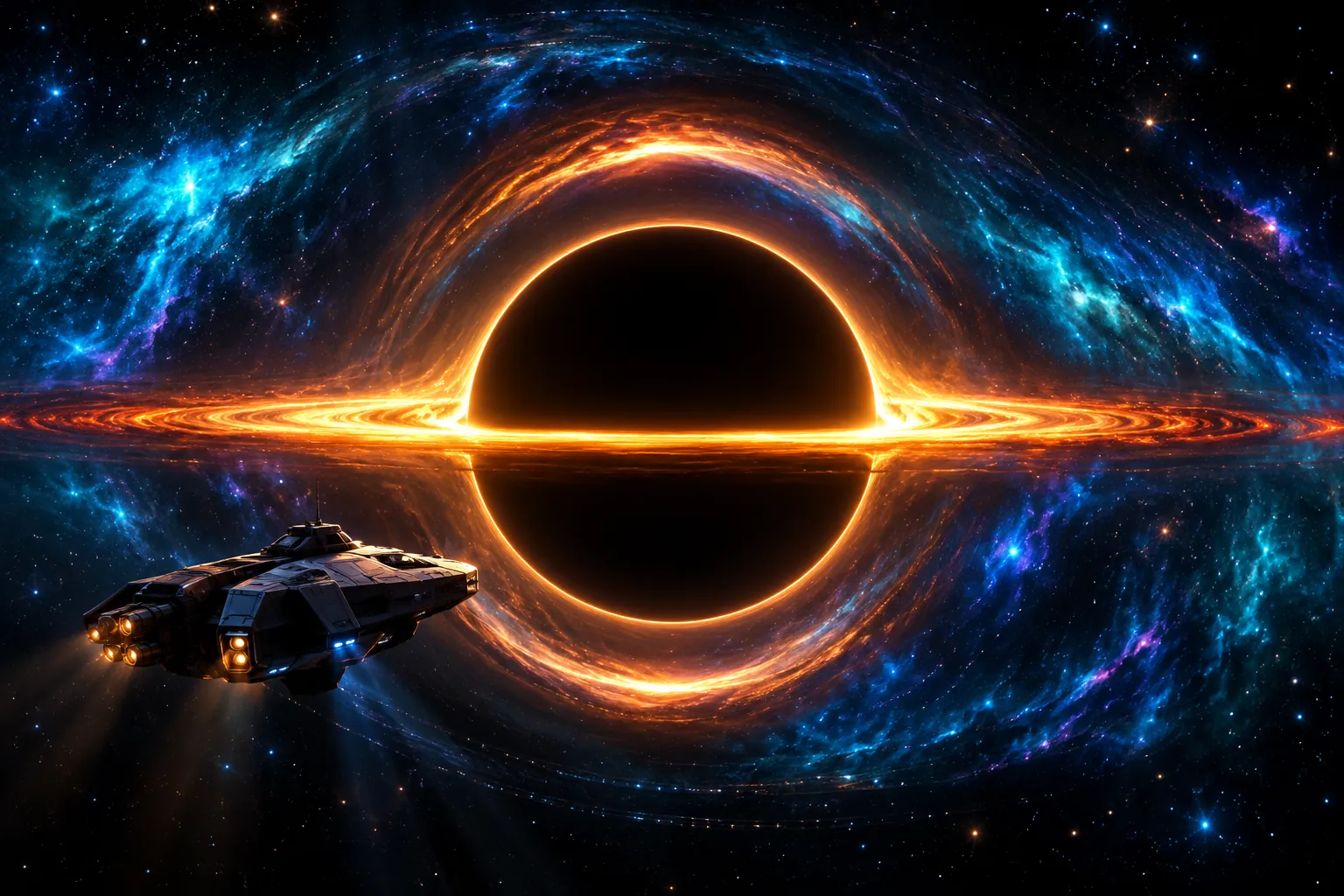
Then comes the black hole era. Black holes are not forever: Stephen Hawking showed in 1974 that they lose energy by radiation and evaporate.
A black hole with the mass of the Sun would take around 10 to the power of 67 years to disappear. The largest supermassive ones would last roughly 10 to the power of 100 years, a number so large it is called a googol.
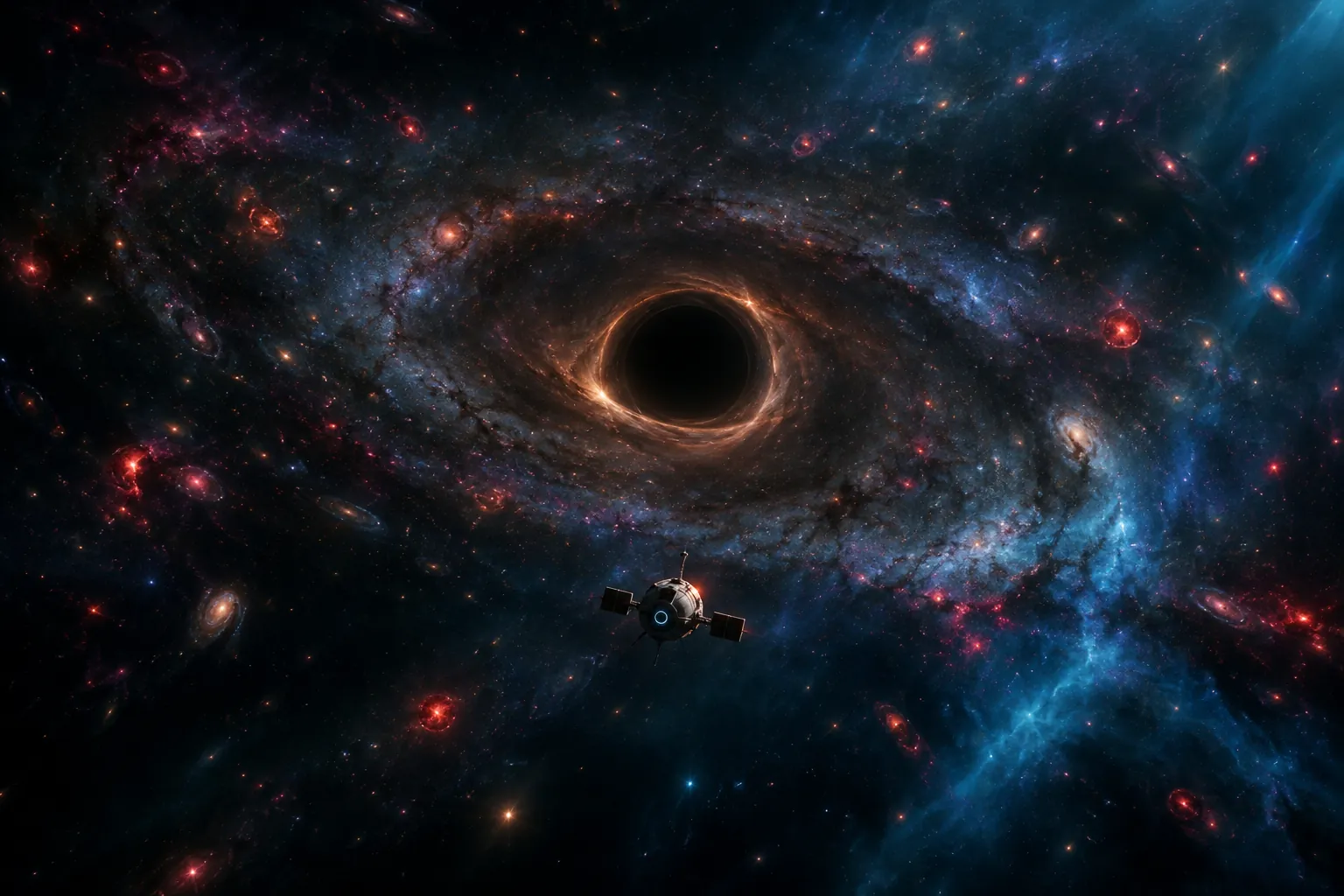
Last is the dark era. Only extremely faint radiation, electrons, positrons and neutrinos remain, spread so thinly that they almost never meet.
The temperature settles toward a tiny fraction of a degree above absolute zero. This is the state we call heat death: maximum entropy, no free energy, no events.
The real science: what is known and what is speculation
Established: the second law of thermodynamics, the expansion of the universe, the acceleration of that expansion since about 1998, and the fact that stars use up fuel. These are measured and tested.
Model-based: the timescales for star formation ending and for black holes evaporating. The calculations are careful, but they rest on physics we have never tested at those extremes.
Speculative: proton decay, whether dark energy stays constant, and whether anything unexpected happens over such huge spans. If dark energy changed, other endings become possible.
The main rivals are the Big Rip, where accelerating expansion eventually tears apart even atoms, and vacuum decay, where space itself switches to a lower-energy state. A Big Crunch, where expansion reverses, is disfavoured by current data.
So the honest summary is that heat death is the best-supported forecast, not a guarantee.
Where it shows up in fiction
Science fiction picked up the idea almost as soon as it appeared. H. G. Wells's The Time Machine (1895) sends its traveller millions of years ahead to a cold beach under a swollen red sun, a vision shaped by the thermodynamic worries of the time.
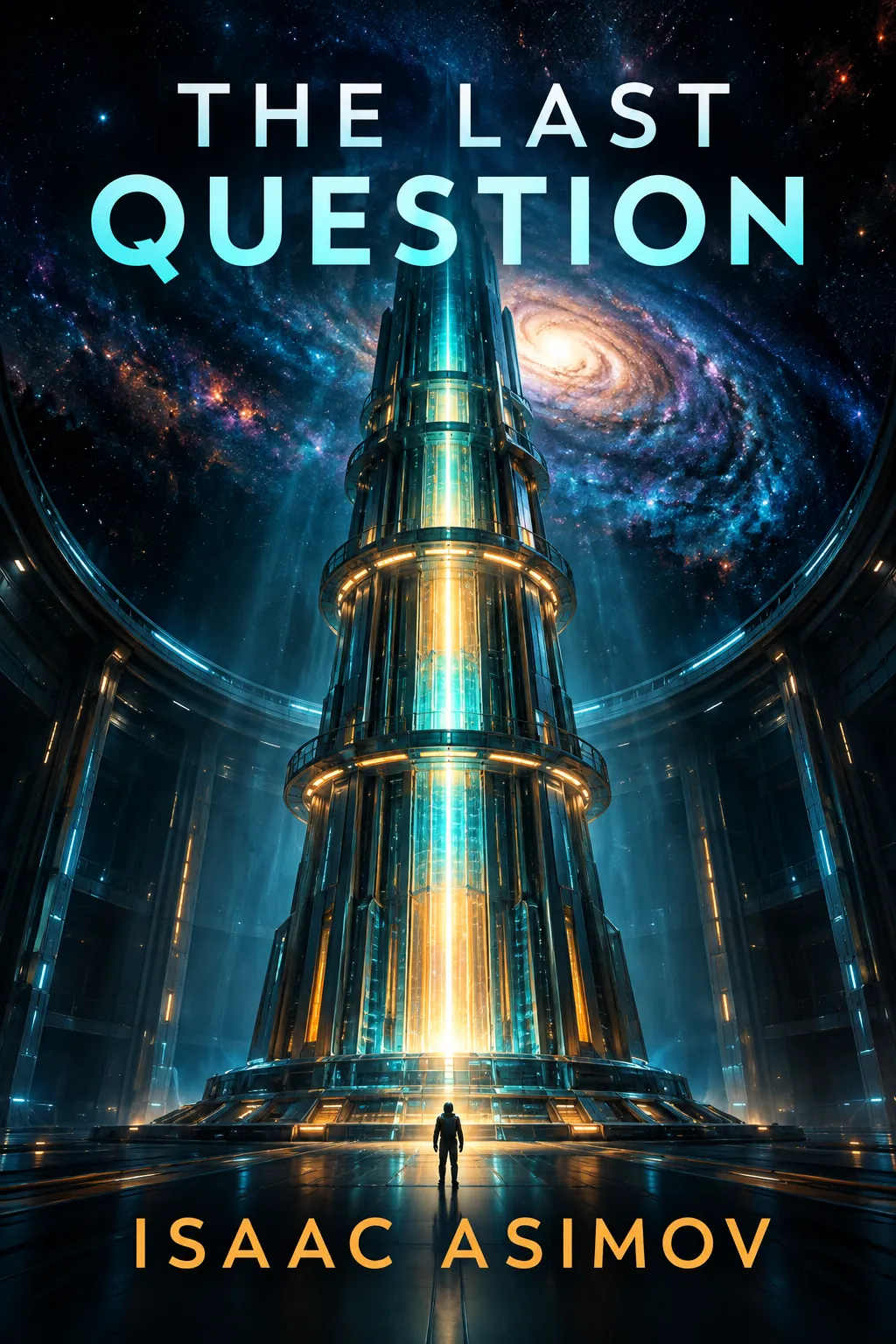
Isaac Asimov's short story The Last Question (1956) is the best-known fictional treatment. It returns again and again over trillions of years to one question: can entropy be reversed?
We will not give away the ending here.
Many other stories use the same background mood, from slow-dying-sun tales to far-future novels set among the last stars. The common thread is the human wish to ask what, if anything, can outlast the end of everything.
The heat death also links to the idea of the Boltzmann brain, a thought experiment about random fluctuations in a universe that has settled into equilibrium. See our page on the Boltzmann brain for that puzzle.
Common misconceptions
"It will be extremely hot." The opposite is true.
The final state is extremely cold and even, and the word "heat" only refers to the thermodynamic idea of heat being evenly distributed.
"Energy will run out." Total energy is conserved.
What runs out is the difference in temperature and density that lets energy do work.
"It is coming soon." The Sun will not become a red giant for about 5 billion years, and the universe's fade-out takes trillions of years or far more.
Humanity's concerns, such as climate or resources, come long before any of this.
"Scientists are sure." They are not.
The idea is the leading scenario, but the numbers depend on assumptions about dark energy and particle physics that could be revised.
"It is the Big Bang in reverse." It is not.
A Big Crunch would reverse expansion; heat death is expansion continuing and everything thinning out.
Read next
Continue with the Boltzmann brain, which asks what could appear by pure chance in a universe at equilibrium.
Then read about the multiverse, where some theories give our universe's fate a wider setting.
For the bigger picture, see the History of Science Fiction, where stories about the end of everything have a long tradition.