In five minutes: what panspermia says
Panspermia is the idea that life, or the molecules life is built from, can travel between planets and even between stars. The word comes from Greek: pan means “all” and sperma means “seed”.
The idea does not say how life began. It says only that life may have begun in one place and then spread to another.
That changes the big question from “how did life start on Earth?” to “did life start on Earth at all?” Most scientists treat the strong version with caution, while a milder version is part of ordinary research.
Picture dandelion seeds on the wind. Nearly every seed lands somewhere useless, but it takes only one to land well.
Panspermia also sits close to many themes in our History of Science Fiction guide, from alien contact to ships that carry life between stars.
Three versions of the idea
Scientists use the word for several different claims, and mixing them up causes most of the confusion.
Lithopanspermia: life inside rocks
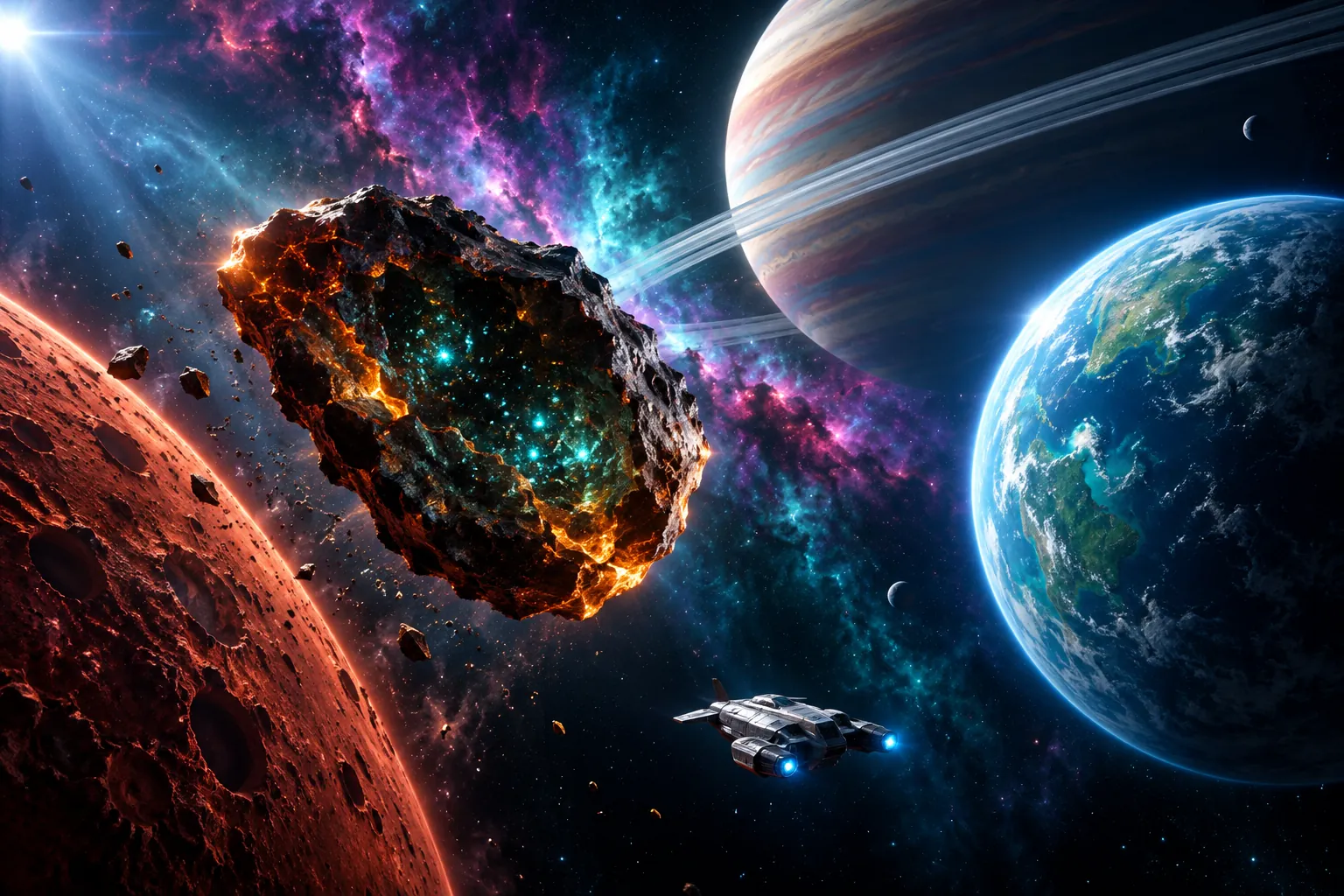
When a large asteroid hits a planet, it can throw rock into space. If microbes lived inside that rock, they might ride it to another world.
We know the rock part works, because meteorites from Mars have been found on Earth. Whether microbes could survive the trip is the open question.
Radiopanspermia: spores on starlight
In 1903 the Swedish chemist Svante Arrhenius proposed that tiny spores could be pushed through space by the pressure of starlight. Later work showed that bare spores would be damaged by ultraviolet light and cosmic rays, so this version has few supporters today.
Directed panspermia: life sent on purpose
In 1973 Francis Crick, who helped work out the structure of DNA, and the chemist Leslie Orgel described directed panspermia. In it, an advanced civilisation sends microbes to other worlds deliberately.
They offered it as a speculation, not a conclusion. It is the version closest to a Von Neumann probe, a machine that travels between stars and copies itself, except that this one would carry seeds of life instead of a factory.
The mild version: ingredients only
Many researchers accept that comets and meteorites delivered organic molecules, such as amino acids, to the young Earth. This is sometimes called soft panspermia.
It claims that chemistry travelled, not living things. That is the part of the story with the most evidence.
How the idea developed
The Greek philosopher Anaxagoras, who lived in the 5th century BC, taught that the world contained “seeds” of everything. Historians often point to him as an early source of the spirit of panspermia, though his idea was philosophy, not astronomy.
The modern version began in the 19th century. In 1871 the physicist Lord Kelvin suggested that living germs could have reached Earth inside meteorites.
Arrhenius followed in 1903 with his spore theory. From the 1970s the astronomer Fred Hoyle and his colleague Chandra Wickramasinghe argued that dust clouds between stars contain living material and that some diseases come from space.
Most scientists did not accept those claims, and the evidence never matched the confidence. The meteorite evidence did keep growing, though.
In 1969 a meteorite fell near Murchison in Australia. It contained dozens of amino acids, some rare in living things on Earth, which showed that space chemistry can make parts of life without any cell.
The real science: what is known and what is a guess
Here is what is established, and what is still speculation.
Established
- Meteorites and asteroids carry organic molecules. The Murchison meteorite is the classic case.
- Japan’s Hayabusa2 brought back samples from the asteroid Ryugu in December 2020. In 2023 researchers reported uracil, one of the building blocks of RNA, in those samples.
- NASA’s OSIRIS-REx returned material from the asteroid Bennu in September 2023. Analyses published in 2025 found 14 of the 20 amino acids used by life on Earth, and all five nucleobases used in DNA and RNA.
- Rocks travel between worlds. Meteorites from Mars and the Moon have been identified on Earth.
- Some organisms survive extreme conditions. In 2007 tardigrades exposed to open space on a European mission survived, and eggs laid afterwards hatched.
- Japan’s Tanpopo experiment, which began on the International Space Station in 2015, suggested that thick clumps of the bacterium Deinococcus radiodurans could survive in space for years.
Still speculative
No one has found living or fossil cells that came from space. The 1996 claim of fossil traces in the Mars meteorite ALH84001 was widely challenged and is not accepted as evidence of life.
The journey is hard. A rock must survive the blast of launch, long exposure to radiation and a fiery entry, then land somewhere life can grow.
The inside of a large rock may be cool and shielded, but that has not been shown for a whole trip between worlds.
There is also a logic limit. Even if life on Earth came from Mars, the question of how life began would only move to Mars.
This is also why space agencies clean spacecraft bound for places like Mars. They want to avoid carrying Earth life there by accident.
Where it shows up in fiction
Panspermia gives writers a way to make life travel. Here are books that use the idea, described without their endings.
Michael Crichton’s The Andromeda Strain (1969) begins when a returning satellite brings back a deadly microbe. The story treats life from space as a biological hazard, not a monster.
Fred Hoyle, who argued for life in space dust in his science, also wrote the novel The Black Cloud (1957). It is about a living cloud that drifts into the solar system.
Arthur C. Clarke’s 2001: A Space Odyssey (1968) imagines alien builders who nudge early humans forward. That is closer to seeding intelligence than seeding life, but it has the same shape as directed panspermia.
Andy Weir’s Project Hail Mary (2021) is built around a single-celled organism that feeds on starlight and crosses space between stars. A space-faring microbe is panspermia in action.
Fiction makes these trips fast and clear. In real physics they would take thousands to millions of years.
The idea also touches a famous puzzle. If life can spread between stars, why is the sky so quiet?
That is the question behind the Fermi paradox.
Common misconceptions
“Panspermia explains how life began.” It does not.
It explains, at most, how life might have moved.
“Scientists have found life in meteorites.” They have found organic molecules, such as amino acids and nucleobases, which are the parts of life.
They have not found living cells or confirmed fossils.
“It means aliens put us here.” Only directed panspermia says that, and its authors offered it as speculation.
The other versions need no one to send anything.
“It is a fringe idea.” The delivery of organic molecules by meteorites is mainstream science.
The transfer of living microbes is a serious but unproven hypothesis. The claims of life in interstellar dust and of diseases arriving from space were rejected by most scientists.
“Humans are not part of this.” We might be.
Spacecraft can carry microbes, which is why planetary protection rules exist.
Read next
- Fermi paradox: if life spreads easily, where is everyone? Read this for the puzzle that makes panspermia matter.
- Von Neumann probe: a self-copying machine that could carry life across the galaxy. Read this to see how directed panspermia might work.
- History of Science Fiction: the wider story of how writers imagined life beyond Earth.