In five minutes
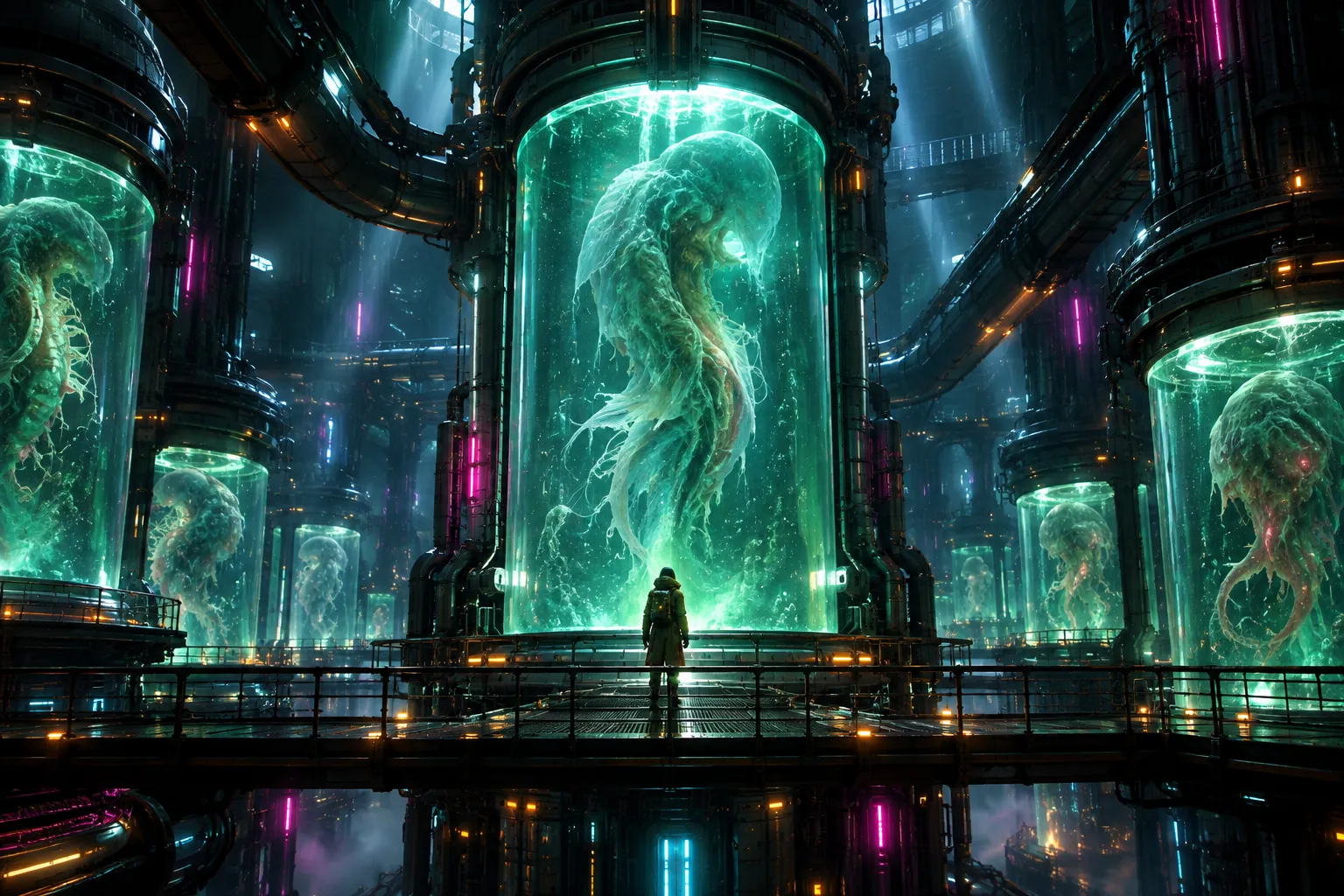
Biopunk is a branch of science fiction about biotechnology: genes, engineered organisms and living machines. Where cyberpunk asks what computers do to people, biopunk asks what happens when life itself can be edited, patented and sold.
The stories tend to follow one pattern. A powerful technology for rewriting living things exists, and the people with money control it.
Then ordinary people, hackers or outcasts bend that technology to their own ends. They work in cramped labs, back rooms and borrowed kitchens, and the results are rarely tidy.
The name copies cyberpunk, a word that comes from a 1983 short story by Bruce Bethke. The "-punk" ending promises a gritty, street-level view of technology, usually with big corporations on one side and scrappy outsiders on the other.
Biopunk belongs to the wider story told in the History of Science Fiction. It sits beside cyberpunk and steampunk, two genres that follow the same naming habit.
What biopunk is
Biopunk is not simply "any story with genetics in it". It has a recognisable set of ingredients.
- Engineered life: modified people, crops, animals or microbes are part of everyday life, not a one-off miracle.
- Control of biology: companies, governments or gangs own the genes, the seeds or the cures.
- The body as a battleground: health, ageing, fertility and identity become things people fight over.
- A biohacking underground: small groups with cheap tools try to do outside the system what the big players do inside it.
- Messy consequences: plagues, ecological collapse and new social classes follow from the technology.
Mary Shelley's Frankenstein (1818) is the great ancestor, because it asks what a creator owes to a living thing they have made. Biopunk is the later, grittier, near-future version of that question, written in the age of real genetic engineering.
Writers have also used other names for the same territory. Paul Di Filippo, for example, used the word "ribofunk" for his own stories about genetic engineering in the 1990s.
The real science
Biopunk works because the science behind it is real. It is worth separating what has been done from what is still speculation.
Established facts:
- The Human Genome Project announced a finished human genome sequence in 2003.
- Dolly the sheep, born in 1996, was the first mammal cloned from an adult cell.
- In 2010 a team led by J. Craig Venter reported a bacterial cell controlled by a chemically synthesised genome.
- In 2012 Jennifer Doudna and Emmanuelle Charpentier and colleagues described how CRISPR-Cas9 can be programmed to cut DNA at chosen places, and they won the 2020 Nobel Prize in Chemistry for it.
- In 2018 the Chinese scientist He Jiankui announced that he had created gene-edited babies. The work was widely condemned, and a Chinese court sentenced him to three years in prison in 2019.
There is also a real do-it-yourself biology movement. The DIYbio community began in 2008, and in 2010 Meredith L. Patterson wrote a "Biopunk Manifesto" arguing that people should be free to do biology outside big institutions.
Most community labs are careful and work under safety rules. They are closer to a hobbyist club than to the secret labs in the novels.
What remains fiction is the speed and scale. Engineered plagues that rewrite whole ecosystems, cells that become intelligent or humans redesigned for a new environment are thought experiments, not current technology.
Where it shows up in fiction
Schismatrix (1985) by Bruce Sterling imagines humanity scattered across the solar system and split between two schools of thought. The Shapers rewrite their own bodies through genetics and training, while the Mechanists add machinery.
It is often named as an early work that carries the cyberpunk attitude into biology.
Blood Music by Greg Bear began as an award-winning novelette in 1983 and became a novel in 1985. It follows a researcher whose engineered cells turn out to be far more capable than anyone intended, and it asks what "a person" is once cells can think.
Oryx and Crake (2003) by Margaret Atwood is set in a world shaped by corporate genetic engineering. Atwood prefers the label speculative fiction, but the book is a standard example of the gene-engineering future.
The Windup Girl (2009) by Paolo Bacigalupi takes place in a Bangkok of the future. Agricultural companies own the seeds, genetically engineered diseases wipe out crops, and food supply is the main source of power.
The novel won both the Hugo and the Nebula awards.
On screen, the film Gattaca (1997) is the classic example of a society sorted by genetic profile. Close to the same ground, Flowers for Algernon shows what medical enhancement does to one person's life.
How to read a biopunk story
When you pick up a biopunk novel, ask who owns the technology before you ask how it works. The science is usually a loose extension of real research, while the real subject is power and inequality.
In The Windup Girl, for example, the gene-editing itself matters less than the companies that hold the seeds and the people who have no choice but to rely on them. The technical details can age, but that power structure stays readable.
A second thing to watch is how the stories treat the body. If genes can be rewritten, then "a natural body" and the line between treatment and enhancement stop being obvious, and characters have to argue about them in daily life.
That links directly to real debates about genome editing today. People still disagree about where to draw the line between editing to cure a disease and editing to improve a trait.
A third clue is the setting. Biopunk likes places where regulation is weak or has failed, such as crowded cities, black markets and improvised labs, because that is where outsiders can get hold of the tools.
Read this way, biopunk is less a forecast than a mirror. It lets readers test today's choices about food, medicine and ownership of life on an imagined future, which also makes it a good topic for essays and class discussion.
Common misconceptions
"Biopunk is just mad-scientist horror." Horror uses the same tools, but biopunk is usually more interested in who owns the technology and who pays for it than in a single monstrous experiment.
"It predicts what will happen." Biopunk is a way of thinking through possibilities, not a forecast.
Many details, such as sudden global plagues or instant redesign of adults, are far beyond today's science.
"Biohacking is the same as bioterrorism." In real life, community biology is a hobby and education movement, and it works within safety guidance.
Fiction exaggerates the danger because danger makes a plot.
"The 'punk' means the music." The word is borrowed for its attitude: anti-authority, low-budget and street-level.
There is no musical link.
"It is the same as cyberpunk with genes added." The mood is similar, but biopunk's central worry is different.
Cyberpunk fears losing humanity to machines, while biopunk fears losing control of living things.
Read next
History of Science Fiction shows where biopunk fits among the genre's big movements.
Cyberpunk explains the genre that gave biopunk its name and its attitude.
Steampunk covers the other "-punk" genre, which looks backward to the Victorian age instead of forward to the gene lab.