In five minutes
Alternate history is fiction that asks what would have happened if one real event had gone the other way, then follows the consequences. A writer picks a moment in the past, changes it, and builds the world that would have grown from that change.
The changed moment is called the point of divergence. Everything before it matches our history, and everything after it slowly drifts away.
The genre belongs to science fiction because it treats history like an experiment: change one variable and watch the result. You can see where it fits in the wider story of the field in our guide to the history of science fiction.
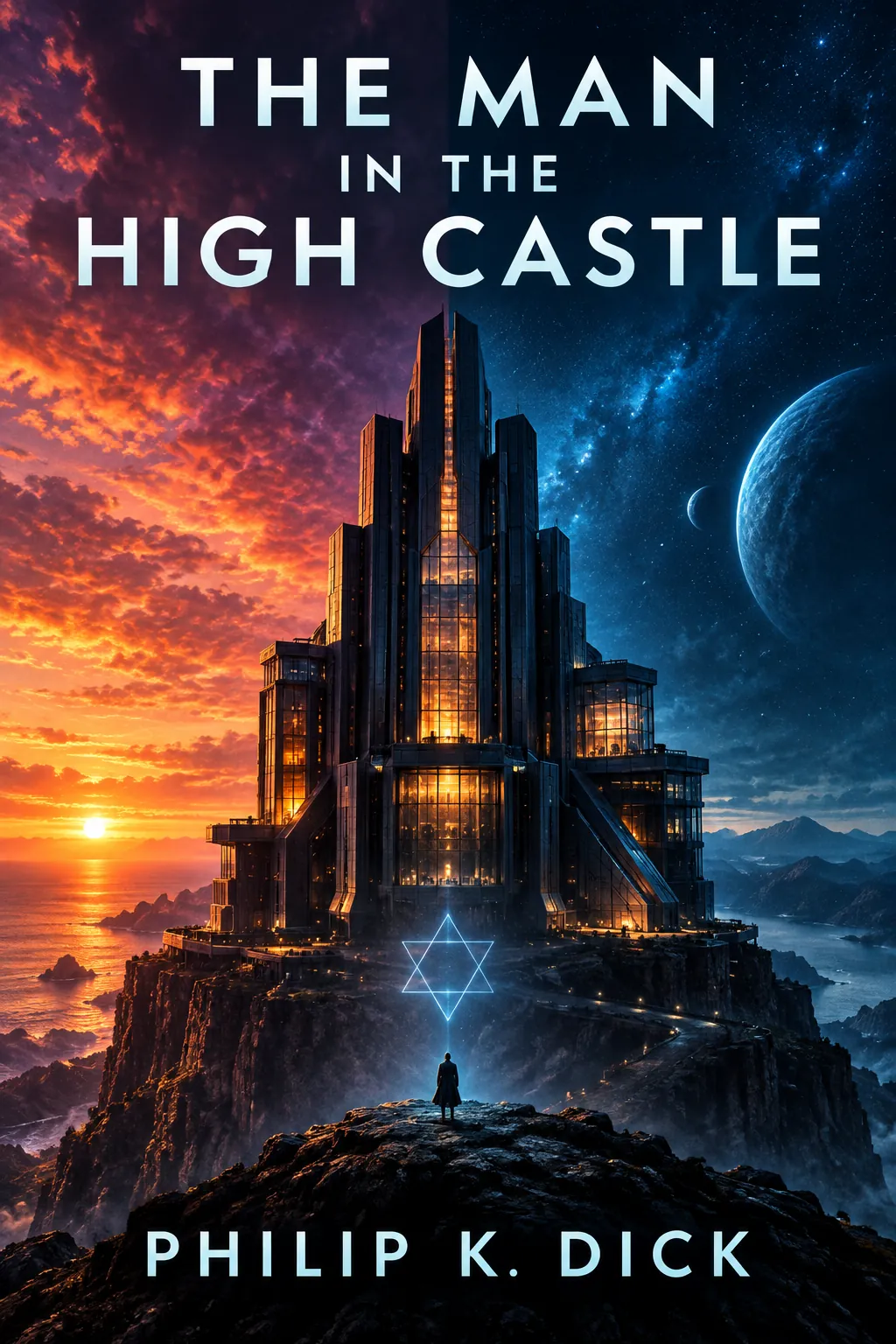
The best-known example is Philip K. Dick's The Man in the High Castle (1962), set in an America that lost the Second World War. It won the Hugo Award for best novel in 1963 and made the idea famous far beyond science fiction readers.
People also search for the same idea as “uchronia”, “what if history” or “counterfactual history”. The rest of this page explains how it works, where it began, how it relates to real science, and which books to try first.
How an alternate history works
Every alternate history needs three parts: a real event, a change to it, and a chain of consequences. The pleasure for the reader comes from recognising the old world inside the new one.
Take the point of divergence first. Good writers choose a moment that was genuinely close, such as a battle decided by weather, an assassination attempt that missed, or a plague that struck hardest in one region.
Then comes the ripple effect. A different battle changes who rules, who rules changes borders and laws, and laws change what ordinary people eat, believe and fear.
Readers judge the result by plausibility. The changes should follow from the cause the way a good chess game follows from its opening, with no convenient miracles.
Many authors add a second layer: the familiar details that survived. A city still has its name and a family still has its quarrels, and the reader sees how much of the world was never up to that one event.
This is why the genre works as commentary. By showing a world that never happened, the writer makes us look harder at the one that did, and at the choices people made inside it.
Where the idea came from
The habit of asking “what if” is old. The Roman historian Livy, writing under the emperor Augustus, paused his history to wonder whether Alexander the Great could have beaten Rome had he turned west.
The first full-length book in the form we now know is usually credited to the French writer Louis Geoffroy. His Napoléon et la conquête du monde (1836) imagines Napoleon succeeding in Russia and going on to rule the world.
In 1876 the philosopher Charles Renouvier published Uchronie, which gave the form its name. He built the word from “utopia”, swapping “place” for “time”, so that it means roughly “a time that never was”.
In 1931 J. C. Squire edited If It Had Happened Otherwise, a collection of essays on historical turning points. Winston Churchill was among the contributors.
In English, the genre grew in the pulp magazines. Murray Leinster's story “Sidewise in Time” (1934) imagined areas of Earth swapping places with the same spots from other histories, and it later gave its name to the Sidewise Awards for Alternate History, founded in 1995.
Landmarks followed. Ward Moore's Bring the Jubilee (1953) imagined a Confederate victory at Gettysburg, and Dick's novel of 1962 became the book most readers still start with.
From the 1990s the genre boomed in print, helped by writers such as Harry Turtledove. It is now a standard shelf in bookshops.
The real science
Alternate history is fiction, but it borrows a real method. Historians use “counterfactual” reasoning when they ask whether an outcome was likely or accidental.
If a war would have ended the same way without one general, that general was not decisive. If it would not, the historian has found a real turning point.
The historian Niall Ferguson gathered essays of this kind in Virtual History (1997). His argument is that thinking about the roads not taken helps us understand the one that was.
What is established is the method, and the fact that small events can sometimes matter a great deal. What is speculation is every particular outcome, because history happens once and nobody can rerun it.
Ideas from physics are sometimes mixed in. Chaos theory shows that tiny differences can grow in weather models, and the many-worlds interpretation of quantum mechanics, proposed by Hugh Everett in 1957, treats every outcome as real in some branch.
Neither idea proves that history behaves like a weather system or that a world of “what if” exists. Authors use them as images, not as evidence.
Where it shows up in fiction
Books come first, and the landmark is Dick's The Man in the High Castle. It imagines the United States divided between Germany and Japan after an Axis victory.
The story follows ordinary people in occupied San Francisco, and one character reads a banned novel that imagines the Allies winning. Our guide to The Man in the High Castle covers the plot and themes.
Ward Moore's Bring the Jubilee (1953) follows a man in a United States where the Confederacy won. It adds a time-travel twist that readers tend to remember.
Keith Roberts's Pavane (1968) imagines that Elizabeth I was assassinated and the Spanish Armada succeeded. In the twentieth century of that world the Catholic Church still rules and holds technology back.
Robert Harris's Fatherland (1992) is a detective story set in Berlin in 1964, in a Germany that won the war. The same year, Harry Turtledove's The Guns of the South sent time travellers to hand modern rifles to the Confederate army.
Philip Roth's The Plot Against America (2004) imagines Charles Lindbergh beating Franklin Roosevelt in the 1940 election. It is told through one Jewish family in Newark.
Michael Chabon's The Yiddish Policemen's Union (2007) is a detective story in a world where a Jewish refuge was founded in Alaska. Kim Stanley Robinson's The Years of Rice and Salt (2002) starts from a Black Death that empties Europe, so Asia and the Islamic world shape the centuries that follow.
Japan has its own tradition of imagined-war novels, called kaso senki. Yoshio Aramaki's Konpeki no Kantai series, from around 1990, is among the best known.
Common misconceptions
“It is the same as a parallel universe”
Not quite. A parallel universe is a physics-flavoured idea about other worlds existing at the same time, while alternate history is about one specific change in our own past.
The two overlap when characters cross between worlds. See parallel universe for that side of the story.
“It needs time travel”
Most alternate histories do not use it. The world is simply different from the first page, and a few stories, like Turtledove's, add time travellers to supply the change.
“It is always about wars and dictators”
The Second World War is the favourite setting, but the genre is wider. Robinson builds a world around a plague, and Chabon builds one around a refuge.
“It predicts the future or says history should have gone another way”
It is a thought experiment, not a forecast or a wish. Many authors use a different world to examine the real one, and not every such world is dark.
“It is just historical fiction”
Historical fiction stays inside what happened. Alternate history deliberately breaks it.
Read next
Start with Parallel universe to see how physics and fiction picture other worlds.
Then read our guide to The Man in the High Castle, the novel that defines the genre for most readers.
For the bigger picture, return to the history of science fiction.