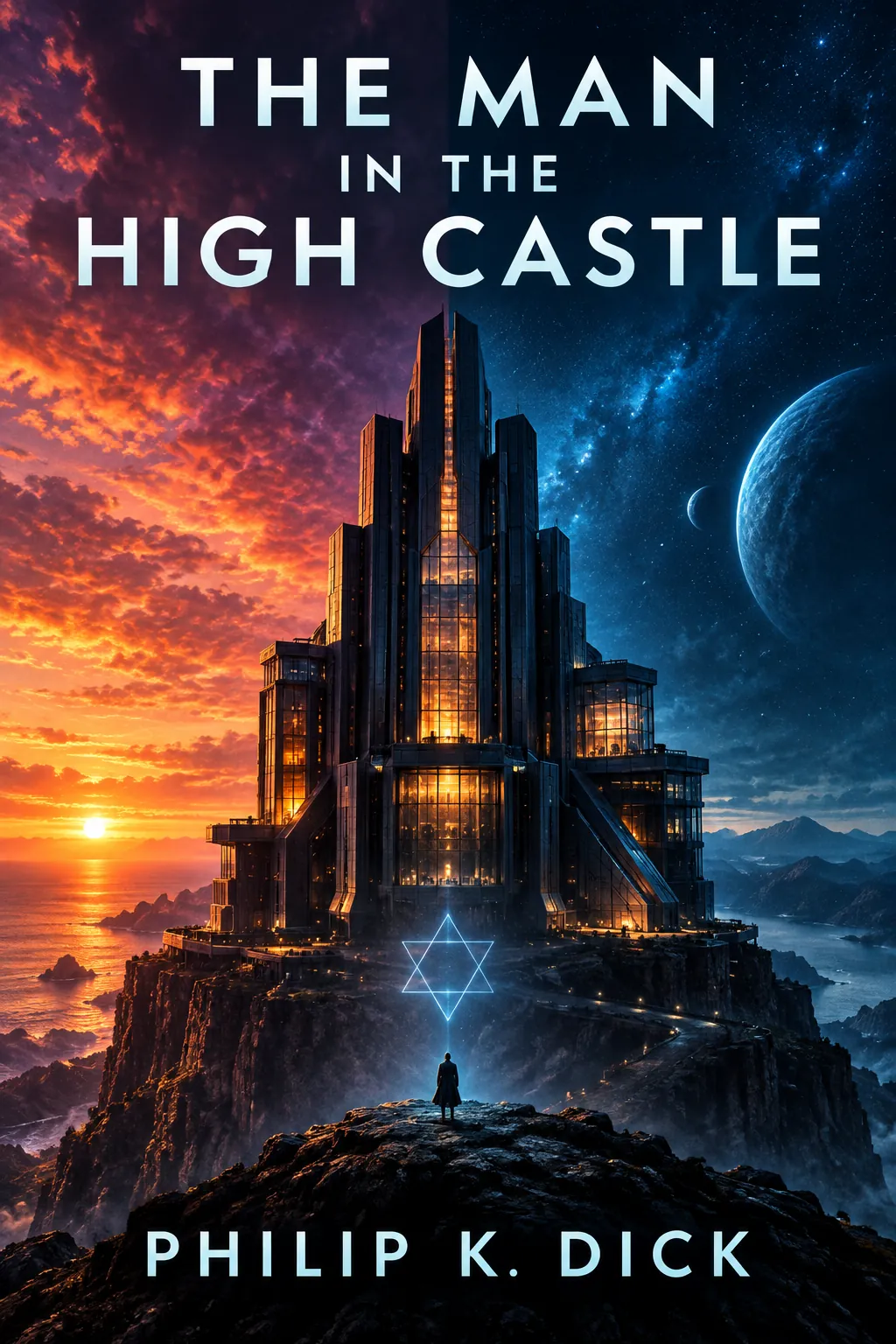
The Man in the High Castle
by Philip K. Dick
The Man in the High Castle is a 1962 novel by Philip K. Dick set in an America that lost the Second World War. Japan controls the Pacific coast, Germany controls the east, and a thin buffer lies between them. Across several linked lives in San Francisco and Colorado, people trade antiques, consult the I Ching and read a banned novel that imagines the Allies winning. The story is less about spies than about fakes, courage and how people live under power they never chose.
The Big Idea
"In a 1962 America ruled by the winners of the Second World War, Philip K. Dick asks what makes anything real, from an antique pistol to a person's own history."
Key Insights
Real and fake are not simple opposites
The novel opens in a market of antiques where many items are fake, yet people still pay for them. Dick shows that value often comes from belief and story, not just from the object itself.
Frank's former employer sells fake historical pieces, while Frank's honest jewellery, which claims no history at all, ends up moving buyers more than the supposedly genuine relics do.
Dignity under power
The characters live under rulers they did not choose, and each finds a different way to keep a sense of self. Some bow, some resist, some quietly refuse. The book respects all of these paths without calling any of them easy.
Childan begins by flattering his customers and ends by speaking up for himself. Tagomi, a gentle official, refuses to hand over Frank even though it costs him his peace of mind.
Chance, choice and the I Ching
Almost everyone consults the I Ching, a Chinese book of divination, before they act. Dick treats it neither as magic nor as a joke, but as a way people handle uncertainty and share responsibility with something outside themselves.
Tagomi throws the coins before key meetings, and Abendsen says the oracle shaped the plot of his own novel.
Alternate history as a mirror
The banned novel inside the novel imagines an Allied victory, which makes readers ask which history feels real and why. By doubling the alternate history, Dick suggests every version of the past is built from choices and stories.
Juliana reads the book as a small sign of hope, and the ending asks whether its picture is truer than the world she walks through.
Chapter Breakdown
Chapter-by-chapter summary
Spoiler warning: this section covers the whole plot, including the ending.
Part 1: San Francisco under the Japanese Pacific States
It is 1962. Germany and Japan won the war and split the United States. Robert Childan sells old American objects to Japanese buyers who treasure them, yet who treat him as a lower rank. Mr. Tagomi, a Japanese trade official, waits for an important Swedish visitor. Frank Frink, a metalworker who hides his Jewish background, loses his job at a factory that makes fake antiques. The scene shows a country where Americans serve their rulers' tastes, and it plants the question that runs through the book: what makes an object, or a person, genuine?
Part 2: Juliana and the road east
Juliana Frink, Frank's former wife, teaches judo in Canon City, Colorado, in the buffer zone between the two empires. She meets Joe Cinnadella, an Italian truck driver and former soldier, and the two begin a trip together. Juliana reads The Grasshopper Lies Heavy, a novel banned in German-controlled lands that imagines the Allies winning the war. She grows curious about its author, who is said to live in a fortified home called the high castle. This part matters because it gives the reader a second history to compare with the first.
Part 3: Tagomi, Baynes and a hidden warning
The visitor Tagomi expects is Mr. Baynes, who presents himself as a Swedish businessman. He is really a German intelligence officer, Rudolf Wegener, who has come to pass on a secret: a faction in Berlin is planning a sudden attack on the Japanese home islands, known as Operation Dandelion. Germany's leadership is in turmoil after its Chancellor's death. Baynes needs a senior Japanese contact, who arrives under the name Yatabe, to take the warning seriously. It matters because it shows the winners are not united and their peace is fragile.
Part 4: Childan, Frank and the new jewellery
Frank and his friend Ed McCarthy start a small workshop and make original jewellery instead of copies. Childan, who has always chased the prestige of old objects, first doubts the pieces, then sees that the Japanese customers around him are moved by something new and plain. He is also made to feel small during an uneasy visit to Paul and Betty Kasoura, a Japanese couple, and learns how badly he wants to be treated as an equal. This part turns the idea of real versus fake into a question about making something of your own.
Part 5: Joe's secret and a room in a cheap hotel
As the trip goes on, Juliana learns that Joe is more than a driver. He is a German agent sent to kill the author, Hawthorne Abendsen. To stop the plot, she kills him with a razor in their room and carries on alone. Until now she had been busy simply protecting her own small life. The scene matters because an ordinary person makes a huge decision in seconds, and it shows how close violence sits to everyday calm in this world.
Part 6: Tagomi's choice
German agents arrive at the Trade Mission to seize Baynes. Tagomi, a gentle man, picks up an antique pistol he bought from Childan and shoots two of them dead. Shaken, he sits in a park with a piece of Frank's jewellery and stares at it until he glimpses a different San Francisco, the world the reader knows, with heavy traffic and no Japanese flags. He cannot bear it and comes back. The scene matters because even the most polite man can be forced into violence, and it hints that other worlds may sit close by.
Part 7: The cost of protecting Frank
The Germans learn that Frank is of Jewish descent and demand that he be handed over. Frank is held by the police, and the German consul presses Tagomi to cooperate. Tagomi, worn out, refuses to sign and Frank goes free. Around the same time Childan speaks up to Paul Kasoura without grovelling for the first time. A man who once lived for his rulers' approval starts to stand on his own feet. The part matters because small acts of courage change what people can bear.
Part 8: The truth about the high castle
Juliana reaches Abendsen's house in Cheyenne, Wyoming. It is not a fortress at all, just an ordinary house. Abendsen tells her he let the I Ching guide the plot of his novel. Juliana asks the oracle why the book was written, and the answer tells her that the book is true. The novel ends there, without explaining what that truth is, and leaves the reader to decide how a made-up history can carry truth about real life.
Characters
Robert Childan
Owner of American Artistic Handcrafts in San Francisco. He sells prewar Americana to Japanese collectors and bows to them in public, while feeling the sting of his own lower rank. His arc is about finding self-respect without anyone's permission.
Frank Frink
A skilled metalworker and former soldier who hides his Jewish ancestry by using the name Frink. After losing his factory job, he starts making original jewellery with a friend, and later becomes a target when his background is discovered.
Juliana Frink
Frank's ex-wife, a judo teacher in Colorado. Quick-minded and independent, she follows a stranger toward the author of the banned novel and then makes the book's hardest choice. She is the one who reaches the high castle.
Nobusuke Tagomi
A senior Japanese trade official in San Francisco. Polite and thoughtful, he consults the I Ching before big decisions. Caught between duty and conscience, he is pushed into an act of violence he never expected from himself.
Mr. Baynes (Rudolf Wegener)
A man who arrives as a Swedish businessman but is really a German intelligence officer. He risks his life to warn Japan about a plan inside the German leadership, because he believes a war between the two powers would be a disaster.
Hawthorne Abendsen
Author of the banned novel The Grasshopper Lies Heavy. People imagine him guarded in a fortress, the so-called high castle, but he is a quiet man who says he let the I Ching guide his writing.
Joe Cinnadella
An Italian former soldier who drives a truck and travels with Juliana. Friendly and charming at first, he hides the real reason he is heading toward the author.
Paul and Betty Kasoura
A Japanese couple who buy American antiques from Childan. Paul treats him with polite superiority, while Betty is more curious about him and the new jewellery. Their home shows how the ruling culture sees its subjects.
Writing about this book
The book gives you plenty to write about without needing a plot summary. Start with a question, then use two or three scenes as evidence.
- What does the novel say makes an object “authentic”? Compare the fake antiques in Part 1 with Frank's new jewellery in Part 4.
- How do different characters keep their dignity under rulers they did not choose? Look at Childan, Tagomi and Juliana.
- Why does Dick let characters use the I Ching to decide things? Is it fate, habit or a way of sharing responsibility?
- What does the banned novel add? The Grasshopper Lies Heavy imagines a different war, but not exactly our own.
A strong thesis might be that truth in this novel belongs to people who act with integrity, not to whoever holds power. Whatever you pick, support it with specific moments and explain why they matter. Keep the alternate-history setting in view, and remember it was written in 1962, less than twenty years after the war ended.
Take Action
Practical steps you can implement today:
-
Ask who benefits when something is called “authentic”. Value can come from a story, a label or the work itself, and those are not the same thing.
-
Dignity does not depend on being respected by the powerful. Childan's best moment comes when he stops performing for his customers.
-
A story set in an alternate world helps you notice how much of your own world's order is the result of choices.
-
Before a hard decision, write the question down clearly. The I Ching works in this book partly as a forced pause.
Notable Quotes
"“For a week Mr. R. Childan had been anxiously watching the mail, but the valuable shipment from the Cannon City firm had not arrived.” (Chapter 1)"
— Philip K. Dick
"“The Grasshopper Lies Heavy” (the title of the banned novel, Part 2)"
— Philip K. Dick
"“Inner Truth” (the hexagram Juliana receives at the end, Part 8)"
— Philip K. Dick
Who Should Read This
Readers aged about 15 and over who like alternate history or thoughtful science fiction will enjoy it, especially for school projects on Philip K. Dick. The pace is slow and the themes are abstract, so patient readers get the most from it. It suits upper secondary and university courses on twentieth-century literature.
Frequently Asked Questions
What is The Man in the High Castle about?
It is set in 1962 in a United States that lost the Second World War, split between Japan on the Pacific coast and Germany in the east. Several characters, including an antiques dealer, a metalworker, a trade official and a judo teacher, find their lives linked. The big themes are authenticity, dignity under power and how history is told.
Who is the man in the high castle?
He is Hawthorne Abendsen, the author of the banned novel The Grasshopper Lies Heavy. Rumour says he lives in a fortified home, and several characters want to meet him. Why they want to, and what they find, is explained in the chapter-by-chapter summary above.
What is The Grasshopper Lies Heavy?
It is the novel inside the novel. It imagines a world where the Allies win the war, but that world is not identical to ours. It is banned in German territory, and its presence adds a second alternate history to the story.
Is the book hard to read?
The language is plain, but the book follows several characters and moves slowly. Many readers treat the first chapters as a way to meet everyone. Reading a short summary of the characters first makes the links easier to see.
Is the book the same as the TV series?
No. The TV series used the novel's setting as a starting point, then changed and expanded many characters and events. Someone who has watched the series can still read the book as a different story. This page covers only Dick's novel.
Check Your Understanding
Pick an answer for each question to see if you were right.
-
Who controls the Pacific coast in the novel?
Japan — Japan rules the Pacific States of America.
-
What is the title of the banned novel inside the book?
The Grasshopper Lies Heavy — The Grasshopper Lies Heavy imagines an Allied victory and is banned in German territory.
-
What does Robert Childan sell?
American antiques and crafts — He runs a shop selling old American objects to Japanese collectors.
-
Which Chinese book do many characters consult before acting?
The I Ching — The I Ching guides decisions for Tagomi, Abendsen and Juliana.
-
Who wrote the banned novel?
Hawthorne Abendsen — Hawthorne Abendsen is the author of The Grasshopper Lies Heavy.
About Philip K. Dick
Philip K. Dick (1928–1982) was an American science fiction writer born in Chicago and based mostly in California. He wrote dozens of novels and short stories about false realities, identity and ordinary people under pressure. The Man in the High Castle won the 1963 Hugo Award for Best Novel and made his name. His later works include Do Androids Dream of Electric Sheep? and A Scanner Darkly.
Summary Written By

Software Engineer & Writer
Software engineer with a passion for distilling complex ideas into actionable insights. Writes about finance, investment, entrepreneurship, and technology.
View all summaries →Reviews
No reviews yet. Be the first to share your thoughts!
Write a Review
Keep reading
Explore the topic: Sci-Fi Authors & AwardsSummaries

Out of My Mind
Sharon M. Draper
“Out of My Mind” by Sharon M. Draper is a poignant narrative that explores the life of Melody Brooks, a…

Ender’s Game
Orson Scott Card
“Ender’s Game” by Orson Scott Card is a riveting science fiction novel that transports readers into a future where humanity…

Pachinko
Min Jin Lee
“Pachinko”, a spellbinding multigenerational historical saga by Min Jin Lee, explores the lives of a Korean family trying to make…

The Perks of Being a Wallflower
Stephen Chbosky
The Perks of Being a Wallflower by Stephen Chbosky is a profound coming-of-age novel, told through the intimate letters of…
Articles

Philip K. Dick
Philip K. Dick (1928–1982) was an American science fiction writer who kept asking one question: what is real, and what…

Parallel Universe
A parallel universe is a separate reality that would exist alongside our own, often with different history or different physical…

Multiverse
The multiverse is the idea that our universe is one of many. It is not one theory but a family…