In five minutes
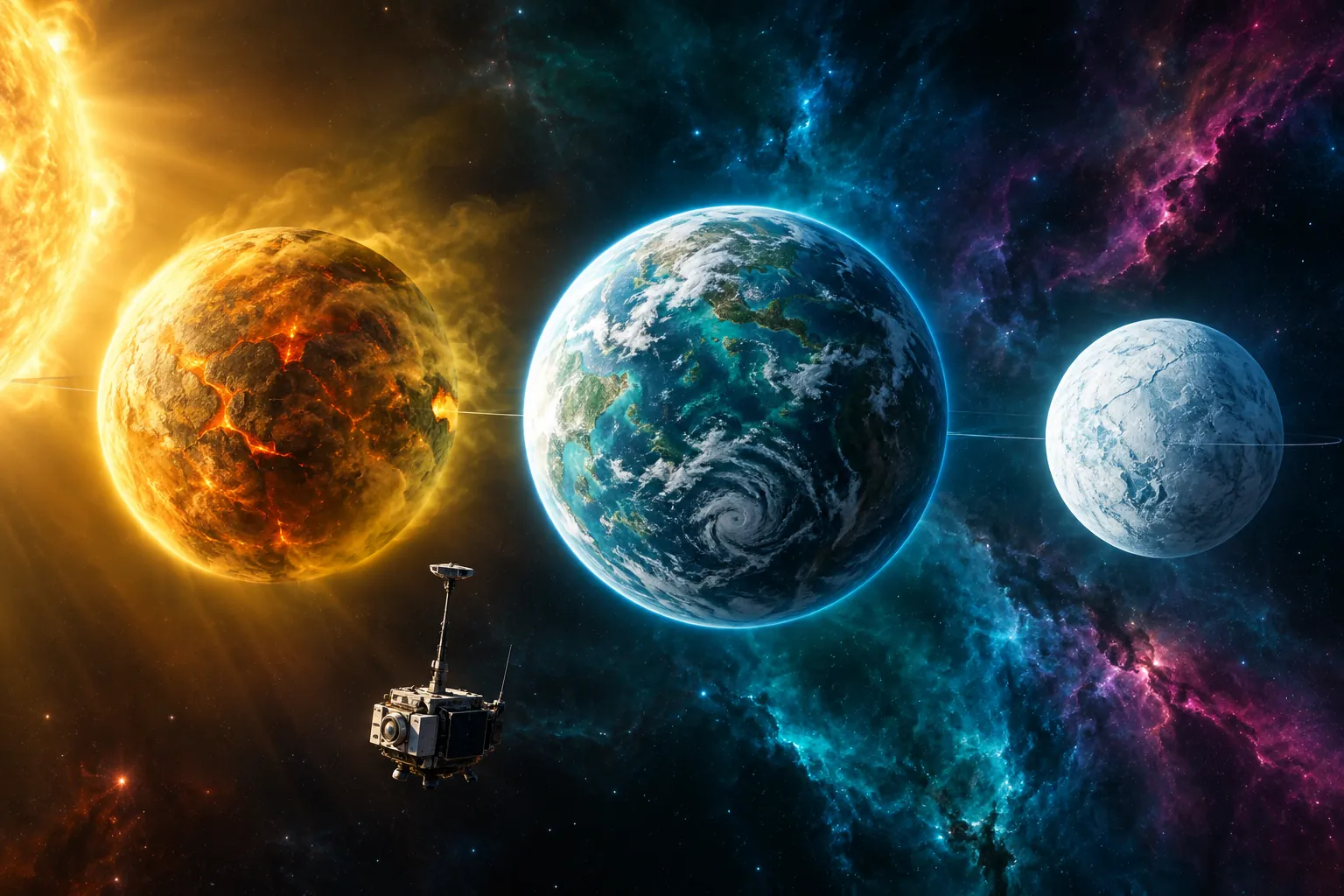
The habitable zone is the band of distances around a star where a rocky planet could keep liquid water on its surface. People also call it the Goldilocks zone, because the temperature should be neither too hot nor too cold.
Too close to the star and the oceans boil away. Too far and they freeze solid.
The key word is “could”. Sitting in the zone gives a planet the right amount of starlight, not a guarantee of water, air or life.
Astronomers use the zone to pick out the most interesting worlds among the more than 6,000 confirmed exoplanets. Science fiction uses it to decide where its characters might one day walk outside.
This article belongs to our History of Science Fiction topic, which follows how science and stories shape each other.
Where the name comes from
“Goldilocks” comes from the English fairy tale of a girl who tries three bowls of porridge and chooses the one that is just right. Robert Southey published the first well-known written version in 1837, and the girl got her golden hair and her name later.
The scientific idea is younger. In 1959 the astrophysicist Su-Shu Huang argued that the region around a star where life as we know it can arise is limited.
The modern version comes from a 1993 paper by James Kasting, Daniel Whitmire and Ray Reynolds. They used climate models to work out where an Earth-like planet could stay warm enough for oceans, and their method is still the base of most estimates.
Scientific papers usually say “circumstellar habitable zone”. “Circumstellar” simply means “around a star”.
How the edges are drawn
The inner edge is set by the runaway greenhouse effect. If a planet receives too much light, its oceans evaporate, and water vapour is itself a strong greenhouse gas, so the planet heats up even more.
In the upper atmosphere, sunlight then splits water molecules and the hydrogen escapes into space. The planet dries out for good.
The outer edge is set by the maximum greenhouse limit. Far from the star, carbon dioxide can warm a planet, but only up to a point, because thick CO2 begins to form clouds and scatter sunlight back into space.
For the Sun, careful models put the inner edge at about 0.95 to 1 astronomical unit and the outer edge at about 1.7. One astronomical unit (AU) is the average distance from Earth to the Sun, roughly 150 million kilometres.
More optimistic estimates assume that Venus and Mars once held water, and they stretch the zone from about 0.75 to 1.8 AU. The exact numbers change with every new climate model, which is why papers quote a range.
The real science
The zone in our own solar system
Earth orbits at 1 AU, comfortably inside. Venus, at 0.72 AU, lies just inside the inner edge, and its surface is about 465 °C under an atmosphere roughly 90 times heavier than ours.
Mars, at 1.52 AU, sits within the zone by some estimates. But it is small and lost most of its air, so liquid water is not stable on its surface today.
Distance alone is not enough. Mass, atmosphere and history decide what a planet becomes.
Different stars, different zones
The zone moves with the brightness of the star. Around a faint red dwarf it sits very close in: Proxima b, the closest known exoplanet to us at about 4.2 light-years, circles its star every 11 days at about 0.05 AU.
Around a hotter, brighter star the zone lies farther out and is wider. Such stars burn through their fuel faster, which leaves less time for life to develop.
Red dwarfs are the most common stars, so many candidate worlds orbit them. They bring problems of their own, such as strong flares and planets so close that they may be tidally locked, with one side always facing the star.
The planet matters as much as the orbit
Earth without any greenhouse gases would average about −18 °C, well below freezing. With its atmosphere it averages about 15 °C.
A planet’s atmosphere, clouds, oceans and size all shift the real conditions. The zone is a first filter, and a rough one.
The zone moves over time
The Sun has grown about 30 percent brighter since it formed some 4.6 billion years ago, and it keeps brightening. Its habitable zone is drifting slowly outward, and in roughly a billion years or more Earth is expected to leave it.
Water outside the zone
Liquid water can exist far outside the zone. Jupiter’s moon Europa and Saturn’s moon Enceladus appear to hide oceans under ice, kept liquid by tidal heating rather than sunlight.
That is why researchers treat the zone as the best place to look for surface life we could detect from light-years away. It is not the only place life could exist.
Worlds astronomers have found
- Kepler-186f (announced 2014): the first Earth-sized planet found in another star’s habitable zone, about 500 light-years away.
- Proxima b (2016): a planet of at least about 1.1 times Earth’s mass around the nearest star beyond the Sun. Whether it has an atmosphere is still unknown.
- TRAPPIST-1 (2017): seven Earth-sized planets around a small star about 40 light-years away, with several near or inside the zone, usually named as e, f and g.
The James Webb Space Telescope is now testing whether rocky planets around red dwarfs keep atmospheres at all. The answer will decide how many “Goldilocks” worlds deserve the name.
Where it shows up in fiction
Novels use the zone to decide where life can plausibly sit. Liu Cixin’s The Three-Body Problem turns the idea upside down with Trisolaris, a world with three suns whose climate swings so wildly that its civilisation is wiped out again and again.
Andy Weir’s Project Hail Mary sends its hero to the Tau Ceti system, a real nearby star where astronomers have reported candidate planets close to the habitable zone.
Isaac Asimov’s short story “Nightfall” (1941) imagines Lagash, a world lit by six suns where darkness comes only once in thousands of years. It turns the question of light on a planet into the whole plot.
The zone also frames terraforming. Mars sits near the outer edge, so warming it and thickening its air is the standard sci-fi plan for turning a nearly habitable world into a habitable one.
And it feeds the Fermi paradox. The more planets that could hold water, the more puzzling the silence of the sky becomes.
Common misconceptions
“A planet in the zone is habitable.” No. The zone only describes the amount of starlight, and the planet still needs an atmosphere, water and a stable climate.
“Every spot on a zone planet is temperate.” No. A tidally locked planet may have a scorching day side and a frozen night side, with only a ring between them that is comfortable.
“Life can only exist inside the zone.” No. Ocean moons such as Europa show that liquid water can exist elsewhere, though we could not easily see life there.
“The zone is a fixed set of numbers.” No. Its edges depend on the climate model and on the star, and they move as a star ages.
“Goldilocks planets are Earth twins.” No. “Earth-like” is a much stricter claim than “in the habitable zone”, and no confirmed planet meets it so far.
Read next
- Fermi paradox: why the number of possibly habitable planets makes the silence of the universe so strange.
- Terraforming: how fiction and science imagine moving a planet into the zone of comfort.
- History of Science Fiction: the wider story of how science ideas became stories.