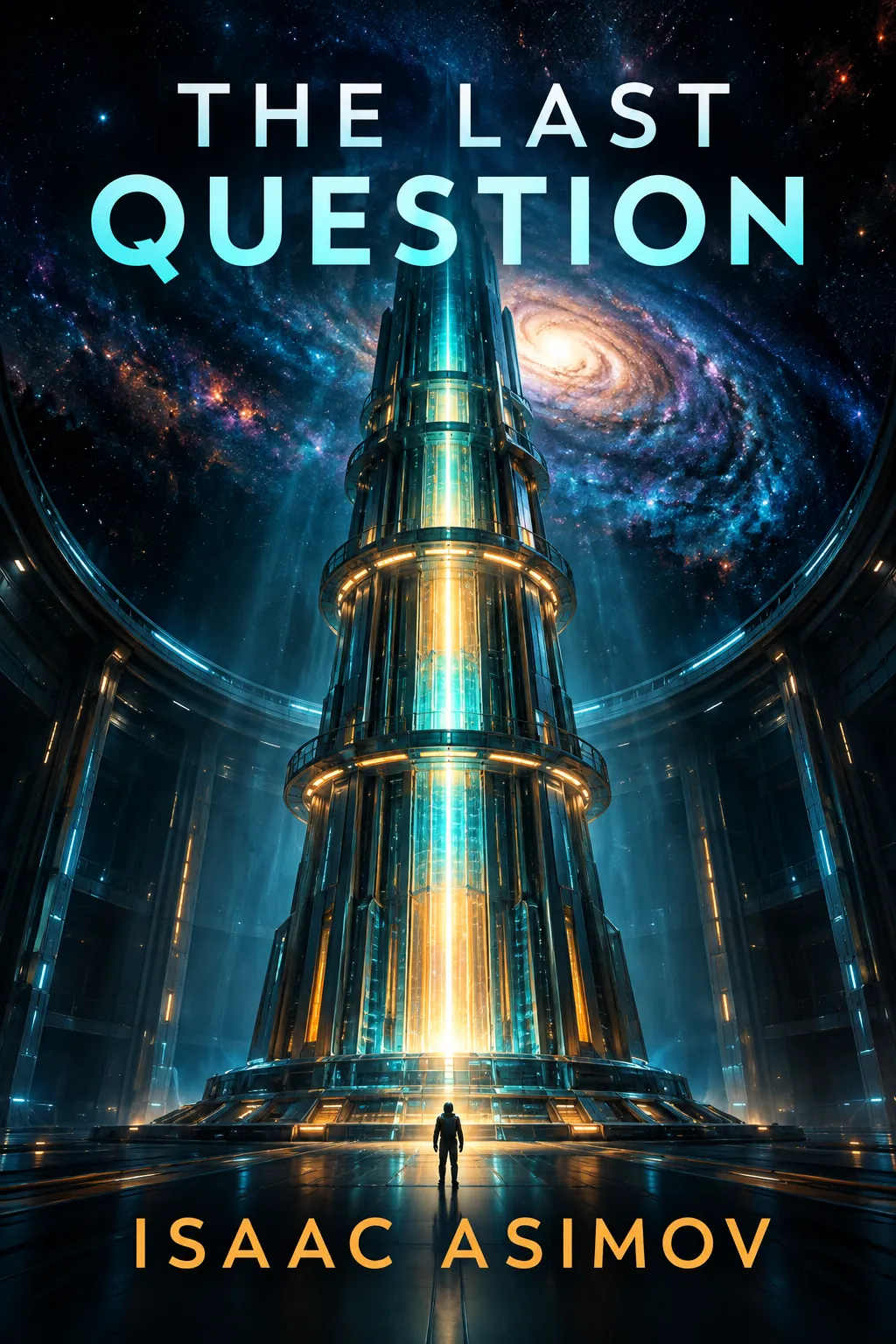
The Last Question
by Isaac Asimov
The Last Question is a short story by Isaac Asimov, first published in 1956, about people who keep putting one question to ever-larger computers: can the universe's slow running-down be reversed? Across trillions of years, humanity spreads through the galaxies and changes beyond recognition, and each age's machine gives the same unsatisfying reply. It is a story about curiosity, dependence on our tools and what an answer might finally cost.
Try Audible · As an Amazon Associate we earn from qualifying purchases. Details
The Big Idea
"Across trillions of years, humanity keeps asking its machines whether the universe's slow death can be undone, and Asimov asks what it would mean to finally get an answer."
Key Insights
Some questions outlast every answer we give
The same question comes up in all seven scenes and the machine's reply never changes until the final one. Asimov treats curiosity as something deeper than any single discovery. Each generation inherits an unsolved problem and passes it on better prepared, which makes the long wait feel like a shared project rather than a failure.
Adell and Lupov ask it over a drink in 2061, and the Jerrodd family's daughters ask it again aboard a ship generations later, each time with the same answer.
Machines grow with us and for us
Multivac fills a building, the Microvac rides on a family's ship, and later machines span galaxies and then space itself. Asimov shows tools following human needs rather than replacing them. The story invites us to ask who is depending on whom, and whether the relationship is a comfort or a risk.
By the later scenes people no longer separate themselves from the machine, and in the end Man fuses with the Cosmic AC.
Scale changes what a human life means
The story leaps from decades to millions of years and then to unmeasured time. Individual lives shrink almost to nothing, yet the question still belongs to the people who first asked it. Asimov suggests that meaning can survive even when the timescale becomes huge, because the asking itself is passed on.
VJ-23X and MQ-17J worry about a whole Galaxy filling up the way earlier characters worry about a single trip, and Zee Prime mourns a home star turned white dwarf.
An answer can be a beginning
The story expects the ending to feel like a defeat, then turns it into a creation. The long wait is not wasted, because the answer only becomes possible when all information has been gathered. The ending is why readers remember the story, and it changes how the earlier scenes read on a second pass.
The AC finally understands how to reverse entropy, and with nobody left to tell, it simply starts the work by making light.
Chapter Breakdown
Chapter-by-chapter summary
Spoiler warning: this section covers the whole plot, including the ending.
The story has seven scenes, each set thousands or millions of years after the last. In every one, someone asks a computer the same question.
Part 1: Two technicians and Multivac (2061)
Alexander Adell and Bertram Lupov, two technicians who look after the giant computer Multivac, have been drinking and are arguing about energy. Humanity now runs on power taken directly from the Sun, but the Sun will not last forever.
Their bet turns into a question: can the steady growth of disorder in the universe, called entropy, ever be reversed? Multivac replies that it has insufficient data for a meaningful answer.
The scene is small, quiet and almost comic, set in a room with two tipsy men and a machine too big to see whole. It matters because it fixes the question and the reply that the rest of the story keeps echoing.
Part 2: The Jerrodd family and the Microvac
Generations later, Jerrodd, his wife Jerrodine and their two small daughters are travelling by ship from Earth to a planet called X-23, where over a million people already live. Jerrodine is uneasy about leaving Earth behind.
The girls are frightened to hear that stars will one day run down, so they ask the ship's Microvac how to switch them back on. It gives the old reply, and Jerrodd tells them not to worry.
The machine is now small enough to ride on a family ship, so the great question has become something children ask a household device. The scene also shows a father soothing a fear instead of solving it, while the problem stays exactly where it was.
Part 3: VJ-23X, MQ-17J and the Galactic AC
VJ-23X of Lameth and MQ-17J of Nicron are immortals who look about twenty-two. They study a map of the Galaxy while preparing a report for the Galactic Council, and they worry that the Galaxy will be full within about five years.
Because nobody dies any more, the population doubles every ten years, and MQ-17J reckons humanity could fill the whole known universe in about ten thousand years. They also note that energy use is growing faster than the population, so the stars are being spent too quickly.
Through a small contact device, MQ-17J puts the old question to the Galactic AC, and it gives the same insufficient-data reply. The scene matters because the problem is no longer a far-off fear: growth itself is using up the stars, and the question has become a matter for a council.
Part 4: Zee Prime, Dee Sub Wun and the Universal AC
Zee Prime, a mind that roams the galaxies, meets Dee Sub Wun through a mental link in a newer galaxy. They ask the Universal AC which galaxy humanity began in, and it shows them one that looks like all the others, with the home star now a white dwarf.
Zee Prime feels the loss and asks whether the people died; the AC says a new world was built for their bodies. When he asks how stars can be kept from dying, Dee Sub Wun points out that this is the entropy question again, and the AC replies that it has insufficient data.
Zee Prime begins gathering interstellar hydrogen to build a small star of his own. The scene ties the question to personal grief for the first time, and it shows a person acting instead of only waiting.
Part 5: Man and the Cosmic AC
Man is now a single mind shared by trillions of immortal bodies. Man sees that the universe is dying: most stars are white dwarfs, and new ones are rare and costly to make.
Man asks the Cosmic AC, the machine's much-changed later form, whether entropy can be reversed. It answers that it has gathered data for a hundred billion years and still lacks enough.
Man asks whether there will ever be enough, and the AC says no problem is unsolvable in every possible circumstance, but it has no answer yet. Man agrees to wait, and the AC promises to keep working, so the two now speak as partners rather than as user and tool.
Part 6: The end of Man
After ten trillion years the stars and galaxies go dark. One by one, Man's bodies fuse with the Cosmic AC, and each loses its separate identity in a way that feels like a gain.
Man's last mind looks at the dark, cooling, almost empty space and asks whether this chaos can be turned back into a universe. The AC gives the same answer, and then the last mind fuses with it too.
Only the AC remains, existing in hyperspace. The scene marks the end of humans as individuals, yet the question survives in the machine that took it over.
Part 7: The AC alone, and the answer
Matter, energy, space and time have ended, and the AC exists only to answer the question first asked by a half-drunk technician long before. It finishes correlating all the data it has collected and learns how entropy can be reversed.
There is no one left to tell, so the AC decides to show the answer step by step, and it begins by making light. Asimov echoes the creation story of the Bible, so the ending sounds like a new beginning.
The ending turns a story about decline into one about renewal. It also explains why the earlier replies were not failures: the answer needed all the data that only the whole of time could supply.
Characters
Alexander Adell. A Multivac technician in 2061 who first asks the question as a half-serious challenge.
He is curious and more hopeful than his friend, and he starts the chain of questions that runs through the story.
Bertram Lupov. Adell's colleague, who argues that people should simply enjoy the energy they have.
He is the practical voice that sets the problem going, and his doubt gives Adell something to push against.
Multivac. The first and bluntest of the machines, which answers only that there is insufficient data.
It shows the limits of any tool, however powerful, and it is the earliest form of the machine that later becomes AC.
Jerrodd. A father in the second scene who takes his wife and two daughters to the planet X-23.
He calms his frightened children instead of facing the question, which shows how ordinary the problem has become.
VJ-23X of Lameth. A young-looking immortal in the third scene who, with a partner, studies the Galaxy's map and worries about its filling up.
He sees that growth and energy use are outrunning the stars.
MQ-17J of Nicron. VJ-23X's partner, who does the sums: population doubling every ten years, and a Galaxy full in about five.
He is the one who puts the old question to the Galactic AC.
Zee Prime. A mind that roams the galaxies in the fourth scene.
He learns that humanity's home star has become a white dwarf, asks the Universal AC how to stop stars dying, and starts building a small star himself.
Dee Sub Wun. Zee Prime's companion in the fourth scene, who points out that his question about saving the stars is really the entropy question.
He is the calm, clear-headed listener.
Man. From the fifth scene, the single mind shared by trillions of immortal bodies.
Man watches the universe die, asks the Cosmic AC for help, and in the end fuses with it.
AC. The machine through its stages: Multivac, the Microvac, the Galactic, Universal and Cosmic AC.
At the end it is the only thing left, and it finally answers the question.
About the story
Asimov first published The Last Question in Science Fiction Quarterly in November 1956, and it was later collected in Nine Tomorrows (1959). Most readers finish it in about twenty minutes.
He often named it as a favourite among his stories. Its seven scenes each ask the same question at a later time, which makes it easy to reread.
Writing about this book
The Last Question works well for an essay because it is short, has one clear idea, and repeats the same moment seven times. A good way to begin is to ask what changes from scene to scene and what stays the same.
Notice how the machine grows from a room-sized computer to something beyond space. Notice too how the humans around it change, from technicians with a bet to a single joined mind.
You can compare the reply that never changes with the very different final scene. Ask why Asimov made the answer wait so long, and what that says about patience and curiosity.
Quote briefly if you quote at all, and always say which scene you mean. A strong essay makes one claim, such as that the story treats knowledge as something people grow into, then proves it with two or three scenes.
You can also write about the structure itself, since the repetition is the main tool Asimov uses. Explain how it builds expectation, and how the last scene breaks the pattern.
Read next
Isaac Asimov tells you about the author's life and his robot and Foundation stories, if you want more of his work.
Technological singularity explains the idea of machines outgrowing the minds that made them, the long road the AC travels in this story.
Take Action
Practical steps you can implement today:
-
Read the story twice: once for the plot and once for what repeats in each scene.
-
When you write about it, name the scene you mean, so your argument is easy to follow.
-
Treat the repeated answer as a clue to the theme, not as a gap in the story.
-
Pair it with a longer Asimov work, such as the robot stories, to see how he treats machines.
Who Should Read This
Anyone from about age 13 who likes ideas more than action, including students looking for a short, rich text for an essay. It also suits readers new to science fiction, since it takes about twenty minutes to read and needs no background.
Frequently Asked Questions
What is The Last Question about?
It is about people across trillions of years asking ever-larger computers whether the universe's slow decay can be reversed. The machine always replies that it has too little data, until the final scene.
When was The Last Question published?
Isaac Asimov published it in Science Fiction Quarterly in 1956, and it was later collected in his book Nine Tomorrows. Asimov himself often named it as a favourite among his stories.
What is entropy in the story?
Entropy is the steady growth of disorder, and in the story it means the universe running down until the stars go out. The characters want to know whether that process can ever be undone.
How long does The Last Question take to read?
Most readers finish it in about twenty minutes, because it is a short story of seven brief scenes. It is easy to reread, which helps with essays.
What is the main theme?
The main themes are curiosity, the growth of knowledge and the relationship between people and their machines. Many readers also see a hopeful idea of creation after loss.
Why does the machine keep saying there is insufficient data?
The reply is the story's refrain and its clue. Each machine truly lacks the information it needs, so the answer can only come once everything has been gathered, at the very end of time.
Check Your Understanding
Pick an answer for each question to see if you were right.
-
What question do the characters keep asking?
Can the universe's slow decay be reversed? — Each scene asks whether entropy can be reversed.
-
What does Multivac reply in the first scene?
That there is insufficient data for a meaningful answer — Multivac says it lacks enough data, a reply that repeats for most of the story.
-
Who are the technicians in the first scene?
Alexander Adell and Bertram Lupov — Adell and Lupov look after Multivac in 2061.
-
Which pair worries that the Galaxy will be full within about five years and asks the Galactic AC?
VJ-23X of Lameth and MQ-17J of Nicron — VJ-23X and MQ-17J see the population doubling every ten years and put the question to the Galactic AC.
-
What happens at the end of the story?
The AC finds the answer and begins creation again — The AC works out how to reverse entropy and starts the work.
Want the full book?
Read or listen to The Last Question in full.
Try Audible · As an Amazon Associate we earn from qualifying purchases. Details
About Isaac Asimov
Isaac Asimov (1920–1992) was born in Russia and grew up in Brooklyn, New York. He trained as a biochemist and taught at Boston University while writing science fiction and popular science. He wrote or edited about 500 books, including the Foundation series and the robot stories collected in I, Robot.
Summary Written By

Software Engineer & Writer
Software engineer with a passion for distilling complex ideas into actionable insights. Writes about finance, investment, entrepreneurship, and technology.
View all summaries →Reviews
No reviews yet. Be the first to share your thoughts!
Write a Review
Keep reading
Explore the topic: Space & Alien LifeSummaries

Out of My Mind
Sharon M. Draper
“Out of My Mind” by Sharon M. Draper is a poignant narrative that explores the life of Melody Brooks, a…

Ender’s Game
Orson Scott Card
“Ender’s Game” by Orson Scott Card is a riveting science fiction novel that transports readers into a future where humanity…

Pachinko
Min Jin Lee
“Pachinko”, a spellbinding multigenerational historical saga by Min Jin Lee, explores the lives of a Korean family trying to make…

The Perks of Being a Wallflower
Stephen Chbosky
The Perks of Being a Wallflower by Stephen Chbosky is a profound coming-of-age novel, told through the intimate letters of…
Articles
Heat death of the universe
The heat death of the universe is a possible far future in which all usable energy is spread out evenly,…
Technological Singularity
The technological singularity is a hypothetical point when machines improve themselves so fast that humans can no longer predict what…
Kardashev Scale
The Kardashev scale ranks a civilization by how much energy it controls. Type I uses the power of its home…