In five minutes
Thoughtcrime is the offence of thinking something the ruling Party forbids. George Orwell invented the word for his 1949 novel Nineteen Eighty-Four.
In the book, the superstate of Oceania punishes a doubtful idea as hard as a violent act. Nobody has to say or do anything wrong, because holding the wrong belief is enough.
The reasoning is simple and chilling. If the state can decide what you are allowed to think, it never has to fear a rebellion, because every rebellion begins as a thought.
That is why Orwell's word outlived the novel. People now use "thoughtcrime" whenever private belief, rather than conduct, is treated as the offence.
This page is part of our History of Science Fiction topic. It completes a set of terms from the same novel, alongside doublethink, Newspeak and Big Brother.
What thoughtcrime means in the novel
Spoiler note: from here this page mentions events from Parts 1 to 3 of the novel, including what happens to Winston.
The word appears early, when Winston Smith, a minor Party worker in London, buys a notebook and starts a secret diary in Part 1. Nothing in Oceania is formally illegal, because the Party has no real laws to break, yet Winston knows the diary could ruin him.
He understands that if he is caught, the penalty will be death or years in a forced-labour camp. The Party has a name for what he has done: thoughtcrime.
Orwell makes a sharp point here. Winston is guilty of the offence the moment he lets himself doubt the Party, and the diary only makes that guilt visible.
Thoughtcrime is therefore not one forbidden act. It is a label for any inner life the Party has not approved: a memory of how things used to be, a private hope, a flicker of disgust at the leaders.
The novel also shows that the crime cannot be hidden for ever. Winston believes the Thought Police will catch him sooner or later, and the book shows that he is right.
How the Party enforces it
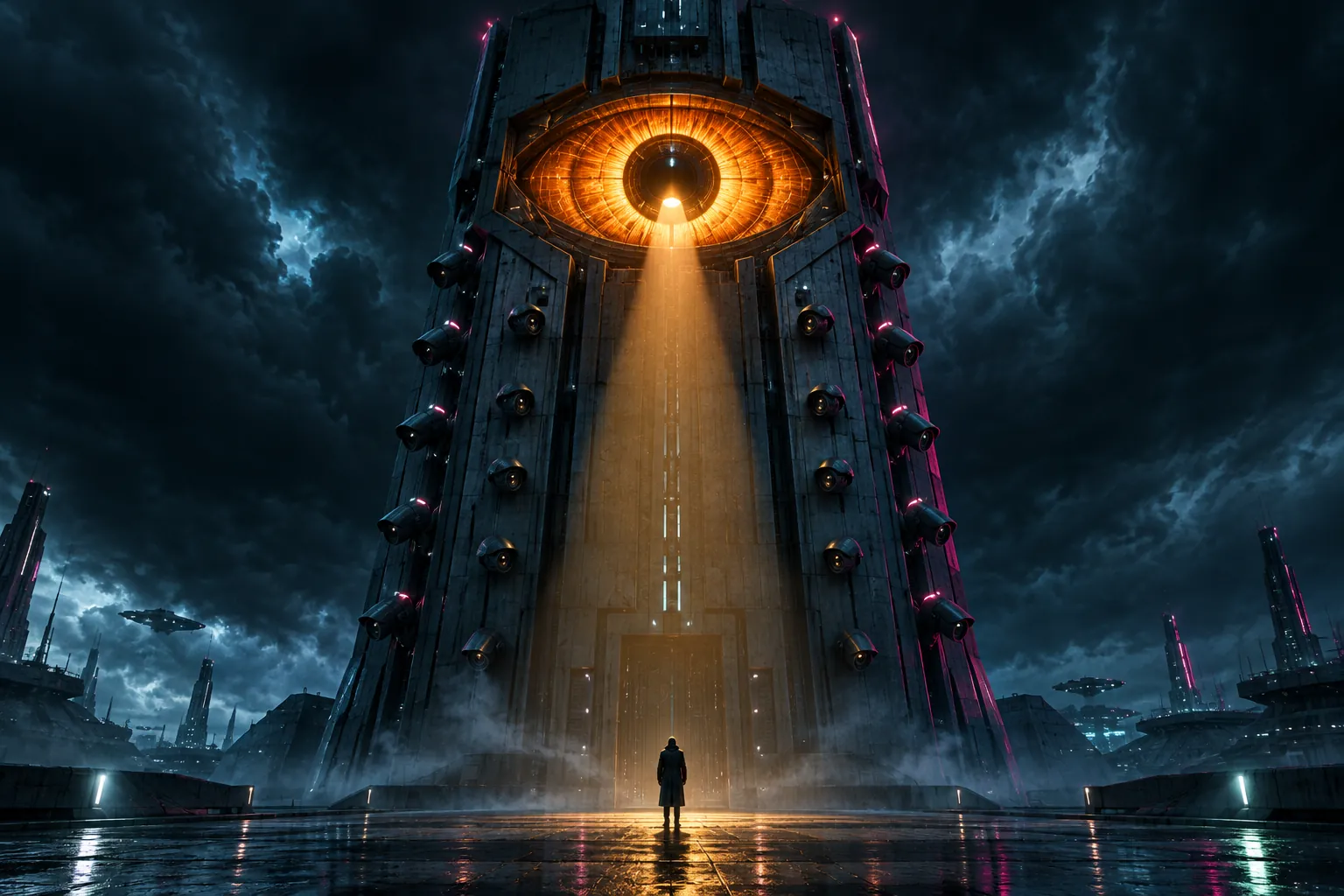
The Party watches through the telescreen, a device in every flat that shows pictures and also sees and hears the room. Nobody can be sure when they are being observed, so everyone behaves as if they always are.
The Thought Police do the arresting, usually quietly and often at night. People simply vanish, and their names are removed from records until it seems they never lived.
Neighbours and colleagues are part of the system too. Children join an organisation called the Spies and are taught to report adults, and in Part 3 Winston's neighbour Parsons is denounced by his own young daughter for something he said in his sleep.
Even the face is policed. Orwell describes "facecrime", wearing an expression that suggests disbelief, as an offence in itself.
The Party also stages the Two Minutes Hate, a daily ritual in which workers scream at a screen showing the Party's enemy. It gives people a safe outlet for feeling and shows who joins in with real enthusiasm.
The goal is not only punishment. In Part 3 the Party official O'Brien explains that the Party wants to change the heretic's mind from the inside, so that the person truly believes, rather than merely obeys.
How it connects to Newspeak and doublethink
Three ideas from the novel work together. Newspeak shrinks the language so that dangerous thoughts become hard to express, and the Newspeak word for thoughtcrime is "crimethink".
Syme, a Party linguist, explains that each year there will be fewer words and so a smaller range of thought. If a word for freedom or rebellion no longer exists, the idea has nowhere to live.
Doublethink is the mental habit of holding two contradictory beliefs and accepting both. It lets a loyal member of the Party avoid thoughtcrime by sincerely believing whatever the Party currently says.
Above all of this sits Big Brother, the face on the posters who seems to watch every person. Thoughtcrime is the offence, the telescreen and the Thought Police are the tools, and Big Brother is the symbol that makes everyone feel watched.
The real science: can anyone police thought?
Thoughtcrime is fiction, and no technology can read a person's beliefs. The Thought Police in the novel rely on watching behaviour, informers and confession, not on mind reading.
Real brain research is far more limited. Laboratory studies can decode small things from the brain activity of willing volunteers, such as which of a few items someone is looking at or imagining, but they do not reveal private opinions.
Modern legal systems usually punish acts, and intent matters only when it is shown through evidence of what someone did. That is the opposite of the world in the novel, where the inner life itself is the offence.
Where Orwell's idea does connect to reality is the effect of being watched. Research on surveillance suggests that people sometimes avoid reading or writing about sensitive topics when they believe they are monitored, and Orwell's point is that this fear does the Party's work for it.
Where it shows up in fiction
The clearest example is Nineteen Eighty-Four itself, where Winston's diary, his love affair with Julia and his conversations with O'Brien all count as thoughtcrime. The book is the origin of the word, so every later use points back to it.
Orwell knew Yevgeny Zamyatin's novel We, which was published in English in 1924. It imagines a state that goes even further and treats imagination as an illness to be removed by surgery.
Philip K. Dick's short story "The Minority Report" (1956) is often confused with thoughtcrime. Its police arrest people for crimes they are predicted to commit, so the target is a predicted act, not a belief.
Ray Bradbury's Fahrenheit 451 and Aldous Huxley's Brave New World show the other ways to control thought. One burns books and the other uses conditioning and pleasure, so forbidden ideas rarely form.
Common misconceptions
One misconception is that the Thought Police can read minds. They cannot, and the whole system depends on spies, telescreens, confessions and fear.
Another is that thoughtcrime simply means criticising the government. In the novel it covers anything the Party dislikes, from remembering a different past to loving someone for personal reasons.
People also say Orwell predicted the present exactly. He wrote a warning shaped by the politics of the 1940s, and the novel is a thought experiment about what a total state might try, not a forecast.
Finally, the word is often used loosely for any social disapproval or disagreement. Orwell's meaning needs a power that punishes belief itself, which is what separates thoughtcrime from ordinary debate or criticism.
Read next
Doublethink explains how a person can believe two opposite things at once, which is how the Party's loyalists avoid the crime.
Newspeak and doublethink (1984) shows how the Party shrinks language to make dangerous thoughts impossible.
Big Brother (Orwellian) covers the face on the poster and why the phrase became shorthand for surveillance.
Return to the History of Science Fiction hub for more ideas from dystopian and speculative fiction.