In five minutes
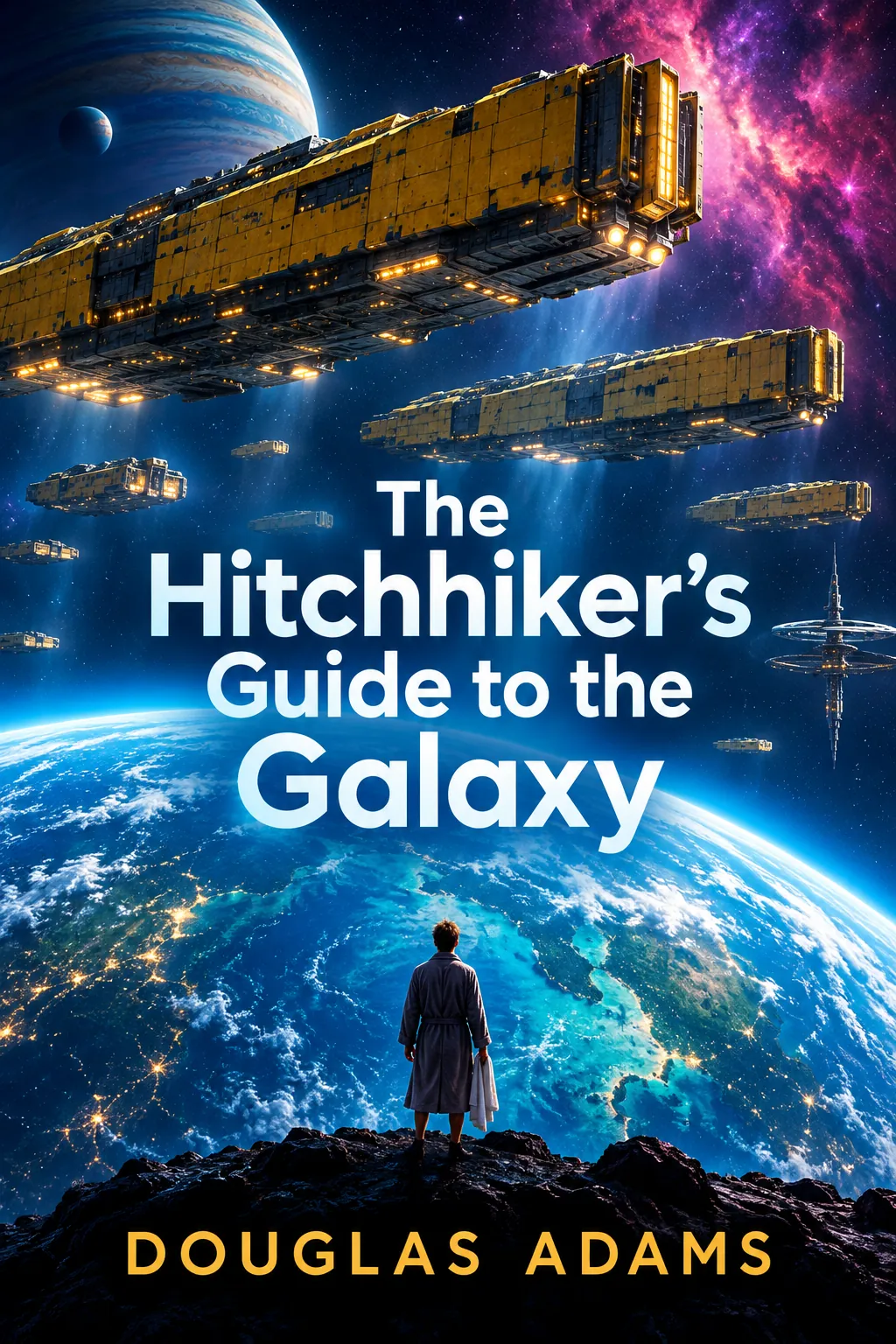
Douglas Adams (1952–2001) was an English writer who made science fiction funny without making it small. His best-known work, The Hitchhiker's Guide to the Galaxy, began as a BBC radio series in 1978.
It then grew into a novel, a TV series, a computer game, a stage show and a film.
His trick was to treat the biggest questions, such as why we are here and what the universe is for, in the calm voice of a man filling in a form. Spaceships break down, planners lose patience with humans, and the answer to everything turns out to be a number.
Adams belongs to the wider story told in our History of Science Fiction. He showed that the genre could laugh at itself and still be clever.
Life and career
Adams was born in Cambridge on 11 March 1952. He grew very tall, about 1.96 metres, and studied English at St John's College, Cambridge, where he joined the Footlights comedy club.
After university he struggled to find steady work and took odd jobs while writing comedy on the side. In 1974 he co-wrote a sketch with Graham Chapman that was broadcast in Monty Python's Flying Circus.
Adams later said the first idea for the Guide came in 1971. He was lying in a field in Innsbruck, Austria, with a hitchhiking guide to Europe, looking up at the stars.
The thought that somebody ought to write a hitchhiker's guide to the galaxy stayed with him for years. BBC Radio 4 broadcast the first episode on 8 March 1978.
Listeners took to it at once, and a second series followed. The novel came out in 1979 and sold in huge numbers, and a BBC television version arrived in 1981.
Adams liked to call the book series a “trilogy in five parts”. The five novels are listed here in the order they were published.
- The Hitchhiker's Guide to the Galaxy (1979)
- The Restaurant at the End of the Universe (1980)
- Life, the Universe and Everything (1982)
- So Long, and Thanks for All the Fish (1984)
- Mostly Harmless (1992)
Alongside the Guide he worked on Doctor Who. He wrote the serials “The Pirate Planet” (1978) and “City of Death” (1979, written with producer Graham Williams), and he was the programme's script editor for its 1979–80 season.
He also wrote two Dirk Gently novels, Dirk Gently's Holistic Detective Agency (1987) and The Long Dark Tea-Time of the Soul (1988). They follow a detective who believes that everything is connected.
In 1984 Adams worked with the company Infocom on a text adventure game of the Guide. In 1998 he released the game Starship Titanic, and in 1999 the online encyclopedia h2g2 went live.
He died of a heart attack in California on 11 May 2001, aged 49. Fans now celebrate Towel Day on 25 May, a tradition that began within weeks of his death.
The Guide in brief
The story opens on an ordinary Thursday. Arthur Dent, an Englishman, is protesting against the bulldozers that threaten his house, when he learns that the whole Earth is about to be demolished to make room for a hyperspace bypass.
His friend Ford Prefect, who turns out to be an alien researcher for the Guide, rescues him just in time. They hitch a ride on the ship of the Vogons, the very aliens doing the demolition.
Along the way they meet Zaphod Beeblebrox, Trillian and Marvin, a robot with a brain the size of a planet who is permanently depressed. The Guide itself is an electronic book with the words “Don't Panic” on its cover, and its advice is odd and often unreliable.
Our page on The Hitchhiker's Guide to the Galaxy covers the plot, characters and themes in more detail.
The real science behind the jokes
Adams was not a scientist, but he followed science closely and was a friend of the biologist Richard Dawkins. His jokes often lean on real ideas: the size of space, evolution, probability and what computers can and cannot do.
The Guide describes space with a line that has become famous: “Space is big. Really big. You just won't believe how vastly, hugely, mind-bogglingly big it is.” The joke works because it is true.
The clearest example of his interest in nature is Last Chance to See. In 1989 he travelled with the zoologist Mark Carwardine to visit animals close to extinction, for a BBC radio series and a book published in 1990.
They looked for the aye-aye in Madagascar, the kakapo in New Zealand, the Komodo dragon in Indonesia and the Yangtze river dolphin in China. The book is funny, but it is also a serious plea to protect wildlife.
A survey in 2006 failed to find a single Yangtze river dolphin, and the animal is now feared extinct. That makes the book a record of something already lost.
The Babel fish in the novel is another example. It is a tiny creature that translates any language when you put it in your ear, and Adams uses it to poke fun at neat arguments about proof and design.
Where Adams fits in science fiction
Before Adams, much popular science fiction was serious and grand. He took the familiar parts, such as spaceships, alien empires and giant computers, and played them for laughs.
In his universe the ships break down, the bureaucracy is cosmic and the greatest computer ever built gives an answer nobody can use. Under the jokes, the stories still carry real curiosity about science and about what people are for.
His style is easy to spot: calm narration, surprising comparisons and a habit of ending a sentence somewhere you did not expect. He admired the comic writer P. G. Wodehouse, and the influence shows in his tone.
His work did not end with his death. In 2002 the collection The Salmon of Doubt appeared, and in 2009 the author Eoin Colfer wrote an authorised sequel, And Another Thing…. The asteroid 25924 Douglasadams also carries his name.
Common misconceptions
“The number 42 has a secret meaning”
In the story, a giant computer called Deep Thought takes 7.5 million years to work out the answer to the ultimate question of life, the universe and everything. Its answer is 42.
Nobody knows what the question was, so the answer is useless, and that is the joke. Adams said he picked 42 because it was an ordinary, small number that sounded funny.
Fans have found theories in different number bases and in many other places. Adams said none of them was intended.
“It began as a novel”
It began as a radio comedy on BBC Radio 4 in 1978. The novel followed in 1979 after the radio series proved popular.
Some scenes and lines differ between the radio, the novel and the TV versions.
“He only wrote the Hitchhiker books”
Adams also wrote for Doctor Who, published the Dirk Gently novels, co-wrote the nature book Last Chance to See and worked on games and websites.
“The series ended when he died”
Adams himself wrote the fifth book, Mostly Harmless, in 1992. The 2009 sequel And Another Thing… was authorised, but it was written by a different author.
Read next
The Hitchhiker's Guide to the Galaxy: the summary, characters and themes of Adams's most famous novel.
History of Science Fiction: see where Adams sits in the long story of the genre.