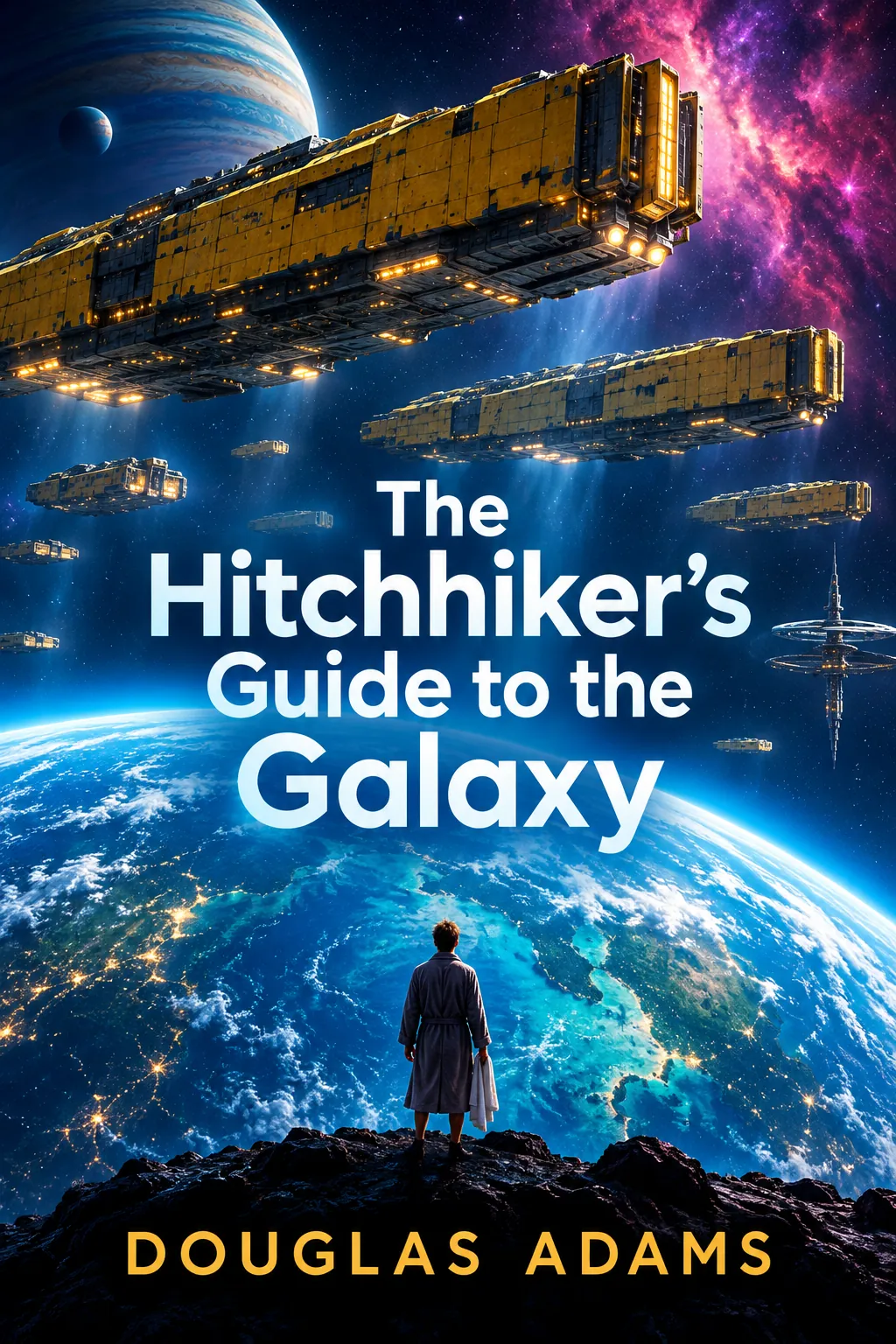
The Hitchhiker's Guide to the Galaxy
by Douglas Adams
The Hitchhiker's Guide to the Galaxy is a comic science-fiction novel by Douglas Adams. Arthur Dent, a mild Englishman, loses his house and then his whole planet on the same Thursday, when alien builders demolish Earth to make room for a hyperspace bypass. His friend Ford Prefect, secretly an alien writer for a travel guide, drags him into space. Together they meet a two-headed galactic president, a gloomy robot and a very large question about the meaning of life.
The Big Idea
"Earth is demolished to make way for a space bypass, and an ordinary Englishman learns that the universe is vast, absurd and indifferent, so the sensible reply is a towel, a sense of humour and no panic."
Key Insights
The universe does not care, and that can be a relief
Adams places humans in a cosmos so large that losing a planet is a paperwork matter. Instead of despair, the effect is freeing: if nothing is personal, nothing needs to be taken so seriously. The comedy works by moving between the small, English scale of Arthur's worries and the vast scale of space.
The demolition notice was on display for fifty years, but in a place no one on Earth could ever have reached.
A good answer needs a good question
Deep Thought gives a perfect, exact answer and it is useless, because nobody asked the right question first. Behind the joke is a real point about thinking: the work of defining a problem is often harder than solving it, and a precise number can hide a confused goal.
After seven and a half million years of calculation, the answer is forty-two, and a second computer, Earth, has to be built to find the question.
Bureaucracy is funny until it is in charge
The Vogons destroy a planet the way a council clears a street, with forms, schedules and no listening. Adams uses them to show how rules can be followed perfectly and still produce harm. The humour makes the idea easy to remember and hard to forget.
The Vogons point to a notice that was technically available for inspection and treat that as consent.
Not panicking is a practical philosophy
The Guide's cover tells travellers not to panic, and the characters who survive are those who stay curious and keep their humour. Marvin shows the opposite: a huge intelligence turned to complaint. The book suggests that calm is not ignorance, but a way to keep thinking when things go wrong.
Ford and Arthur are thrown into space, and the ship that rescues them arrives because of an improbable coincidence, not a plan.
Chapter Breakdown
Chapter-by-chapter summary of The Hitchhiker's Guide to the Galaxy
Spoiler warning: this section covers the whole plot, including the ending.
Part 1: Earth goes first
Arthur Dent wakes in a quiet English town to find bulldozers outside his house. The council wants a bypass, and Arthur lies down in the mud to stop them. His friend Ford Prefect turns up, gets the council man to take Arthur's place in the mud, and marches Arthur to the pub. There Ford confesses that he is an alien from a small planet near Betelgeuse, stuck on Earth for fifteen years while researching it for a travel guide. Today, he says, the planet ends. Yellow ships arrive, and their Vogon crews explain that Earth is being demolished for a hyperspace bypass. The notice, they add, has been on show in a planning office on Alpha Centauri for fifty years. Why it matters: one man's grief over a house is swallowed by something so much bigger that the joke and the tragedy become the same thing.
Part 2: Thrown off the Vogon ship
Ford signals a passing Vogon ship with a small gadget, and the two of them are lifted aboard just before Earth vanishes. The Vogons are bureaucrats who care about nobody. Ford puts a Babel fish in Arthur's ear, a tiny creature that translates any language, so Arthur can understand the guards. Captain Jeltz then reads out his own poetry, which is terrible. When the two prisoners fail to praise it, he has them thrown out of the airlock. Why it matters: the Vogons are the book's favourite target, power that is slow, dull and impossible to argue with.
Part 3: Rescued by improbability
With seconds of air left, Ford and Arthur are saved by the unlikeliest rescue imaginable. The ship that picks them up is the Heart of Gold, a brand-new starship driven by the Infinite Improbability Drive, which makes impossible things happen by making them briefly likely. On board are Zaphod Beeblebrox, a distant cousin of Ford and the President of the Galaxy, who has two heads; Trillian, a woman Arthur once met at a party; and Marvin, a robot with a brain the size of a planet and a miserable outlook. Why it matters: the drive turns chance itself into a comic engine.
Part 4: The legendary planet
Zaphod admits that he stole the ship on purpose, but he cannot say why, because he wiped part of his own memory. He is looking for Magrathea, a legendary planet that once built other planets for the very rich. When the Heart of Gold arrives, two missiles are fired at it. The improbability drive turns them into a sperm whale and a bowl of petunias, and both fall toward the surface. The whale has just enough time to wonder who it is and why it is there. On the silent planet, Arthur meets an old man named Slartibartfast. Why it matters: disaster is handled as a joke, and the sad little thoughts of the whale give the scene an odd tenderness.
Part 5: The answer is forty-two
Slartibartfast leads Arthur into the planet's factory and tells him the history of the biggest question of all. Long ago, hyperintelligent beings from many dimensions built the giant computer Deep Thought to find the Answer to Life, the Universe and Everything. After seven and a half million years it announced the answer: forty-two. Nobody had known what the question was, so Deep Thought designed a still greater computer to find it. That computer was Earth, ordered from and built by Slartibartfast's people. It ran for ten million years and was destroyed five minutes before it finished. Why it matters: it is the book's best-known joke, that an answer is useless without the right question.
Part 6: The mice and the escape
Arthur learns that the beings who ordered Earth appear on it as laboratory mice, and that Trillian's white mice are among them. They believe the lost question may still be stored in the brain of Arthur, the last native of Earth who is still alive, and they offer to buy it. Arthur refuses. In the middle of the argument, Magrathean police arrive and open fire, and the group escapes in the Heart of Gold. The question is still unknown, and they decide to go for dinner at the end of the universe. Why it matters: humans thought they were the point, and the book gently suggests they were the experiment.
Characters
Arthur Dent
An ordinary Englishman who is still in his dressing gown when the universe turns up. He is the reader's stand-in: confused, polite, homesick and always wanting a cup of tea. His common sense is often useless in space, but it never leaves him.
Ford Prefect
A researcher for the Guide from a small planet near Betelgeuse. After fifteen years stranded on Earth he shortened the planet's entry to “Mostly harmless”. Cheerful, resourceful and slightly irresponsible, he is Arthur's guide to everything.
Zaphod Beeblebrox
The President of the Imperial Galactic Government, a showman with two heads. He stole the Heart of Gold at its launch, but he cannot explain why, since he deliberately blocked his own memory. Reckless, charming and hard to take seriously.
Trillian
Born Tricia McMillan on Earth, she studied maths and astrophysics before leaving the planet with Zaphod after a party where she met Arthur. She is quick and calm, and she keeps the ship's problems in perspective. Her two pet white mice turn out to matter.
Marvin
A robot with a brain the size of a planet and nothing worthy to use it on. He is gloomy, politely rude and sure that every task is pointless. His complaints are among the funniest running jokes in the book.
Slartibartfast
An elderly designer from Magrathea who builds planets for a living. He is proud of having shaped the coastline of Norway and of the award he won for its fjords. He quietly tells Arthur what Earth was really for.
Captain Prostetnic Vogon Jeltz
Captain of the Vogon construction fleet, a hulking bureaucrat who follows orders without feeling. He writes poetry that is painful to hear and throws Arthur and Ford out of his airlock when they fail to praise it.
Deep Thought
A vast computer built by hyperintelligent beings to answer the ultimate question. It thinks for seven and a half million years and says the answer is forty-two. It then points out that the real trouble is that nobody knows the question.
The mice
The white mice of Earth's laboratories, Trillian's pets among them, are the many-dimensional beings who ordered the planet. They treat people as parts of an experiment, and they would like to have Arthur's brain.
The Guide
The in-story book that gives the novel its title: an electronic encyclopedia for travellers. It is often wrong, usually funny and more reassuring than a correct one would be. “Don't Panic” is printed on its cover in large friendly letters.
Writing about this book
A strong school essay on this novel does not retell the plot. It picks one scene or idea and asks why Adams made it funny. Good starting questions:
- Why is it funnier that Earth is demolished for a bypass than for a war? What is Adams saying about officials and plans?
- What does the answer “forty-two” show about the difference between an answer and an understanding?
- Arthur is the only ordinary person in the story. How does the author use him to guide the reader?
- Is “Don't Panic” advice, a joke, or both?
For structure, introduce your chosen scene in two or three sentences, explain what you felt and why, then connect it to something from your own life, such as a rule that made no sense or a plan that changed overnight. Finish by saying what you think the author wanted readers to take away. Quote sparingly, never more than a line, and put every idea in your own words.
Take Action
Practical steps you can implement today:
-
Before racing to an answer, check that you are asking the right question; a neat solution to the wrong problem is still wrong.
-
When a plan collapses, step back and look for the funny side; humour keeps your thinking clear.
-
Read notices and rules before they are used on you, and ask who they were written for.
-
In a crisis, say “Don't panic” to yourself and do the next small, practical thing.
Notable Quotes
"“The ships hung in the sky in much the same way that bricks don't.” (Chapter 3)"
— Douglas Adams
"“Don't Panic” is printed on the Guide's cover in large, friendly letters. (Chapter 3)"
— Douglas Adams
"“Forty-two,” said Deep Thought, with infinite majesty and calm. (the Deep Thought scene)"
— Douglas Adams
Who Should Read This
Readers from about 13 who like comedy, science fiction or both, and anyone who wants to try sci-fi without heavy science. It suits school and university students looking for a short, funny book that still gives them something to write about. No background in science fiction is needed.
Frequently Asked Questions
What is The Hitchhiker's Guide to the Galaxy about?
It follows Arthur Dent, an ordinary Englishman who survives the demolition of Earth by hitching a ride with his alien friend Ford Prefect. They travel across the galaxy and learn that Earth was a giant computer built to find the question to the ultimate answer.
Why is the answer 42?
In the story, the supercomputer Deep Thought computes the answer to Life, the Universe and Everything and gives forty-two, because no one had told it the question. Adams later said the number had no deep meaning and was chosen because it seemed funny.
Do I need to read the sequels?
No. The first novel works as a complete story with a funny, open ending. Adams wrote five novels in the series, and later books follow the same characters further across the galaxy. You can stop after one or continue.
Is the novel the same as the radio show or the films?
Not exactly. The story began as a BBC Radio 4 series in 1978, and the novel followed in 1979. Later radio, television and film versions change details and jokes. This guide summarises the novel.
Why does everyone mention a towel?
The in-story Guide says a towel is one of the most useful things a traveller can carry. It can keep you warm and serve many other purposes. Fans treat it as a symbol of being prepared and sensible in a strange world.
Check Your Understanding
Pick an answer for each question to see if you were right.
-
Why do the Vogons destroy Earth?
To build a hyperspace bypass — They clear the planet to make room for a hyperspace bypass, and they say the plans were on display.
-
What does the Babel fish do?
Translates languages in the ear — The Babel fish is placed in the ear and translates any language, letting Arthur understand aliens.
-
What answer does Deep Thought give?
Forty-two — After seven and a half million years of thought, Deep Thought announces forty-two.
-
According to Slartibartfast, what is Earth?
A giant computer — Earth was built as a computer to find the question to the ultimate answer.
-
What do the missiles fired at the Heart of Gold turn into?
A whale and a bowl of petunias — The improbability drive turns them into a sperm whale and a bowl of petunias.
About Douglas Adams
Douglas Adams (1952–2001) was an English writer and humorist. He began The Hitchhiker's Guide to the Galaxy as a BBC Radio 4 comedy in 1978 and turned it into a novel in 1979. The book matters because it made science fiction funny without making it small, and it opened the genre to readers who thought it was not for them.
Summary Written By

Software Engineer & Writer
Software engineer with a passion for distilling complex ideas into actionable insights. Writes about finance, investment, entrepreneurship, and technology.
View all summaries →Reviews
No reviews yet. Be the first to share your thoughts!
Write a Review
Keep reading
Explore the topic: Science FictionSummaries

Out of My Mind
Sharon M. Draper
“Out of My Mind” by Sharon M. Draper is a poignant narrative that explores the life of Melody Brooks, a…

Ender’s Game
Orson Scott Card
“Ender’s Game” by Orson Scott Card is a riveting science fiction novel that transports readers into a future where humanity…

Pachinko
Min Jin Lee
“Pachinko”, a spellbinding multigenerational historical saga by Min Jin Lee, explores the lives of a Korean family trying to make…

The Perks of Being a Wallflower
Stephen Chbosky
The Perks of Being a Wallflower by Stephen Chbosky is a profound coming-of-age novel, told through the intimate letters of…
Articles

A Christmas Carol themes: generosity, isolation and responsibility
Dickens's novella is usually read as a story about a man who changes his mind. Its themes are sharper than…
Nebula Award: What It Is and Notable Winners
The Nebula Award is an American science fiction and fantasy prize voted on by working writers. The Science Fiction and…
Seiun Award
The Seiun Award is Japan's oldest science fiction award, first given in 1970. Fans who attend the annual Japan SF…