William Gibson in five minutes
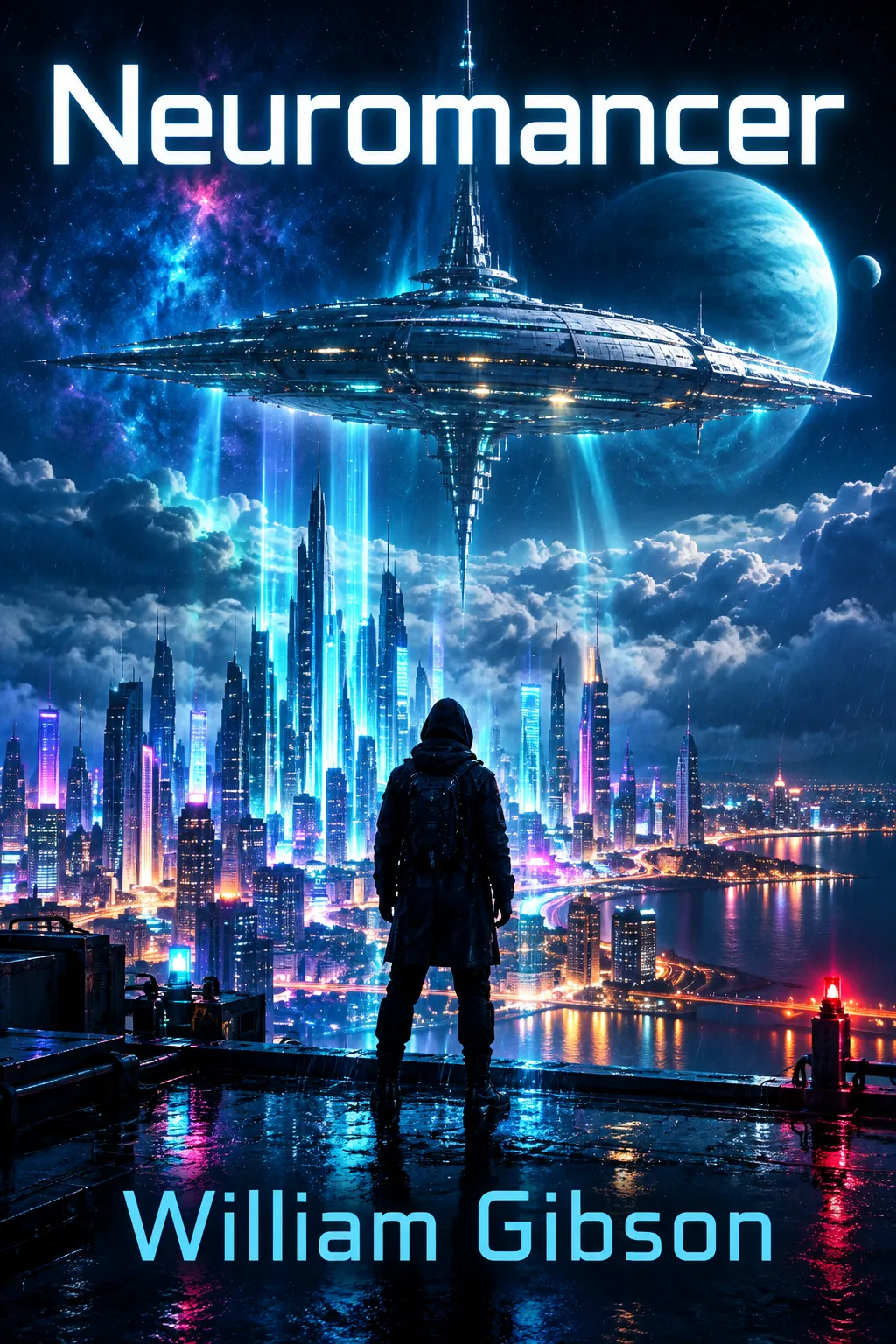
William Gibson is an American-Canadian writer, born in 1948, who helped create cyberpunk and gave the world the word “cyberspace”. His first novel, Neuromancer (1984), pictured the computer network as a place you could enter, years before most people had email.
He did not come from a computer background. He wrote his early stories on a manual typewriter, and he has often said he cares more about how technology feels to live with than about how it works.
That focus is why his books still read well. He wrote about a world where technology is everywhere, a little grubby and mostly owned by corporations, and many readers now recognise it.
Below you will find his life, his main books, what he got right and wrong, and where to start. He is part of our History of Science Fiction series.
Early life: from South Carolina to Vancouver
Gibson was born on 17 March 1948 in Conway, South Carolina. His father died when he was a young child, and his mother moved the family to the small town of Wytheville, Virginia.
He was a bookish teenager who read science fiction paperbacks, and later the Beat writers, especially William S. Burroughs. Both left a mark on his dense, jumpy prose.
In 1968 he moved to Canada, reportedly to avoid the Vietnam War draft. He settled in Vancouver and studied English at the University of British Columbia, graduating in 1977.
His first published story, “Fragments of a Hologram Rose”, appeared in 1977. He still lives in Vancouver.
Where the word “cyberspace” came from
The word that made Gibson famous first appeared in print in his short story “Burning Chrome”, published in Omni in 1982. He has said he picked it because it sounded good and meant almost nothing yet.
He has also described watching teenagers in video arcades, so absorbed that they seemed to believe in the space inside the screen. That image helped him imagine a shared digital space.
Other early stories include “Johnny Mnemonic” and “The Gernsback Continuum” (both 1981). They were collected in Burning Chrome in 1986.
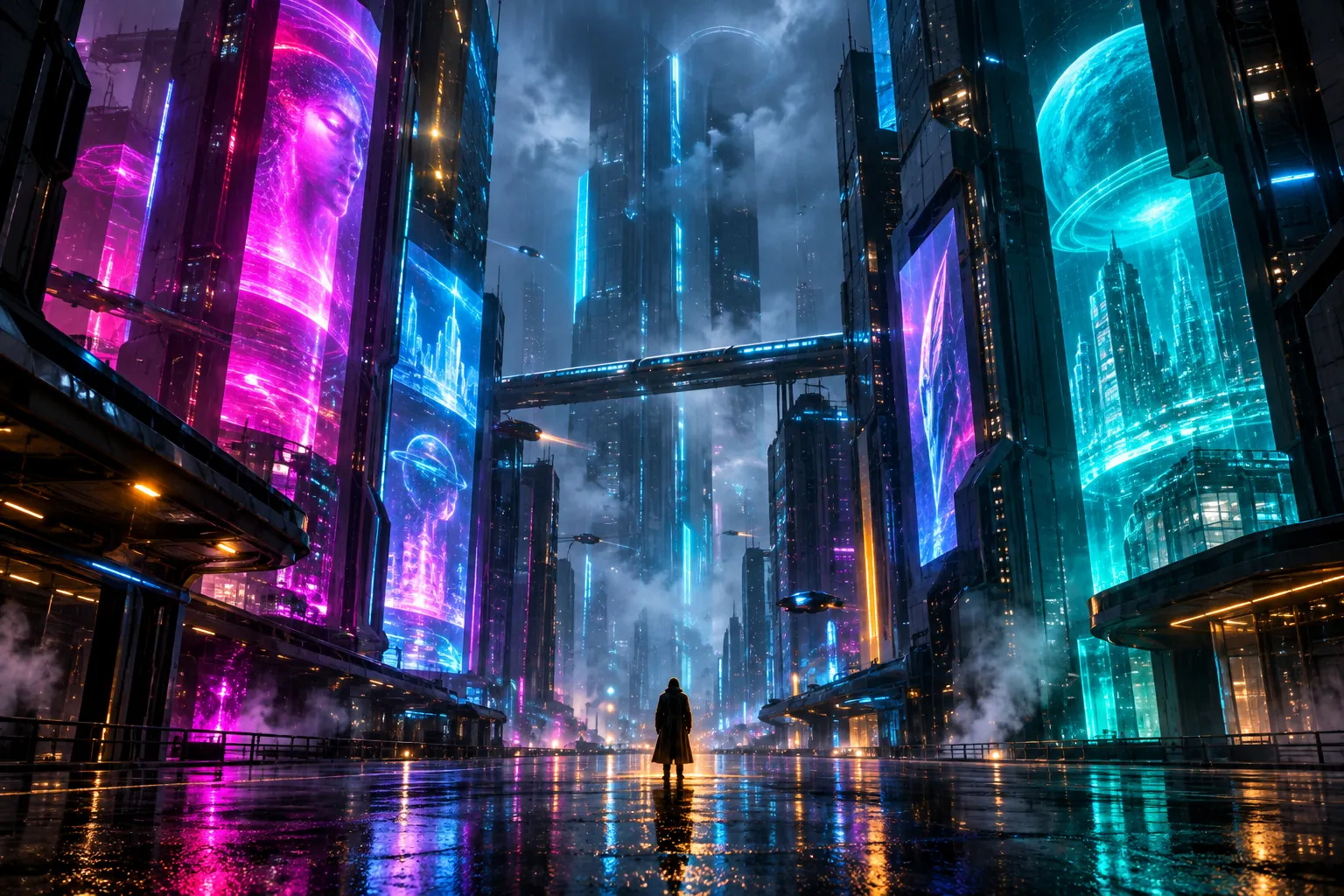
At the time, much science fiction was about starships and distant futures. Gibson moved the setting to a neon-lit, corporate, computerised world that looked like a stretched version of the present.
The phrase “high tech, low life” is often used to sum up the cyberpunk mood that grew from this.
Neuromancer (1984)
Neuromancer was Gibson’s first novel, published in the Ace Specials series. It is widely described as the first novel to win the Hugo, the Nebula and the Philip K. Dick Award.
Its hero, Case, was once a gifted hacker but has been damaged so that he can no longer enter the network. A mysterious employer offers to fix him in exchange for a dangerous job.
The book defines cyberspace as a “consensual hallucination” shared by operators around the world (chapter 3). The opening line sets the tone: “The sky above the port was the color of television, tuned to a dead channel.”
(chapter 1)
The style is dense and fast, and it rarely stops to explain. Readers follow the mood and the tension first, and the terms later.
Part of the story takes place in Chiba City, Japan, which Gibson uses as a symbol of high technology. For plot and characters, see our Neuromancer study guide.
After Neuromancer: the Sprawl, the Bridge and the present day
Neuromancer is the first book of the Sprawl trilogy. Count Zero (1986) and Mona Lisa Overdrive (1988) widen the same world.
In 1990 he co-wrote The Difference Engine with Bruce Sterling, an alternate Victorian Britain where Charles Babbage’s mechanical computers were built and used.
The Bridge trilogy followed in the 1990s: Virtual Light (1993), Idoru (1996) and All Tomorrow’s Parties (1999). They are set in a near future that includes California and Tokyo.
In 1993 he also wrote a famous magazine essay for Wired about visiting Singapore, “Disneyland with the Death Penalty”.
In the 2000s his style changed. Pattern Recognition (2003), Spook Country (2007) and Zero History (2010) are set almost in the present day, and deal with advertising, brands, surveillance and location tracking.
He returned to the future with The Peripheral (2014) and Agency (2020). The Peripheral became a television series in 2022.
The 1995 film Johnny Mnemonic, based on his short story, was written by Gibson himself. He has also published a non-fiction collection, Distrust That Particular Flavor (2012).
The real science: what he got right and wrong
Gibson was not trying to predict the future. He took the technology and the social trends of the early 1980s and stretched them until they looked strange.
What he got right is mostly the atmosphere. He saw a world-wide network, information as a source of wealth, large companies controlling it, and hacking and data theft as everyday threats.
The real internet works very differently. It is built on packet switching and the TCP/IP protocols, and it became part of ordinary life when the web spread in the 1990s.
Nobody jacks a brain into it. Brain-computer interfaces are real in medical research, where they help paralysed people control a cursor or a device, but they are far from the free plug-in of the novels.
He also missed some things. The world of Neuromancer has almost no pocket-sized personal communication devices, and nothing like the smartphone.
A fair summary is that he often got the feel of the networked world right, and the shape of the machines wrong.
Where his ideas show up in fiction
Gibson’s imagery shaped how later films, games and novels showed networks. The film The Matrix (1999) is often named as one example.
Bruce Sterling’s anthology Mirrorshades (1986) gathered the cyberpunk writers of the period, and Gibson is one of its best-known names. For the wider movement, read our Cyberpunk article.
Common misconceptions
“Gibson invented the internet.”
He did not. Researchers and engineers built the technology, while Gibson supplied a word and a picture that made it easy to imagine.
“He started cyberpunk alone.”
Cyberpunk was a group movement. The word comes from a 1983 story title by Bruce Bethke, was spread by editor Gardner Dozois, and writers such as Sterling, Pat Cadigan, John Shirley and Rudy Rucker were part of it.
“He was a computer expert.”
He was not. He has said he knew little about computers when he wrote Neuromancer, and he used a manual typewriter.
“He only wrote 1980s cyberpunk.”
His books from Pattern Recognition onward are mostly present-day thrillers, and his most recent novels return to the future with a different tone.
Read next
Start with Neuromancer, then try the short stories in Burning Chrome and, if you prefer a present-day setting, Pattern Recognition.
The Cyberpunk article explains the movement around him, and the History of Science Fiction hub shows where he fits in the genre.