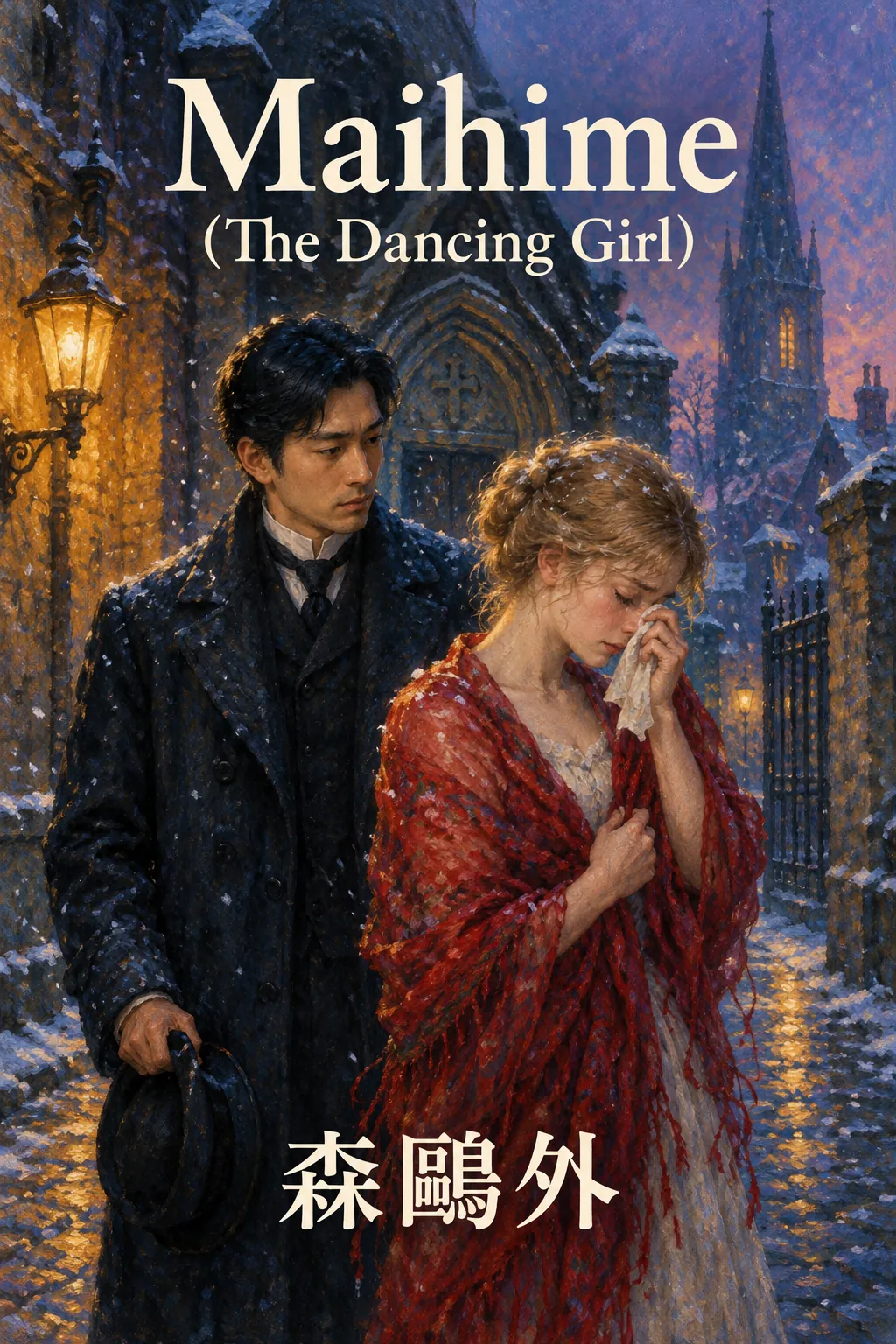
Maihime (The Dancing Girl)
by 森鷗外
Maihime (The Dancing Girl) is a short story by Mori Ogai, published in 1890, about Ota Toyotaro, a young official sent to study in Germany. In Berlin he meets Elis, a poor dancer, and begins to live by his own wishes instead of his superiors' orders. The story is told as a diary written on the voyage home, in classical Japanese. Its central question is whether love or career will win, and what Toyotaro owes to each.
The Big Idea
"A Japanese government student in 1880s Berlin finds his own will, falls for a young dancer, and is pulled between love and career. Maihime asks what it costs to become an individual."
Key Insights
The awakening of the individual
In Berlin, Toyotaro realises that his earlier success came from doing what others expected. He begins to read, think and love on his own terms. Maihime is often read as an early Japanese story about modern selfhood, the idea that a person has wants and values that belong to them alone.
On an exam, a question about how Toyotaro changes in Berlin is usually answered by contrasting the obedient student of the first part with the man who helps Elis because he wants to. Use both moments as evidence.
Love against career
Elis offers Toyotaro a private life that he chose himself. The state, his mother's hopes and his own ambition offer a public life with status. The story does not pretend the two can be combined, and Toyotaro ends up failing both.
Aizawa's visit is the point where the conflict becomes explicit. In an essay, explain what love and career each stand for before judging which Toyotaro should have chosen, so that your argument rests on the text and not on opinion alone. Remember that his choice happens inside a Meiji system that expected loyal service.
A narrator who lets things happen to him
Toyotaro rarely chooses outright. He slides into living with Elis, accepts the Count's offer on the spot, and at the end blames his friend rather than himself. The story invites readers to notice the gap between what he does and how he tells it.
The final lines are a good test. Does the line about hatred show honest self-knowledge, or an excuse? Strong answers weigh both readings and point to the words that support each. Compare the good friend sentence just before it.
A diary, classical prose and a limited view
The story is a first-person diary written in elegant classical Japanese. Everything we know about Elis and Aizawa comes from Toyotaro, so his version of events cannot be taken at face value. The formal style also gives his regret a solemn, almost ceremonial weight.
When you write about the story, say who is speaking and what they might leave out. For instance, Elis speaks only a few times, and each time her words cut through the narrator's tidy account. This is a useful habit for any narrated text.
Chapter Breakdown
Part-by-part summary
Spoiler warning: this section covers the whole plot, including the ending.
Maihime has no chapter titles, so we divide it into seven natural parts.
Part 1: A ship at Saigon
The ship has finished loading coal in the harbour at Saigon, and the other passengers have settled for the night.
Toyotaro sits alone in his cabin and decides to write down what happened to him in Germany.
This is not a travel diary. It is a confession that he has carried for years.
Opening with the return voyage tells us from the first line that he is going home having lost something.
The frame turns the whole story into a memory told with regret.
Part 2: A model student in Berlin
Toyotaro lost his father young and was raised by a mother who put all her hopes in him.
He finished university with an excellent record, joined a government office and was chosen to study in Germany.
In Berlin, the free air makes him doubt whether his obedient life was really his own.
He drifts from his official studies towards literature and history, and away from his fellow Japanese students, who find him cold.
He is still a loyal official on paper, but inwardly he has started to ask what he wants.
This change of heart is the seed of everything that follows.
Part 3: Meeting Elis on Klosterstrasse
One evening Toyotaro finds a young girl crying at the gate of an old church on Klosterstrasse.
She is Elis, a dancer at a theatre, and her father has just died, leaving no money for a funeral.
Toyotaro helps her as far as he can.
For the first time he is kind to someone for no official reason.
He begins to visit her home, and a close friendship grows.
Elis's world of rehearsals, rent and small kindnesses is far from the offices and lecture rooms he knows.
Part 4: Dismissal and a new life
Rumours that Toyotaro is spending time with a dancer reach his superior through the other students.
He is dismissed from his post and loses his government support.
Around the same time he learns that his mother has died.
With no job and no way home, he moves in with Elis and her mother, and earns a little as a newspaper correspondent.
He has found real warmth, but he knows he has closed the door to a career.
The household runs on small wages and shared trust.
Part 5: Aizawa and Count Amakata
After a while his old friend Aizawa Kenkichi arrives in Berlin as secretary to Count Amakata, a senior minister.
Aizawa admires Toyotaro's talent and urges him to leave Elis and return to the world of official careers.
Toyotaro does not agree at first, but the words stay with him.
Introduced to the Count, he is given translation work and wins his trust, and he travels with him to Russia.
For the first time in years he is treated again as a useful man.
That feeling makes the next choice harder to resist.
Part 6: A promise in the snow
When he comes back from Russia, Elis is expecting a child.
The Count now tells Toyotaro to return to Japan with him, and Toyotaro, caught between duty and fear, agrees on the spot.
Walking home through the snowy streets, he realises what he has promised and collapses in the road.
He spends weeks in a fever while Elis nurses him day and night.
He has not yet found the courage to tell her, and the story stresses that he did not so much decide as let himself be carried along.
Part 7: Elis's breakdown and the voyage home
While Toyotaro lies ill, Aizawa visits Elis and tells her that he is going back to Japan.
Elis, who trusted him completely, is overwhelmed by the betrayal and loses her sanity.
When Toyotaro recovers, the woman he knew is gone, and doctors say she is unlikely to get better.
He leaves money with her mother and sails for Japan.
Back in the cabin at Saigon, he calls Aizawa a rare and good friend, yet admits that a thread of hatred for him remains.
The ending shows a narrator who still cannot take full responsibility for what happened.
Characters
- Ota Toyotaro: the narrator, an obedient high achiever who discovers his own wishes in Berlin but cannot hold on to them under pressure.
- Elis: a poor young dancer who supports her mother and trusts Toyotaro completely, which makes her fate so painful.
- Aizawa Kenkichi: Toyotaro's practical old friend and the Count's secretary, who wants to save his career and unwittingly destroys Elis's hope.
- Count Amakata: a senior minister who values Toyotaro's skills and stands for the state's expectations.
- Elis's mother: a practical woman worried about money and her daughter's future, who takes Toyotaro in.
- The other Japanese students: fellow students whose gossip leads to Toyotaro's dismissal and who stand for the watching eye of the institution.
- Toyotaro's mother: a widow whose hopes rest on her son, seen only in memory, who makes family duty feel heavy.
Reading classical Japanese
Maihime is written in the formal literary style of Meiji Japan, so the grammar looks different from modern Japanese.
A few forms help: tsu and nu mark completed actions, keri marks a past event or a sudden realisation, and beshi means must, will or should.
Missing subjects are common, so keep asking who is acting.
Reading the plot summary first makes the original much easier to follow.
What exams ask
Teachers usually test feelings (what Toyotaro feels and why), reasons (why he was dismissed, or why he could not refuse Aizawa), the last sentence, and some vocabulary and grammar.
For short written answers of 60 or 100 characters, build the sentence as situation, feeling and reason.
Writing about this book
For a reflection or essay, keep the plot short and spend your words on one choice.
Three approaches work well.
- Sympathy: connect Toyotaro's wish to please others with a time you did what was expected instead of what you wanted.
- Criticism: ask why he could not make a different choice, and what he should have said to Elis.
- Elis's view: imagine how it feels to be told nothing and to learn the truth from someone else.
In every case, quote one short phrase from the text and then move to your own idea.
The title is also worth a thought: the dancer of the title is Elis, yet the story is about the man who tells it.
Ask what that gap says about whose story this is.
Finish with how your view of the story changed while reading.
The model answers below are learning examples. Compare them with your own work and never submit them as yours.
Take Action
Practical steps you can implement today:
-
Before reading the original, list the story in seven steps: voyage, Berlin, Elis, dismissal, Aizawa, the promise, the collapse. Classical Japanese becomes easier when you know the plot.
-
For feeling questions, name three things: whose expectation, what Toyotaro feels, and what he does. Then find one phrase from the text to support each.
-
Treat the last lines as an open question. Write one sentence for each reading, honest confession or self-defence, and decide which the text supports better.
-
In a reflection, keep the plot short and spend most words on one choice Toyotaro makes and how it compares with a decision in your own life.
Notable Quotes
"“The coal has already been loaded.” (Part 1, the opening line)"
— 森鷗外
"“My Toyotaro, have you deceived me so completely?” (Part 7, Elis)"
— 森鷗外
"“A friend as good as Aizawa Kenkichi will be hard to find again.” (Part 7)"
— 森鷗外
"“Yet one thread of hatred for him still remains in my mind to this day.” (Part 7)"
— 森鷗外
Who Should Read This
Students who study Maihime in Japanese high-school literature classes, readers of Meiji literature, and anyone who wants to understand how Japan's first modern writers dealt with Western ideas of the individual. It suits upper-secondary and university readers, and the plot summary helps even if the classical prose is hard going.
Characters
Ota Toyotaro
protagonist and narrator
A high-achieving government student who has always done what he was told. In Berlin he discovers his own wishes, but he cannot hold on to them when pressure comes. He writes his story afterwards, in regret.
Elis
love interest and tragic figure
A poor, young dancer who works in a theatre and supports her mother. She is sincere, affectionate and fully trusting. Her trust is what makes the ending so painful, and she never understands the world of ministries that takes Toyotaro away.
Aizawa Kenkichi
friend and foil
Toyotaro's old friend, now secretary to Count Amakata. Practical and loyal, he wants to save Toyotaro's career. His honesty with Elis causes a collapse he may not have intended, and Toyotaro both thanks and resents him.
Count Amakata
authority figure
A senior minister who values Toyotaro's language skills and wants him to come back to Japan. He is less a villain than the face of the state's expectations. He appears mostly through his decisions.
Elis's mother
supporting character
A practical woman who worries about her daughter's future and the household's money. She takes Toyotaro in and later receives his support when he leaves. She shows the ordinary poverty around Elis.
The other Japanese students
group of antagonists
Fellow students in Berlin who dislike Toyotaro's independent habits. Their gossip reaches his superior and leads to his dismissal. They stand for the watching eye of the institution and never appear as individuals.
Toyotaro's mother
background figure and symbol of duty
A widow whose hopes rest on her son. She is seen only in memory and through the news of her death, but her expectations shape Toyotaro's sense of duty. She makes the weight of family obligation real.
Exam practice: sample answers
Model answers are examples to learn from; write your own in your words.
character feeling and reason explanation
1. At the end of Maihime, Toyotaro writes that a trace of hatred for Aizawa still remains in his mind. Why does he write this? Explain his feelings with reference to the whole story.
Outline
- Identify who he means (Aizawa) and what Aizawa did for him and to Elis.
- Note Toyotaro's own choice: he agreed to return to Japan without telling Elis.
- Explain why gratitude and hatred can exist together.
- Link the sentence to the theme of individual will and social expectation.
Basic Model answer
Toyotaro says that Aizawa is a very good friend, but he also still hates him a little. Aizawa wanted to help Toyotaro by sending him back to a good career in Japan.
But Aizawa also told Elis the truth, and she lost her mind. Toyotaro is grateful for the help and angry about the result.
So he has two feelings at once. He is sad about Elis and cannot forget what happened.
I think the last sentence shows how sorry he is. He also agreed to go back to Japan himself, so part of the blame is his.
These mixed feelings are written at the very end of the diary, where his regret is strongest.
Good Model answer
Toyotaro writes about his lingering hatred because Aizawa is both his rescuer and the person who set Elis's collapse in motion. Both feelings are real, and the sentence holds them together.
First, Aizawa is a true friend. He found Toyotaro, who had been dismissed and was working as a journalist, and introduced him to Count Amakata, which reopened his career.
Toyotaro admits that such a friend is hard to find.
Second, Aizawa told Elis that Toyotaro was going home while Toyotaro lay ill. Elis, who had trusted him, lost her sanity, so the same friend who saved Toyotaro's future also destroyed the person he loved.
Third, the hatred is not only about Aizawa. Toyotaro had agreed to return to Japan on the spot, without asking Elis.
By blaming Aizawa he can push some of that guilt away from himself.
The sentence therefore shows gratitude, grief and an unwillingness to face his own weakness. Notice how his words good friend and hate sit side by side.
It comes at the end of the diary, so it also tells the reader that his regret has not faded. Whether this is honest confession or a quiet excuse is open to debate, but either way the story ends in unresolved feeling.
Excellent Model answer
The closing sentence of Maihime looks like a remark about a friend, but it is really the narrator's most revealing moment: he praises Aizawa and admits hatred in the same breath, and the contradiction shows how far he is from taking full responsibility.
The case for gratitude is strong. Aizawa found Toyotaro after his dismissal, introduced him to Count Amakata and gave him back a career.
Toyotaro calls him a friend of a kind not easily found again.
The case for resentment is just as clear. While Toyotaro lay feverish, Aizawa told Elis he was leaving, and her mind gave way.
Her words that Toyotaro had deceived her so completely make the harm impossible to forget.
Yet the hatred cannot rest on Aizawa alone. Toyotaro, who in Berlin had discovered his own will, agreed to follow the Count home on the spot, and collapsed in the snow because he knew what he had done.
Aizawa only delivered a decision that Toyotaro had already made and kept hidden from Elis.
Moving the blame outward is therefore a psychological defence. It lets him keep the self-image of a man to whom things happened.
Form supports this reading. The sentence ends in a classical form that suggests a speaker noticing something he must admit, so the hatred is stated almost as a discovery.
Because the whole story is a diary, we also hear only Toyotaro's account, and we must ask what the narrator leaves out.
Historical context matters as well. A Meiji student sent abroad at state expense was expected to return and serve, so his dilemma is not purely personal but is produced by a system that rewards obedience.
In sum, the sentence expresses gratitude, grief and evasion at once. It is honest in naming the feeling and evasive in directing it at the wrong target, and that tension is the story's final statement about the difficulty of being an individual.
A strong exam answer would state this thesis in the first sentence, split the causes into three reasons, and tie them back to the theme of individual will against social expectation.
For a 100-character Japanese answer, one clause each for Aizawa's act, Toyotaro's choice and his mixed regret is enough.
Marking rubric
- Correctly identifies Aizawa and what he did.
- Mentions Toyotaro's own choice to go home.
- Explains why gratitude and hatred coexist.
- Uses at least one phrase or event from the text as evidence.
- Connects the answer to the theme of individual will.
Now write your own
Write your own answer in 100 words, then compare it with the three samples and check which elements you are missing.
reflection or reading response (learning example)
2. Write a reflective response to Maihime about Toyotaro's choice, connecting it to an experience of your own.
Outline
- Open with your first reaction to the story.
- Pick one scene and explain what it shows.
- Connect it honestly to something in your own life.
- End with what you learned or will do differently.
Basic Model answer
I felt sorry for Toyotaro when I read Maihime. He studied hard to please his mother and his bosses, but in Berlin he met Elis and wanted to follow his own heart.
In the end his friend Aizawa told him to go home, and he agreed. I wish he had decided for himself.
I have also done things only because other people wanted them, and I felt bad afterwards.
The story taught me that I should think about what I really want. I would like to speak up more often when I have to make a choice.
I also felt sad for Elis, because she did nothing wrong. I think many students can understand his pressure.
Good Model answer
What stayed with me most in Maihime was how easily Toyotaro is carried along. In Berlin he discovers his own will and loves a poor dancer, yet when his friend Aizawa and Count Amakata offer him a way back to a career, he agrees at once.
At first I wanted to blame him for not choosing Elis. As I read on, I saw the weight he carried: his mother's hopes, his duty as a government student and his chance to regain a lost position.
Even so, I cannot fully excuse him. When he agreed to go home, he did not tell the person who mattered most.
Elis learned the truth from someone else and lost her mind.
I recognise a smaller version of this in myself. Once I hid my real opinion from a friend because I wanted to meet other people's expectations, and the secret stayed heavy in me for weeks.
The scene where he collapses in the snow after agreeing shows that his body knew the choice was wrong before his mind did. When Toyotaro says at the end that hatred for Aizawa remains, I felt that he was avoiding his own regret, as I once did.
Maihime taught me that important decisions should be shared with the people they affect. Next time my wishes and others' expectations differ, I will say what I really think before I decide.
Excellent Model answer
When I first met the opening line of Maihime, a short sentence saying that the coal had been loaded, I was put off by the stiff classical style. By the end I thought the formality suited a man who is trying to write down something he cannot undo.
What moved me most was that Toyotaro neither chooses Elis nor leaves her cleanly. In Berlin he starts to question his role as a useful tool for others, and he loves Elis as a free person.
Yet when offered a return to his career, he accepts it before he has even spoken to her.
My first reaction was anger. Then I thought of a time I answered a teacher with I'm fine about my future when I was actually unsure, and let other people's hopes decide for me.
I called that a decision, but it was a drift.
There is one important difference, though. My drift mostly affects me, while his silence destroyed Elis.
Her cry that Toyotaro had deceived her so completely shows how deeply secrecy can wound.
The ending taught me more. He calls Aizawa a rare friend and still admits he hates him.
I read this as the human habit of looking for someone to blame when regret becomes too heavy. His diary is both honest and slippery, and that mixture is why I believe the story is still read.
I also noticed the title. The dancer is Elis, but the story belongs to the man who narrates, so we only see her through his eyes.
That made me want to reread the story asking what she might have said.
Finally, Meiji Japan expected a state-funded student to come back and serve. His dilemma was personal, but it was also made by a system, and today's pressure from school or family is a lighter version of the same thing.
My view of Toyotaro moved from he is weak to I am not so different. The lesson I take is to speak honestly to those who will be affected before I let expectations choose for me.
That is also why I think a reflection on this book should end with a promise to act, not only an opinion.
Marking rubric
- Specific scene or phrase from the book.
- Honest personal connection that is more than a general statement.
- A visible change or development in the writer's view.
- Clear paragraphs and a closing lesson.
Now write your own
Choose one scene from Maihime and one experience of your own, then write your own reflection in your own words instead of copying a sample.
Frequently Asked Questions
What is Maihime about?
Spoiler note: this answer covers the ending. Maihime follows Ota Toyotaro, a Japanese government student in Berlin, who falls in love with a poor dancer called Elis. Under pressure from friends and officials he chooses to return to Japan and his career, and Elis loses her mind. The story is his diary on the voyage home.
Who wrote Maihime and when?
Mori Ogai wrote it after returning from four years of study in Germany, and it appeared in the magazine Kokumin no Tomo in January 1890. It is the first of his three early German stories, followed by Utakata no ki and Fumizukai. Ogai died in 1922, so the Japanese text is in the public domain.
Who are the main characters in Maihime?
The core trio is Ota Toyotaro (the narrator), Elis (the dancer) and Aizawa Kenkichi (his friend and Count Amakata's secretary). Count Amakata, Elis's mother, the other Japanese students and Toyotaro's mother shape events from the background. Our character list gives each a short profile.
What are the main themes of Maihime?
The central themes are the awakening of the individual, the clash between love and public duty, and the way a narrator can excuse himself. The classical style and diary form add a sense of regret. These are also the main points to use in essays.
Is Maihime hard to read, and how can I study it?
The classical Japanese is the main difficulty. Learn the plot first, then read the original in short sections and note the forms tsu, nu, keri and beshi. For a 60- or 100-character answer, aim for situation, feeling and reason in a single sentence.
Check Your Understanding
Pick an answer for each question to see if you were right.
-
Who wrote Maihime?
Mori Ogai — Mori Ogai published it in 1890, drawing on his own years of study in Germany.
-
Where is Toyotaro when he begins writing his diary?
A ship in the harbour at Saigon — The story opens on the voyage home, with the ship loading coal at Saigon.
-
Where does Toyotaro first meet Elis?
Near the gate of an old church on Klosterstrasse — He finds her crying near an old church because her father has died.
-
Why does Toyotaro lose his government post?
Rumours about his relationship with a dancer reach his superior — Other Japanese students report his behaviour, and he is dismissed.
-
How does Toyotaro feel about Aizawa at the end?
He calls him a rare friend but still feels some hatred — The last lines hold praise and hatred together, which is why they are so often discussed.
About 森鷗外
Mori Ogai (1862–1922) was a Japanese army surgeon and one of the leading writers of the Meiji era. He studied in Germany from 1884 to 1888, and that experience shaped Maihime, his first major story, published in 1890. He also wrote the historical stories The Abe Family and Takasebune, and translated widely from German.
Summary Written By

Software Engineer & Writer
Software engineer with a passion for distilling complex ideas into actionable insights. Writes about finance, investment, entrepreneurship, and technology.
View all summaries →Reviews
No reviews yet. Be the first to share your thoughts!
Write a Review
Keep reading
Explore the topic: Culture & the ArtsSummaries

Animal Farm by George Orwell
George Orwell
The animals of Manor Farm revolt against their human owner to create a utopian society based on equality. However, the…

The Outsiders by S.E. Hinton
S.E. Hinton
Ponyboy Curtis and his gang of Greasers clash with the wealthy Socs in a cycle of violence. After a tragic…

The Great Gatsby by F. Scott Fitzgerald
F. Scott Fitzgerald
Nick Carraway enters the orbit of Jay Gatsby, a mysterious millionaire obsessed with reclaiming his past love, Daisy Buchanan. Amidst…

Of Mice and Men by John Steinbeck
John Steinbeck
George and Lennie, two migrant workers during the Great Depression, dream of owning their own land to escape a life…
Articles

What Is Romanticism?
Romanticism was a European and American movement, roughly 1770 to 1850, that put emotion, imagination, nature and the individual above…

The Tale of the Bamboo Cutter
The Tale of the Bamboo Cutter (Taketori Monogatari) tells of Princess Kaguya, a girl found inside a glowing bamboo stalk,…

Ragnarok: the end of the Norse gods
Ragnarök is the end of the world in Norse mythology: a final battle in which gods, giants and monsters destroy…