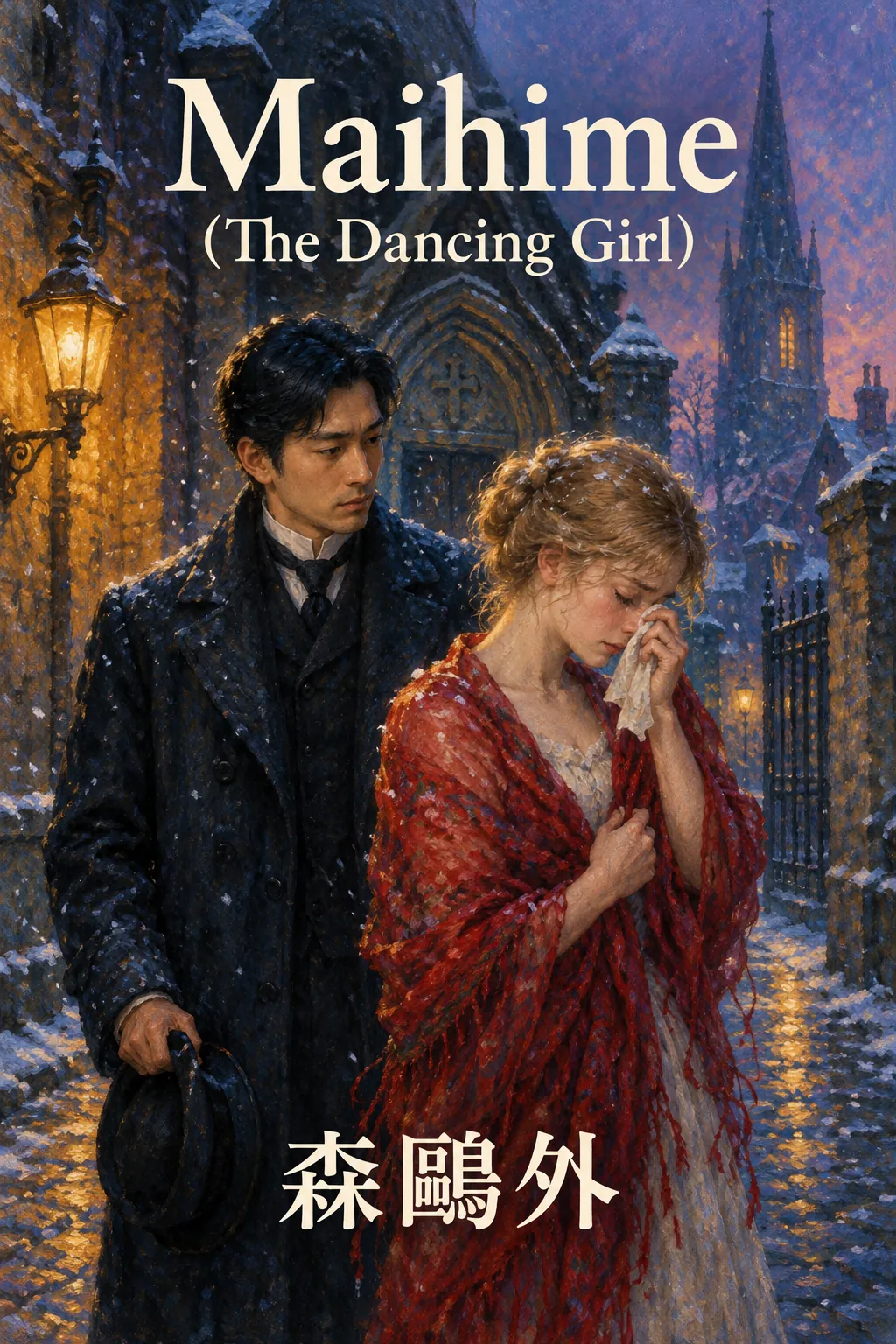
Maihime (The Dancing Girl)
oleh 森鷗外
Maihime (The Dancing Girl) is a short story by Mori Ogai, published in 1890, about Ota Toyotaro, a young official sent to study in Germany. In Berlin he meets Elis, a poor dancer, and begins to live by his own wishes instead of his superiors' orders. The story is told as a diary written on the voyage home, in classical Japanese. Its central question is whether love or career will win, and what Toyotaro owes to each.
Ide Utama
"A Japanese government student in 1880s Berlin finds his own will, falls for a young dancer, and is pulled between love and career. Maihime asks what it costs to become an individual."
Wawasan Utama
The awakening of the individual
In Berlin, Toyotaro realises that his earlier success came from doing what others expected. He begins to read, think and love on his own terms. Maihime is often read as an early Japanese story about modern selfhood, the idea that a person has wants and values that belong to them alone.
On an exam, a question about how Toyotaro changes in Berlin is usually answered by contrasting the obedient student of the first part with the man who helps Elis because he wants to. Use both moments as evidence.
Love against career
Elis offers Toyotaro a private life that he chose himself. The state, his mother's hopes and his own ambition offer a public life with status. The story does not pretend the two can be combined, and Toyotaro ends up failing both.
Aizawa's visit is the point where the conflict becomes explicit. In an essay, explain what love and career each stand for before judging which Toyotaro should have chosen, so that your argument rests on the text and not on opinion alone. Remember that his choice happens inside a Meiji system that expected loyal service.
A narrator who lets things happen to him
Toyotaro rarely chooses outright. He slides into living with Elis, accepts the Count's offer on the spot, and at the end blames his friend rather than himself. The story invites readers to notice the gap between what he does and how he tells it.
The final lines are a good test. Does the line about hatred show honest self-knowledge, or an excuse? Strong answers weigh both readings and point to the words that support each. Compare the good friend sentence just before it.
A diary, classical prose and a limited view
The story is a first-person diary written in elegant classical Japanese. Everything we know about Elis and Aizawa comes from Toyotaro, so his version of events cannot be taken at face value. The formal style also gives his regret a solemn, almost ceremonial weight.
When you write about the story, say who is speaking and what they might leave out. For instance, Elis speaks only a few times, and each time her words cut through the narrator's tidy account. This is a useful habit for any narrated text.
Rincian Bab
Part-by-part summary
Spoiler warning: this section covers the whole plot, including the ending.
Maihime has no chapter titles, so we divide it into seven natural parts.
Part 1: A ship at Saigon
The ship has finished loading coal in the harbour at Saigon, and the other passengers have settled for the night.
Toyotaro sits alone in his cabin and decides to write down what happened to him in Germany.
This is not a travel diary. It is a confession that he has carried for years.
Opening with the return voyage tells us from the first line that he is going home having lost something.
The frame turns the whole story into a memory told with regret.
Part 2: A model student in Berlin
Toyotaro lost his father young and was raised by a mother who put all her hopes in him.
He finished university with an excellent record, joined a government office and was chosen to study in Germany.
In Berlin, the free air makes him doubt whether his obedient life was really his own.
He drifts from his official studies towards literature and history, and away from his fellow Japanese students, who find him cold.
He is still a loyal official on paper, but inwardly he has started to ask what he wants.
This change of heart is the seed of everything that follows.
Part 3: Meeting Elis on Klosterstrasse
One evening Toyotaro finds a young girl crying at the gate of an old church on Klosterstrasse.
She is Elis, a dancer at a theatre, and her father has just died, leaving no money for a funeral.
Toyotaro helps her as far as he can.
For the first time he is kind to someone for no official reason.
He begins to visit her home, and a close friendship grows.
Elis's world of rehearsals, rent and small kindnesses is far from the offices and lecture rooms he knows.
Part 4: Dismissal and a new life
Rumours that Toyotaro is spending time with a dancer reach his superior through the other students.
He is dismissed from his post and loses his government support.
Around the same time he learns that his mother has died.
With no job and no way home, he moves in with Elis and her mother, and earns a little as a newspaper correspondent.
He has found real warmth, but he knows he has closed the door to a career.
The household runs on small wages and shared trust.
Part 5: Aizawa and Count Amakata
After a while his old friend Aizawa Kenkichi arrives in Berlin as secretary to Count Amakata, a senior minister.
Aizawa admires Toyotaro's talent and urges him to leave Elis and return to the world of official careers.
Toyotaro does not agree at first, but the words stay with him.
Introduced to the Count, he is given translation work and wins his trust, and he travels with him to Russia.
For the first time in years he is treated again as a useful man.
That feeling makes the next choice harder to resist.
Part 6: A promise in the snow
When he comes back from Russia, Elis is expecting a child.
The Count now tells Toyotaro to return to Japan with him, and Toyotaro, caught between duty and fear, agrees on the spot.
Walking home through the snowy streets, he realises what he has promised and collapses in the road.
He spends weeks in a fever while Elis nurses him day and night.
He has not yet found the courage to tell her, and the story stresses that he did not so much decide as let himself be carried along.
Part 7: Elis's breakdown and the voyage home
While Toyotaro lies ill, Aizawa visits Elis and tells her that he is going back to Japan.
Elis, who trusted him completely, is overwhelmed by the betrayal and loses her sanity.
When Toyotaro recovers, the woman he knew is gone, and doctors say she is unlikely to get better.
He leaves money with her mother and sails for Japan.
Back in the cabin at Saigon, he calls Aizawa a rare and good friend, yet admits that a thread of hatred for him remains.
The ending shows a narrator who still cannot take full responsibility for what happened.
Characters
- Ota Toyotaro: the narrator, an obedient high achiever who discovers his own wishes in Berlin but cannot hold on to them under pressure.
- Elis: a poor young dancer who supports her mother and trusts Toyotaro completely, which makes her fate so painful.
- Aizawa Kenkichi: Toyotaro's practical old friend and the Count's secretary, who wants to save his career and unwittingly destroys Elis's hope.
- Count Amakata: a senior minister who values Toyotaro's skills and stands for the state's expectations.
- Elis's mother: a practical woman worried about money and her daughter's future, who takes Toyotaro in.
- The other Japanese students: fellow students whose gossip leads to Toyotaro's dismissal and who stand for the watching eye of the institution.
- Toyotaro's mother: a widow whose hopes rest on her son, seen only in memory, who makes family duty feel heavy.
Reading classical Japanese
Maihime is written in the formal literary style of Meiji Japan, so the grammar looks different from modern Japanese.
A few forms help: tsu and nu mark completed actions, keri marks a past event or a sudden realisation, and beshi means must, will or should.
Missing subjects are common, so keep asking who is acting.
Reading the plot summary first makes the original much easier to follow.
What exams ask
Teachers usually test feelings (what Toyotaro feels and why), reasons (why he was dismissed, or why he could not refuse Aizawa), the last sentence, and some vocabulary and grammar.
For short written answers of 60 or 100 characters, build the sentence as situation, feeling and reason.
Writing about this book
For a reflection or essay, keep the plot short and spend your words on one choice.
Three approaches work well.
- Sympathy: connect Toyotaro's wish to please others with a time you did what was expected instead of what you wanted.
- Criticism: ask why he could not make a different choice, and what he should have said to Elis.
- Elis's view: imagine how it feels to be told nothing and to learn the truth from someone else.
In every case, quote one short phrase from the text and then move to your own idea.
The title is also worth a thought: the dancer of the title is Elis, yet the story is about the man who tells it.
Ask what that gap says about whose story this is.
Finish with how your view of the story changed while reading.
The model answers below are learning examples. Compare them with your own work and never submit them as yours.
Ambil Tindakan
Langkah praktis yang bisa Anda terapkan hari ini:
-
Before reading the original, list the story in seven steps: voyage, Berlin, Elis, dismissal, Aizawa, the promise, the collapse. Classical Japanese becomes easier when you know the plot.
-
For feeling questions, name three things: whose expectation, what Toyotaro feels, and what he does. Then find one phrase from the text to support each.
-
Treat the last lines as an open question. Write one sentence for each reading, honest confession or self-defence, and decide which the text supports better.
-
In a reflection, keep the plot short and spend most words on one choice Toyotaro makes and how it compares with a decision in your own life.
Kutipan Menarik
"“The coal has already been loaded.” (Part 1, the opening line)"
— 森鷗外
"“My Toyotaro, have you deceived me so completely?” (Part 7, Elis)"
— 森鷗外
"“A friend as good as Aizawa Kenkichi will be hard to find again.” (Part 7)"
— 森鷗外
"“Yet one thread of hatred for him still remains in my mind to this day.” (Part 7)"
— 森鷗外
Siapa yang Harus Membaca Ini
Students who study Maihime in Japanese high-school literature classes, readers of Meiji literature, and anyone who wants to understand how Japan's first modern writers dealt with Western ideas of the individual. It suits upper-secondary and university readers, and the plot summary helps even if the classical prose is hard going.
Tentang 森鷗外
Mori Ogai (1862–1922) was a Japanese army surgeon and one of the leading writers of the Meiji era. He studied in Germany from 1884 to 1888, and that experience shaped Maihime, his first major story, published in 1890. He also wrote the historical stories The Abe Family and Takasebune, and translated widely from German.
Ringkasan Ditulis Oleh

Software Engineer & Writer
Software engineer with a passion for distilling complex ideas into actionable insights. Writes about finance, investment, entrepreneurship, and technology.
Lihat semua ringkasan →Ulasan
Belum ada ulasan. Jadilah yang pertama berbagi pemikiran Anda!
Tulis Ulasan
Lanjut membaca
Jelajahi topik: Budaya dan SeniRingkasan

Animal Farm karya George Orwell — Ringkasan & Analisis
George Orwell
Hewan-hewan di Peternakan Manor memberontak melawan petani kejam Mr. Jones untuk mendirikan masyarakat utopia berdasarkan kesetaraan. Namun, kepemimpinan babi yang…

The Outsiders oleh S.E. Hinton
S.E. Hinton
Novel ini mengikuti kehidupan Ponyboy Curtis dan kelompok 'Greasers' yang terjebak dalam perang saudara dengan kelompok 'Socs' yang kaya. Melalui…

The Great Gatsby karya F. Scott Fitzgerald — Ringkasan & Analisis
F. Scott Fitzgerald
Diceritakan oleh Nick Carraway, novel ini mengikuti Jay Gatsby, seorang jutawan misterius yang berusaha memenangkan kembali cinta Daisy Buchanan. Di…

tikus dan Manusia oleh John Steinbeck
John Steinbeck
Kisah tentang dua buruh tani migran, George dan Lennie, yang bermimpi memiliki tanah sendiri untuk hidup mandiri. Namun, keterbatasan mental…
Artikel

Apa Itu Romantisisme? Pengertian, Ciri, dan Tokohnya
Romantisisme adalah gerakan seni dan pemikiran di Eropa dan Amerika, kira-kira tahun 1770 hingga 1850, yang menempatkan emosi, imajinasi, alam,…

Kisah Penebang Bambu (Taketori Monogatari)
Kisah Penebang Bambu (Taketori Monogatari) bercerita tentang Putri Kaguya, gadis yang ditemukan di dalam batang bambu yang bersinar. Ia tumbuh…

Ragnarok: Akhir Dunia dan Kiamat Para Dewa Nordik
Ragnarök adalah akhir dunia dalam mitologi Nordik: pertempuran terakhir tempat para dewa, raksasa, dan monster saling membinasakan, bumi tenggelam ke…