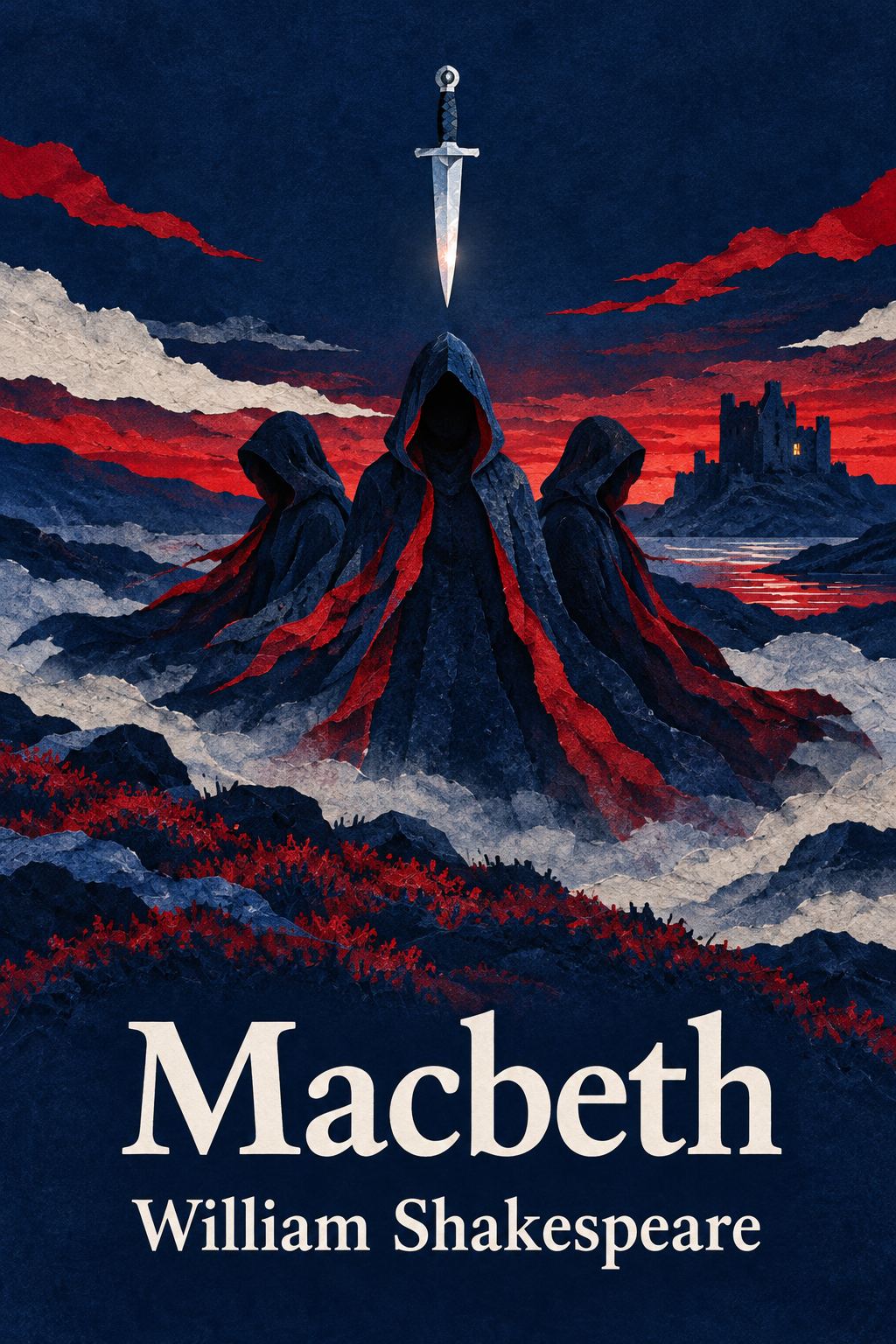
Macbeth
oleh William Shakespeare
Macbeth is a Scottish general who has just won a battle for King Duncan. On a heath, three witches tell him he will become king. Urged on by his ambitious wife, Lady Macbeth, he murders Duncan in his sleep and takes the throne. Fear and guilt then drive him to more killings, and his kingdom slides into chaos. The play asks how far one choice can carry a person, and why guilt can cost more than any enemy.
Ide Utama
"The play argues that ambition, fed by a prophecy and a push from his wife, turns a loyal general into a king who cannot stop killing."
Wawasan Utama
Ambition that feeds on itself
The play argues that ambition is not a single choice but an appetite that grows with each success. Once Macbeth has a crown, he needs to protect it, and protecting it requires more killings. The witches start the process, but his own desire keeps it moving. Readers can ask at which point he could have stopped, and whether anyone around him could have stopped him.
Act 3, Scene 1: Macbeth, already king, decides Banquo must die because Banquo’s descendants might rule. The motive is no longer to win power but to guard what he has already taken.
Guilt that will not wash away
Macbeth’s guilt shows itself almost at once. He sees a dagger, hears a voice that tells him he has murdered sleep, and is haunted by what he has done. Lady Macbeth, who seems so calm at first, falls apart, and her sleep becomes a kind of confession. Shakespeare returns again and again to blood and sleep, so the reader feels how the crime sticks to each character.
Act 5, Scene 1: Lady Macbeth rubs her hands again and again while her doctor and gentlewoman can only watch. The scene shows that her crime now lives in her body and mind, not on her hands alone.
Fate or choice?
The witches seem to decide Macbeth’s future, yet they never order him to kill. The play leaves open whether the sisters only predict what will happen or whether they show Macbeth what he already wants. His choices after each prophecy suggest that the decision was his own. Shakespeare hands that question to the audience, and the answer shifts depending on which act you focus on.
Act 1, Scene 3: the witches greet Macbeth as a future king. When the first part of their promise comes true, the second part starts to feel within reach.
Appearance and reality
From the first scene, the play tells us that things are not what they seem. Macbeth wears the face of a loyal subject and a welcoming host while he plans murder. Lady Macbeth also teaches him to hide his real intentions behind a calm face. The gap between what people show and what they feel keeps the audience uneasy from start to finish.
Act 1, Scene 5: Lady Macbeth advises her husband to show King Duncan a calm, innocent face while hiding what he intends.
Rincian Bab
Chapter-by-chapter summary
Spoiler warning: this section covers the whole plot, including the ending.
Act 1: The prophecy
The play opens on a bleak heath, where three witches agree to meet Macbeth again. Back at the king’s camp, Macbeth and his comrade Banquo have just beaten a rebel lord and an invading army from Norway. King Duncan rewards Macbeth with the title of Thane of Cawdor, which is the same title the witches had already greeted him with before the news arrived. The witches also promised that he would be king. Banquo hears a different prophecy: his own descendants will rule, though he will not. Then Duncan names his elder son, Malcolm, as heir. That closes the road to the throne that Macbeth has been picturing, and it stirs his ambition further. Macbeth writes to his wife, Lady Macbeth, who reads his letter as a plan and begins to shape one. Why it matters: the play’s trouble begins with a thought Macbeth has not yet acted on, and this act shows how easily a promise can turn into a wish.
Act 2: The murder at Inverness
Duncan arrives as a guest at Macbeth’s castle at Inverness. Lady Macbeth has already set the night in motion: she has drugged the king’s guards with wine. Macbeth hesitates, then sees a dagger hovering before him, and he goes to the king’s room. He kills Duncan while the king sleeps, comes back shaken, and brings the bloodied daggers with him. Lady Macbeth takes them and smears the sleeping guards, so they look guilty. Next comes a darkly comic scene in which a drunken porter answers a loud knocking at the gate and jokes about sinners who might end up in hell. Macduff finds the body and raises the alarm. Macbeth kills the guards, claiming he did it in a rage. Duncan’s sons flee, Malcolm to England and Donalbain to Ireland, which makes them look guilty. Macbeth is made king and goes to Scone for his crowning. Why it matters: the play moves from thought to deed, and guilt starts to grow from the very first night.
Act 3: A king who cannot rest
Now king, Macbeth is uneasy. The witches said Banquo’s line would rule, and Banquo is wise, trusted and a threat to Macbeth’s peace of mind. So Macbeth hires murderers to kill Banquo and his son Fleance. The attack kills Banquo, but Fleance escapes. At a feast for his nobles, the ghost of Banquo takes Macbeth’s own seat, and Macbeth’s outbursts startle the guests. Lady Macbeth covers for him, tells the lords to leave at once, and insists that her husband is only unwell. Macbeth speaks of blood calling for more blood, and he decides to visit the witches again. Why it matters: one murder does not end fear. It multiplies it, and his suspicion now reaches everyone close to him.
Act 4: Apparitions and a family’s fate
In a dark cavern, Macbeth meets the three witches around a boiling cauldron. They summon apparitions. An armed head warns him about Macduff. A bloodied child says that no one born of a woman will harm him. A child crowned and holding a tree says he will not be defeated until Birnam Wood moves up to Dunsinane Hill. A line of kings, the descendants of Banquo, then passes by. Macbeth takes comfort from the riddles and does not heed the warning about Macduff. Macduff has already fled to England, so Macbeth’s men murder his wife, his children and his household instead. In England, Malcolm tests Macduff’s loyalty by pretending to be a worse ruler than Macbeth. Then Ross brings Macduff the news of his family’s death. Why it matters: the witches’ promises give Macbeth a false sense of safety, and his cruelty now reaches people who were never part of the plot.
Act 5: Blood that will not wash out
Lady Macbeth, once the stronger voice in the castle, now walks in her sleep at Dunsinane. She rubs her hands together as if trying to wash out a stain. Her doctor and a gentlewoman watch in horror and talk about what they have seen. Later, Macbeth learns that his wife has died; the play gives the news in a few lines and never explains how. Macbeth answers with his famous speech about life as a series of empty days, a moment of bleak despair. Meanwhile, Malcolm’s army advances, and each soldier carries a branch cut from Birnam Wood, so the forest seems to move toward the castle. In the final battle, Macbeth meets Macduff, who reveals that he was not born in the usual way. Macbeth is killed, and Malcolm is named king. Why it matters: the last act ties prophecy, guilt and the cost of power into a single, bleak picture.
Characters
The main Macbeth characters are few, and each one is pulled into the plot by a choice, a fear or a promise.
- Macbeth: A brave general and a man of strong imagination, he is torn between conscience and desire. He hesitates at first, but each crime he commits to protect his position makes him more ruthless, and his fear grows with his power.
- Lady Macbeth: Macbeth’s wife and the play’s driving force behind the first murder. She reads his letter as a plan, calls on dark spirits to strip her of mercy, and later is haunted by guilt, sleepwalking and washing imaginary blood from her hands.
- King Duncan: Scotland’s gentle and trusting king. He honours Macbeth with a new title and visits his castle as a guest. His murder is the first great crime of the play and sets everything else in motion.
- Banquo: Macbeth’s fellow general, who hears the same witches but does not act on their words. His murder, and the ghost that returns at the banquet, mark the turning point in Macbeth’s guilt.
- Macduff: A nobleman who distrusts Macbeth from the start. After his family is murdered, he goes into exile in England and leads the army that will bring Macbeth down.
- Malcolm: Duncan’s elder son, who flees after his father’s murder and returns with English help. He is careful and tests the loyalty of those around him before he takes the throne.
- The three witches: They open the play and offer prophecies that tempt Macbeth. They never give direct commands. Instead, they show him what he already wants to hear.
Writing about this book
Book reports work best when you pick one question and follow it through the play. Good questions include whether Macbeth chooses his crimes or is pushed into them, and whether Lady Macbeth is stronger than her husband. Choose one scene that stayed with you, such as the dagger vision or the sleepwalking scene, and explain why it lingers. Then take each of Macbeth’s major decisions and ask what he feared and what he hoped to gain at that moment. Keep quotations short and always give the act and scene. Write in your own words, and avoid copying summaries or other students’ essays. Finish with a connection to today: ambition and guilt appear in many workplaces, families and political struggles, and a fresh example can make your essay stand out.
Read next: the other great tragedies
Macbeth belongs to Shakespeare’s four great tragedies. To see how he handles power and guilt in another play, read Hamlet or King Lear. Othello, the fourth play in the group, is about jealousy and is a good next step after you finish this one.
Ambil Tindakan
Langkah praktis yang bisa Anda terapkan hari ini:
-
After each big decision Macbeth makes, write down what he gained and what he lost. The pattern shows how each choice creates the need for the next.
-
Read Act 1, Scene 7 aloud and note how Lady Macbeth argues. Decide whether her words are reasons, dares or threats.
-
Track the imagery of sleep, blood and washing through the play. Notice how the same images return as guilt grows.
-
Before forming an opinion, decide whether the witches cause Macbeth’s choices or only reveal them. Then find two lines that support your view.
Kutipan Menarik
"“Stars, hide your fires; Let not light see my black and deep desires.” (Act 1, Scene 4)"
— William Shakespeare
"“Macbeth does murder sleep.” (Act 2, Scene 2)"
— William Shakespeare
"“Blood will have blood.” (Act 3, Scene 4)"
— William Shakespeare
"“Out, damned spot! out, I say!” (Act 5, Scene 1)"
— William Shakespeare
Siapa yang Harus Membaca Ini
Readers aged 14 and up who want to meet Shakespeare for the first time, and students studying the play for a class or an exam. It suits anyone interested in power, guilt or dark stories. The language is old and the play is short, so reading a modern edition with notes helps. This page gives you the shape of the story before you turn to the full text.
Tentang William Shakespeare
William Shakespeare (1564–1616) was an English playwright and poet who wrote for the London theatre companies of his day. His comedies, histories and tragedies are still performed around the world. Macbeth, written around 1606, is one of his four great tragedies.
Ringkasan Ditulis Oleh

Software Engineer & Writer
Software engineer with a passion for distilling complex ideas into actionable insights. Writes about finance, investment, entrepreneurship, and technology.
Lihat semua ringkasan →Ulasan
Belum ada ulasan. Jadilah yang pertama berbagi pemikiran Anda!
Tulis Ulasan
Lanjut membaca
Jelajahi topik: FiksiRingkasan

Out of My Mind
Sharon M. Draper
“Out of My Mind” karya Sharon M. Draper adalah kisah menyentuh tentang kehidupan Melody Brooks, seorang gadis muda penderita cerebral…

Ender’s Game
Orson Scott Card
“Ender’s Game” karya Orson Scott Card adalah novel fiksi ilmiah memikat yang membawa pembaca ke masa depan saat umat manusia…

Pachinko
Min Jin Lee
“Pachinko”, sebuah saga sejarah lintas generasi yang memikat karya Min Jin Lee, mengisahkan perjuangan sebuah keluarga Korea dalam mengarungi gejolak…

The Perks of Being a Wallflower
Stephen Chbosky
The Perks of Being a Wallflower karya Stephen Chbosky adalah novel coming-of-age yang mendalam, dikisahkan melalui surat-surat pribadi Charlie, seorang…
Artikel
Zaman Pencerahan Dijelaskan: Gagasan, Tokoh, dan Warisannya
Zaman Pencerahan adalah gerakan abad ke-18 di Eropa yang menempatkan akal dan bukti di atas tradisi serta otoritas. Para pemikir…
Sejarah Dunia 1700–1918: Revolusi, Industri, Kekaisaran dan Perang
Antara 1700 dan 1918, revolusi, pabrik, kekaisaran, dan perang dunia membentuk ulang masyarakat di Eropa, Amerika, Asia, dan Afrika. Panduan…

Tema A Christmas Carol: kemurahan hati, isolasi dan tanggung jawab
Novela Dickens biasanya dibaca sebagai kisah seorang pria yang mengubah pikirannya. Tema-temanya lebih tajam dari itu: kemurahan hati sebagai praktik,…