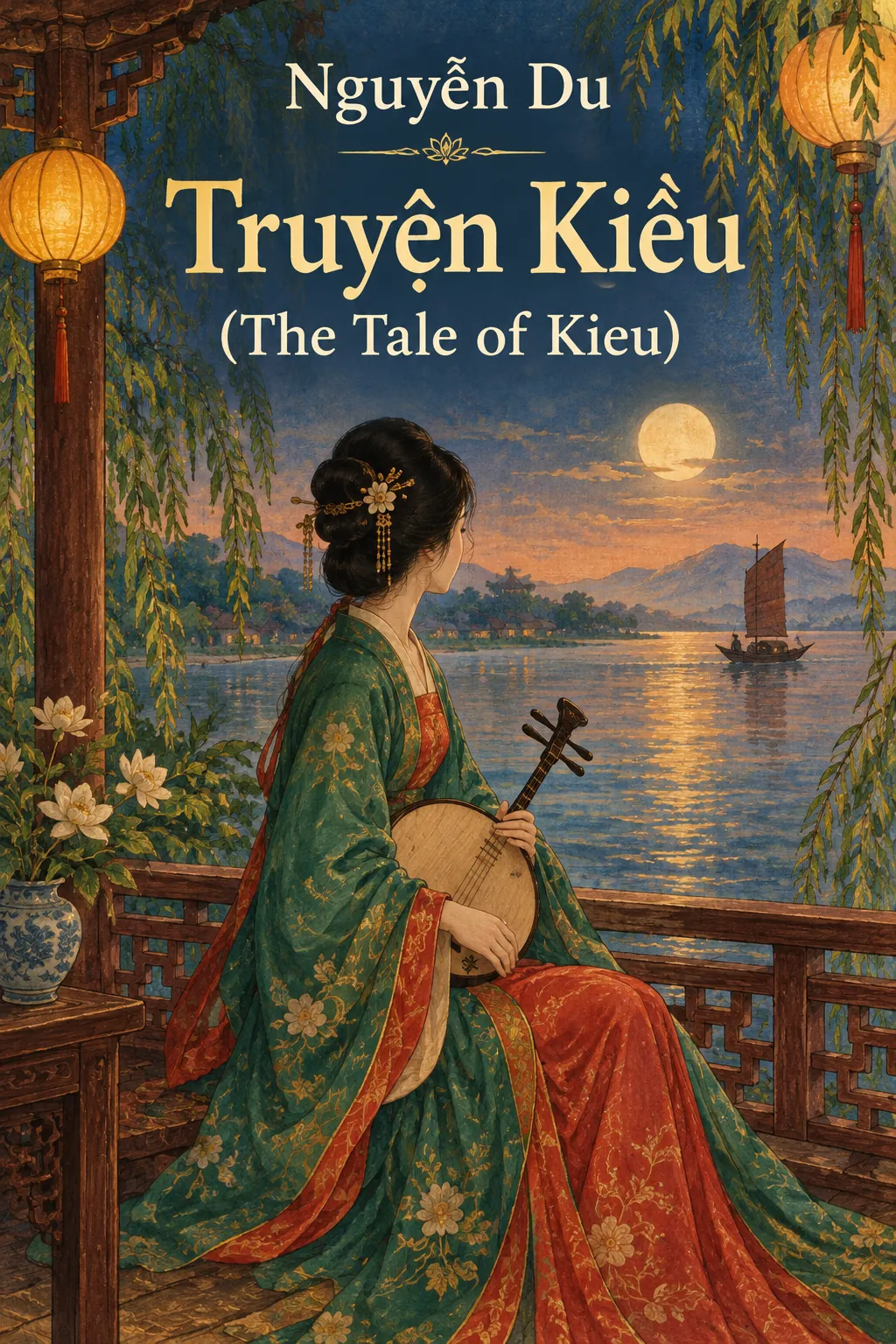
Truyện Kiều (The Tale of Kieu)
by Nguyễn Du
Truyện Kiều is a Vietnamese verse novel of 3,254 lines by Nguyễn Du. It follows Thúy Kiều, a beautiful and talented girl who falls in love with the scholar Kim Trọng. When her family is struck by disaster she sells herself to save her father and is swept into fifteen years of wandering, betrayal and loss. The poem asks why talent and virtue so often meet suffering, and answers with deep compassion for its heroine.
The Big Idea
"Truyện Kiều follows a gifted young woman who gives up love to save her father, then spends fifteen years crushed by money, deceit and power while keeping her goodness."
Key Insights
Talent and fate
The poem opens by saying that talent and fate seem to quarrel, and the whole story tests this idea. Kiều is gifted in every art, yet her gifts are what make her a target for buyers, rivals and rulers. Nguyễn Du does not blame her for this. He shows a world that rarely rewards the best people.
Đạm Tiên's tomb in Part 1 shows the same pattern, since a famous singer ends forgotten and mourned only by strangers.
Filial duty against love
Kiều faces a choice between her father's life and her own happiness, and chooses her father without long argument. In the Confucian world of the poem filial duty comes first, but the poem never hides the price. Nguyễn Du lets the reader feel both the nobility of her choice and the pain it causes.
In Trao duyên she says that duty and love are hard to keep whole together, and then she gives up her vows.
Money and power as villains
The people who hurt Kiều are not simply cruel by nature. Many of them act for money, status or advantage, from the false accuser to the trader who buys her to the official who tricks Từ Hải. Nguyễn Du shows a society where people can be bought and sold, and he treats this as the real source of Kiều's suffering.
Mã Giám Sinh pretends to be a gentleman buyer, but he is only after profit.
Compassion for women who suffer
The poem looks at a woman who is bought, sold and blamed, and it refuses to judge her. It shows that Kiều keeps her kindness, her loyalty and her sense of gratitude through everything. This is why readers speak of Nguyễn Du's nhân đạo, his humane view of people.
After her revenge, Kiều still lets Hoạn Thư go free when the woman speaks to her honestly.
Chapter Breakdown
Chapter-by-chapter summary
Spoiler warning: this section covers the whole plot, including the ending.
The poem has no numbered chapters, so this guide follows its three traditional parts.
Part 1: Meeting and betrothal (Gặp gỡ và đính ước)
The poem opens with the Vương family, a father, a mother, a son and two daughters, Thúy Kiều and her younger sister Thúy Vân. Kiều is the more gifted, admired for her beauty, her poetry, her painting and her music.
At the spring festival of Thanh minh, Kiều weeps at the forgotten tomb of the dead singer Đạm Tiên. On the way home she meets the young scholar Kim Trọng, and the two fall in love.
They meet in secret and swear vows under the moon. Then Kim Trọng must leave to attend a family funeral, and their short happiness ends.
Why it matters: this part sets up the love Kiều will lose and plants the idea that beauty and talent invite misfortune.
Part 2: Disaster and wandering (Gia biến và lưu lạc)
While Kim Trọng is away, a false accusation puts Kiều's father in prison. To raise the money to save him, Kiều sells herself and asks Vân to marry Kim Trọng in her place, in the scene called Trao duyên.
The buyer, Mã Giám Sinh, is really a trader in girls, and he hands her to the brothel keeper Tú Bà. Kiều tries to kill herself, is calmed with false promises and is kept in the Ngưng Bích tower, then tricked by the smooth talker Sở Khanh and forced into the brothel.
The merchant Thúc Sinh buys her freedom and takes her as a second wife. His jealous wife Hoạn Thư brings Kiều into her house as a servant, and Kiều escapes to a convent under the nun Giác Duyên.
A woman who was meant to shelter her instead sells her into a brothel again. There Kiều meets the rebel leader Từ Hải, who frees her and makes her his wife.
When Từ Hải wins power, Kiều repays those who helped her and punishes those who harmed her, though she spares Hoạn Thư after a clever plea. Later the official Hồ Tôn Hiến tricks Từ Hải into surrender and has him killed.
Kiều is forced to marry a minor chief and throws herself into the Tiền Đường river, but Giác Duyên saves her. Why it matters: fifteen years of hardship show a good person ground down by money, lies and power, and the poem asks who is to blame.
Part 3: Reunion (Đoàn tụ)
Kiều lives quietly again under Giác Duyên's care while her family searches for her. Kim Trọng, who married Vân as Kiều asked but never forgot Kiều, finally finds her.
The family is reunited and Kim Trọng proposes marriage. Kiều agrees to a formal union but asks that they stay devoted friends, sharing music and conversation, because she feels her years of hardship make a marriage unfitting.
Why it matters: the ending offers peace rather than a fairy tale, and the closing lines say that the heart, meaning goodness, is worth more than talent.
Two exam excerpts
Trao duyên (Passing on the Love)
Kiều asks Vân to take her place with Kim Trọng and gives her keepsakes of their vows. The passage is a long speech full of bowing, pleading and reasoning that finally breaks into grief for Kim Trọng.
Key points for exams: the request is humble, the dilemma is “duty and love cannot both be whole”, and the monologue form shows her inner pain.
Kiều ở lầu Ngưng Bích (Kiều in the Ngưng Bích Tower)
Tú Bà keeps Kiều in a tower by the sea while she plots to push her into the brothel. Alone, Kiều thinks of Kim Trọng and her parents, then gazes out at the sea.
The last eight lines repeat “buồn trông” (sadly I watch) four times, and each repeat brings a new image: a far sail, a drifting flower, withered grass and roaring waves. Together they trace her fading hope and growing fear.
Characters
- Thúy Kiều: the heroine, talented, devoted to her family and always ready to sacrifice herself.
- Kim Trọng: the scholar she loves, faithful and gentle.
- Thúy Vân: her younger sister, who takes Kiều's place in marriage.
- Vương Viên ngoại: her father, whose arrest sets the tragedy in motion.
- Mã Giám Sinh and Tú Bà: the dealer and the brothel keeper who trade in girls.
- Sở Khanh: the false rescuer who betrays her.
- Thúc Sinh and Hoạn Thư: the kind merchant and his jealous, clever wife.
- Từ Hải: the rebel hero who treats Kiều as an equal.
- Giác Duyên: the nun who shelters and rescues her.
Writing about this book
Most Vietnamese exam questions ask for a nghị luận văn học essay of about 600 chữ on a character or excerpt. Plan it as mở bài, thân bài with two or three clear points, and kết bài.
Quote only a couplet or two, and always explain what the words do. Name devices such as lục bát, tả cảnh ngụ tình, điệp ngữ and độc thoại nội tâm, then say what each one shows about Kiều.
Link the excerpt to the whole poem: Trao duyên starts Kiều's life of sacrifice, and Ngưng Bích shows her loneliness before the next deception. Finish by saying what Nguyễn Du wants readers to feel, which is compassion for people crushed by an unfair world.
The model answers on this page are learning examples at three levels. Compare them with your own writing, then write your own version in your own words.
Take Action
Practical steps you can implement today:
-
Read each part for its main event, then ask what choice the heroine makes and what it costs her.
-
When you analyse a couplet, name the device and explain what it shows about feelings, not just the words.
-
Quote briefly and always comment on the quote in your own words.
-
Link every excerpt back to the whole poem and to Nguyễn Du's compassion.
Notable Quotes
"“A hundred years in a human life: talent and fate, how they love to quarrel.” (Opening lines)"
— Nguyễn Du
"“Sister, will you listen? Sit, and let me bow before I speak.” (Trao duyên)"
— Nguyễn Du
"“Sadly I watch the sea at dusk, a far sail drifting in and out of sight.” (Kiều ở lầu Ngưng Bích)"
— Nguyễn Du
"“Duty and love are hard to keep whole, both at once.” (Trao duyên)"
— Nguyễn Du
Who Should Read This
Students aged about 14 to 18 in Vietnamese schools who need to study Truyện Kiều for Ngữ văn, thi vào lớp 10 or THPT, and English readers who want a clear overview of Vietnam's best-loved poem. No prior knowledge is needed.
Characters
Thúy Kiều
protagonist
The eldest Vương daughter, famed for her beauty and her gifts in poetry, painting and music. She gives up her love to save her father, then lives through fifteen years of sale and betrayal without losing her kindness.
Kim Trọng
lover
A young scholar who falls in love with Kiều and swears vows with her under the moon. He never forgets her and finds her again at the end.
Thúy Vân
sister
Kiều's younger sister, gentler and less brilliant. Kiều asks her to take her place with Kim Trọng, and she marries him.
Vương Viên ngoại
father
Kiều's father, a respected man whose arrest after a false accusation starts the tragedy. His rescue is the reason for Kiều's sacrifice.
Mã Giám Sinh
antagonist
A trader who pretends to be a scholar buyer and takes Kiều from her family. He delivers her to the brothel, which shows how money turns people into goods.
Tú Bà
antagonist
The brothel keeper who buys and controls Kiều. She hides her cruelty behind a soft voice and keeps Kiều in the Ngưng Bích tower.
Sở Khanh
antagonist
A smooth-talking man who pretends to rescue Kiều from the brothel, then betrays her. He stands for false kindness.
Thúc Sinh
supporting character
A merchant who buys Kiều's freedom and takes her as a second wife. He is kind but weak, and he cannot protect her from his wife.
Hoạn Thư
foil
Thúc Sinh's wife, clever and jealous, who plots to bring Kiều into her house as a servant. When Kiều later has power over her, Hoạn Thư's honest plea earns her pardon.
Từ Hải
hero
A rebel leader who frees Kiều and treats her as an equal. He is brave and trusting, and a trick by the official Hồ Tôn Hiến leads to his death.
Giác Duyên
helper
A nun who shelters Kiều in the convent and later saves her from the river. She represents kindness and refuge.
Exam practice: sample answers
Model answers are examples to learn from; write your own in your words.
nghị luận văn học
1. Analyse the excerpt Trao duyên (Truyện Kiều, Nguyễn Du) to show Thúy Kiều's pain and sacrifice.
Outline
- Opening: place the excerpt in the story and state your point.
- Body 1: the humble way Kiều asks, including bowing to her sister.
- Body 2: her reasons, the dilemma between duty and love, and the keepsakes.
- Body 3: the final outburst to Kim Trọng and what it shows.
- Conclusion: the excerpt's value and Nguyễn Du's compassion.
Basic Model answer
Trao duyên shows how far Thúy Kiều will go for her family. Her father is in prison, so she has sold herself, and she asks her younger sister Thúy Vân to marry Kim Trọng in her place.
Kiều begins very politely. She is the older sister, yet she asks like someone begging for help, and she even bows to Vân before she speaks.
She then explains that her love was cut short, and she gives Vân keepsakes to remember it. At the end she cries out to Kim Trọng that she has failed him.
The passage shows that Kiều is loyal to her parents and deeply in love. This is why readers pity her and also admire her.
Good Model answer
In Trao duyên, Nguyễn Du turns a family favour into a scene of heartbreak. Kiều asks Vân to replace her, and every line shows how much this costs her.
First, the way she asks shows she knows the request is unfair. She bows to her younger sister before speaking, reversing the usual order of age in a Confucian household.
Second, she names her dilemma directly: it is hard to keep both duty and love whole. She describes her new love as a carrying-pole snapping halfway down the road, so we see that disaster cut the romance off and duty to her father left her no choice.
Third, she calls the keepsakes shared property and asks Vân to keep the vows. This makes the request sound reasonable, yet it also shows that she cannot let the memories go.
Finally her feelings break through. She turns away from Vân and calls out to Kim Trọng, admitting she has wronged him, so the scene ends in her private grief.
Nguyễn Du uses the flowing lục bát form, a mix of formal and everyday words, and inner monologue to reveal her mind. Kiều is admirable for her sacrifice and pitiable because she keeps loving, and that mixture is why the passage moves readers.
Excellent Model answer
Trao duyên is the moment when Nguyễn Du puts a person at a crossroads with no good way out: to keep her duty as a daughter she must betray her love. The excerpt is powerful because Kiều does what she believes is right, and the price of being right is her own heart.
From the first couplet the tone is unusual. In “Cậy em em có chịu lời / Ngồi lên cho chị lạy rồi sẽ thưa”, the repeated “em” sounds like pleading, and the verb “lạy” reverses the order of elder and younger sister in a Confucian family.
One gesture tells us that what comes next is heavier than any ordinary request.
Her argument is carefully built. She compresses the tragedy into one line, “Hiếu tình khó nói hai bề vẹn hai”, then appeals to family feeling and Vân's youth with “Ngày xuân em hãy còn dài”.
Kiều does not use an elder's authority; she persuades through moral reasoning and sisterly love.
The deeper point is that she hands over her love and yet cannot release it. She gives Vân the “tơ thừa”, the leftover thread, but she immediately recalls the fan she was promised and the night of the vow.
The word “trao” (give) is only on the surface of a loss that cannot be given away.
Her mood then turns to death. In “Chị dù thịt nát xương mòn / Ngậm cười chín suối hãy còn thơm lây” she imagines smiling in the underworld, which sounds like thanks in advance but is really her way of consoling herself that the sacrifice has meaning.
At the end the speaker and listener separate. She stops looking at Vân and calls “Kim lang”, admitting “Thôi thôi thiếp đã phụ chàng từ đây”.
The short, exclamatory rhythm and inner monologue end the passage in her own pain, not in the calm of a duty fulfilled.
Set within the whole poem, Trao duyên begins the fifteen years of wandering. The decision is a pattern for all her later choices: she keeps sacrificing herself for others, and the world keeps returning injustice.
This echoes the opening remark that talent and fate quarrel.
For a modern reader the scene raises a question about sacrifice for family. It is admirable, but a society that lets one person carry the cost alone also deserves questioning.
Nguyễn Du does not condemn Kiều; he only lets us see what her goodness costs her.
So Trao duyên is more than a request for a favour. It is where the art of monologue, refined language and humane vision come together and turn one girl's pain into a shared human voice.
Marking rubric
- States a clear point about Kiều's pain and sacrifice.
- Uses two or three short quotes accurately and comments on them.
- Names at least two techniques, such as dialogue, inner monologue, imagery or lục bát, and says what they show.
- Links the excerpt to the whole poem and ends with Nguyễn Du's compassion.
Now write your own
Write your own answer in about 600 chữ. Use at least two couplets from the excerpt and explain each in your own words before comparing your work with the levels above.
nghị luận văn học
2. Feel and analyse the last eight lines of Kiều ở lầu Ngưng Bích to show Thúy Kiều's state of mind and Nguyễn Du's use of tả cảnh ngụ tình (describing scenery to express feeling).
Outline
- Opening: situate the lines in the excerpt and state your point.
- Body 1: the repeated “buồn trông” and its effect.
- Body 2: the four images of far sail, drifting flower, withered grass and roaring waves.
- Body 3: the language, including reduplicated words and rhythm.
- Conclusion: the value of the passage and Nguyễn Du's compassion.
Basic Model answer
The last eight lines of Kiều ở lầu Ngưng Bích show Thúy Kiều's sadness. She is locked in a tower by Tú Bà and does not know what will happen to her.
The repeated words “buồn trông” appear four times. Each time Kiều looks at something new, and her sadness gets deeper.
First she sees a far sail, which makes her think of home, but it is too far away. Then she sees a flower drifting on the water, which looks like her own life, carried away with no direction.
Next she sees withered grass reaching the horizon, which feels empty. At last she hears waves roaring around her, and she is afraid something bad will come.
Nguyễn Du uses scenery to show feelings very well. This makes readers feel sorry for Kiều.
Good Model answer
The last eight lines of Kiều ở lầu Ngưng Bích record the days when Thúy Kiều is held in the tower, and Nguyễn Du lets scenery speak for her. Instead of making Kiều complain directly, he has her look out at the sea, so each view reflects a mood.
The most striking technique is the repetition of “buồn trông” at the start of four couplets. The repetition works like waves, and with each return the sadness grows deeper.
In the first couplet a sail appears “thấp thoáng” and “xa xa” at dusk. The sail suggests a way home, but because it is so far and faint, hope is only a thin thread.
The second couplet shows a flower drifting “man mác” on the current, and the image suggests Kiều's own fate carried away with no direction. The third shows withered grass, “dàu dàu”, running to the horizon, so the future seems empty with nothing to lean on.
The last couplet is the most violent, with waves roaring “ầm ầm” around her seat. The sound is a warning of disaster, and Kiều is indeed about to be deceived by Sở Khanh.
The reduplicated words paint the scene and carry feeling at the same time, and the gentle lục bát makes the sadness sink in. In short, tả cảnh ngụ tình lets Nguyễn Du express Kiều's heart and his own pity for the unfortunate.
Excellent Model answer
The final eight lines of Kiều ở lầu Ngưng Bích are often taught as a model of tả cảnh ngụ tình, but their real strength is how they move. The scenery is not a fixed backdrop; it grows from faint to fierce as Kiều's mind darkens, until the sea itself seems to close in on her.
The frame is the four-fold “buồn trông”. After Kiều has recalled Kim Trọng and her parents in the preceding lines, a passage of memory turns outward into a gaze at the sea, and the repeated phrase becomes both a refrain and a rising wave.
The first image is “Thuyền ai thấp thoáng cánh buồm xa xa”. The questioning “ai” suggests she does not even know whose boat it is, and “xa xa” keeps home out of reach, so hope appears only to retreat.
The second, “Hoa trôi man mác biết là về đâu”, asks the question Kiều dares not ask herself. The flower is a classic image of a woman's fate, and the unanswered “về đâu” makes her future a blank.
The third, “Nội cỏ dàu dàu”, fills the whole view with a colourless green. The scene is wider than before, and that width is emptiness, not freedom.
Only in the last couplet does the sound turn violent: “Ầm ầm tiếng sóng kêu quanh ghế ngồi”. The waves come close enough to touch her seat, so danger is no longer far away, and this fits the plot because Sở Khanh's trap follows at once.
The movement from far to near, from soft to loud and from dim hope to fear is carried by the language. Reduplicated words such as thấp thoáng, man mác, dàu dàu and ầm ầm set the mood by sound alone.
It also matters whom Kiều is thinking of. She mourns her parents and Kim Trọng before herself, so her sadness is shaped by love, not selfishness.
This is part of Nguyễn Du's humane vision.
Readers today may link this to a broader question: how should we respond to people who are trapped and alone? The poem's answer is compassion without lecturing, and that is why the lines still move us.
Marking rubric
- Identifies the repeated “buồn trông” and explains its effect.
- Explains each of the four images and what feeling it carries.
- Comments on reduplicated words, rhythm or sound.
- Links the lines to Kiều's situation and to Nguyễn Du's compassion.
Now write your own
Pick one of the four images and write a paragraph of about 150 chữ on it. Quote the couplet, name the technique and explain the feeling in your own words.
Frequently Asked Questions
What is Truyện Kiều about?
It tells the story of Thúy Kiều, a talented girl who sacrifices her love to save her father and then lives through fifteen years of sale, betrayal and escape. The poem ends with her reunion with her family and Kim Trọng. Nguyễn Du uses her life to ask why good people suffer.
How many lines does Truyện Kiều have?
The poem has 3,254 lines in the lục bát form, which alternates a six-syllable line with an eight-syllable line. It was written in chữ Nôm, the old script for Vietnamese.
What is the original title of the poem?
Its original title is Đoạn trường tân thanh, often translated as New Cry from a Broken Heart. Most readers simply call it Truyện Kiều or The Tale of Kieu.
What are Trao duyên and Kiều ở lầu Ngưng Bích?
They are two excerpts commonly studied for exams. Trao duyên is Kiều's request that her sister take her place with Kim Trọng, and Ngưng Bích shows her loneliness in the tower where she is held.
How do I write a good essay on an excerpt from Truyện Kiều?
State a clear point in your opening, then use two or three paragraphs, each with a short quote and your own commentary. Name the art techniques and explain what they show, then end with the meaning of the whole poem.
Check Your Understanding
Pick an answer for each question to see if you were right.
-
What is the original title of Truyện Kiều?
Đoạn trường tân thanh — Nguyễn Du's original title is Đoạn trường tân thanh.
-
Who does Kiều ask to take her place in love with Kim Trọng?
Thúy Vân — Kiều asks her younger sister Thúy Vân in the scene of Trao duyên.
-
Which verse form is Truyện Kiều written in?
Lục bát — The poem uses lục bát, alternating six- and eight-syllable lines.
-
Who rescues Kiều when she jumps into the Tiền Đường river?
Giác Duyên — The nun Giác Duyên saves her.
-
What is the effect of the repeated words “buồn trông” in the last lines of the Ngưng Bích excerpt?
It shows her sadness growing deeper — Each repeat opens a new image of loneliness and fear, so the sadness grows.
About Nguyễn Du
Nguyễn Du (1765–1820) was a Vietnamese poet and scholar-official who served under the Nguyễn dynasty. He wrote Truyện Kiều in the chữ Nôm script, and Vietnamese readers honour him as their national poet. UNESCO recognised him as a world cultural figure in 1965.
Summary Written By

Software Engineer & Writer
Software engineer with a passion for distilling complex ideas into actionable insights. Writes about finance, investment, entrepreneurship, and technology.
View all summaries →Reviews
No reviews yet. Be the first to share your thoughts!
Write a Review
Keep reading
Explore the topic: Study GuidesSummaries
Animal Farm by George Orwell
George Orwell
The animals of Manor Farm revolt against their human owner to create a utopian society based on equality. However, the…

The Outsiders by S.E. Hinton
S.E. Hinton
Ponyboy Curtis and his gang of Greasers clash with the wealthy Socs in a cycle of violence. After a tragic…

The Great Gatsby by F. Scott Fitzgerald
F. Scott Fitzgerald
Nick Carraway enters the orbit of Jay Gatsby, a mysterious millionaire obsessed with reclaiming his past love, Daisy Buchanan. Amidst…

Of Mice and Men by John Steinbeck
John Steinbeck
George and Lennie, two migrant workers during the Great Depression, dream of owning their own land to escape a life…
Articles

Kyotsu Test Japanese (共通テスト国語): Time Plan and Strategy
The Kyotsu Test Japanese paper is a 90-minute, 200-point multiple-choice exam with five sections: three modern-text sections, classical Japanese and…

How to Write a Literary Analysis Essay
A literary analysis essay argues one clear claim about how a text works and proves it with short quotations and…
The Tale of the Bamboo Cutter
The Tale of the Bamboo Cutter (Taketori Monogatari) tells of Princess Kaguya, a girl found inside a glowing bamboo stalk,…