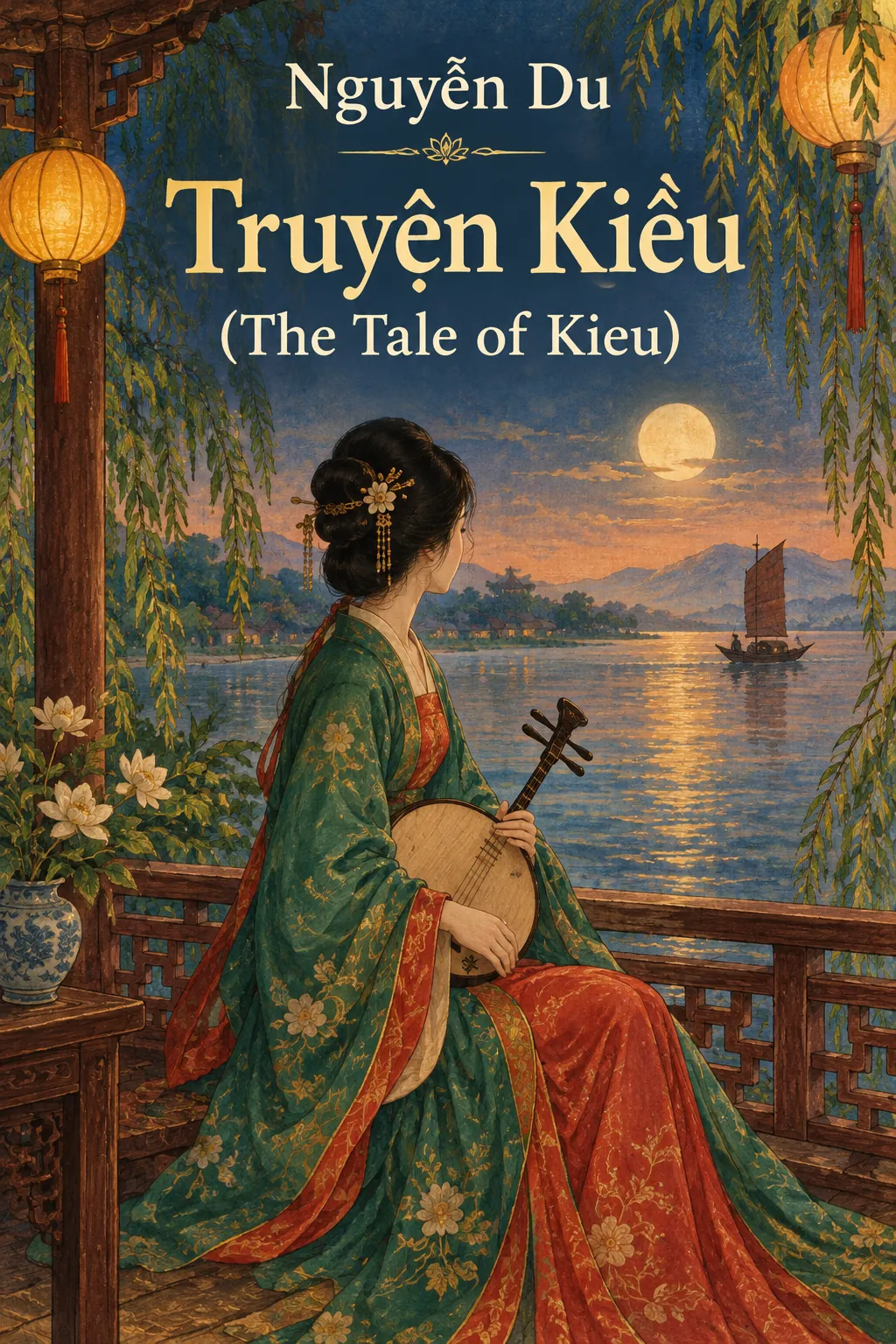
Truyện Kiều (The Tale of Kieu)
oleh Nguyễn Du
Truyện Kiều is a Vietnamese verse novel of 3,254 lines by Nguyễn Du. It follows Thúy Kiều, a beautiful and talented girl who falls in love with the scholar Kim Trọng. When her family is struck by disaster she sells herself to save her father and is swept into fifteen years of wandering, betrayal and loss. The poem asks why talent and virtue so often meet suffering, and answers with deep compassion for its heroine.
Ide Utama
"Truyện Kiều follows a gifted young woman who gives up love to save her father, then spends fifteen years crushed by money, deceit and power while keeping her goodness."
Wawasan Utama
Talent and fate
The poem opens by saying that talent and fate seem to quarrel, and the whole story tests this idea. Kiều is gifted in every art, yet her gifts are what make her a target for buyers, rivals and rulers. Nguyễn Du does not blame her for this. He shows a world that rarely rewards the best people.
Đạm Tiên's tomb in Part 1 shows the same pattern, since a famous singer ends forgotten and mourned only by strangers.
Filial duty against love
Kiều faces a choice between her father's life and her own happiness, and chooses her father without long argument. In the Confucian world of the poem filial duty comes first, but the poem never hides the price. Nguyễn Du lets the reader feel both the nobility of her choice and the pain it causes.
In Trao duyên she says that duty and love are hard to keep whole together, and then she gives up her vows.
Money and power as villains
The people who hurt Kiều are not simply cruel by nature. Many of them act for money, status or advantage, from the false accuser to the trader who buys her to the official who tricks Từ Hải. Nguyễn Du shows a society where people can be bought and sold, and he treats this as the real source of Kiều's suffering.
Mã Giám Sinh pretends to be a gentleman buyer, but he is only after profit.
Compassion for women who suffer
The poem looks at a woman who is bought, sold and blamed, and it refuses to judge her. It shows that Kiều keeps her kindness, her loyalty and her sense of gratitude through everything. This is why readers speak of Nguyễn Du's nhân đạo, his humane view of people.
After her revenge, Kiều still lets Hoạn Thư go free when the woman speaks to her honestly.
Rincian Bab
Chapter-by-chapter summary
Spoiler warning: this section covers the whole plot, including the ending.
The poem has no numbered chapters, so this guide follows its three traditional parts.
Part 1: Meeting and betrothal (Gặp gỡ và đính ước)
The poem opens with the Vương family, a father, a mother, a son and two daughters, Thúy Kiều and her younger sister Thúy Vân. Kiều is the more gifted, admired for her beauty, her poetry, her painting and her music.
At the spring festival of Thanh minh, Kiều weeps at the forgotten tomb of the dead singer Đạm Tiên. On the way home she meets the young scholar Kim Trọng, and the two fall in love.
They meet in secret and swear vows under the moon. Then Kim Trọng must leave to attend a family funeral, and their short happiness ends.
Why it matters: this part sets up the love Kiều will lose and plants the idea that beauty and talent invite misfortune.
Part 2: Disaster and wandering (Gia biến và lưu lạc)
While Kim Trọng is away, a false accusation puts Kiều's father in prison. To raise the money to save him, Kiều sells herself and asks Vân to marry Kim Trọng in her place, in the scene called Trao duyên.
The buyer, Mã Giám Sinh, is really a trader in girls, and he hands her to the brothel keeper Tú Bà. Kiều tries to kill herself, is calmed with false promises and is kept in the Ngưng Bích tower, then tricked by the smooth talker Sở Khanh and forced into the brothel.
The merchant Thúc Sinh buys her freedom and takes her as a second wife. His jealous wife Hoạn Thư brings Kiều into her house as a servant, and Kiều escapes to a convent under the nun Giác Duyên.
A woman who was meant to shelter her instead sells her into a brothel again. There Kiều meets the rebel leader Từ Hải, who frees her and makes her his wife.
When Từ Hải wins power, Kiều repays those who helped her and punishes those who harmed her, though she spares Hoạn Thư after a clever plea. Later the official Hồ Tôn Hiến tricks Từ Hải into surrender and has him killed.
Kiều is forced to marry a minor chief and throws herself into the Tiền Đường river, but Giác Duyên saves her. Why it matters: fifteen years of hardship show a good person ground down by money, lies and power, and the poem asks who is to blame.
Part 3: Reunion (Đoàn tụ)
Kiều lives quietly again under Giác Duyên's care while her family searches for her. Kim Trọng, who married Vân as Kiều asked but never forgot Kiều, finally finds her.
The family is reunited and Kim Trọng proposes marriage. Kiều agrees to a formal union but asks that they stay devoted friends, sharing music and conversation, because she feels her years of hardship make a marriage unfitting.
Why it matters: the ending offers peace rather than a fairy tale, and the closing lines say that the heart, meaning goodness, is worth more than talent.
Two exam excerpts
Trao duyên (Passing on the Love)
Kiều asks Vân to take her place with Kim Trọng and gives her keepsakes of their vows. The passage is a long speech full of bowing, pleading and reasoning that finally breaks into grief for Kim Trọng.
Key points for exams: the request is humble, the dilemma is “duty and love cannot both be whole”, and the monologue form shows her inner pain.
Kiều ở lầu Ngưng Bích (Kiều in the Ngưng Bích Tower)
Tú Bà keeps Kiều in a tower by the sea while she plots to push her into the brothel. Alone, Kiều thinks of Kim Trọng and her parents, then gazes out at the sea.
The last eight lines repeat “buồn trông” (sadly I watch) four times, and each repeat brings a new image: a far sail, a drifting flower, withered grass and roaring waves. Together they trace her fading hope and growing fear.
Characters
- Thúy Kiều: the heroine, talented, devoted to her family and always ready to sacrifice herself.
- Kim Trọng: the scholar she loves, faithful and gentle.
- Thúy Vân: her younger sister, who takes Kiều's place in marriage.
- Vương Viên ngoại: her father, whose arrest sets the tragedy in motion.
- Mã Giám Sinh and Tú Bà: the dealer and the brothel keeper who trade in girls.
- Sở Khanh: the false rescuer who betrays her.
- Thúc Sinh and Hoạn Thư: the kind merchant and his jealous, clever wife.
- Từ Hải: the rebel hero who treats Kiều as an equal.
- Giác Duyên: the nun who shelters and rescues her.
Writing about this book
Most Vietnamese exam questions ask for a nghị luận văn học essay of about 600 chữ on a character or excerpt. Plan it as mở bài, thân bài with two or three clear points, and kết bài.
Quote only a couplet or two, and always explain what the words do. Name devices such as lục bát, tả cảnh ngụ tình, điệp ngữ and độc thoại nội tâm, then say what each one shows about Kiều.
Link the excerpt to the whole poem: Trao duyên starts Kiều's life of sacrifice, and Ngưng Bích shows her loneliness before the next deception. Finish by saying what Nguyễn Du wants readers to feel, which is compassion for people crushed by an unfair world.
The model answers on this page are learning examples at three levels. Compare them with your own writing, then write your own version in your own words.
Ambil Tindakan
Langkah praktis yang bisa Anda terapkan hari ini:
-
Read each part for its main event, then ask what choice the heroine makes and what it costs her.
-
When you analyse a couplet, name the device and explain what it shows about feelings, not just the words.
-
Quote briefly and always comment on the quote in your own words.
-
Link every excerpt back to the whole poem and to Nguyễn Du's compassion.
Kutipan Menarik
"“A hundred years in a human life: talent and fate, how they love to quarrel.” (Opening lines)"
— Nguyễn Du
"“Sister, will you listen? Sit, and let me bow before I speak.” (Trao duyên)"
— Nguyễn Du
"“Sadly I watch the sea at dusk, a far sail drifting in and out of sight.” (Kiều ở lầu Ngưng Bích)"
— Nguyễn Du
"“Duty and love are hard to keep whole, both at once.” (Trao duyên)"
— Nguyễn Du
Siapa yang Harus Membaca Ini
Students aged about 14 to 18 in Vietnamese schools who need to study Truyện Kiều for Ngữ văn, thi vào lớp 10 or THPT, and English readers who want a clear overview of Vietnam's best-loved poem. No prior knowledge is needed.
Tentang Nguyễn Du
Nguyễn Du (1765–1820) was a Vietnamese poet and scholar-official who served under the Nguyễn dynasty. He wrote Truyện Kiều in the chữ Nôm script, and Vietnamese readers honour him as their national poet. UNESCO recognised him as a world cultural figure in 1965.
Ringkasan Ditulis Oleh

Software Engineer & Writer
Software engineer with a passion for distilling complex ideas into actionable insights. Writes about finance, investment, entrepreneurship, and technology.
Lihat semua ringkasan →Ulasan
Belum ada ulasan. Jadilah yang pertama berbagi pemikiran Anda!
Tulis Ulasan
Lanjut membaca
Jelajahi topik: Panduan BelajarRingkasan
Animal Farm karya George Orwell — Ringkasan & Analisis
George Orwell
Hewan-hewan di Peternakan Manor memberontak melawan petani kejam Mr. Jones untuk mendirikan masyarakat utopia berdasarkan kesetaraan. Namun, kepemimpinan babi yang…

The Outsiders oleh S.E. Hinton
S.E. Hinton
Novel ini mengikuti kehidupan Ponyboy Curtis dan kelompok 'Greasers' yang terjebak dalam perang saudara dengan kelompok 'Socs' yang kaya. Melalui…
The Great Gatsby karya F. Scott Fitzgerald — Ringkasan & Analisis
F. Scott Fitzgerald
Diceritakan oleh Nick Carraway, novel ini mengikuti Jay Gatsby, seorang jutawan misterius yang berusaha memenangkan kembali cinta Daisy Buchanan. Di…
tikus dan Manusia oleh John Steinbeck
John Steinbeck
Kisah tentang dua buruh tani migran, George dan Lennie, yang bermimpi memiliki tanah sendiri untuk hidup mandiri. Namun, keterbatasan mental…
Artikel
Kisah Penebang Bambu (Taketori Monogatari)
Kisah Penebang Bambu (Taketori Monogatari) bercerita tentang Putri Kaguya, gadis yang ditemukan di dalam batang bambu yang bersinar. Ia tumbuh…
Ragnarok: Akhir Dunia dan Kiamat Para Dewa Nordik
Ragnarök adalah akhir dunia dalam mitologi Nordik: pertempuran terakhir tempat para dewa, raksasa, dan monster saling membinasakan, bumi tenggelam ke…
Unsur Intrinsik Cerpen dan Novel
Unsur intrinsik adalah bagian yang membangun cerita dari dalam: tema, tokoh dan penokohan, alur, latar, sudut pandang, gaya bahasa, dan…