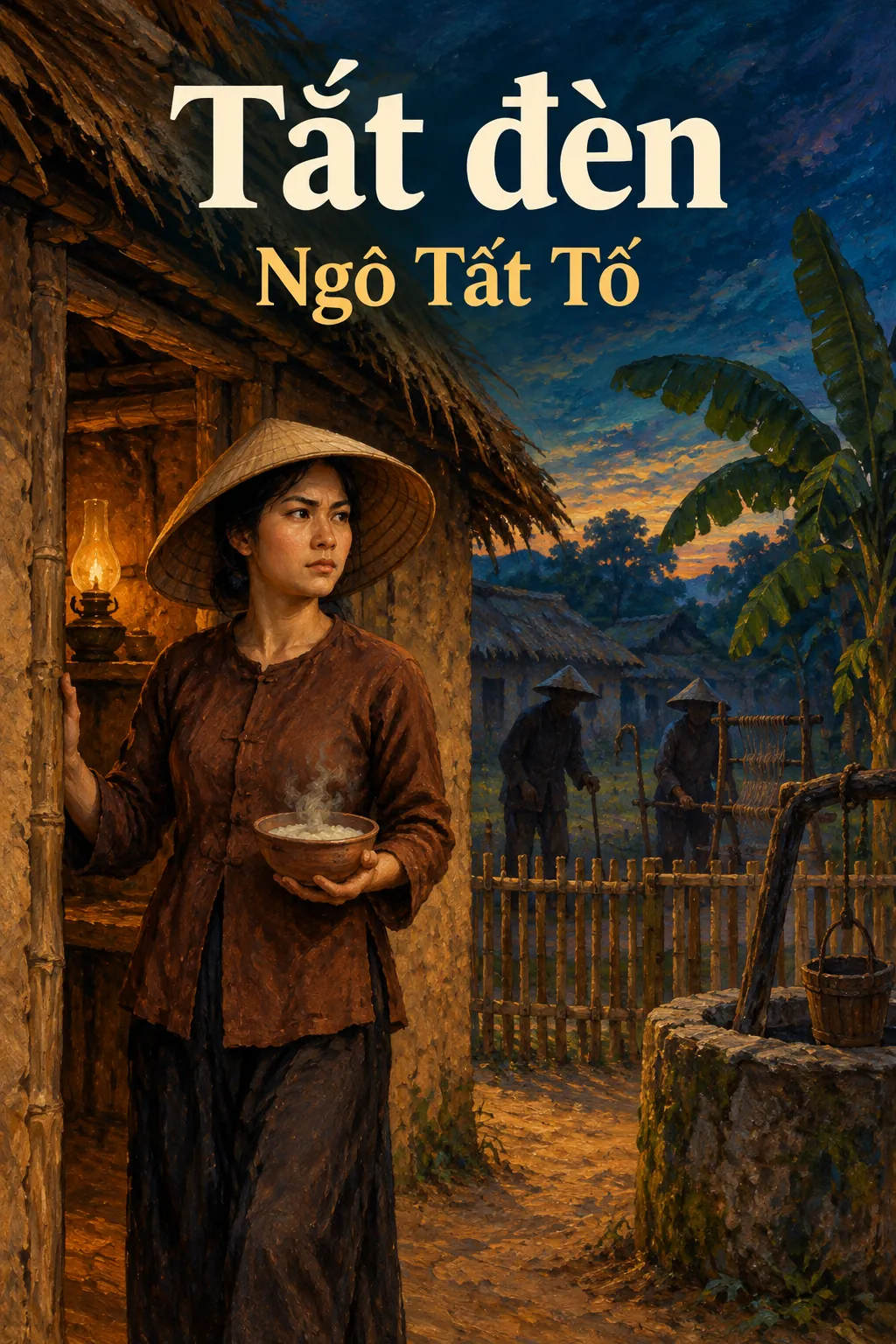
Tắt đèn
by Ngô Tất Tố
Tắt đèn (When the Lights Go Out) is a Vietnamese novel by Ngô Tất Tố about a poor peasant family in a northern village under colonial rule. Tax season arrives, and Chị Dậu must find money to save her sick husband from beatings and arrest. She sells what little she has, begs, and swallows insults, until one confrontation pushes her past patience. The book is a sharp portrait of poverty, power and a woman's courage.
The Big Idea
"Tắt đèn shows how a colonial-era tax system crushes a peasant family, and how Chị Dậu, pushed past endurance, turns from pleading to fighting back."
Key Insights
Tax as a machine of ruin
The sưu is not just money. It is a chain that runs from colonial rule to village officials to a single poor household, and each link takes its share. Because it is collected by force, a family can lose its dog, its child and its health in one season. The novel never explains the tax system in theory; it shows its cost in objects, bodies and people, which is why the reader feels the injustice so directly.
Chị Dậu sells her dogs and her daughter cái Tí and still faces arrest for the dead brother's tax.
Love is the root of both patience and rebellion
Chị Dậu does not change character when she fights. The same love that makes her beg and endure insults makes her strike when her sick husband is about to be tied up. The book suggests that gentleness and courage are not opposites. For an essay, this is a useful way to avoid describing her as two separate people: the patient wife and the fighter are one woman reacting to different levels of danger.
She calls the cai lệ “sir” at first, then throws him to the ground when he moves to bind her husband.
Power without a face
The cai lệ has no name and gives no reasons, only commands and blows. Ngô Tất Tố uses him to stand for a whole system of petty authority rather than one cruel man. His quick defeat also mocks a power that looks solid but is hollow. The author lets him fall almost comically, which shows contempt for the confidence of men who act in the name of the law without any sense of right.
A man who bullies the whole village cannot withstand one woman pushed to her limit.
Wealth buys people
Nghị Quế is the quiet winner of the tax season. He buys when the poor are desperate, taking a mother's dogs and her child at a low price. The novel ties poverty to the people who profit from it. Because he rarely raises his voice, his cruelty seems respectable, and that makes him a sharper picture of village power than the loud enforcers.
He buys the litter of dogs and the child cái Tí from a mother who has nothing else left to sell.
Speech shows status
Vietnamese pronouns carry rank, so a change of address is a change of power. Chị Dậu begins with the lowest forms and ends with the highest, and the reader can follow her inner shift without any comment from the narrator. This is why teachers ask students to look closely at how she names herself and the officials: the grammar itself tells the story of the scene.
She moves from “child” and “sir” to “I”, and finally speaks to the cai lệ as a superior would.
Chapter Breakdown
Chapter-by-chapter summary
Spoiler warning: this section covers the whole plot, including the ending.
Tắt đèn was serialised in the newspaper Việt nữ in 1937 and has 27 chapters, so this guide groups them into five parts. The five-part division is our own, not the book's, and the parts are not numbered chapters.
The famous excerpt Tức nước vỡ bờ, which students study in school, is chapter XVIII and falls in the third part.
Part 1: Tax season in the village
The story opens in a village in northern Vietnam during the season when the poll tax (sưu) must be paid. Chị Dậu's household is among the poorest in the village.
Her husband, anh Dậu, is ill, and the family must also pay the tax owed for his brother, who has died. Village officials press every household hard, and anyone who cannot pay is tied up and beaten.
The village is run by its own officials, who answer to the colonial administration above them. Each level wants its share, so the pressure on a poor household grows as it travels down.
Anh Dậu is dragged to the communal house, so Chị Dậu must find money at once. This opening matters because it creates the pressure behind every later choice: nothing she does afterwards makes sense unless we feel how close the family is to ruin.
Part 2: Selling what they have
To pay the tax, Chị Dậu sells her litter of dogs and her eldest daughter, the child cái Tí, to the household of the rich Nghị Quế. The price is very low, and it is still not a fortune.
With the money, anh Dậu is released and carried home, but the family has lost its child and nearly everything of value.
Chị Dậu's grief is quiet but clear: she knows the sale is a betrayal of her child and does it only because the alternative is her husband's death. The author lets the reader feel that choice without a speech.
This part shows how the tax turns even a mother's love into a transaction. It also introduces Nghị Quế, who profits from the village's misery.
Part 3: Tức nước vỡ bờ
Anh Dậu lies at home, barely alive. A kind neighbour lends a little rice, and Chị Dậu cooks porridge and coaxes her husband to eat.
Just then the cai lệ and the village head's man burst in, demanding the tax owed for the dead brother. Chị Dậu begs politely, calling them “sir” and herself “child”, but the cai lệ pushes her aside and hits her.
When he moves to tie up her husband, she stops begging. She argues, then fights, and throws down both men.
Notice how quickly the scene moves: a few lines of dialogue, a push, a blow, then the reversal. The speed makes the turn feel like a breaking point rather than a plan.
This scene matters because it shows that the gentle woman of the opening is not weak: she is patient only for as long as patience can protect her family.
Part 4: After the fight
The fight brings her no safety. Chị Dậu is arrested and brought before the district magistrate (quan huyện).
He tries to assault her, and she throws the silver coins in his face and runs away.
Escaping him does not clear the debt, because part of the tax is still unpaid. A man from the household of the old mandarin, quan cụ, a provincial official, gives her two đồng toward it and offers her work as a wet nurse (ở vú), giving her milk to the old man because he has lost his teeth.
She leaves her baby, cái Tỉu, with a neighbour and goes to town.
This part matters because the author refuses an easy victory: one brave act frees her from one predator, not from the debt, so a mother must again sell her labour to survive.
Part 5: Into the dark
For a while she sends money home from her work in town. Then, one dark night, the old mandarin, quan cụ, creeps into her room intending to assault her.
Chị Dậu escapes and runs out into a night as black as ink, as dark as her own prospects.
The book ends there, without rescue or answer. Many readers feel the open ending is the book's sharpest argument, since no authority steps in to help her.
The ending matters because it carries the meaning of the title: the lamp of this family has been put out, and the reader is left to ask who is responsible.
Characters
- Chị Dậu: a poor peasant wife and mother, the heart of the novel. She is tender, resourceful and patient, and she fights only when her husband is in danger.
- Anh Dậu: her sick husband, beaten for unpaid tax. He stands for the weak peasant who cannot defend himself.
- The cai lệ: a petty enforcer who carries out the tax demands with shouting and blows. He has no name and no argument, only the confidence of someone acting for authority.
- The village head's man: the cai lệ's partner, who adds his own threats and insults.
- Nghị Quế: a rich village notable who buys Chị Dậu's litter of dogs and her daughter cái Tí.
- Cái Tí: the eldest daughter, sold to raise tax money. She is the book's clearest victim.
- The district magistrate (quan huyện): the official before whom Chị Dậu is brought after the fight. He tries to assault her, and she throws the silver in his face and runs.
- The old mandarin (quan cụ): the old official of the provincial household who hires Chị Dậu as a wet nurse to pay the rest of the tax. He creeps into her room at night, and she flees.
- The kind neighbour: an old woman who lends a little rice, a small sign that poor people still help each other.
Writing about this book
Most school questions ask you to analyse Chị Dậu in the excerpt Tức nước vỡ bờ. Start with a thesis: she is both a loving wife and a woman with hidden strength.
Then build three points: her love for her husband, her patience before the officials, and her explosion of resistance. For each, give one concrete detail, such as the porridge, the polite way she addresses the officials, or the moment she throws the cai lệ down.
Look at her pronouns. She moves from “child” and “sir” to “I”, and finally to a tone that treats the cai lệ as an inferior.
That change is a quick way to show how the author reveals character through speech.
Then widen the view with the author's purpose: the scene accuses the tax system and praises the hidden courage of peasant women. Add a limit to show depth: one fight does not free her, and the novel ends in darkness.
A short plan helps under exam pressure: one sentence for each of the three points, one for the author's skill, one for the limit. Spend your last minutes on the conclusion, which should return to your thesis instead of repeating the plot.
Quote briefly, under 25 words, and use your own words for the rest. The model answers below show three levels, and they are for learning and for comparing with your own work.
Take Action
Practical steps you can implement today:
-
When you analyse a character, track how their way of speaking changes; here the pronouns show the turn from pleading to fighting.
-
Link a scene to its context: tax, class and village power explain why Chị Dậu is pushed so far.
-
Argue that patience and courage can come from the same love instead of treating them as opposites.
-
Show depth by noting limits: the fight is a spark of resistance, not a solution.
Notable Quotes
"“My husband is ill, and you have no right to mistreat him.” (excerpt Tức nước vỡ bờ, our translation)"
— Ngô Tất Tố
"“Tie up my husband right now and I'll show you!” (excerpt Tức nước vỡ bờ, our translation)"
— Ngô Tất Tố
"“I beg you, sir, my husband has only just come round. Please let him be.” (excerpt Tức nước vỡ bờ, our translation)"
— Ngô Tất Tố
Who Should Read This
Students in lower and upper secondary school who study Tắt đèn in Vietnamese literature class, and readers who want a short, powerful picture of peasant life under colonial rule. It is also helpful for anyone preparing an essay on Chị Dậu or on the excerpt Tức nước vỡ bờ, including students who read Vietnamese literature in translation.
Characters
Chị Dậu
protagonist
A poor peasant wife and mother who does everything to save her sick husband. She is tender and patient, and when the officials strike her and try to bind her husband, she fights back and throws them down.
Anh Dậu
supporting character
Chị Dậu's husband, weak from illness and from beatings over the unpaid tax. He is less a hero than a symbol of the helpless peasant.
The cai lệ
antagonist
A petty enforcer who carries out tax collection with shouting and blows. He has no name and no argument, which makes him stand for a whole system of petty authority.
The village head's man
antagonist
The cai lệ's partner, who adds threats and insults. He shows how many small officials profit from the tax.
Nghị Quế
antagonist
A rich village notable who buys Chị Dậu's litter of dogs and her eldest daughter cái Tí. He represents the wealth that grows from other people's poverty.
Cái Tí
victim / symbol
Chị Dậu's eldest daughter, sold to raise tax money. Her fate shows how the tax turns even a family's love into a cost.
The district magistrate (quan huyện)
antagonist
The official before whom Chị Dậu is brought after the fight. He tries to assault her, and she throws the silver coins in his face and runs, which shows that her pride cannot be bought or forced.
The old mandarin (quan cụ)
antagonist
The old official of the provincial household who hires Chị Dậu as a wet nurse to pay the rest of the tax. He creeps into her room at night, and his attempt drives her out into the dark.
The kind neighbour
foil
An old woman who lends a little rice to the family. She is a small sign that poor people still help each other when power turns against them.
Exam practice: sample answers
Model answers are examples to learn from; write your own in your words.
character analysis (nghị luận văn học)
1. Analyse the character of Chị Dậu in the excerpt Tức nước vỡ bờ from Tắt đèn by Ngô Tất Tố (about 600 words in the exam).
Outline
- Opening: author, work, excerpt and a thesis about Chị Dậu
- Point 1: a loving wife (the porridge, her care)
- Point 2: patience before the officials (how she addresses them, her begging)
- Point 3: sudden resistance (the lines and the fight, the change of pronouns)
- Art and meaning: dramatic situation, short dialogue, social criticism
- Conclusion: the unity of tenderness and strength
Basic Model answer
In the excerpt Tức nước vỡ bờ, Chị Dậu is first a loving wife. Her husband is sick and beaten, so she cooks him porridge and tries to protect him.
When the tax collectors burst in, she begs politely, calling them “sir” and herself “child”.
But she is also strong. When the cai lệ hits her and tries to tie up her husband, she stops pleading and fights back, knocking him down.
Her way of speaking changes as she grows angrier, which shows the turning point.
Through Chị Dậu, Ngô Tất Tố shows that gentle peasants can resist when they are pushed to the limit. She is loving and brave.
Good Model answer
Ngô Tất Tố's Tắt đèn exposes how the tax system crushed peasants in 1930s Vietnam. In the excerpt Tức nước vỡ bờ, Chị Dậu is both a devoted wife and a woman with hidden strength.
First, she is deeply caring. Her husband has just been beaten for unpaid tax and is barely able to eat, so she cooks porridge and urges him to take it.
This small detail shows her tenderness, and it also shows how little her family has left, since they have already sold their dogs and a child to pay the tax.
Second, she endures humiliation for her family. When the cai lệ and the village head's man arrive, she calls them “sir”, calls herself “child”, and begs for one more day.
Her speech shows the low status of a peasant before authority.
Third, she fights back at the breaking point. When the cai lệ strikes her and moves to tie up her husband, she answers, “My husband is ill, and you have no right to mistreat him.”
Then she calls him “you” with contempt, speaks of herself as the one in charge, and throws him to the ground. The shift in how she addresses them marks her move from supplicant to equal to dominant.
The scene also shows the author's skill: short dialogue, strong verbs and a tense situation reveal character quickly. The excerpt condemns an unjust colonial society and also shows that love can turn a patient woman into a fighter.
Excellent Model answer
If Tắt đèn is an indictment of the poll tax and the people crushed beneath it, the excerpt Tức nước vỡ bờ is the moment the indictment turns into action. Ngô Tất Tố builds Chị Dậu as a whole person: patient out of love, and rebellious out of the same love.
The setting matters. In tax season the village belongs to beatings and ropes.
Chị Dậu's family has already sold its dogs and a child, her husband has been beaten to exhaustion, and the collectors arrive before he finishes his porridge.
First, her patience is not weakness but love squeezed into the shape of her social position. She calls the intruders “sir”, calls herself “child”, and asks for one more day.
This is both the etiquette of a peasant facing power and the gamble of a wife who will humble herself to keep her husband.
Facing her is the cai lệ, drawn in a few lines and with no name or argument, only shouting, a rope and the confidence of someone acting in the name of the law. Because he stands for the whole machinery rather than for one bad man, the scene reads as a judgement on a system.
Second, her resistance has stages. First she holds on to politeness: “My husband is ill, and you have no right to mistreat him.”
When he hits her, she answers, “Tie up my husband right now and I'll show you!”, and she acts at once. Each change of pronoun moves her from a bowed figure to one who demands justice, and then to one who stands over her oppressor.
The style supports this. Short exchanges, strong verbs and rural speech make the fight a revelation of character, and the bitter comedy of a bully who cannot withstand one woman mocks authority itself.
Placed within the novel, the moment is not a solution. She is soon arrested and escapes the magistrate who assaults her, but the tax is still unpaid, so she leaves her child to work as a wet nurse, and finally flees another assault into the dark night.
The scene is therefore both a bright point of vitality and a warning about a society where a gentle person must become fierce to protect her family.
In short, Chị Dậu endures and rises, yields and resists, and the unity of these opposites gives the character, and the novel, its lasting force.
Marking rubric
- A clear thesis about Chị Dậu
- Three developed points with evidence
- Analysis of language (pronouns, verbs) and situation
- Social and historical context
- Introduction and conclusion that fit the question
Now write your own
Write your own 600-word analysis of Chị Dậu. Then compare your points, evidence and conclusion with the three levels above, and do not copy any sentence.
theme / title analysis (nghị luận văn học)
2. Some say the title Tức nước vỡ bờ names a law of life. Explain this idea through the excerpt from Tắt đèn.
Outline
- Explain the proverb literally and figuratively
- Pressure builds: tax, sold child, husband beaten
- The breaking point: the fight and the change of pronouns
- Meaning: oppression breeds resistance, but also a limit
- Conclusion
Basic Model answer
“Tức nước vỡ bờ” is a Vietnamese proverb: when water is pressed too hard, it breaks the bank. It means that people pushed too far will fight back.
In the excerpt, Chị Dậu is pushed to the limit. She is poor, her husband is ill, and the family has already sold its dogs and a child to pay the tax.
Still the cai lệ and the village head's man come to take her husband and they hit her.
At first she begs and stays patient. But when they strike her and try to tie up her husband, she fights back and knocks them down.
So the title fits the story: oppression leads to resistance. The excerpt condemns an unjust society and praises the hidden strength of a peasant woman.
Good Model answer
“Tức nước vỡ bờ” is a familiar proverb. Literally, water pressed too hard breaks its bank; figuratively, too much oppression produces resistance.
As the name of the excerpt from Ngô Tất Tố's Tắt đèn, it sums up both the events and the idea of the passage.
First, the pressure builds. Chị Dậu's family is poor and has already sold its dogs and a child, yet tax is still owed.
Her husband, beaten to exhaustion, has barely woken when the cai lệ and the village head's man arrive. Her pleading brings only shouting and blows.
Next comes the breaking point. When the cai lệ hits her and goes to tie up her husband, she can bear no more.
She argues, then fights, and throws down both men. She also changes how she addresses them, which signals that the bank has broken.
The title therefore names a law as well as an event: gentle peasants do resist, but only when they have no way out. The title also hints at the cost: the bank breaks only after long suffering.
Through it, the author accuses a cruel tax system and praises the hidden strength of peasant women.
In conclusion, the title is rich in meaning, summing up the moment and the truth behind it.
Excellent Model answer
The proverb “tức nước vỡ bờ” says that water forced beyond its limit breaks its banks. When the excerpt from Ngô Tất Tố's Tắt đèn is called by this phrase, the title does more than name a fight: it sets out a law of life and a way of reading the novel.
To see why the water is so high, count the layers of pressure on Chị Dậu. The tax is a general burden, but for her it becomes sold dogs, a sold child and a husband beaten.
In the excerpt her husband has just woken and taken a little porridge when the collectors burst in, so the gap between a tiny hope and a sudden blow raises the pressure to its peak.
The author then lets the water rise step by step. Chị Dậu begs from the lowest position, as “child” to “sir”.
The cai lệ answers with blows and shouting. She replies “I” and demands justice for a sick man, and finally she calls herself the stronger and calls him “you”.
These shifts of address work as psychological signals, so we feel her inner change without any comment from the narrator.
Those who fall are the very agents of the system. The cai lệ has no name, no argument, only the aggression of someone acting for the law, so his fall is symbolic: apparently solid power proves fragile before a wife pushed to the end.
The mocking tone used for the fallen cai lệ adds to this, ridiculing authority that cannot withstand one woman.
Yet the title must be read with the rest of the novel. Chị Dậu is soon arrested and escapes a magistrate who tries to assault her, but the tax is still unpaid, so she leaves her child to work as a wet nurse and flees into the night, and lone resistance does not free her.
Ngô Tất Tố trusts in the vitality of peasants but sees clearly that it is not enough on its own.
The law also outlasts its time. Where dignity is trampled for long, anger accumulates, and the wise do not push others to the limit.
In short, the title names the central moment and compresses a truth: excessive oppression breeds resistance, and even the gentle have limits.
Marking rubric
- Explain the proverb in both senses
- Trace the build-up of pressure with evidence
- Identify the breaking point and its signs in the language
- Show the limits of the title in light of the whole novel
Now write your own
Write your own response to this question, then add a short paragraph connecting the title to a modern example of injustice (a social-argument link-up) and compare it with the levels above.
Frequently Asked Questions
What is Tắt đèn about?
Tắt đèn is a novel by Ngô Tất Tố about the poor peasant family of Chị Dậu during the tax season in a northern village. She sells her dogs and her daughter, faces violent officials, and finally has to flee. It is a portrait of poverty and injustice under colonial rule, told through one household instead of through statistics or speeches.
Who is Chị Dậu?
Chị Dậu is the heroine, a poor wife and mother who does everything to protect her sick husband. She is gentle and patient, but she fights back when he is attacked. Many readers see her as a symbol of the strength of Vietnamese peasant women, and she is one of the most analysed characters in school literature.
What happens in the excerpt Tức nước vỡ bờ?
Chị Dậu cooks porridge for her sick husband when the cai lệ and the village head's man burst in to take him. She begs, is struck, and then throws both men to the ground. The scene is famous as the moment a patient woman fights back, and it is the usual basis for character analysis essays.
Why is the book called Tắt đèn?
Readers usually take the title as an image of a family's light of hope going out. The darkness of the final scene supports that reading. The author does not explain the title in the story, so in an essay you should present this as an interpretation and support it with the ending.
Which part of Tắt đèn do students usually study?
The excerpt Tức nước vỡ bờ, chapter XVIII, is the part most often taught and tested, usually as a character analysis of Chị Dậu. Some exams also ask about the wider novel and its ending, so learn how the excerpt fits into the whole story.
Check Your Understanding
Pick an answer for each question to see if you were right.
-
Who wrote Tắt đèn?
Ngô Tất Tố — Ngô Tất Tố wrote Tắt đèn, which was serialised in the newspaper Việt nữ in 1937 and published as a book in 1939.
-
What is the poll tax called in the novel?
Sưu — The sưu is the poll tax that drives the family into ruin.
-
What does Chị Dậu sell to raise tax money?
Her dogs and her daughter — She sells her litter of dogs and her eldest daughter cái Tí to Nghị Quế's household.
-
How does Chị Dậu's way of addressing the cai lệ change in the excerpt?
She moves from “child” and “sir” to a tone of equals and then superiors — Her shifting pronouns show her move from pleading to defiance.
-
What does the final scene suggest?
A dark and uncertain future — Chị Dậu flees into a dark night that matches her uncertain future.
About Ngô Tất Tố
Ngô Tất Tố (1893–1954) was a Vietnamese journalist, scholar and novelist from a village near Hanoi. He wrote about peasant life and the abuses of village officials. Tắt đèn was serialised in the newspaper Việt nữ in 1937 and published as a book in 1939, and remains his best-known work. He later joined the resistance and died in 1954.
Summary Written By

Software Engineer & Writer
Software engineer with a passion for distilling complex ideas into actionable insights. Writes about finance, investment, entrepreneurship, and technology.
View all summaries →Reviews
No reviews yet. Be the first to share your thoughts!
Write a Review
Keep reading
Explore the topic: Study GuidesSummaries
Animal Farm by George Orwell
George Orwell
The animals of Manor Farm revolt against their human owner to create a utopian society based on equality. However, the…

The Outsiders by S.E. Hinton
S.E. Hinton
Ponyboy Curtis and his gang of Greasers clash with the wealthy Socs in a cycle of violence. After a tragic…

The Great Gatsby by F. Scott Fitzgerald
F. Scott Fitzgerald
Nick Carraway enters the orbit of Jay Gatsby, a mysterious millionaire obsessed with reclaiming his past love, Daisy Buchanan. Amidst…

Of Mice and Men by John Steinbeck
John Steinbeck
George and Lennie, two migrant workers during the Great Depression, dream of owning their own land to escape a life…
Articles

Kyotsu Test Japanese (共通テスト国語): Time Plan and Strategy
The Kyotsu Test Japanese paper is a 90-minute, 200-point multiple-choice exam with five sections: three modern-text sections, classical Japanese and…

How to Write a Literary Analysis Essay
A literary analysis essay argues one clear claim about how a text works and proves it with short quotations and…

The Tale of the Bamboo Cutter
The Tale of the Bamboo Cutter (Taketori Monogatari) tells of Princess Kaguya, a girl found inside a glowing bamboo stalk,…