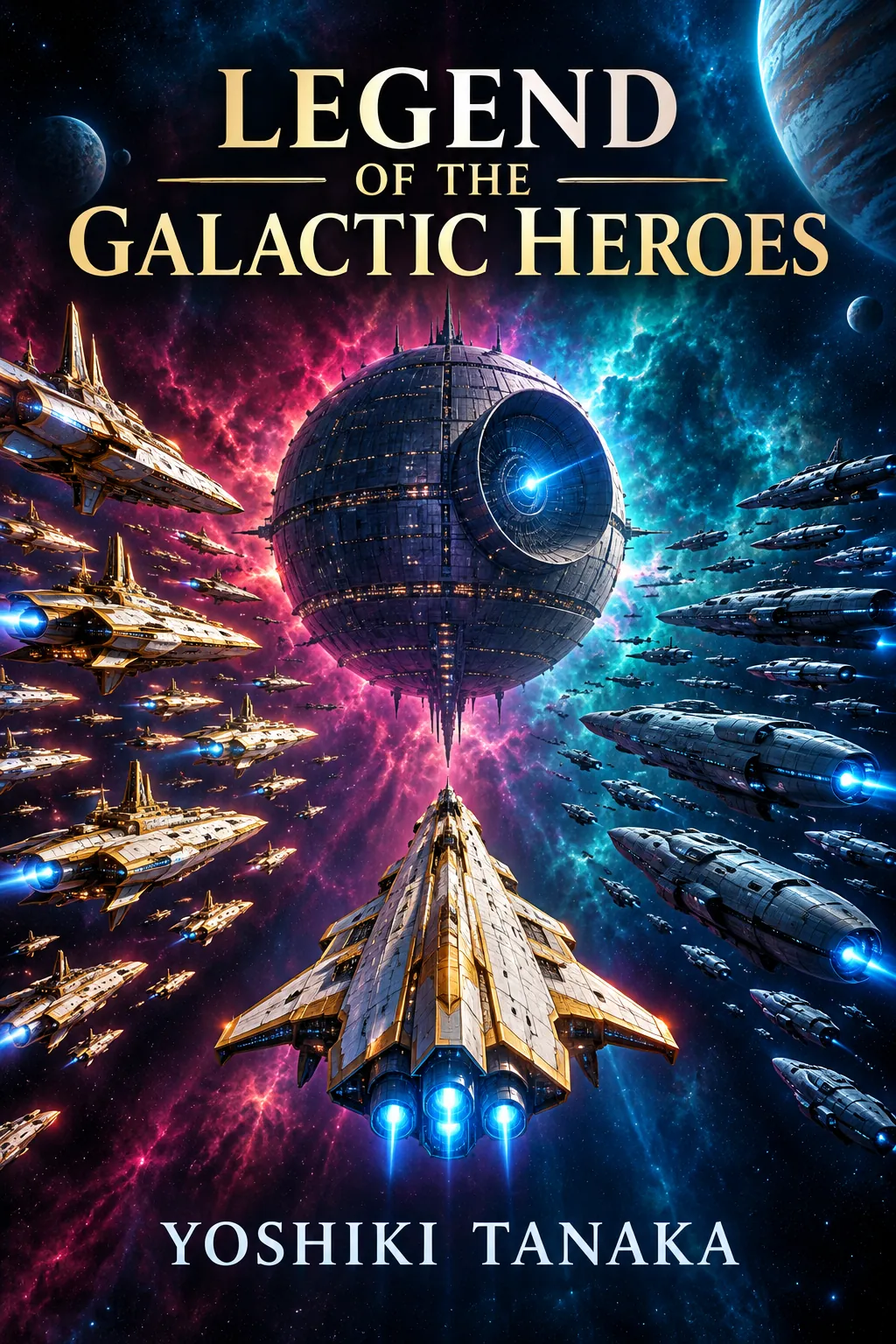
Legend of the Galactic Heroes
by Yoshiki Tanaka
Legend of the Galactic Heroes is a Japanese space opera in ten volumes by Yoshiki Tanaka, set in a far future where an autocratic Galactic Empire and the democratic Free Planets Alliance have fought for generations. Volume 1, Dawn, introduces Reinhard von Lohengramm, an ambitious young Imperial officer, and Yang Wen-li, a reluctant Alliance strategist who would rather be a historian. Their first clashes show how much one capable officer can change on either side.
Try Audible · As an Amazon Associate we earn from qualifying purchases. Details
The Big Idea
"Two gifted commanders, Reinhard of an autocratic Empire and Yang Wen-li of a democratic Alliance, steer a galactic war. Volume 1 asks what talent owes a flawed system, and what such systems do with talent."
Key Insights
Talent against a flawed system
Both heroes are far more capable than the systems they serve. Tanaka asks what a gifted person should do when institutions waste talent: take them over, as Reinhard plans to, or defend them while criticising them, as Yang does. Neither answer comes free, and the novel lets the reader feel the cost of both.
Reinhard sets out to end the Goldenbaum dynasty that took his sister, while Yang, who never wanted to be a soldier, keeps serving an Alliance whose government sells a costly retreat as a victory.
No system is innocent
The novel does not present democracy as good and autocracy as evil. The Empire is corrupt and the Alliance is led by short-sighted politicians, so the reader has to judge each side by what it actually does. This is why the book keeps rewarding a second reading.
Flushed with the capture of Iserlohn, the Alliance launches a huge invasion of Imperial space, and the campaign ends in disaster at Amritsar.
War is also logistics and politics
Battles in the book are won by positioning, supply and time, not only by brilliance. This makes the war feel like history rather than adventure and shows how political decisions turn into dead soldiers. Planners far from the front matter as much as the admirals who fight.
The Alliance expedition stretches its supply lines deep into Imperial space and loses them, and the Empire simply lets distance do part of its work.
History as a way of seeing
The narrator tells the story from a distance, like a chronicle written long afterwards. That voice treats even the biggest triumphs as a moment in a long history, and it fits Yang, the man who wanted to be a historian. It also gives the reader a calm place to stand while the war rages.
The book opens with a short history of how humanity split into two powers before it introduces its heroes, so the first battle already feels like a chapter in a longer record.
Chapter Breakdown
Volume 1, part by part
Spoiler warning: this section covers the whole plot of volume 1, including how it ends, and then outlines where the series goes.
This page follows the novels only, not the anime. Each part below is one of the volume's major events, told in order, and the names follow common English usage.
The two powers and the galaxy they fight over
The book opens with a short history of how humanity spread across the stars and then split into two powers.
The Galactic Empire is an autocracy ruled by the Goldenbaum dynasty and a hereditary nobility, while the Free Planets Alliance is a democracy founded by people who fled that rule.
Between them sits Fezzan, a small trading state that does business with both sides, and the two big powers have been at war, on and off, for about a century and a half.
The story is told like a chronicle written long afterwards, which gives even the battles a cool, historian's distance. That voice, and this three-way board, frame everything that follows.
Reinhard and Yang
Reinhard is a brilliant young officer from a poor noble family in the Empire, and his older sister Annerose was taken into the Emperor's household while he was still a boy. He joined the military to win enough power to take her back and, along the way, to end the corrupt dynasty that took her.
His closest friend, Siegfried Kircheis, fights beside him, and together they build a reputation for winning.
On the Alliance side, Yang Wen-li wanted to be a historian but entered a free military academy because he needed the money, and he drifts upward in a service he never quite wanted.
One man wants the throne and the other wants a quiet life, and the clash between those two wishes is the engine of the whole series.
The Battle of Astarte
The Alliance sends three fleets into the Astarte star zone, meaning to close around Reinhard's smaller Imperial fleet from several sides.
Reinhard refuses to be encircled and strikes the Alliance fleets one by one, so two of them are wiped out before they can help each other.
Yang, a junior staff officer with the third fleet, urges its commander to join the others quickly, and when that commander is wounded Yang takes over.
He turns the fight into a slow battle of attrition and leads most of his fleet out of the star zone.
The Alliance government presents the battle as a victory, and Yang rises fast, soon receiving a fleet of his own, the 13th.
It is the first time both leads show their gifts in one battle: Reinhard's boldness against Yang's skill at rescuing a lost situation.
The capture of Iserlohn
Iserlohn is an enormous fortress in the corridor between the two powers, and the Alliance had tried to take it many times at great cost.
Yang does not try to batter it down.
Instead the Rosen Ritter, an elite Alliance ground regiment led by Walter von Schönkopf, slip in disguised as Imperial personnel and take the fortress commander hostage.
With the control centre in their hands, Yang's 13th Fleet moves in, and the fortress changes sides almost without a fight.
The feat makes Yang's name, and he comes to be called the “Undefeated Magician”.
It also hands the Alliance a base at the heart of the war and, as the next parts show, a dangerous kind of confidence.
The Castrop rebellion
In the Empire, the late Duke von Castrop was a finance minister who had stolen heavily from the state, and when the government moves to take that wealth back, his son Maximilian refuses and rebels.
Reinhard sends Kircheis to deal with it, and the revolt is put down.
The episode is small beside the great battles, but it shows how rotten the nobility is and how Reinhard now has the standing to give orders and trusted people to carry them out.
It also turns the reader's eye back to the Empire, where his rise is making powerful people wary.
The Alliance invasion of Imperial territory
Having taken Iserlohn, the Alliance decides to strike deep into Imperial space, with Fleet Admiral Lasalle Lobos as its commander-in-chief.
The plan looks bold on paper, but the fleets spread out, their supply lines stretch and are cut, and soldiers who take food from local people provoke revolts.
Reinhard turns his forces on the scattered Alliance fleets, and several of them are destroyed. Yang's 13th Fleet is the exception, keeping about nine tenths of its strength.
The lesson is that wars are lost through distance and hunger as much as through bad tactics, and that a government's ambition can outrun what its soldiers can do.
Amritsar
Lobos orders the surviving fleets to gather at Amritsar and make a stand.
Reinhard's forces close in, the Alliance is crushed in the great battle there, and the survivors retreat toward Iserlohn.
Yang's 13th Fleet fights hard to cover the withdrawal and keeps the defeat from becoming total.
The campaign leaves the Alliance with a fraction of its former strength, and the gains at Iserlohn are thrown away.
Here the book shows its central warning for the first time: a democracy can be led into disaster by its own enthusiasm.
Where volume 1 leaves the two powers
By the end of the volume, the Alliance invasion is in ruins, yet Yang has proved himself in two very different ways, through the retreat at Astarte and the quiet capture of Iserlohn.
Reinhard has won again and is clearly the Empire's most dangerous commander, but he is still a young officer who has not yet reached what he wants.
Neither man has his wish, and both sides are more exposed than before, which sets up volume 2, Ambition (野望篇).
Where the series goes
Dawn is the first of ten main volumes, published between 1982 and 1987.
In later volumes Reinhard rises from admiral to ruler of the whole Empire and goes on to conquer the Alliance, founding a new dynasty.
Yang is assassinated in volume 8, and his young ward Julian Mintz carries on.
Reinhard dies of illness while still young, and the series ends by asking what remains of an age once its two great figures are gone.
Characters
Reinhard von Lohengramm is a brilliant, proud young Imperial officer from a poor noble family. He wants to bring down the Goldenbaum dynasty and win back his sister, and he is known as an ever-victorious commander.
Siegfried Kircheis is Reinhard's childhood friend and closest aide. Calm and loyal, he fights beside Reinhard and keeps his ambition from running out of control.
Annerose is Reinhard's older sister, who was taken into the Emperor's household while he was still a boy. She is the personal reason behind his drive to climb the ranks and bring down the dynasty.
Yang Wen-li is the Alliance officer who wanted to be a historian. Relaxed and sharp-minded, he saves the situation at Astarte, takes Iserlohn without a long siege, and serves a democracy he wants to protect.
Walter von Schönkopf commands the Rosen Ritter, the Alliance's elite ground regiment, and leads the infiltration of Iserlohn. Bold and witty, he is a fighter who enjoys a daring plan.
Frederica Greenhill is a capable young Alliance officer who becomes Yang's trusted aide. Steady and sharp, she supports him with sound judgement and careful organisation, and she grows more important as the series goes on.
Friedrich IV is the ageing Emperor of the Goldenbaum dynasty. His passive rule leaves the court to rival nobles and gives Reinhard room to rise, and his household is where Annerose lives.
Lasalle Lobos is the Alliance Fleet Admiral who commands the invasion of Imperial territory and orders the survivors to gather at Amritsar. His campaign shows how far an ambitious plan can outrun its supplies.
Writing about this book
Pick one question instead of retelling the plot.
A good one for volume 1 is how Reinhard and Yang each answer the problem of a flawed system.
Reinhard wants to tear down a corrupt dynasty and rule better himself, while Yang wants to protect a democracy that is slow and often foolish.
Support your point with scenes: the retreat at Astarte for Yang's calm, the capture of Iserlohn for his habit of avoiding waste, and Reinhard's promise about his sister for his motive.
Then ask what each man risks, because Reinhard's path leans on one person's judgement and Yang's leans on voters and officials he does not fully trust.
Quote sparingly and in your own words, and say which volume you read.
For a reader response, say which side you found yourself rooting for and why, and whether that changed by the end of the volume.
Take Action
Practical steps you can implement today:
-
Judge a leader by what the system does with their power, not by how attractive their goals sound.
-
Look at supplies, distance and timing before a plan: many failures are logistics, not courage.
-
Notice who benefits when a crowd cheers a quick victory, and ask what it will cost later.
-
Read long series in order, volume by volume, since the early setup pays off much later.
Notable Quotes
"“Kircheis, wouldn't you like to have the universe?” (Chapter 1, our own English rendering of Reinhard's line)"
— Yoshiki Tanaka
Who Should Read This
Readers of about 14 and up who like space opera, military strategy or political drama. It suits students writing about leadership, democracy and autocracy, and anyone who enjoys big casts and long history-like stories that unfold over many volumes.
Frequently Asked Questions
Is Legend of the Galactic Heroes a novel or an anime?
It began as Yoshiki Tanaka's novel series, ten main volumes published in Japan from 1982 to 1987. Anime adaptations were made later, but this page covers only the novels. Starting with the books gives you the full story as the author wrote it.
Where should I start with the series?
Start with volume 1, Dawn (黎明篇), then continue with volume 2, Ambition (野望篇). The series is one continuous story, so reading in order is the best choice, and Dawn introduces the main characters and the war.
Is there an English translation?
Yes. Viz Media's Haikasoru imprint has published the series in English, beginning with volume 1, Dawn, translated by Daniel Huddleston in 2016. Names on this page follow common English usage, so they may differ slightly from other spellings you meet.
Who are the main sides in the war?
The Galactic Empire is an autocracy ruled by the Goldenbaum dynasty and nobles, and the Free Planets Alliance is a democracy. Between them lies Fezzan, a neutral trading state. Reinhard serves the Empire, and Yang Wen-li serves the Alliance.
Is it hard to keep track of all the names?
Volume 1 has a large cast, but it centres on two people, Reinhard and Yang Wen-li, and their circles. It helps to read the Empire's side and the Alliance's side as two stories that cross at Astarte and Amritsar, and to keep the character list nearby.
Check Your Understanding
Pick an answer for each question to see if you were right.
-
Who wrote Legend of the Galactic Heroes?
Yoshiki Tanaka — The series was written by Yoshiki Tanaka and published in Japan between 1982 and 1987.
-
Which neutral trading state lies between the Empire and the Alliance?
Fezzan — Fezzan is a small trading state that does business with both powers.
-
What did Yang Wen-li want to be before he ended up in the military?
A historian — Yang wanted to study history and entered a free military academy because he needed the money.
-
Which fortress does Yang's 13th Fleet capture in volume 1?
Iserlohn — The Rosen Ritter infiltrate Iserlohn Fortress in disguise, and it falls almost without a fight.
-
In which battle do Reinhard and Yang first face each other in volume 1?
Astarte — At Astarte, Reinhard destroys two Alliance fleets, and Yang takes command of a third and leads it out of the star zone.
Want the full book?
Read or listen to Legend of the Galactic Heroes in full.
Try Audible · As an Amazon Associate we earn from qualifying purchases. Details
About Yoshiki Tanaka
Yoshiki Tanaka, born in 1952, is a Japanese novelist best known for Legend of the Galactic Heroes, a ten-volume space opera published between 1982 and 1987. He has also written the fantasy series Arslan Senki and the Sōryū-den novels. His fiction often blends military history, political intrigue and large-scale storytelling.
Summary Written By

Software Engineer & Writer
Software engineer with a passion for distilling complex ideas into actionable insights. Writes about finance, investment, entrepreneurship, and technology.
View all summaries →Reviews
No reviews yet. Be the first to share your thoughts!
Write a Review
Keep reading
Explore the topic: Sci-Fi Genres & IdeasSummaries

Out of My Mind
Sharon M. Draper
“Out of My Mind” by Sharon M. Draper is a poignant narrative that explores the life of Melody Brooks, a…

Ender’s Game
Orson Scott Card
“Ender’s Game” by Orson Scott Card is a riveting science fiction novel that transports readers into a future where humanity…

Pachinko
Min Jin Lee
“Pachinko”, a spellbinding multigenerational historical saga by Min Jin Lee, explores the lives of a Korean family trying to make…

The Perks of Being a Wallflower
Stephen Chbosky
The Perks of Being a Wallflower by Stephen Chbosky is a profound coming-of-age novel, told through the intimate letters of…
Articles

Space opera
Space opera is science fiction on the grandest scale: starships, galactic empires and wars, with adventure and human drama placed…

Seiun Award
The Seiun Award is Japan's oldest science fiction award, first given in 1970. Fans who attend the annual Japan SF…

A Christmas Carol themes: generosity, isolation and responsibility
Dickens's novella is usually read as a story about a man who changes his mind. Its themes are sharper than…