Florante at Laura
by Francisco Balagtas
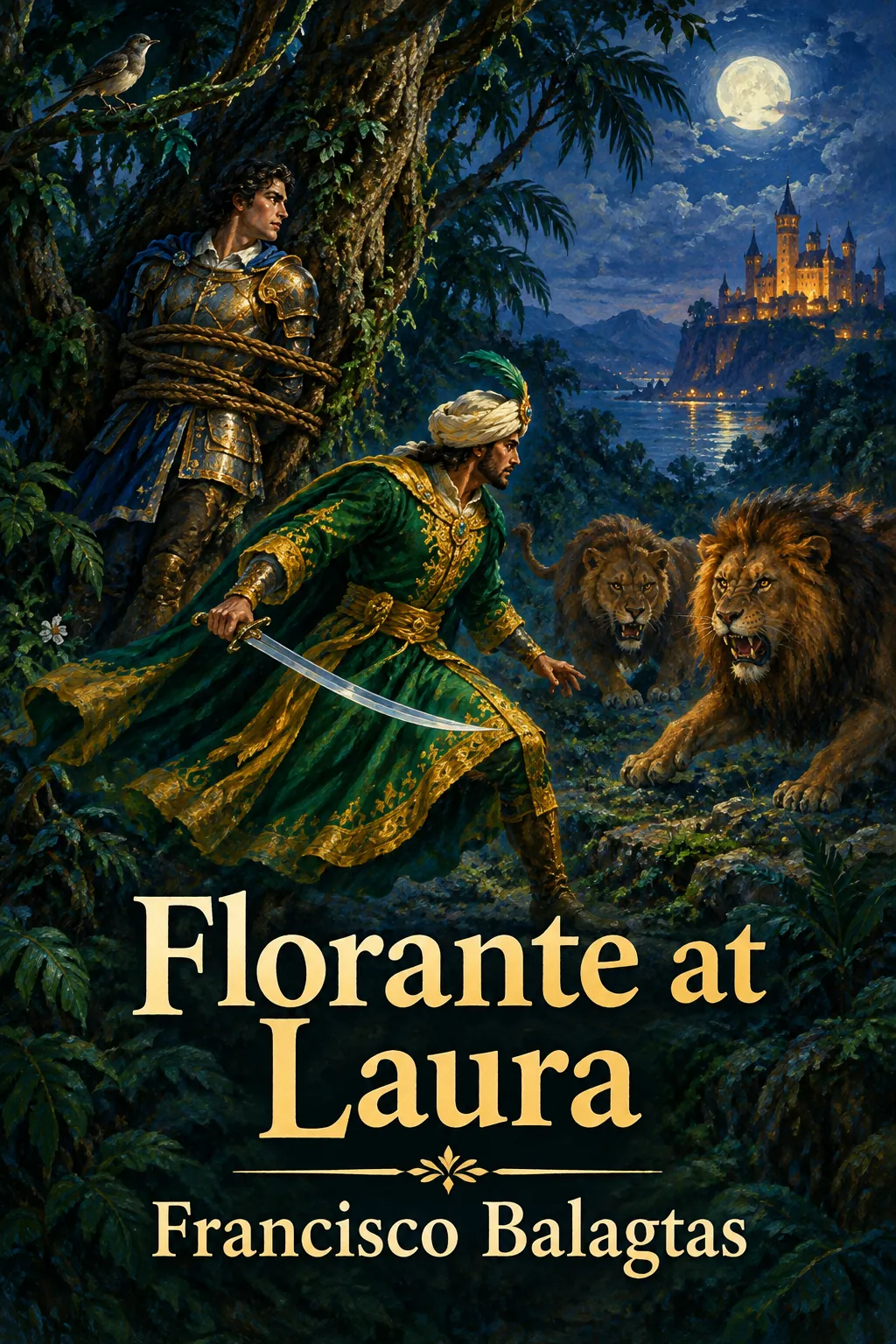
Florante at Laura is a narrative poem by Francisco Balagtas about Florante, a young Albanian general found tied to a tree in a dark forest. He is grieving for his country and for Laura, the woman he loves. Aladin, a Persian prince in exile, hears his cries and comes to help. As Florante tells his story, the poem moves from a school in Athens to wars and a betrayed kingdom, and asks who deserves to rule.
The Big Idea
"Balagtas's narrative poem asks what makes a ruler, a friend and a lover worthy of trust. Through the sufferings of Florante and Aladin, it argues that loyalty and love outlast treachery and tyranny."
Key Insights
Treachery and the abuse of power (Kataksilan)
Balagtas shows betrayal growing from small envy into a public disaster. Adolfo's jealousy in Athens becomes a seizure of the throne in Albania, and Sultan Ali-Adab's desire for Flerida makes him a tyrant to his own son. The poem presents this as a danger in every court, not only one nation.
Adolfo has Florante ambushed just after Florante has defended Albania, so the man who protected the kingdom is punished and the man who endangered it is rewarded.
Love and loyalty (Pag-ibig at katapatan)
Love in the poem is tested by separation, danger and temptation. Florante keeps Laura in his heart even in chains, and Aladin's love for Flerida survives banishment. Their faithfulness is set against Adolfo's wish to possess, which shows the difference between love and control.
Flerida agrees to marry the Sultan to save Aladin's life, then escapes to search for him, which shows love as courage and sacrifice.
Friendship across faith and nations (Pagkakaibigan)
The bond between Florante and Aladin is the poem's most striking choice. Aladin owes Florante nothing, yet he risks his life against two lions. Balagtas shows goodness in a Persian prince while a nobleman from Albania turns traitor, so the poem judges people by their actions, not their labels.
Menandro, Aladin and Flerida together bring about the rescue, forming a circle of loyal friends from different lands.
Hope after suffering (Pag-asa)
The story begins at its lowest point, with a hero chained in a dark forest, and then moves backward to explain how he got there. By returning to the forest and letting the characters meet, Balagtas shows that despair is only the middle of the story. Hope arrives through the actions of other people.
Florante's lament opens the poem, and by the end he rules Albania beside Laura, with Persia at peace under Aladin and Flerida.
Chapter Breakdown
Chapter-by-chapter summary (Buod ng mga Kabanata)
Spoiler warning: this section covers the whole plot, including the ending.
Balagtas wrote the poem in saknong (stanzas), and school editions group them into kabanata with different titles and numbers. The seven parts below follow the story's natural turns, so you can match them to the chapter list in your own copy.
Part 1: In the Dark Forest (Sa Gubat na Madilim)
The poem opens in a wild forest outside Albania, where Florante is tied to a tree and speaks his grief aloud. He cries out for Laura and mourns his country, which he says is ruled by treachery.
Nearby, Prince Aladin, a Persian exile, hears the lament and sees two lions closing in on the helpless man. He kills the lions and frees Florante.
Starting in the middle of the crisis gives the poem its mood of sorrow and makes us ask how a hero ended up here. The rest of the story answers that question.
Part 2: Childhood and Athens (Ang Kabataan at ang Atenas)
Florante is the son of Duke Briseo and Princess Floresca of Albania. As a boy he is sent to Athens to study under the teacher Antenor, where he becomes an outstanding pupil.
His success makes the nobleman Adolfo jealous, and during a school play Adolfo tries to harm him. Menandro, Antenor's nephew and Florante's close friend, saves him, and Adolfo soon leaves for Albania.
These school scenes show where Adolfo's hatred begins and why Menandro's loyalty will matter later.
Part 3: Love and War at Crotona (Si Laura at ang Digmaan sa Crotona)
Florante returns to Albania with Menandro, where he meets Laura, the daughter of King Linceo, and the two fall in love. Soon envoys from Crotona ask Albania for help against Persian attack, and Florante agrees to lead the army.
At Crotona he defeats the Persian general Osmalik in a long battle and stays there for some months.
This is Florante at his best, as a general, a friend and a lover, which makes his later fall more painful.
Part 4: The Fall of Albania (Ang Pagbagsak ng Albanya)
On his way home Florante finds a Persian flag flying over Albania. He saves Laura from execution, retakes the palace and frees the king and Adolfo, and he is honoured as Defender of Albania.
The praise deepens Adolfo's hatred. After Florante drives back another invasion, King Linceo calls him home, but Adolfo's men ambush and imprison him.
In prison Florante learns that his father and the king have been killed, and he is then taken to the forest and bound to the tree where the poem began. The real danger came from inside the kingdom.
Part 5: Aladin's Story (Ang Salaysay ni Aladin)
After the rescue, Aladin explains why he too is alone in the forest. He is the son of Sultan Ali-Adab of Persia and loves Flerida, but the Sultan wants her for himself.
The Sultan imprisons his son, and Flerida agrees to marry the Sultan to save Aladin's life. Aladin is banished and wanders in despair.
Aladin's grief mirrors Florante's, so the two men, a Christian and a Muslim, understand each other's pain.
Part 6: Flerida and Laura (Si Flerida at si Laura)
Meanwhile Flerida has escaped the Sultan's palace and is searching for Aladin in the same forest. She comes upon Adolfo about to attack a woman and shoots him dead with her bow.
The woman is Laura. She explains that Adolfo seized power with lies and plots, wanted to make her his queen, and was driven out when Menandro's army arrived, so he fled into the woods with her.
With this meeting the forest holds all four lovers, and the poem's separate stories come together.
Part 7: Reunion and Restoration (Ang Muling Pagkikita)
Menandro's army finds them, and Florante, Laura, Aladin and Flerida are reunited. They return to Albania, where Florante and Laura marry and rule as king and queen.
Aladin and Flerida also marry and take up rule in Persia, and the poem ends in peace between the two lands.
Justice returns not by magic but through the loyalty of friends, which is the aral of the whole poem.
Characters (Mga Tauhan)
- Florante: the son of Duke Briseo and Princess Floresca, a gifted student in Athens and later the general who defends Albania. He is brave, loyal and devoted to Laura, and the poem's suffering centres on him.
- Laura: the daughter of King Linceo and Florante's beloved. She is faithful under pressure and survives Adolfo's plots until she is rescued.
- Aladin: the Persian prince banished by his father Sultan Ali-Adab. He rescues Florante from the lions and becomes his friend, showing that goodness does not depend on religion or nation.
- Flerida: Aladin's beloved, whom the Sultan tries to take for himself. She is resourceful and brave, and she stops Adolfo with an arrow to save Laura.
- Adolfo: Florante's jealous rival from Athens and the poem's main villain. He seizes the throne of Albania through treachery and cruelty.
- Menandro: Florante's close friend and Antenor's nephew. He saves Florante in Athens and later brings the army that ends Adolfo's rule.
- Sultan Ali-Adab: the ruler of Persia and Aladin's father. He abuses his power by imprisoning and banishing his son because he desires Flerida.
- Antenor: Florante's teacher in Athens. He represents wise guidance and the value of a good education.
Themes (Tema) at a glance
- Treachery and the abuse of power (kataksilan)
- Love and loyalty (pag-ibig at katapatan)
- Friendship across faith and nations (pagkakaibigan)
- Hope after suffering (pag-asa)
Writing about this book (Pagsulat tungkol sa Florante at Laura)
Grade 9 and 10 tasks on this poem usually ask for a character analysis, a theme and aral essay, a reaction paper or a compare-and-contrast. Start every task by choosing one clear point and proving it with evidence from the story.
For a character analysis, pick a trait, such as Adolfo's envy or Flerida's courage, and show it in two or three scenes. Explain what each action reveals about the character.
For a theme and aral essay, state the theme in one sentence, then show how it appears in at least two different parts of the poem. Finish with the lesson you take from it for your own life.
For a reaction paper, say honestly what moved or surprised you, and always support it with a moment from the text. A strong reaction paper connects the poem to today, such as corruption in public life or friendship across differences.
For compare and contrast, choose pairs that really illuminate each other, such as Florante and Aladin or Adolfo and Sultan Ali-Adab. Quote only a few words, in Filipino, and explain them in your own words.
The model answers below are labelled examples for learning. Study how they are built, then write your own and compare.
Take Action
Practical steps you can implement today:
-
Read the opening stanza first, then ask how each later part explains why Florante is tied to the tree.
-
Keep a small chart of tauhan with one trait and one scene for each, so character analysis becomes quick.
-
Link every theme to two scenes from different parts of the poem before writing an aral essay.
-
Quote only a few words of Balagtas's Filipino, then explain them in your own English, so your essay stays original.
Notable Quotes
"“Sa loob at labas ng bayan kong sawi, kaliluha'y siyang nangyayaring hari.” (Opening stanza; our translation: inside and outside my sorrowing land, treachery reigns as king.)"
— Francisco Balagtas
"“Ang laki sa layaw karaniwa'y hubad sa bait at muni't sa hatol ay salat.” (Florante's childhood account; our translation: a child raised in indulgence is usually bare of wisdom and short of judgment.)"
— Francisco Balagtas
"“masaklap na bunga ng maling paglingap, habag ng magulang sa irog na anak.” (Florante's childhood account; our translation: the bitter fruit of misplaced care, a parent's pity for a beloved child.)"
— Francisco Balagtas
Who Should Read This
This guide is for Grade 9 and 10 students in the Philippines who study Florante at Laura in English or Filipino class, and for anyone meeting the poem for the first time. It suits readers aged 14 to 17 who need a clear buod, a list of tauhan, the main themes and model answers.
Characters
Florante
protagonist
Florante is the son of Duke Briseo and Princess Floresca of Albania. He is a gifted student, a successful general and a faithful lover of Laura. His fall and recovery drive the story, and his suffering carries the poem's grief for a betrayed country.
Laura
beloved of the protagonist
Laura is the daughter of King Linceo and Florante's beloved. She is faithful and brave under pressure, and she survives Adolfo's attempts to make her his queen. Her rescue by Flerida helps bring the four lovers together.
Aladin
deuteragonist and rescuer
Aladin is a Persian prince banished by his father, Sultan Ali-Adab. He saves Florante from two lions and becomes his friend. His kindness shows that virtue does not depend on a person's religion or country.
Flerida
heroine and rescuer
Flerida is Aladin's beloved, whom the Sultan tries to marry. She agrees to the marriage to save Aladin's life, then escapes to look for him. In the forest she shoots Adolfo with her bow to protect Laura.
Adolfo
antagonist
Adolfo is Florante's rival from Athens, driven by envy and a hunger for power. He seizes the throne of Albania through betrayal and cruelty and tries to force Laura to marry him. He is a foil to Florante and the poem's picture of tyranny.
Menandro
loyal friend
Menandro is Antenor's nephew and Florante's close friend. He saves Florante during a school play in Athens and later leads the army that drives Adolfo out of power. He represents friendship that lasts across years.
Sultan Ali-Adab
antagonist (second tyrant)
Sultan Ali-Adab is the ruler of Persia and Aladin's father. He imprisons and banishes his own son because he wants Flerida for himself. He parallels Adolfo by showing power used for selfish desire.
Antenor
mentor
Antenor is Florante's teacher in Athens and Menandro's uncle. He represents wise guidance and the value of education. His school is also where Adolfo's envy of Florante first becomes clear.
King Linceo
ruler of Albania
King Linceo is Laura's father and the king of Albania. He trusts Florante to defend the kingdom but fails to see Adolfo's treachery. His death marks the collapse of Albania's rule.
Duke Briseo
father figure
Duke Briseo is Florante's father and a royal adviser in Albania. His death at the hands of Adolfo's regime is one of the blows that Florante learns about in prison. He represents the loyal servants lost when treachery rules.
Osmalik
Persian general
Osmalik is the Persian general whom Florante defeats at Crotona. His defeat shows Florante's military skill and begins the chain of events that deepens Adolfo's envy.
Exam practice: sample answers
Model answers are examples to learn from; write your own in your words.
character analysis
1. Character analysis: How does Balagtas present Adolfo as a foil to Florante? Use evidence from the poem in your answer.
Outline
- State what a foil is and name the two characters
- Compare their behaviour in Athens
- Compare their behaviour in Albania
- Compare how each treats Laura
- Conclude with what the contrast teaches
Basic Model answer
Adolfo is the foil of Florante. A foil is a character who is the opposite of the hero, so that the hero's qualities are easier to see.
Florante is brave, loyal and loved by the people of Albania. He fights for his country and helps his friends, such as Menandro.
Adolfo is jealous and selfish. In Athens he hates Florante because Florante is a better student, and later he wants power for himself.
Their actions show the difference. Florante defends Albania from its enemies, but Adolfo plots against the king and takes the throne.
He also wants Laura, even though Florante loves her.
Because of this, readers can clearly see what a good leader and a bad leader look like. Balagtas wants us to admire Florante and to be careful of people like Adolfo.
In conclusion, Adolfo is a foil to Florante because he is jealous and cruel while Florante is loyal and brave. Their difference helps us understand the lesson of the poem.
Good Model answer
In Florante at Laura, Francisco Balagtas makes Adolfo a foil to Florante, and the contrast shows that true leadership is measured by service to others, not by ambition.
The contrast begins in Athens, where both young men study under Antenor. Florante earns respect through talent and good character, while Adolfo grows bitter and, during a school play, tries to harm him until Menandro intervenes.
This early scene matters because it shows Adolfo's flaw before he has any power. He hates Florante not for something Florante did, but for what Florante is.
The contrast sharpens in Albania. Florante defeats the Persian general Osmalik at Crotona, then returns to save Laura and the palace from invaders, and he is honoured as Defender of Albania.
Each honour feeds Adolfo's envy.
Adolfo then uses Florante's service against him. Florante is ambushed when he is called home, the king and Florante's father are killed, and Florante is left bound to a tree.
The opening lines of the poem name this reversal: Sa loob at labas ng bayan kong sawi, kaliluha'y siyang nangyayaring hari. Treachery rules as king, and Adolfo is its human face.
The foil also explains the ending. Menandro, who once saved Florante from Adolfo's attack, returns with an army, and Flerida's arrow stops Adolfo in the forest.
Love completes the contrast. Florante's love for Laura is shown in loyalty and grief, whereas Adolfo treats her as something to possess and pursues her into the forest.
A good reader will also notice that Adolfo is not only Florante's rival but a danger to the whole kingdom. His private envy becomes public harm, so the poem treats him as a warning as well as an enemy.
Balagtas therefore uses Adolfo to show what Florante is not. The comparison teaches that talent and loyalty make a leader, while envy turns power into tyranny.
Excellent Model answer
Balagtas builds Adolfo as the dark mirror of Florante, and the mirror does more than flatter the hero: it turns a personal rivalry into a judgment on how power should be held.
The rivalry starts in Antenor's school in Athens, where talent meets envy. Florante earns admiration without seeking it, whereas Adolfo measures himself only against others.
When the envy turns into an attempt on Florante's life during a school play, Menandro's quick rescue also introduces the loyal friendship that will later help to save Albania.
Notice that Adolfo's cruelty is private before it is political. The poem lets us see the vice in a young student, so that his later crimes feel like the natural growth of a character, not a sudden twist.
Back in Albania, the contrast becomes one of public duty. Florante answers Crotona's call for help and defeats the Persian general Osmalik, then returns to rescue Laura and the palace when invaders threaten the kingdom.
Each victory is service to others, while each honour he receives deepens Adolfo's hatred.
Adolfo's victory is not won in battle but by conspiracy. While Florante is fighting for the realm, Adolfo takes the throne, and the king and Florante's father die.
Thus the man who defended Albania is chained to a tree, while the man who endangered it wears the crown.
This reversal is the poem's central irony, and the opening stanza names it plainly: Sa loob at labas ng bayan kong sawi, kaliluha'y siyang nangyayaring hari. The speaker says that treachery rules as king, and Adolfo is its human face.
Love sharpens the contrast further. Florante's love for Laura is shown in his grief for her while he suffers, while Adolfo's desire for her is control, and he pursues her in the forest until Flerida stops him with an arrow.
The arrow is meaningful because it comes from a Persian princess, someone Adolfo's world would not have counted as a rescuer.
Adolfo also has a double in the Persian Sultan Ali-Adab, who banishes his own son Aladin because he wants Flerida for himself. By placing an Albanian usurper and a Persian tyrant in parallel, Balagtas shows that corruption is not a matter of religion or nation, and that virtue can be found in Aladin as clearly as in Florante.
Many readers also hear a political voice behind the story. Because the poem appeared under Spanish rule, they read Albania as the Philippines and Adolfo as the abusive official who thrives while the loyal are punished.
This reading is an interpretation, but the poem's setting and its mood of sorrow give it support.
A final point concerns form. The awit, with its steady twelve-syllable lines, lets Balagtas place a lament and a story side by side, so we meet Florante's grief first and learn Adolfo's guilt only slowly, which makes the reader share the shock of the truth.
In the end, Adolfo is the foil that gives Florante's goodness its meaning. He shows what ambition looks like without conscience, and the poem returns from the dark forest to a restored kingdom only when loyal people act together: Menandro with the army, Aladin with his friendship, Flerida with her bow.
Marking rubric
- Defines foil and names the contrast clearly (2 marks)
- Uses specific scenes from Athens and Albania (3 marks)
- Quotes briefly and explains the quotation (2 marks)
- Shows what the contrast teaches about leadership (2 marks)
- Organises paragraphs and uses accurate language (1 mark)
Now write your own
Choose another pair of foils from the poem, such as Aladin and Sultan Ali-Adab or Flerida and Adolfo. Write your own character analysis of about 300 words, then compare it with the three levels above.
theme and aral essay
2. Theme and aral essay: Explain how Florante at Laura deals with betrayal and the abuse of power. State one aral that a Grade 10 reader can take from it.
Outline
- Name the theme and the main examples of it
- Show the effects on people and kingdoms
- Show how the poem answers betrayal
- State the aral and link it to today
Basic Model answer
Florante at Laura shows how betrayal and abuse of power hurt both people and countries. The main traitor is Adolfo, who is jealous of Florante and takes the throne of Albania by force.
Because of him, the king and Florante's father are killed, and Florante is tied to a tree in the forest.
Another example is Sultan Ali-Adab in Persia. He wants Flerida, the woman his son Aladin loves, so he punishes his own son.
These two rulers use power for themselves and not for the people.
The poem also shows what happens when good people stay loyal. Menandro, Aladin and Flerida help the heroes, and in the end the kingdom is saved.
The aral is that power must be used with honesty and care. We should not let envy or selfishness control us, and we should be loyal to people who are good to us.
Good Model answer
Florante at Laura presents betrayal and abuse of power as forces that destroy families and kingdoms, and it answers them with loyalty, friendship and justice.
Adolfo is the clearest example. Driven by envy, he plots against the kingdom and takes the throne, and the king and Florante's father are put to death, so Albania loses both its ruler and its defender.
The Persian side repeats the pattern. Sultan Ali-Adab imprisons and banishes his son Aladin because he wants Flerida for himself.
In both courts, personal desire is placed above duty and justice.
Florante's suffering shows the cost. He loses his father, his freedom and nearly his life, so betrayal is not an abstract idea but a personal wound felt in a family.
The poem's opening gives the idea its voice: Sa loob at labas ng bayan kong sawi, kaliluha'y siyang nangyayaring hari. The speaker says treachery rules inside and outside the country, which tells us this is a problem of the whole society.
Balagtas does not stop at despair. Aladin saves Florante from lions, Flerida stops Adolfo with her arrow, and Menandro brings an army.
Each rescue shows that goodness needs action, not only suffering.
These rescues also cross lines of religion and country, since a Persian prince and princess help an Albanian general. The poem suggests that character matters more than the label a person carries.
The aral for a Grade 10 reader is that power is a trust. Leaders must serve others, and ordinary people must refuse the envy and selfishness that make betrayal possible.
Today's readers may connect this to corruption in public life, where private gain harms ordinary people. Finally, the story ends with restored kingdoms, which gives hope that justice is possible when loyal people act together.
Excellent Model answer
Balagtas treats treachery as a chain that runs from the schoolroom to the throne, and he answers it with a counter-chain of loyal acts, so that the poem's aral is not only that tyranny is wrong but that goodness must be active.
The chain begins with envy. In Athens Adolfo cannot bear Florante's success and tries to harm him at a school play, which shows that betrayal begins as a private feeling long before it becomes a public crime.
A reader who notices this early scene understands the later coup as the grown-up form of an old jealousy.
In Albania the chain reaches the state. Adolfo ambushes the general who has just defended the kingdom, and the king and Florante's father die.
The opening stanza states the result directly: Sa loob at labas ng bayan kong sawi, kaliluha'y siyang nangyayaring hari.
The word hari is the point: treachery is not merely a crime here but a ruler. Balagtas, writing under colonial rule, gives readers a language to describe a society where wrongdoers are in charge, and many have read Albania as a veiled picture of the Philippines.
This reading is an interpretation, but the poem's persistent grief for a betrayed land supports it.
The same pattern appears in Persia. Sultan Ali-Adab, a father and a ruler, imprisons his own son because he desires Flerida.
The parallel prevents any simple reading of the poem as Christian virtue against Muslim vice, because tyranny is shown on both sides and virtue appears in Aladin and Flerida as clearly as in Florante.
The proverb Ang laki sa layaw karaniwa'y hubad / sa bait at muni't sa hatol ay salat can be read as widening the theme from politics to upbringing. It suggests that care without discipline weakens judgment, and that the habits of the young eventually shape the conduct of the powerful.
Against the chain of betrayal, Balagtas sets a chain of rescues. Aladin saves Florante from the lions, Flerida stops Adolfo with her arrow, and Menandro returns with the army that ends the usurper's rule.
Aladin and Flerida owe Florante and Laura nothing, yet they act, which makes loyalty a choice and not an accident.
The structure of the poem supports this movement. It begins in a dark forest at the moment of greatest despair, moves backward through Florante's and Aladin's stories, and returns to the forest, where the characters come together.
The form itself says that despair is only the middle of the story.
A critical reader might add that the neat ending of marriages and restored thrones is conventional and may ease the poem's anger too quickly. Still, the happy ending is earned by the characters' actions, and it gives the aral hope: justice is not guaranteed, but it can be built by people who refuse to be traitors.
The aral, then, is twofold. We must refuse the envy and selfishness that begin betrayal, and we must be ready to act, as Aladin, Flerida and Menandro do, when others suffer from it.
Marking rubric
- States the theme and the main examples (3 marks)
- Explains effects on people and kingdoms (2 marks)
- Shows how the poem responds to betrayal (2 marks)
- States a clear aral and links it to today (2 marks)
- Uses short, accurate quotations and clear paragraphs (1 mark)
Now write your own
Write your own theme and aral essay of about 350 words on a different theme, such as friendship across religions or hope after suffering. Use at least two scenes from different parts of the poem.
compare and contrast
3. Compare and contrast: How are Florante and Aladin alike and different, and what does the comparison suggest about the poem's view of friendship?
Outline
- Name the main similarities
- Name the main differences
- Explain their friendship
- State what the comparison teaches
Basic Model answer
Florante and Aladin are alike in some ways and different in others. Both are young men who lose the people they love because of unjust rulers.
Florante is separated from Laura by Adolfo's treachery, and Aladin is separated from Flerida by his father the Sultan.
They are also different. Florante is a Christian general from Albania who is known for fighting in wars, while Aladin is a Muslim prince from Persia who has been banished from his home.
Both men also feel such deep sorrow that they almost give up hope, which makes them understand each other.
Their friendship is the most important part. Aladin saves Florante from two lions even though they come from different countries and religions.
This comparison teaches that goodness is not limited by religion or nation. A good person helps others who suffer, and true friendship can cross differences.
Good Model answer
Florante and Aladin are mirror figures. Both lose the person they love through the abuse of power, but they differ in role and background, and their friendship shows that the poem values character over religion or nation.
The first similarity is loss. Florante loses Laura, his family and his freedom when Adolfo seizes Albania, while Aladin loses Flerida and his home when Sultan Ali-Adab imprisons and banishes him.
In both cases a person with power uses it for selfish desire. Neither hero is defeated by a fair fight; both are wronged by those who should have protected them.
The second similarity is despair. Florante is found bound to a tree and crying out his grief, and Aladin is a wanderer who has given up on his own life.
Their pain gives them a shared understanding.
The differences are just as clear. Florante is a public hero, a general who defends Albania and is honoured for it, while Aladin's suffering is mostly private and domestic, centred on his father and Flerida.
Florante's enemy is a conspirator, Adolfo, but Aladin's enemy is his own father, which makes his wound a family one.
They also differ in religion and homeland, since Florante is an Albanian Christian and Aladin a Persian Muslim. Many would expect them to be enemies, because Florante's early victories were against Persian forces.
Instead, Aladin saves Florante from the two lions and nurses him. The rescue is a deliberate choice, and it makes Aladin the one who gives Florante a chance to tell his story.
This comparison suggests that the poem judges people by their actions. Goodness appears in a Persian prince, while the traitor Adolfo belongs to Florante's own kingdom.
Excellent Model answer
Florante and Aladin are built as mirror figures, and the poem uses their pairing to argue that friendship, not religion or rank, is the force that repairs a broken world.
The similarities are deliberate. Each man is wronged by someone who holds power: Adolfo seizes Albania and destroys Florante's family, while Sultan Ali-Adab imprisons and banishes his own son because he wants Flerida.
The symmetry goes further. Each man loses a beloved, and each is rescued by the courage of someone outside his own land.
Aladin rescues Florante from the lions, and Flerida rescues Laura from Adolfo with her arrow. A man saves a man and a woman saves a woman, so the rescues form a balanced pattern that unites the four lovers.
The two couples also mirror each other in how they love. Florante keeps faith with Laura through chains and grief, and Aladin keeps faith with Flerida through banishment, so both men prove that love can survive the loss of rank and freedom.
The differences are equally important. Florante is a public man, a general whose actions affect nations, and his suffering is political: he is betrayed by a rival and a corrupt court.
Aladin's suffering is domestic and personal, since his enemy is his father and his wound is a family one. Together they show that tyranny can appear in a throne room or in a home.
Their religions also differ. Florante is an Albanian Christian and Aladin a Persian Muslim, and readers who know the history of conflict between Christians and Muslims in the Spanish-ruled Philippines may find the pairing notable.
It is a bold choice for a poem written in that world, because Balagtas makes the Persian prince the rescuer and the Albanian nobleman the traitor. The poem therefore avoids dividing virtue by religion, and it judges each person by what he does.
The pairing also corrects the idea of the hero as a lone fighter. Florante the general cannot save himself, and he is rescued by a wanderer with no army, which reminds the reader that strength needs help from others.
A counter-view is possible: Aladin's rescue happens almost by chance, because he hears the lament while wandering. Yet his choice to stay, to fight the lions and to listen shows that goodwill, not luck, makes the friendship.
Structure strengthens the point. Because Aladin saves Florante, Florante is able to tell his story, and Aladin then tells his, so each man becomes the other's listener.
This shared telling is where friendship begins, and it gives the poem its frame: a lament in the forest, then two life stories, then a return to the forest and a rescue.
The poem's opening words, Sa loob at labas ng bayan kong sawi, kaliluha'y siyang nangyayaring hari, express Florante's grief, but it is Aladin's presence that turns grief into conversation and then into action.
Finally, both men are restored in parallel. Florante rules Albania with Laura, and Aladin takes up rule in Persia with Flerida, so the poem ends with two kingdoms led by friends rather than rivals.
The comparison therefore suggests that friendship across difference is not a decoration but the poem's answer to treachery.
Marking rubric
- Names similarities and differences with evidence (4 marks)
- Explains the friendship and the rescue (2 marks)
- States what the comparison teaches (2 marks)
- Organises the comparison clearly (1 mark)
- Uses accurate language and brief quotations (1 mark)
Now write your own
Compare Florante and Laura, or Laura and Flerida, in your own words. Write about 300 words and use at least two scenes as evidence.
Frequently Asked Questions
Who wrote Florante at Laura and when?
Francisco Balagtas, also written Baltazar, a Tagalog poet from Bulacan. The poem is dated 1838, and the earliest known printed edition is from 1853. Balagtas died in 1862, so the original Tagalog text is in the public domain.
What is the summary (buod) of Florante at Laura?
Florante, an Albanian general, is found tied to a tree in a forest after being betrayed by his rival Adolfo. Prince Aladin saves him, and each man tells his story. After more rescues the lovers are reunited, Adolfo's rule ends, and justice is restored.
Who are the main characters (tauhan) of Florante at Laura?
The main tauhan are Florante, Laura, Aladin and Flerida, with Adolfo as the villain and Menandro as the loyal friend. Sultan Ali-Adab, King Linceo, Duke Briseo and the teacher Antenor shape the story. The character list on this page gives each role.
How many chapters (kabanata) does Florante at Laura have?
Balagtas wrote 399 saknong (stanzas), not chapters. Many school editions group the stanzas into kabanata with titles, and the grouping differs between editions, so follow the version your teacher uses. This guide divides the story into seven parts.
What are the themes and aral of Florante at Laura?
The main themes are treachery and abuse of power, love and loyalty, friendship across religion and nation, and hope after suffering. A common aral is that power is a trust and that people should be judged by their actions, not their labels.
What kind of poem is Florante at Laura?
It is an awit, a Tagalog narrative poem in four-line stanzas with twelve syllables per line. The story is set in Albania and Persia, and it is told partly through the characters' own accounts of their lives.
Check Your Understanding
Pick an answer for each question to see if you were right.
-
Where is Florante when the poem opens?
Tied to a tree in a dark forest — The poem begins with Florante bound to a tree in a forest, lamenting his fate.
-
Who saves Florante from two lions?
Aladin — Prince Aladin of Persia hears Florante's lament and kills the lions.
-
Who is Florante's jealous rival?
Adolfo — Adolfo envies Florante from their school days in Athens and later seizes the throne of Albania.
-
Who stops Adolfo in the forest with a bow and arrow?
Flerida — Flerida, searching for Aladin, finds Adolfo attacking Laura and shoots him.
-
What is the poetic form of Florante at Laura?
An awit with twelve-syllable lines — It is an awit written in four-line stanzas of twelve syllables.
About Francisco Balagtas
Francisco Balagtas (1788–1862), also written Baltazar, was a Tagalog poet from Bulacan in the Philippines. He wrote Florante at Laura under Spanish colonial rule, and it is regarded as a masterpiece of Tagalog literature. He is often called the Prince of Tagalog Poets, and Filipino students still read his poem today.
Summary Written By

Software Engineer & Writer
Software engineer with a passion for distilling complex ideas into actionable insights. Writes about finance, investment, entrepreneurship, and technology.
View all summaries →Reviews
No reviews yet. Be the first to share your thoughts!
Write a Review
Keep reading
Explore the topic: Study GuidesSummaries

The Outsiders by S.E. Hinton
S.E. Hinton
Ponyboy Curtis and his gang of Greasers clash with the wealthy Socs in a cycle of violence. After a tragic…
To Kill a Mockingbird by Harper Lee
Harper Lee
A young girl named Scout Finch grows up in the racially divided town of Maycomb, Alabama. Through her father Atticus's…
Rashomon
Ryunosuke Akutagawa
Rashomon is a short story by Ryunosuke Akutagawa, published in 1915 and set in Kyoto during a time of famine…
Macbeth
William Shakespeare
Macbeth is a Scottish general who has just won a battle for King Duncan. On a heath, three witches tell…
Articles
Susanoo and the Eight-Headed Serpent (Yamata no Orochi)
In the Kojiki, the storm god Susanoo, banished from heaven, reaches Izumo and learns that the eight-headed serpent Yamata no…
The Trojan War and the wooden horse
The Trojan War is the Greek legend of a ten-year siege of Troy, ended by a hollow wooden horse. The…

Kuchisake-onna and Japanese Urban Legends
Kuchisake-onna, the slit-mouthed woman, is a Japanese urban legend about a masked stranger who asks children whether she is pretty.…