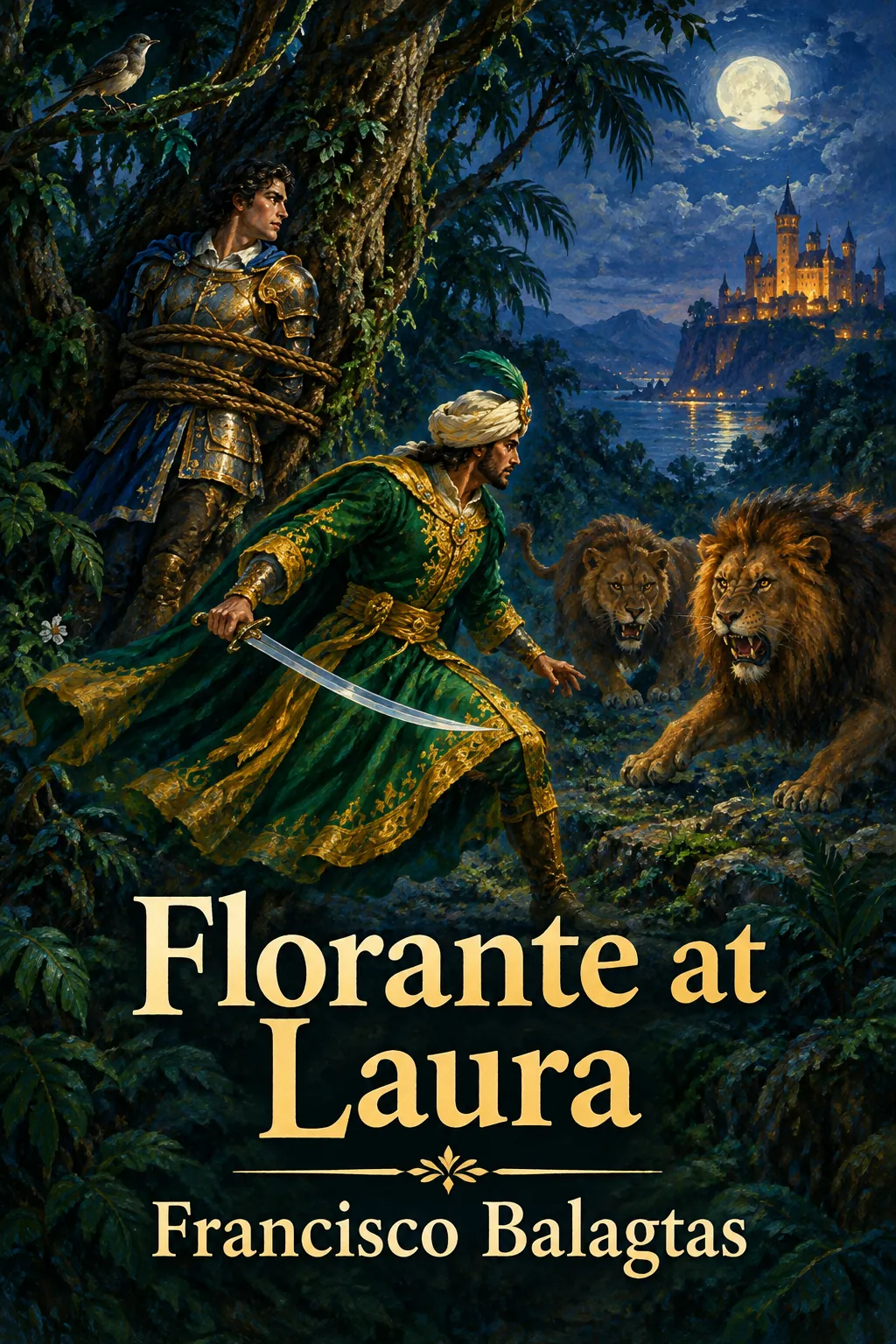
Florante at Laura
Tác giả: Francisco Balagtas
Florante at Laura is a narrative poem by Francisco Balagtas about Florante, a young Albanian general found tied to a tree in a dark forest. He is grieving for his country and for Laura, the woman he loves. Aladin, a Persian prince in exile, hears his cries and comes to help. As Florante tells his story, the poem moves from a school in Athens to wars and a betrayed kingdom, and asks who deserves to rule.
Ý Tưởng Chính
"Balagtas's narrative poem asks what makes a ruler, a friend and a lover worthy of trust. Through the sufferings of Florante and Aladin, it argues that loyalty and love outlast treachery and tyranny."
Những Hiểu Biết Cốt Lõi
Treachery and the abuse of power (Kataksilan)
Balagtas shows betrayal growing from small envy into a public disaster. Adolfo's jealousy in Athens becomes a seizure of the throne in Albania, and Sultan Ali-Adab's desire for Flerida makes him a tyrant to his own son. The poem presents this as a danger in every court, not only one nation.
Adolfo has Florante ambushed just after Florante has defended Albania, so the man who protected the kingdom is punished and the man who endangered it is rewarded.
Love and loyalty (Pag-ibig at katapatan)
Love in the poem is tested by separation, danger and temptation. Florante keeps Laura in his heart even in chains, and Aladin's love for Flerida survives banishment. Their faithfulness is set against Adolfo's wish to possess, which shows the difference between love and control.
Flerida agrees to marry the Sultan to save Aladin's life, then escapes to search for him, which shows love as courage and sacrifice.
Friendship across faith and nations (Pagkakaibigan)
The bond between Florante and Aladin is the poem's most striking choice. Aladin owes Florante nothing, yet he risks his life against two lions. Balagtas shows goodness in a Persian prince while a nobleman from Albania turns traitor, so the poem judges people by their actions, not their labels.
Menandro, Aladin and Flerida together bring about the rescue, forming a circle of loyal friends from different lands.
Hope after suffering (Pag-asa)
The story begins at its lowest point, with a hero chained in a dark forest, and then moves backward to explain how he got there. By returning to the forest and letting the characters meet, Balagtas shows that despair is only the middle of the story. Hope arrives through the actions of other people.
Florante's lament opens the poem, and by the end he rules Albania beside Laura, with Persia at peace under Aladin and Flerida.
Tóm Tắt Chương
Chapter-by-chapter summary (Buod ng mga Kabanata)
Spoiler warning: this section covers the whole plot, including the ending.
Balagtas wrote the poem in saknong (stanzas), and school editions group them into kabanata with different titles and numbers. The seven parts below follow the story's natural turns, so you can match them to the chapter list in your own copy.
Part 1: In the Dark Forest (Sa Gubat na Madilim)
The poem opens in a wild forest outside Albania, where Florante is tied to a tree and speaks his grief aloud. He cries out for Laura and mourns his country, which he says is ruled by treachery.
Nearby, Prince Aladin, a Persian exile, hears the lament and sees two lions closing in on the helpless man. He kills the lions and frees Florante.
Starting in the middle of the crisis gives the poem its mood of sorrow and makes us ask how a hero ended up here. The rest of the story answers that question.
Part 2: Childhood and Athens (Ang Kabataan at ang Atenas)
Florante is the son of Duke Briseo and Princess Floresca of Albania. As a boy he is sent to Athens to study under the teacher Antenor, where he becomes an outstanding pupil.
His success makes the nobleman Adolfo jealous, and during a school play Adolfo tries to harm him. Menandro, Antenor's nephew and Florante's close friend, saves him, and Adolfo soon leaves for Albania.
These school scenes show where Adolfo's hatred begins and why Menandro's loyalty will matter later.
Part 3: Love and War at Crotona (Si Laura at ang Digmaan sa Crotona)
Florante returns to Albania with Menandro, where he meets Laura, the daughter of King Linceo, and the two fall in love. Soon envoys from Crotona ask Albania for help against Persian attack, and Florante agrees to lead the army.
At Crotona he defeats the Persian general Osmalik in a long battle and stays there for some months.
This is Florante at his best, as a general, a friend and a lover, which makes his later fall more painful.
Part 4: The Fall of Albania (Ang Pagbagsak ng Albanya)
On his way home Florante finds a Persian flag flying over Albania. He saves Laura from execution, retakes the palace and frees the king and Adolfo, and he is honoured as Defender of Albania.
The praise deepens Adolfo's hatred. After Florante drives back another invasion, King Linceo calls him home, but Adolfo's men ambush and imprison him.
In prison Florante learns that his father and the king have been killed, and he is then taken to the forest and bound to the tree where the poem began. The real danger came from inside the kingdom.
Part 5: Aladin's Story (Ang Salaysay ni Aladin)
After the rescue, Aladin explains why he too is alone in the forest. He is the son of Sultan Ali-Adab of Persia and loves Flerida, but the Sultan wants her for himself.
The Sultan imprisons his son, and Flerida agrees to marry the Sultan to save Aladin's life. Aladin is banished and wanders in despair.
Aladin's grief mirrors Florante's, so the two men, a Christian and a Muslim, understand each other's pain.
Part 6: Flerida and Laura (Si Flerida at si Laura)
Meanwhile Flerida has escaped the Sultan's palace and is searching for Aladin in the same forest. She comes upon Adolfo about to attack a woman and shoots him dead with her bow.
The woman is Laura. She explains that Adolfo seized power with lies and plots, wanted to make her his queen, and was driven out when Menandro's army arrived, so he fled into the woods with her.
With this meeting the forest holds all four lovers, and the poem's separate stories come together.
Part 7: Reunion and Restoration (Ang Muling Pagkikita)
Menandro's army finds them, and Florante, Laura, Aladin and Flerida are reunited. They return to Albania, where Florante and Laura marry and rule as king and queen.
Aladin and Flerida also marry and take up rule in Persia, and the poem ends in peace between the two lands.
Justice returns not by magic but through the loyalty of friends, which is the aral of the whole poem.
Characters (Mga Tauhan)
- Florante: the son of Duke Briseo and Princess Floresca, a gifted student in Athens and later the general who defends Albania. He is brave, loyal and devoted to Laura, and the poem's suffering centres on him.
- Laura: the daughter of King Linceo and Florante's beloved. She is faithful under pressure and survives Adolfo's plots until she is rescued.
- Aladin: the Persian prince banished by his father Sultan Ali-Adab. He rescues Florante from the lions and becomes his friend, showing that goodness does not depend on religion or nation.
- Flerida: Aladin's beloved, whom the Sultan tries to take for himself. She is resourceful and brave, and she stops Adolfo with an arrow to save Laura.
- Adolfo: Florante's jealous rival from Athens and the poem's main villain. He seizes the throne of Albania through treachery and cruelty.
- Menandro: Florante's close friend and Antenor's nephew. He saves Florante in Athens and later brings the army that ends Adolfo's rule.
- Sultan Ali-Adab: the ruler of Persia and Aladin's father. He abuses his power by imprisoning and banishing his son because he desires Flerida.
- Antenor: Florante's teacher in Athens. He represents wise guidance and the value of a good education.
Themes (Tema) at a glance
- Treachery and the abuse of power (kataksilan)
- Love and loyalty (pag-ibig at katapatan)
- Friendship across faith and nations (pagkakaibigan)
- Hope after suffering (pag-asa)
Writing about this book (Pagsulat tungkol sa Florante at Laura)
Grade 9 and 10 tasks on this poem usually ask for a character analysis, a theme and aral essay, a reaction paper or a compare-and-contrast. Start every task by choosing one clear point and proving it with evidence from the story.
For a character analysis, pick a trait, such as Adolfo's envy or Flerida's courage, and show it in two or three scenes. Explain what each action reveals about the character.
For a theme and aral essay, state the theme in one sentence, then show how it appears in at least two different parts of the poem. Finish with the lesson you take from it for your own life.
For a reaction paper, say honestly what moved or surprised you, and always support it with a moment from the text. A strong reaction paper connects the poem to today, such as corruption in public life or friendship across differences.
For compare and contrast, choose pairs that really illuminate each other, such as Florante and Aladin or Adolfo and Sultan Ali-Adab. Quote only a few words, in Filipino, and explain them in your own words.
The model answers below are labelled examples for learning. Study how they are built, then write your own and compare.
Hành Động Ngay
Các bước thực tế bạn có thể thực hiện ngay hôm nay:
-
Read the opening stanza first, then ask how each later part explains why Florante is tied to the tree.
-
Keep a small chart of tauhan with one trait and one scene for each, so character analysis becomes quick.
-
Link every theme to two scenes from different parts of the poem before writing an aral essay.
-
Quote only a few words of Balagtas's Filipino, then explain them in your own English, so your essay stays original.
Trích Dẫn Đáng Nhớ
"“Sa loob at labas ng bayan kong sawi, kaliluha'y siyang nangyayaring hari.” (Opening stanza; our translation: inside and outside my sorrowing land, treachery reigns as king.)"
— Francisco Balagtas
"“Ang laki sa layaw karaniwa'y hubad sa bait at muni't sa hatol ay salat.” (Florante's childhood account; our translation: a child raised in indulgence is usually bare of wisdom and short of judgment.)"
— Francisco Balagtas
"“masaklap na bunga ng maling paglingap, habag ng magulang sa irog na anak.” (Florante's childhood account; our translation: the bitter fruit of misplaced care, a parent's pity for a beloved child.)"
— Francisco Balagtas
Ai Nên Đọc Cuốn Này
This guide is for Grade 9 and 10 students in the Philippines who study Florante at Laura in English or Filipino class, and for anyone meeting the poem for the first time. It suits readers aged 14 to 17 who need a clear buod, a list of tauhan, the main themes and model answers.
Về Francisco Balagtas
Francisco Balagtas (1788–1862), also written Baltazar, was a Tagalog poet from Bulacan in the Philippines. He wrote Florante at Laura under Spanish colonial rule, and it is regarded as a masterpiece of Tagalog literature. He is often called the Prince of Tagalog Poets, and Filipino students still read his poem today.
Tóm Tắt Được Viết Bởi

Kỹ sư phần mềm & Nhà văn
Kỹ sư phần mềm với niềm đam mê chuyển đổi ý tưởng phức tạp thành hiểu biết thực tiễn. Viết về tài chính, đầu tư, khởi nghiệp và công nghệ.
Xem tất cả tóm tắt →Đánh Giá
Chưa có đánh giá nào. Hãy là người đầu tiên chia sẻ suy nghĩ của bạn!
Viết Đánh Giá
Đọc tiếp
Khám phá chủ đề: Hướng dẫn học tậpTóm tắt sách

Những Kẻ Ngoài Lề - S.E. Hinton
S.E. Hinton
Câu chuyện xoay quanh Ponyboy Curtis và nhóm bạn Greasers, những thanh niên nghèo bị coi thường bởi nhóm Socs…
Giết con chim nhại - Harper Lee
Harper Lee
Một câu chuyện cảm động về hai đứa trẻ tại Alabama chứng kiến cha mình, luật sư Atticus Finch, bào…
La Sinh Môn (Rashomon)
Ryunosuke Akutagawa
La Sinh Môn là truyện ngắn của Akutagawa Ryunosuke, đăng năm 1915, lấy bối cảnh Kyoto thời nạn đói và…
Macbeth
William Shakespeare
Macbeth là một vị tướng Scotland vừa thắng trận cho vua Duncan. Trên một vùng đồng hoang, ba mụ phù…
Bài Viết
Susanoo và con rắn tám đầu Yamata no Orochi (Bát Kỳ Đại Xà)
Trong Kojiki, thần bão Susanoo bị đuổi khỏi thiên giới, đến vùng Izumo và biết rằng con rắn tám đầu…
Cuộc chiến thành Troy và con ngựa gỗ
Chiến tranh thành Troy là truyền thuyết Hy Lạp về cuộc vây hãm Troy kéo dài mười năm, kết thúc…
Kuchisake-onna và truyền thuyết đô thị Nhật Bản: người phụ nữ rạch miệng
Kuchisake-onna, người phụ nữ rạch miệng, là truyền thuyết đô thị Nhật Bản về một người lạ đeo khẩu trang…