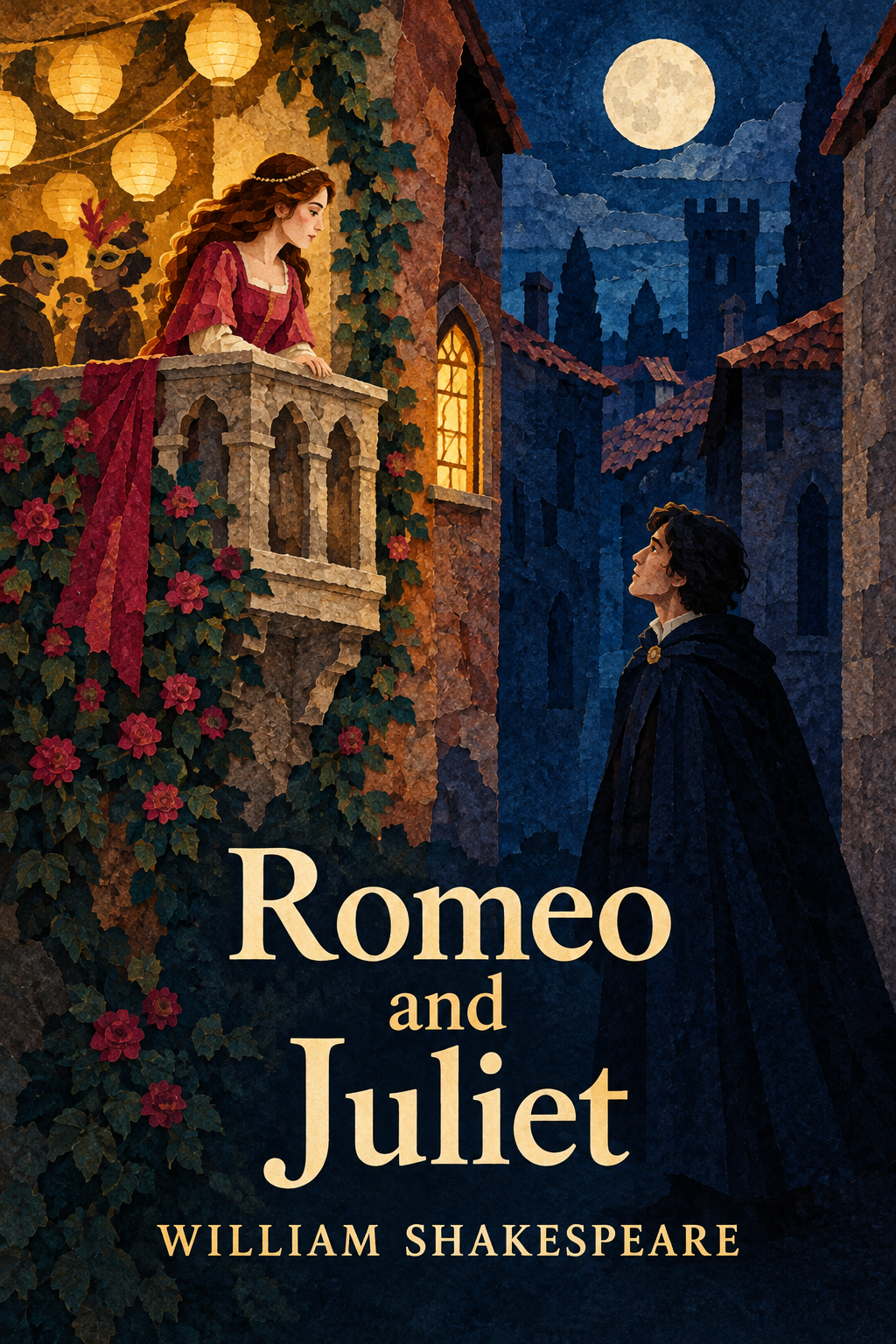
Romeo and Juliet
Tác giả: William Shakespeare
Romeo and Juliet is Shakespeare's tragedy about two young lovers from rival families in Verona. Romeo is a Montague and Juliet is a Capulet. They meet at a Capulet party, fall in love and marry in secret. Their happiness is tested by a street fight, a banishment and a plan that depends on timing. The play is short, fast and emotional, and it is a good place to start reading Shakespeare.
Ý Tưởng Chính
"Romeo and Juliet is a tragedy about two young lovers from feuding Verona families who fall in love fast and marry in secret, defying both households. The play asks what a family feud costs people who never chose it."
Những Hiểu Biết Cốt Lõi
A feud that outlives its cause
The play never explains how the Montague and Capulet feud began. The families keep fighting out of habit, and the servants, who have no stake in the quarrel, pick it up and carry it into the streets. The feud is the world the lovers must escape, and it turns every private choice into a public matter.
The opening brawl starts with a quarrel between servants over almost nothing. The Prince's warning shows that the city's leaders are losing patience, yet neither family can stop, and the same pattern returns again and again through the play.
Haste and impulse
Romeo and Juliet move from a first meeting to a secret marriage within about a day. Friar Laurence warns against the speed of it: “Wisely and slow; they stumble that run fast.” The play shows how quickly a choice made in a rush can harden into consequences that nobody can take back.
Romeo goes from pining for Rosaline to declaring love for Juliet in a single evening. The speed that makes their romance exciting is the same speed that leaves no time for second thoughts when the street fight breaks out.
Bad luck and bad timing
Many of the play's turns depend on a message that does not arrive, or arrives too late. Shakespeare builds the ending from small accidents, so the audience is left wondering whether anyone could have stopped it. Fate is named again and again, from the prologue's star-crossed lovers to Romeo's own cry against his fortune.
Friar John is held up by fears of plague, so the letter meant to save Juliet never reaches Romeo. Romeo sums up the feeling himself: “O, I am fortune's fool!”
Names and identity
Names decide who the lovers are allowed to love. Juliet argues that a name is only a word, but in Verona a family name tells everyone which side you are on. The characters react to those labels far more than to the people wearing them, and that gap is what makes the feud so hard to end.
On her balcony Juliet asks, “What's in a name?” and suggests Romeo drop his. At the end both fathers settle the feud by promising golden statues to the children they have lost, which turns the lovers into a symbol of peace.
Tóm Tắt Chương
Chapter-by-chapter summary
Spoiler warning: this section covers the whole plot, including the ending.
Act 1: Brawl, feast and first sight
The prologue sets the scene: two proud households in Verona have an old feud, and a pair of star-crossed lovers from them will pay for it. Servants of the Montagues and the Capulets start a street brawl, and Prince Escalus warns that the next fight will be punished by death. Romeo, a Montague, is moping over Rosaline, who has vowed to stay chaste. His cousin Benvolio talks him into going in disguise to a Capulet feast. There Romeo sees Juliet, and they speak and kiss before they learn each other's family names. Tybalt, Juliet's hot-tempered cousin, recognizes Romeo's voice and wants a fight, but Lord Capulet orders him to leave the guest alone. Why it matters: the feud is the world the lovers must escape, and their love begins in the middle of it.
Act 2: The balcony and the secret wedding
Romeo climbs over the orchard wall into the Capulet garden and hears Juliet speaking alone at her balcony. She asks why he has to be a Montague and begs him to refuse his name. Romeo says he will take her at her word, and the two confess their love in one of the play's most famous scenes. They agree to marry, and the Nurse carries messages between them to arrange the details. Romeo goes to Friar Laurence, who agrees to marry them in secret, partly hoping the union will end the feud. The wedding takes place at the friar's cell later that same day. Why it matters: the friar hopes the marriage will heal the feud, and that hope makes what follows more painful.
Act 3: Tybalt, Mercutio and banishment
Tybalt, still spoiling for a fight, challenges Romeo in the street. Romeo refuses, because he is now Tybalt's kinsman by marriage. Mercutio, Romeo's friend, is furious at what he sees as cowardice and fights in Romeo's place. Romeo steps between them, and Tybalt stabs Mercutio under Romeo's arm. Mercutio dies cursing both houses. In grief and rage, Romeo kills Tybalt. The Prince banishes Romeo from Verona instead of sentencing him to death. After one night together as husband and wife, the lovers part at dawn, and Romeo leaves for Mantua. Juliet's father meanwhile arranges her marriage to the young nobleman Paris. Why it matters: a street quarrel has become a crime, and the lovers' plans start to fall apart.
Act 4: The sleeping potion
Juliet's father has already set her wedding to Paris for Thursday. Juliet goes to Friar Laurence in despair, and he offers a desperate plan: a potion that will make her seem dead for about forty-two hours, so she can be laid in the family tomb. He will send word to Romeo in Mantua to come and take her away. Juliet agrees, and in front of her father she pretends to accept the marriage. Capulet, delighted, moves the wedding earlier, to Wednesday. Juliet drinks the potion the night before. The next morning the Nurse finds her cold, and the wedding preparations turn into mourning. Why it matters: the whole rescue depends on a single letter reaching Romeo in time.
Act 5: The tomb and the ending
In Mantua, Romeo wakes from a dream in which Juliet finds him dead and brings him back to life with kisses. Then his servant Balthasar brings the news that she is dead. Romeo buys poison from a poor apothecary and rides back to Verona. Friar John's letter, which would have told Romeo the truth, never arrives: he is held up by fears of plague. At the Capulet tomb, Romeo meets Paris, who has come to mourn Juliet; they fight, and Romeo kills him. Romeo drinks the poison beside Juliet's body. Juliet wakes, finds him dead, and stabs herself with his dagger. Watchmen, the Prince and both families arrive, and Friar Laurence explains the whole story. The Prince rebukes both houses, and the fathers agree to peace and promise gold statues for the children they lost. Why it matters: the peace comes only after the deaths, which is the play's bitterest irony.
Characters
- Romeo Montague: The son of Lord Montague and the play's romantic lead. He starts out lovesick over Rosaline, then falls for Juliet at first sight and acts on impulse. Passionate and quick to act, he drives the story with choices that cannot be undone.
- Juliet Capulet: Lord and Lady Capulet's daughter, and not yet fourteen. She begins as an obedient daughter, then becomes the play's most determined character, choosing love over her family's wishes and, in the end, her own fate.
- Friar Laurence: A friar in Verona who knows his herbs. He marries Romeo and Juliet in secret, hoping the marriage will heal the feud, and he gives Juliet the sleeping potion. His plans depend on messages and timing, and both fail him.
- The Nurse: Juliet's nurse, a warm and talkative servant who has known her since childhood. She carries messages between the lovers and is loyal at first, but after Romeo's banishment she urges Juliet to marry Paris, and Juliet loses trust in her.
- Mercutio: Romeo's quick-witted friend and a kinsman of the Prince. He mocks romance, delivers the famous Queen Mab speech, and dies in a fight he takes on for Romeo. His death is the first big turning point of the play.
- Benvolio: Romeo's cousin and the family's peacemaker. He tries to stop fights, persuades Romeo to attend the Capulet feast, and describes the street fight to the Prince. His calm approach contrasts with the anger of Tybalt and Mercutio.
- Tybalt: Lady Capulet's nephew and the family's quick-tempered swordsman. He hates the Montagues, recognizes Romeo at the feast, and kills Mercutio. Romeo then kills him in revenge, and that killing sets the story on its darkest course.
- Lord Capulet: Juliet's father and head of the Capulet house. He hosts the feast with warmth, but he turns harsh when Juliet refuses Paris, and he pushes the wedding forward out of pride and anger. Regret comes at the very end.
- Lady Capulet: Juliet's mother, cool and formal, with little warmth toward her daughter. She backs the match with Paris and, after Tybalt's death, wants the wedding arranged quickly. She is more concerned with appearances than with Juliet's feelings.
- Paris: A young nobleman and kinsman of the Prince, who wants to marry Juliet. He is courteous and confident, but he hardly knows her and treats the match as settled business. He dies at the tomb, fighting Romeo.
- Prince Escalus: The ruler of Verona, who wants peace above all. He threatens death for brawling and, after the deaths of Mercutio and Tybalt, banishes Romeo rather than executing him. His final rebuke pushes both families toward a peace they should have made earlier.
Writing about this book
If you are writing a book report, start with a question rather than a plot list. Good options include: Who is most responsible for the deaths, and why? Does Romeo change during the play, or does he only react to what happens to him? What would have changed if Friar John's letter had arrived on time? Choose one scene, such as the balcony or the tomb, and explain how the language shows what the characters feel. Support every point with a short quote, along with its act and scene.
A useful structure has three parts: a clear claim, two or three scenes that prove it, and a closing paragraph that asks what the play says about your own world. Keep each quote short, and check the wording against your edition, since line numbers differ between editions. Your own opinion is what makes the report worth reading, so argue it with evidence from the text rather than with a summary of the story.
Hành Động Ngay
Các bước thực tế bạn có thể thực hiện ngay hôm nay:
-
Track the feud across the play. Note who starts each fight and how the Prince responds, and ask why the quarrel never ends.
-
Read the balcony scene aloud. The rhythm shifts as the lovers talk, and hearing it shows how their feelings change.
-
Make a short timeline of the messages in Acts 4 and 5. Spotting the gaps between them shows how the ending was built.
-
Compare Friar Laurence's advice with what the lovers actually do, then decide whether his plan was wise, careless or simply unlucky.
Trích Dẫn Đáng Nhớ
"But soft, what light through yonder window breaks (Act 2, Scene 2)"
— William Shakespeare
"Wisely and slow; they stumble that run fast (Act 2, Scene 3)"
— William Shakespeare
"O, I am fortune's fool (Act 3, Scene 1)"
— William Shakespeare
"For never was a story of more woe than this of Juliet and her Romeo (Act 5, Scene 3)"
— William Shakespeare
Ai Nên Đọc Cuốn Này
Ages 14 and up. Romeo and Juliet is a common text in high school English classes, and it suits readers who are new to Shakespeare, students writing a book report and anyone who wants a short, intense play about love and conflict. Reading it with a glossary helps with the older English.
Về William Shakespeare
William Shakespeare (1564–1616) was an English playwright and poet from Stratford-upon-Avon. He wrote comedies, history plays and tragedies for the London stage, including Hamlet and Macbeth. Romeo and Juliet is one of his early tragedies, usually dated to about 1595. He drew the story from older Italian tales and an English poem, then reshaped it for the stage.
Tóm Tắt Được Viết Bởi

Kỹ sư phần mềm & Nhà văn
Kỹ sư phần mềm với niềm đam mê chuyển đổi ý tưởng phức tạp thành hiểu biết thực tiễn. Viết về tài chính, đầu tư, khởi nghiệp và công nghệ.
Xem tất cả tóm tắt →Đánh Giá
Chưa có đánh giá nào. Hãy là người đầu tiên chia sẻ suy nghĩ của bạn!
Viết Đánh Giá
Đọc tiếp
Khám phá chủ đề: Truyện hư cấuTóm tắt sách

Tóm Tắt Sách Vượt Qua Giới Hạn (Out of My Mind)
Sharon M. Draper
“Out of My Mind” by Sharon M. Draper is a poignant narrative that explores the life of Melody Brooks, a…

Tóm Tắt Sách Ender’s Game
Orson Scott Card
“Ender’s Game” by Orson Scott Card is a riveting science fiction novel that transports readers into a future where humanity…

Tóm Tắt Sách Pachinko (Pachinko)
Min Jin Lee
“Pachinko”, a spellbinding multigenerational historical saga by Min Jin Lee, explores the lives of a Korean family trying to make…

Tóm Tắt Sách Những Ưu Ái Của Kẻ Vô Hình (The Perks of Being a Wallflower)
Stephen Chbosky
The Perks of Being a Wallflower by Stephen Chbosky is a profound coming-of-age novel, told through the intimate letters of…
Bài Viết
Thời Khai sáng là gì? Ý tưởng, nhà tư tưởng và di sản
Khai sáng là phong trào tư tưởng châu Âu thế kỷ 18, đề cao lý tính và bằng chứng hơn…
Lịch sử thế giới 1700–1918: Cách mạng, công nghiệp, đế quốc và chiến tranh
Từ 1700 đến 1918, cách mạng, nhà máy, đế chế và một cuộc chiến tranh thế giới đã định hình…

Chủ đề A Christmas Carol: lòng hào phóng, sự cô lập và trách nhiệm
Truyện ngắn của Dickens thường được đọc như câu chuyện về một người đàn ông thay đổi suy nghĩ. Nhưng…