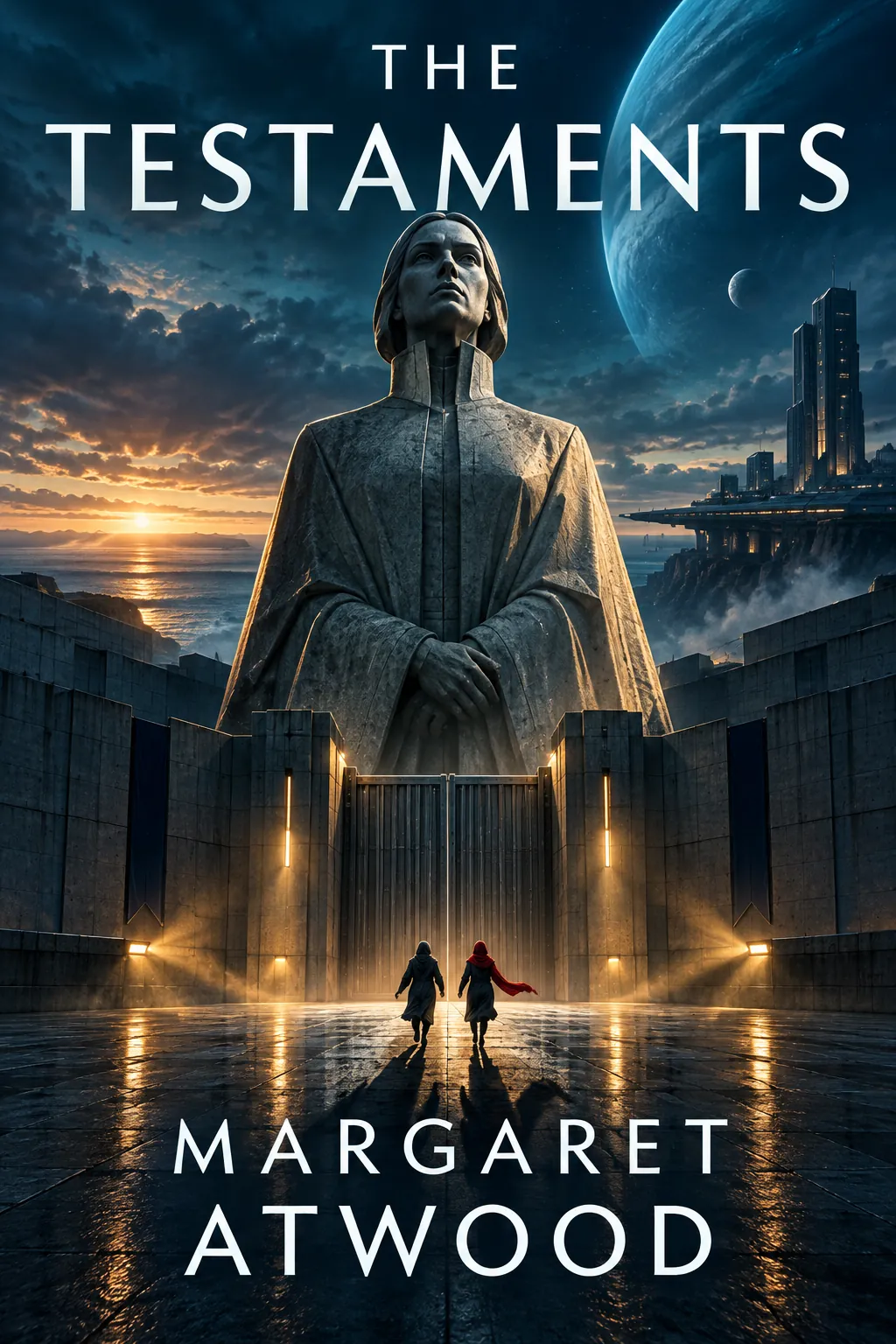
The Testaments
by Margaret Atwood
The Testaments is Margaret Atwood's 2019 sequel to The Handmaid's Tale, set about fifteen years later in the Republic of Gilead. Three voices tell it: Aunt Lydia, the feared and powerful head of the Aunts, who writes a secret manuscript; Agnes, a Commander's daughter raised inside Gilead; and Daisy, a teenager growing up in Canada who watches Gilead on the news. Their lives seem unrelated, yet all three are drawn toward one dangerous mission.
Try Audible · As an Amazon Associate we earn from qualifying purchases. Details
The Big Idea
"Fifteen years after The Handmaid's Tale, three women's testimonies show what it costs to resist a regime from inside and outside it."
Key Insights
Power and complicity
Lydia helps build the system she secretly wants to destroy, and the book refuses to say whether that makes her guilty or brave. Atwood asks readers to judge people by what they do with the power they have, not by the title they hold. The result is a character who is hard to like and hard to dismiss, which keeps the reader thinking long after the last page.
Lydia protects herself by gathering secrets, then uses the same secrets to push Gilead toward collapse.
Testimony as a weapon
The title and the format make the point that the truth, written down and kept safe, can outlast a regime. The epilogue adds a twist by showing how historians later weigh the same documents, with doubts and polite jokes. Atwood suggests that a record only matters if somebody finds it and believes it.
The microdot with the files and the hidden manuscript are both just words and data, yet they bring down Gilead.
Growing up inside a system
Agnes shows how an unjust world can feel normal to a child. Her rebellion begins with small questions, not a plan, which is how many people first notice injustice. The book also shows how adults around her, kind in their own way, pass on the rules without ever stopping to question them.
Agnes learns to see marriage to Judd as a threat only when it is about to happen to her.
Ordinary people and risk
The mission depends on a teenager, a friend and an old Aunt, none of whom is a trained spy. Atwood suggests that resistance is built from small, frightened choices, made by people who would rather be somewhere safe. This is why the ending hurts: courage costs something, and someone pays for it.
Becka hides in the cistern, where she dies, so that the story of Jade's disappearance can hold.
Chapter Breakdown
Chapter-by-chapter summary
The Testaments is the sequel to The Handmaid's Tale, and it reads best after that book.
It is told in three kinds of document: Lydia's hidden manuscript and two later witness transcripts. The book has no single chapter list worth memorising, so this guide follows the story in ten natural parts.
Spoiler warning: this section covers the whole plot, including the ending.
Part 1: The statue and the hidden manuscript
The novel opens with Aunt Lydia looking at her statue at Ardua Hall, the headquarters of the Aunts. She remarks dryly that statues usually go to the dead.
She begins a secret manuscript, the Ardua Hall Holograph, and hides it in the library. Her voice is sharp, funny and self-aware, and she clearly knows the statue flatters her.
Why it matters: from the first page we know we are reading evidence, not propaganda, written by someone who expects to be caught. Writing in secret is the one thing in her life that Gilead does not manage.
Part 2: Agnes grows up as a Commander's daughter
Agnes lives in the house of Commander Kyle and his Wife Tabitha, and she learns the rules of Gilead as simple facts of life. She half remembers an earlier mother, but she has been told that woman was bad.
At school, Aunts train the girls for marriage and obedience. Girls are taught what to wear, what to say and what to fear, and most of them accept it.
Why it matters: this is what the first book never showed, a child who has never known anything else.
Part 3: Daisy in Toronto
Daisy is a teenager in Canada who helps in her parents' second-hand clothing shop. Gilead is a news item to her, and she is bored and a little rebellious.
Missionaries called Pearl Girls knock on doors in the city, offering lonely young women a better life in Gilead. Protesters and news crews turn the issue into noise that Daisy mostly ignores.
Why it matters: Daisy stands for readers outside the regime, who think it is far away.
Part 4: Agnes is promised in marriage
Tabitha dies, Kyle marries a new Wife, Paula, and Paula arranges for Agnes to be promised to the much older Commander Judd. Agnes is horrified.
Her friend Becka is also afraid of what marriage will bring. The two girls talk in whispers about what is allowed and what is not.
Agnes finds an escape inside the system and asks to become a Supplicant at Ardua Hall, a kind of trainee Aunt. She takes the name Victoria.
Why it matters: her first act of rebellion uses the regime's own rules against it.
Part 5: Daisy learns who she is
When Daisy turns sixteen, her parents are killed in an attack by Gilead's agents. The resistance group Mayday then tells her the truth: she is Baby Nicole, the child smuggled out of Gilead years ago.
She had been a symbol on both sides of the border all her life without knowing it.
Why it matters: her private grief turns into a public duty, and she has to decide whether she will accept it.
Part 6: Lydia's past and her double game
Lydia explains how she, once a judge, was imprisoned in a stadium when Gilead took power and was forced to choose between death and cooperation. She chose to survive.
Over the years she gathered secrets about powerful men, and she secretly works as a mole for Mayday.
Why it matters: she is neither hero nor villain, which is what makes her the most interesting voice. The reader is asked to judge her without being told how.
Part 7: Lydia recruits the two girls
Lydia shows Victoria files that expose Gilead's corruption and reveal her own past: she is the daughter of a Handmaid, and she has a half-sister who escaped. Meanwhile Mayday trains Daisy to pose as a street girl called Jade so the Pearl Girls will recruit her.
Lydia's plan is to smuggle proof of the elite's crimes into Canada. The proof will be a microdot hidden in Nicole's cross tattoo.
Why it matters: the plan only works if two young women who have never met trust an old woman who has lied for decades.
Part 8: Inside Gilead
Nicole is taken into Gilead and soon discovers that Judd wants her as his wife. His political standing is slipping, and a young bride would help him.
Lydia, Agnes and Becka change the plan so that Agnes and Nicole will leave as Pearl Girls. Becka, who has also become a Supplicant and now bears the name Aunt Immortelle, stays behind to help keep up the story that Jade has simply run off.
Why it matters: three girls have to act as adults, and each depends on the others.
Part 9: The escape
When Judd's plans move faster than expected, Agnes and Nicole leave early. They overpower Aunt Vidala on the way out, and Lydia buys them time by telling Aunt Elizabeth that Vidala has accused her.
They reach the coast and take a boat toward Canadian waters, where Mayday picks them up. They are reunited with their mother.
Why it matters: the sisters, who had never met, finally know each other, and the cost of the mission begins to show.
Part 10: Aftermath and the epilogue
Canadian media publish what the microdot held. This leads to purges, a military coup and a popular revolt, and Gilead collapses.
Becka dies hiding in a water cistern, where she stayed to keep up the story that Jade had run off. The manuscript ends with Lydia planning to take her own life before she can be questioned.
The epilogue is a transcript of a 2197 academic conference on Gilead. Professor Pieixoto discusses how the documents were authenticated and ends with a statue in Becka's honour.
Why it matters: the epilogue shows that even a fall of a regime becomes a subject of polite academic talk, and that someone always decides how the story is told.
Characters
Aunt Lydia. A former judge who becomes the most powerful Aunt and secretly works against Gilead.
She is clever, patient and morally compromised.
Agnes Jemima (Aunt Victoria). Raised in a Commander's home, she refuses marriage to Judd by joining the Aunts.
Her education is a window on how Gilead shapes girls.
Daisy / Nicole / Jade. A Canadian teenager who learns she is Baby Nicole and goes into Gilead undercover.
She is blunt, quick and slowly grows into her mission.
Commander Judd. A powerful founder of Gilead who wants to marry a very young girl.
He stands for the regime's hypocrisy.
Becka (Aunt Immortelle). Agnes's friend and the novel's quiet heroine.
She hides in the cistern to keep the story of Jade's disappearance alive, and her fate gives the ending its weight.
Aunt Vidala. A harsh Aunt who teaches at the school and watches Lydia with suspicion.
Aunt Elizabeth. Another Aunt who is caught up in Lydia's schemes.
Paula. Kyle's second Wife, who pushes the marriage to Judd as a way to rise in status.
Neil and Melanie. Daisy's adoptive parents in Toronto, who secretly work with the resistance.
Professor Pieixoto. The scholar of the 2197 epilogue, who studies Gilead as history, a little too cheerfully.
Writing about this book
Start with the structure. Three narrators, each with a different kind of document, let Atwood show Gilead from the top, from the middle and from outside.
A good essay chooses one question and follows it through the three voices. Useful questions include how Lydia justifies her choices, how Gilead educates girls, and what the epilogue does to our trust in the story.
Quote briefly and put each quotation to work. Lydia's remark in Chapter 6 that she has become swollen with power lets you talk about power, memory and who gets to be remembered.
Compare the book with The Handmaid's Tale. The first novel is a warning; this one asks how such a system might end and who pays for that.
Avoid the TV series: examiners ask about the novel, and the two differ in important ways.
In your conclusion say why testimony matters in a world where records can be destroyed. That links the plot to the title.
Take Action
Practical steps you can implement today:
-
Ask who is telling the story, and what kind of document they are writing, before you decide what to believe.
-
Write down what you notice about unfair rules; small records can matter later.
-
Judge characters by their choices under pressure, not by their titles.
-
Read The Handmaid's Tale first; the sequel builds on its world.
Notable Quotes
"“I've become swollen with power, true, but also nebulous with it—formless, shape-shifting.” (Lydia's manuscript, ch. 6)"
— Margaret Atwood
"“You don't believe the sky is falling until a chunk of it falls on you.” (Lydia's manuscript)"
— Margaret Atwood
Who Should Read This
Readers who finished The Handmaid's Tale and wonder what came next. It suits ages 15 and up, including upper secondary and college literature classes. It is a faster, more plot-driven read than its predecessor, so it also works for newcomers to dystopian fiction.
Frequently Asked Questions
Do I need to read The Handmaid's Tale first?
It helps a lot. The Testaments assumes you know what Gilead is and what Handmaids and Aunts do, and the ending connects to the first book. But the new narrators are explained well enough that a careful reader can follow the plot without it.
Who are the narrators of The Testaments?
There are three: Aunt Lydia, through her hidden manuscript; Agnes, a girl raised in Gilead; and Daisy, a teenager in Canada. Agnes and Daisy speak in witness transcripts, which are presented as evidence later studied by scholars.
When is The Testaments set?
The story takes place about fifteen years after the events of The Handmaid's Tale. The epilogue jumps much further ahead, to a 2197 academic symposium, where Gilead is studied as a historical subject.
What is the main theme of The Testaments?
The central themes are power and complicity, the role of testimony and records, and how young people are shaped by the world they grow up in. The book also looks at the courage ordinary people show when they act against injustice.
Did The Testaments win any prizes?
Yes. It was a joint winner of the 2019 Booker Prize with Bernardine Evaristo's Girl, Woman, Other. It was also a bestseller and was named best fiction in the Goodreads Choice Awards that year.
Check Your Understanding
Pick an answer for each question to see if you were right.
-
What is the name of Aunt Lydia's secret manuscript?
The Ardua Hall Holograph — Lydia writes and hides the Ardua Hall Holograph, named for the place where the Aunts live.
-
How does Agnes avoid marrying Commander Judd?
She asks to become a Supplicant at Ardua Hall — Agnes joins the Aunts as a Supplicant and takes the name Victoria, which removes her from marriage.
-
Who is Daisy really?
Baby Nicole — Mayday tells Daisy she is Baby Nicole, the child smuggled out of Gilead long before.
-
Where is the hidden evidence carried?
In a microdot in a tattoo — The files are stored in a microdot hidden in Nicole's cross tattoo.
-
What does the epilogue show?
A 2197 academic symposium on Gilead — The epilogue is a partial transcript of a future conference where scholars discuss the documents.
Want the full book?
Read or listen to The Testaments in full.
Try Audible · As an Amazon Associate we earn from qualifying purchases. Details
About Margaret Atwood
Margaret Atwood (born 1939 in Ottawa) is a Canadian novelist, poet and essayist. Her 1985 novel The Handmaid's Tale became one of the best-known dystopian novels of the century. Its 2019 sequel, The Testaments, shared the Booker Prize with Bernardine Evaristo's Girl, Woman, Other. Atwood had won the Booker earlier for The Blind Assassin.
Summary Written By

Software Engineer & Writer
Software engineer with a passion for distilling complex ideas into actionable insights. Writes about finance, investment, entrepreneurship, and technology.
View all summaries →Reviews
No reviews yet. Be the first to share your thoughts!
Write a Review
Keep reading
Explore the topic: Science FictionSummaries

Out of My Mind
Sharon M. Draper
“Out of My Mind” by Sharon M. Draper is a poignant narrative that explores the life of Melody Brooks, a…

Ender’s Game
Orson Scott Card
“Ender’s Game” by Orson Scott Card is a riveting science fiction novel that transports readers into a future where humanity…

Pachinko
Min Jin Lee
“Pachinko”, a spellbinding multigenerational historical saga by Min Jin Lee, explores the lives of a Korean family trying to make…

The Perks of Being a Wallflower
Stephen Chbosky
The Perks of Being a Wallflower by Stephen Chbosky is a profound coming-of-age novel, told through the intimate letters of…
Articles

A Christmas Carol themes: generosity, isolation and responsibility
Dickens's novella is usually read as a story about a man who changes his mind. Its themes are sharper than…

Proxima Centauri
Proxima Centauri is the nearest star to the Sun, about 4.25 light-years away. It is a small red dwarf, too…

Time dilation
Time dilation is the effect, predicted by Einstein's relativity and measured, that clocks tick at different rates depending on speed…